Alibaba Group used its cloud unit's annual Apsara Conference in Hangzhou to unveil the Zhenwu V900, a new AI accelerator that Chief Executive Eddie Wu described as China's most powerful AI chip, alongside plans to expand Alibaba Cloud's global data center capacity to more than 20 gigawatts by 2032. Shares rose in both Hong Kong and U.S. premarket trading following the announcement, though the company did not revise its existing capital spending guidance.
What Alibaba Announced
Wu introduced the Zhenwu V900 at the conference, which CNBC described as part of a broader roadmap spanning chips, cloud infrastructure and AI models; Yahoo Finance reported that Wu used the event to highlight the company's investment in AI infrastructure and advanced computing. According to Yahoo Finance's account of his remarks, the accelerator can be deployed in clusters of up to 500,000 units to train advanced AI models, a scale intended to support Alibaba's next generation of large language models. CNBC reported that the chip is scheduled for mass production and commercial release in the first quarter of 2027; no unit volume for that year was disclosed, and neither report named a foundry or process node.
Performance Claims Lack Independent Verification
The only performance figure Alibaba published was a relative one: the V900 is said to deliver three times the performance of its predecessor, the Zhenwu M890, which was released in May. Wu called the V900 "the most powerful AI chip in China today, delivering three times the performance of its predecessor, the Zhenwu M890," a claim made by Alibaba itself and, as both outlets noted, not independently verified in the reporting reviewed here. No memory capacity, bandwidth or comparative benchmark against rival accelerators appeared in either account, so how the V900 stacks up against competing hardware remains an open question based on the available reporting.
Alibaba's existing Zhenwu chips are already in commercial use, with CNBC reporting they serve more than 650 customers across automotive, finance, energy and manufacturing sectors. That detail suggests the Zhenwu line, and potentially the V900 that follows it, is intended for external sale or rental rather than purely internal Alibaba Cloud deployment, though neither report specified commercial terms for the V900.
The 20 Gigawatt Target
Alibaba's pledge to expand data center capacity beyond 20 gigawatts by 2032 was framed as part of the same infrastructure push tied to the chip launch. The reporting reviewed did not include Alibaba Cloud's current installed capacity figure, so the scale of the gap between today's footprint and the 2032 goal cannot be quantified here. Alibaba has not revised its capital expenditure guidance of RMB 380 billion, according to Yahoo Finance, meaning management has not yet attached a specific incremental spending figure to the new target.
For context on scale, other AI infrastructure commitments announced elsewhere this year are smaller: CNBC noted that Nvidia said earlier this month it would work with Australian partners to support up to 2 gigawatts of AI infrastructure by 2027, while Meta in July announced a 1-gigawatt data center in Alberta, Canada expected to cost about $9 billion. Alibaba's 20-gigawatt ambition, if realized, would represent a multiple of either project, though the comparison is directional rather than a like-for-like measure of cost or timeline.
Market Reaction
The two outlets differed slightly on the magnitude of the share move. Yahoo Finance reported Alibaba's Hong Kong-listed shares closed 2% higher on the day, while its U.S.-listed stock gained more than 3% in premarket trading. CNBC separately reported that shares jumped around 3% in Hong Kong. Both figures point to a positive but modest reaction rather than a dramatic repricing.
Analyst Estimates: Citi's Revenue Math
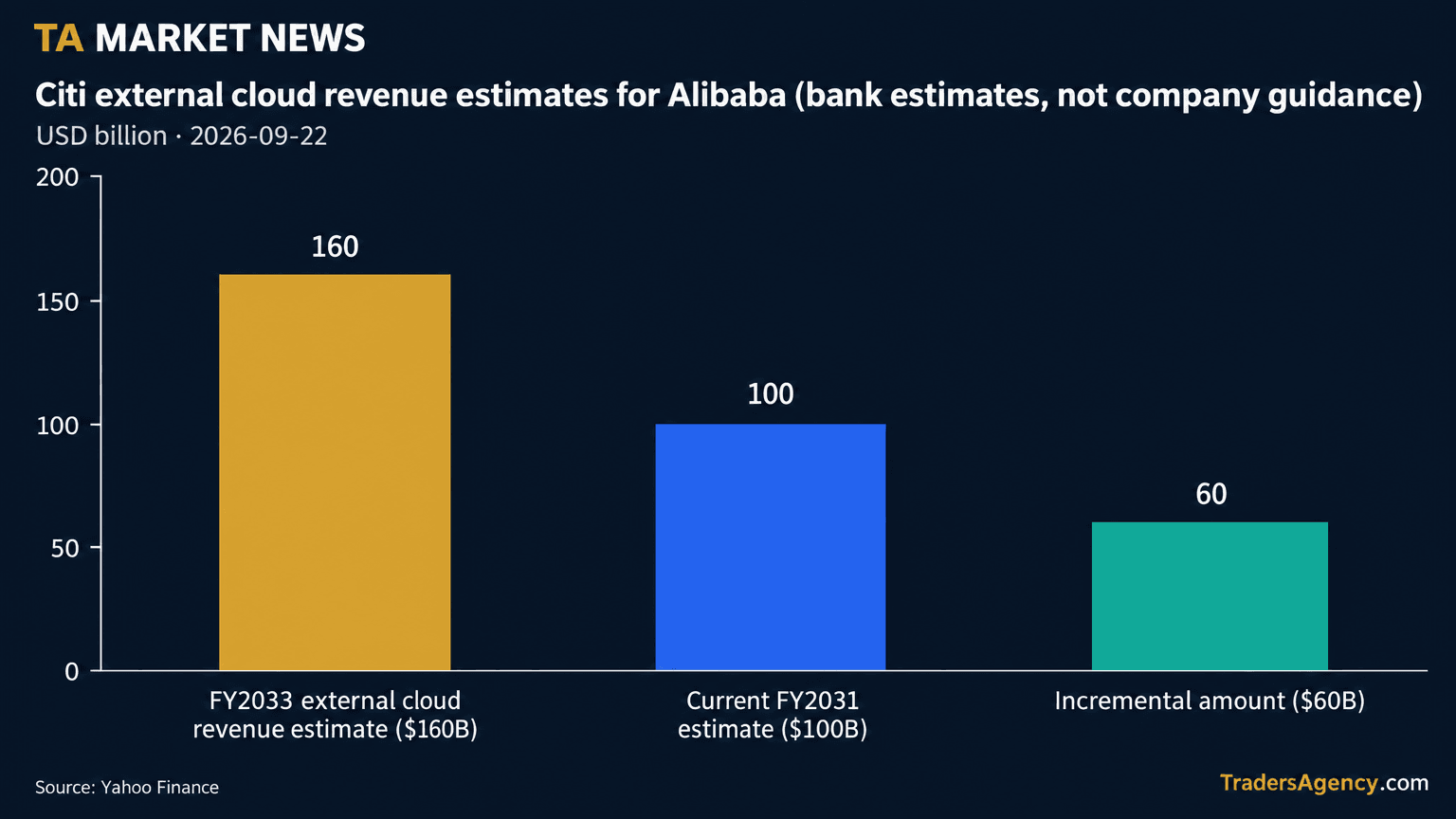
Citi analysts, cited by Yahoo Finance, offered a preliminary read on what the 20-gigawatt target could mean financially. The bank said Wu's message could translate into $160 billion of external cloud revenue by fiscal year 2033, an incremental $60 billion above Citi's current estimate of $100 billion in fiscal year 2031 ($160 billion minus $100 billion equals $60 billion, matching Citi's stated figure). Citi added that this would imply a roughly 40% revenue compound annual growth rate from fiscal 2026 to fiscal 2033. These are Citi's own projections, not figures confirmed by Alibaba, and should be read as one bank's interpretation of the announcement rather than company guidance.
Citi also said it expects Alibaba to source part of its planned computing capacity through partnerships with other industry participants, potentially structured as operating expense rather than direct capital investment, a framing that would help explain why management left its RMB 380 billion capex guidance unchanged despite the expanded infrastructure ambition.
Financial Backdrop
The chip and infrastructure announcements arrive against a backdrop of heavy AI investment weighing on near-term profitability. Yahoo Finance reported that Alibaba posted a 75% decline in net profit in its most recent quarterly results, with margin compression linked to its investment program, even as AI cloud and computing revenue rose sharply in the June quarter. Wu described AI-driven customer demand as "exceptionally robust" and said it was contributing to Alibaba Cloud's revenue growth, according to Yahoo Finance's account of his remarks.
On the model side, CNBC reported that Alibaba's next-generation Qwen 4 model is currently in training, with Qwen 4.5 and Qwen 5 series planned. Yahoo Finance separately reported that Wu outlined an ambition to train a model containing up to 10 trillion parameters and said the Qwen development team was exploring recursive self-improvement, an approach in which AI systems contribute to improving their own capabilities. Per CNBC, Wu said machine thinking still had an "enormous growth runway," comparing today's AI development to the early stages of electrification and adding that "AI coding is simply the light bulb of the machine intelligence era."
Bottom Line
Alibaba's Zhenwu V900 launch and 20-gigawatt data center target mark a significant escalation in the company's AI infrastructure ambitions, but the publicly reported details remain thin on hard specifications, unit economics and incremental funding. The performance claims are Alibaba's own, the capacity target has not been matched with revised capex guidance, and the financial upside modeled by Citi is an external estimate rather than management's forecast. Investors reacted positively but modestly, leaving the gap between ambition and confirmed execution as the key variable to watch as 2027 mass production approaches.
DISCLAIMER: Traders Agency does not offer financial advice. The information provided is for educational purposes only and should not be considered financial advice. Traders Agency is not responsible for any financial losses or consequences resulting from the use of the information provided. Trading carries inherent risks and may not be suitable for all individuals. You are advised to conduct your own research and seek personalized advice before making any investment decisions, recognizing the potential risks and rewards involved.
See more from Traders Agency on Google
Make us a preferred source and our market analysis will appear more prominently in your Google Search, Top Stories, and AI results.
Add to Preferred Sources