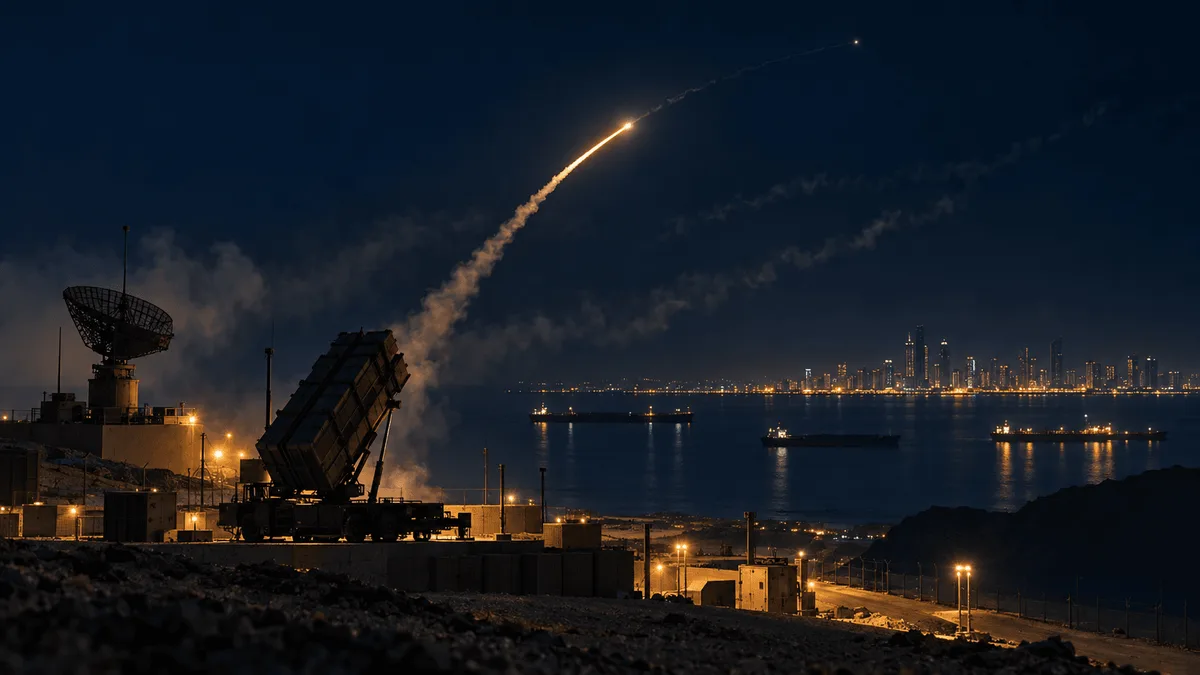
Bahrain said its air defenses intercepted and destroyed several Iranian aerial attacks early Sunday, November 15, shortly after explosions and air raid sirens were reported across the Gulf kingdom. Iran's Revolutionary Guards Corps (IRGC) claimed separately that it had struck a US military installation in Bahrain, though no US or Bahraini official has confirmed that claim.
What Bahrain and Iran Said
Bahrain's military said its air defenses intercepted several Iranian aerial attacks before they reached their targets, according to CNBC, which reported that the Bahraini military accused Tehran of continuing a "systematic hostile approach" toward the kingdom. The Qatar News Agency carried similar language from Bahrain's General Command, which it said described the attacks as "heinous" and part of a sustained pattern of hostility from Iran, per QNA.
Iran's IRGC, through state-run Press TV, said it had launched six drones targeting a US air defense radar system at the Al-Rifaa (also transliterated Al-Riffa) helicopter base in Bahrain, framing the action as retaliation for what it called hostile US actions, according to both CNBC and Radio Free Europe/Radio Liberty (RFE/RL).
Unverified Claim of a Hit
Neither CNBC nor RFE/RL reported any confirmation from US or Bahraini authorities that the radar installation was actually struck. Both outlets explicitly noted the absence of immediate confirmation, meaning Iran's assertion that it successfully hit the radar system remains unverified at the time of reporting. Neither report included Pentagon comment, denial or confirmation of the IRGC's claim, nor any indication of casualties or damage to American personnel.
Bahrain's Response and Posture
Bahrain's Foreign Ministry said the country rejected "turning its territory into an arena for settling scores" and held Iran fully responsible for the attacks and their consequences, RFE/RL reported. The General Command separately affirmed that all of Bahrain's weapons systems and units remain at the highest level of readiness to defend the kingdom, according to QNA. RFE/RL noted that Sunday marked the second time Bahrain has been targeted in three days, following a period of relative calm in the broader conflict.
Wider Regional Context
The incident came amid a backdrop of continued regional friction. The Saudi-led coalition said on Sunday it had intercepted two Houthi ballistic missiles launched toward Riyadh and three drones in Saudi Arabia's oil-rich Eastern Province, as reported by both CNBC and RFE/RL. RFE/RL also reported that Iran has restricted shipping through the Strait of Hormuz, a key global oil transit route, as part of the broader conflict.
CNBC reported, citing Reuters, that President Trump has said in recent days he might hold off from further attacks on Iran if the US faces no new provocations from Tehran or the Iran-backed Houthis in Yemen, but that he would maintain the US naval blockade of Iran. RFE/RL separately reported that Trump has said the blockade will remain in place. Neither outlet reported any additional change to US force posture or new shipping advisories tied specifically to Sunday's events in Bahrain.
Background
The conflict began on February 28 with US and Israeli strikes on Iran and has since spread across the region, with Tehran launching missile and drone attacks on US military bases in Gulf countries, according to CNBC. RFE/RL noted that diplomatic efforts to end the nearly nine-month war have not yet produced a breakthrough, even amid a broader lull in fighting that preceded this weekend's attacks.
Interpretation
Based on the reported facts, the gap between Iran's claim of a successful radar strike and the lack of any US or Bahraini confirmation is significant on its own terms: it leaves the operational outcome of the attack unresolved pending further official statements. Bahrain's description of being targeted twice in three days, paired with its military's declared state of readiness, suggests the kingdom is treating these strikes as part of a continuing pattern rather than an isolated event, though that assessment rests on Bahrain's own characterization as relayed by RFE/RL and QNA.
Bottom Line
Bahrain says its air defenses intercepted and destroyed several Iranian aerial attacks early Sunday, while Iran claims it struck a US radar installation at a Bahraini base — a claim that remains unconfirmed by US or Bahraini authorities. The exchange unfolded alongside Saudi interceptions of Houthi missiles and drones and continuing Iranian restrictions on Strait of Hormuz shipping, with President Trump reported to be maintaining the US naval blockade even as he has signaled possible restraint on further strikes absent new provocations.
DISCLAIMER: Traders Agency does not offer financial advice. The information provided is for educational purposes only and should not be considered financial advice. Traders Agency is not responsible for any financial losses or consequences resulting from the use of the information provided. Trading carries inherent risks and may not be suitable for all individuals. You are advised to conduct your own research and seek personalized advice before making any investment decisions, recognizing the potential risks and rewards involved.
- CNBC Top News: Bahrain intercepts Iranian aerial attacks as Tehran says it attacked US base · accessed Nov 15, 2026
- Qatar News Agency: Qatar news agency · accessed Nov 15, 2026
- Radio Free Europe/Radio Liberty: Bahrain Says It Intercepted Iranian Attacks As Tehran Claims Strike On US Base · accessed Nov 15, 2026
See more from Traders Agency on Google
Make us a preferred source and our market analysis will appear more prominently in your Google Search, Top Stories, and AI results.
Add to Preferred Sources