
Bank of America reported third-quarter 2026 net income of roughly $6.9 billion, a decline from a year earlier, after absorbing a $1.2 billion noninterest expense charge tied to regulatory consent orders over its anti-money-laundering and sanctions compliance programs. The charge, combined with softer trading and investment-banking revenue, pulled diluted earnings per share down to $0.91 from an adjusted $1.08 that excludes the one-time item, according to the bank's regulatory filing.
Settlement Tied to AML Consent Orders
The charge stems from consent orders the Office of the Comptroller of the Currency and the Financial Crimes Enforcement Network announced on October 13, 2026, covering aspects of Bank of America's Bank Secrecy Act, anti-money-laundering and economic sanctions compliance programs. The bank recorded the $1.2 billion in civil money penalties as non-tax-deductible noninterest expense for the quarter, per its filing. CNBC noted the episode involved regulators' allegations that the company failed to report billions of dollars in suspicious transactions, a matter CNBC said would raise questions about oversight at the second-largest U.S. bank by assets. The bank's own forward-looking disclosures flag continued uncertainty over potential penalties and remediation tied to the consent orders, though the filing does not detail specific remediation spending figures.
Revenue Topped a Year Ago, But Trading Missed Estimates
Revenue net of interest expense rose about 3% to $30.0 billion ($30.1 billion on a fully taxable-equivalent basis), which CNBC reported was roughly $570 million below consensus estimates, largely because of weaker Wall Street trading results. Total sales and trading revenue fell 5% to $5.1 billion from $5.36 billion a year earlier, according to the bank's filing. Fixed income, currencies and commodities revenue dropped 17% to $2.57 billion from $3.09 billion, driven by weakness in mortgages, municipals and credit, while equities revenue rose 11% to $2.51 billion from $2.27 billion on higher client financing activity, particularly in Asia and the U.S. Based on the filing's reported figures, ($5,362M − $5,075M) / $5,362M works out to a decline of about 5.4% year over year in total sales and trading revenue, consistent with the bank's reported 5% figure.
CNBC reported that both trading lines missed Wall Street forecasts, with FICC roughly $450 million below the StreetAccount estimate and equities nearly $300 million short of analysts' expectations despite the year-over-year gain. Total Corporation investment banking fees excluding self-led deals fell 11% to $1.8 billion, per the filing.
Net Interest Income Climbs on Loan and Deposit Growth
Net interest income rose 8% year over year to $16.4 billion ($16.6 billion on an FTE basis), which the bank attributed to higher loan and deposit balances, increased Global Markets-related NII and the repricing of fixed-rate assets. Net interest yield rose 15 basis points to 2.16%. CFO Alastair Borthwick pointed to the NII growth and improving yield, along with a 17% rise in asset management fees, as supportive of the quarter, according to the earnings release.
Credit Quality and Provisions
Provision for credit losses was $1,269 million, down from $1,295 million a year earlier and $1,366 million in the second quarter of 2026, per the bank's reported data. Net charge-offs totaled $1,349 million, versus $1,367 million a year ago and $1,412 million last quarter. Nonperforming loans and leases rose to $5,544 million from $5,347 million a year earlier, though they declined from $5,751 million in the prior quarter. The allowance for loan and lease losses stood at $13,005 million, down from both $13,252 million a year ago and $13,114 million last quarter. Separately, the credit card net charge-off rate improved to 3.22% from 3.46% a year earlier and 3.55% in the second quarter, with both early- and late-stage card delinquencies improving year over year for a sixth straight quarter, the filing said.
Expenses Jump, Efficiency Ratio Worsens
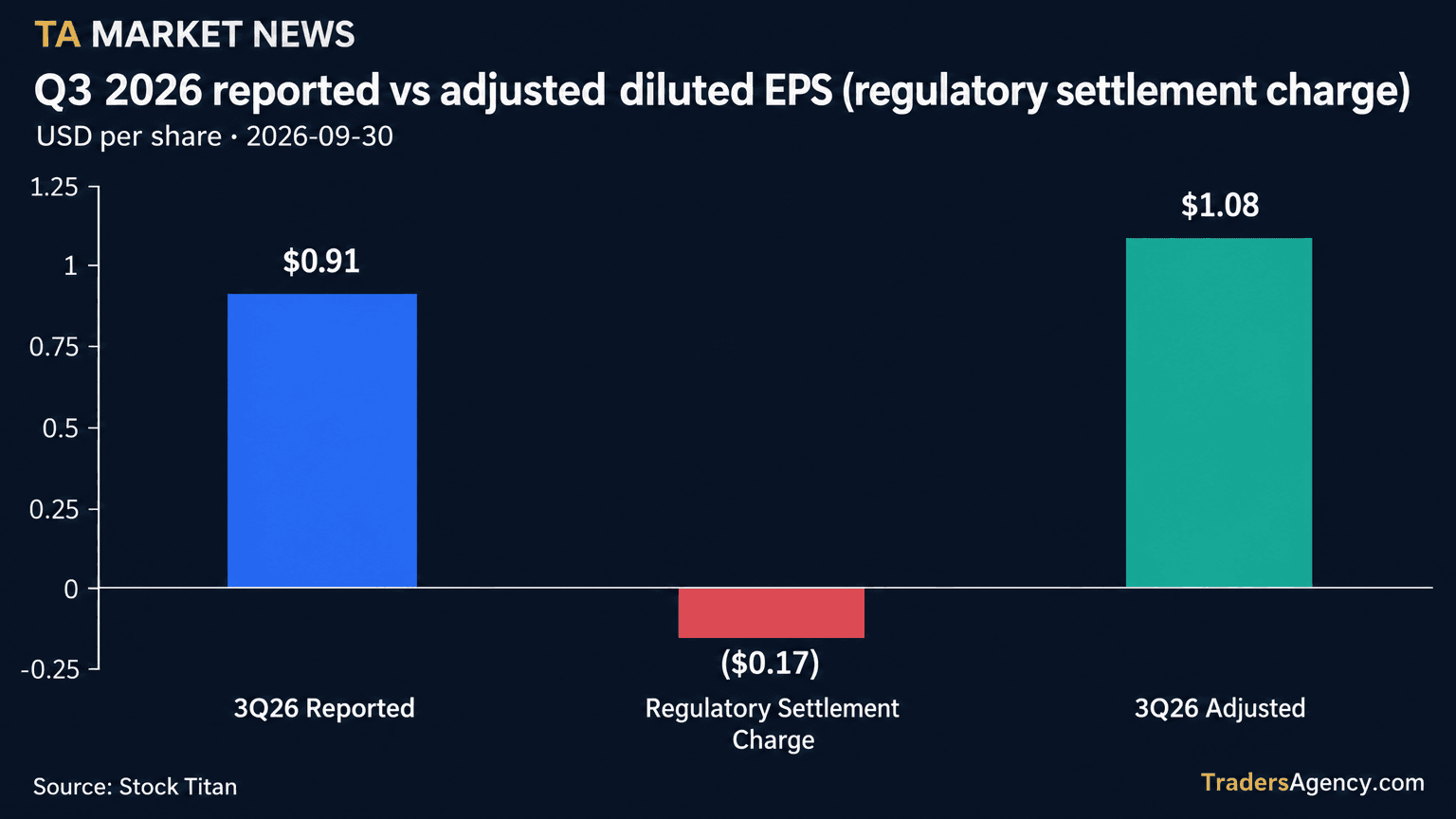
Noninterest expense rose $2.4 billion to $19.7 billion, pushing the efficiency ratio to 66%. Excluding the regulatory settlement charge, adjusted noninterest expense was $18.5 billion with an adjusted efficiency ratio of 62%, according to the filing. The settlement's impact on earnings is laid out in the bank's own adjusted-versus-reported table: reported pretax income of $9.0 billion compares with an adjusted $10.2 billion once the $1.2 billion charge is added back, and reported net income of $6.9 billion compares with an adjusted $8.1 billion. The corresponding $0.17 per-share drag, when added to the $0.91 reported EPS, reconciles to the $1.08 adjusted figure the bank disclosed.
Management's Framing

CEO Brian Moynihan's remarks in the earnings release centered on client growth rather than the settlement, saying that while investment banking and sales and trading revenues were lower, commercial lending grew in every client segment. Borthwick's comments, also from the release, emphasized the NII increase, improving net interest yield, asset management fee growth and continued improvement in asset quality alongside strong liquidity and capital. Moynihan and Borthwick were scheduled to discuss results on an 8:30 a.m. ET investor call on October 14, but the materials reviewed do not include call commentary on remediation costs or ongoing compliance spending tied to the consent orders.
Market Reaction and Peer Backdrop

Bank of America shares fell more than 4% in premarket trading following the results, CNBC reported. The report followed mixed results a day earlier from JPMorgan Chase, Goldman Sachs, Citigroup and Wells Fargo, with JPMorgan missing both EPS and revenue estimates for the first time in years, according to CNBC's reporting. The available sources do not detail those banks' individual trading results, so a direct quarter-over-quarter trading comparison across the group cannot be drawn from this reporting.
Bottom Line
Bank of America's third quarter illustrates how a single regulatory charge, layered onto a trading shortfall versus Wall Street expectations, can overwhelm otherwise steady net interest income growth and improving consumer credit metrics. The bank's own adjusted figures suggest underlying profitability held up better than the headline number implies, but the settlement's reputational overhang, flagged in the bank's own risk disclosures as a source of continued uncertainty, is likely to remain a focus for investors and regulators alike in coming quarters.
DISCLAIMER: Traders Agency does not offer financial advice. The information provided is for educational purposes only and should not be considered financial advice. Traders Agency is not responsible for any financial losses or consequences resulting from the use of the information provided. Trading carries inherent risks and may not be suitable for all individuals. You are advised to conduct your own research and seek personalized advice before making any investment decisions, recognizing the potential risks and rewards involved.
- CNBC Top News: Bank of America (BAC) Q3 2026 earnings · accessed Oct 14, 2026
- Bank of America / PR Newswire: Bank of America Reports Third Quarter 2026 Financial Results · accessed Oct 14, 2026
- Stock Titan: Bank of America Q3 2026 profit falls to $6.9B · accessed Oct 14, 2026
See more from Traders Agency on Google
Make us a preferred source and our market analysis will appear more prominently in your Google Search, Top Stories, and AI results.
Add to Preferred Sources