
The Bank of Japan raised its policy rate to 1.25% on September 18, the highest level in 31 years, in a decision that split the board 7-2. Rather than strengthening on the hawkish move, the yen weakened past 157 against the dollar, the 10-year Japanese Government Bond yield slipped, and the Nikkei 225 gained 1.5%, according to CNBC.
The Vote and the Dissent
Two board members, Toichiro Asada and Ayano Sato, voted against the hike. Both were appointed by Prime Minister Sanae Takaichi and are described by CNBC and the Straits Times as dovish newcomers to the board.
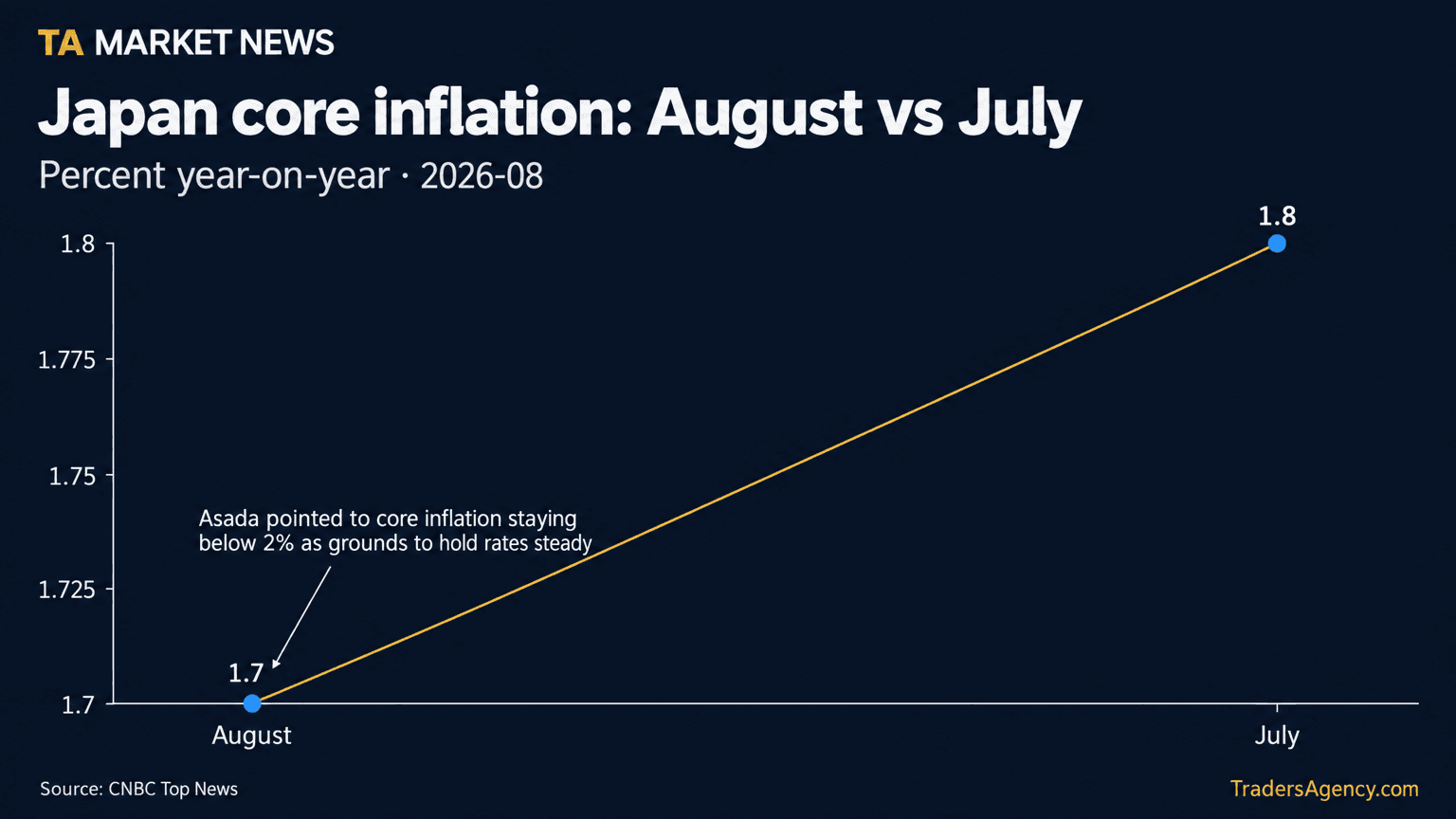
According to CNBC, Asada noted that with the core inflation rate below 2%, the economic situation might not be strong, and he advocated holding rates steady. Sato, per the same report, said current economic and price developments did not appear to have substantially accelerated compared with before.
Oxford Economics' Shigeto Nagai told CNBC's Access Middle East that the two dissents signaled Takaichi was not yet convinced to accede to US requests for faster rate hikes, adding that the statement's overall tone was "less hawkish than financial markets had hoped for."
Ueda on the Pace of Hikes and the Yen
Governor Kazuo Ueda told reporters the BOJ's focus has shifted from pushing prices higher to guarding against an inflation overshoot. "It's important to stabilise underlying inflation at 2 per cent. Our policy phase has changed," he said, in what the Straits Times called his strongest remark to date on the bank's resolve to keep raising rates. He warned that if the risk of underlying inflation overshooting 2% materialized, it "could have a negative impact on Japan's economy."
On timing, Ueda said he would not rule out either back-to-back rate hikes or increases of 50 basis points, while stressing the BOJ aims to move preemptively so it is not forced into large, market-unsettling adjustments later. Asked about the pace, he said, "We're in a phase where we need to look at various data carefully. But that doesn't mean we can move slowly," declining to specify where Japan's neutral or terminal rate sits.
The Straits Times noted that despite this hawkish framing, the hike failed to rally the yen; instead, the currency weakened as investors focused on the dissent from Asada and Sato, who argued the BOJ should remain patient.
Market Reaction Defies the Textbook
The combination of a weaker yen, a softer 10-year JGB yield and a 1.5% gain in the Nikkei 225 following a rate increase is the opposite of the conventional market response. CNBC quoted Hirofumi Suzuki, chief FX strategist at Sumitomo Mitsui Banking Corporation, saying, "The two dissenting votes in favor of keeping rates unchanged came as a surprise." Masahiko Loo, senior fixed income strategist at State Street Investment Management, told CNBC that the reaction also stemmed from the fact that the hike came without an updated outlook report, which limited the BOJ's ability to reinforce a hawkish message through revised forecasts.
Views on Ueda's tone diverged. OCBC's Vasu Menon said, per the Straits Times, that the near-term message was "not hawkish enough to trigger a significant repricing of the yen." Fitch Ratings' Jessica Hinds took a different view, saying "Governor Ueda sounded on the hawkish side."
What the Statement Said
The BOJ's statement said economic and price developments are moving in line with its baseline forecast, but flagged a risk of underlying inflation deviating from the 2% target: "Wholesale inflation remains elevated and price pressures from business-to-business trading have started to spill over into consumer prices." The central bank also said financial conditions remain accommodative even after the increase, according to the Straits Times.
Japan's core inflation, meanwhile, eased to 1.7% year-on-year in August from 1.8% in July — a decline of 0.1 percentage point (1.7 - 1.8) — according to data reported by CNBC. That reading remains below the BOJ's 2% target, the same benchmark Asada cited in arguing for caution, while the BOJ's statement flagged a risk of underlying inflation deviating from the target as business-to-business price pressures spill into consumer prices, per the Straits Times. Read together, those two framings help explain the split board — an interpretation of the attributed data and statement language, not a BOJ characterization.
The BOJ said it would continue raising rates as economic and price conditions develop, while acknowledging growth is likely to decelerate because of high oil prices tied to the Middle East conflict, CNBC reported. The bank has not set a public terminal rate, saying instead it will conduct policy "as appropriate" to stabilize underlying inflation around its 2% target.
Context and Attributed Expectations
This was the BOJ's first hike in three months, following a June increase, and continues a pattern of tightening roughly twice a year since the bank exited a decade-long stimulus program in 2024, per the Straits Times. Markets had largely priced in a September move after a string of hawkish signals, including the BOJ's July warning about inflation overshoot risk. The Straits Times also reported that US Treasury Secretary Scott Bessent voiced support for "decisive" monetary steps to combat yen weakness in a September meeting with Ueda.
Looking ahead, analysts polled by Reuters, as cited by the Straits Times, expect the BOJ to raise rates to 1.5% by end-March 2027 and to 1.75% in the second quarter of 2027, a further increase of 0.25 percentage point (1.75 minus 1.5, our calculation). Most of those surveyed saw the eventual terminal rate settling at 1.75% or higher. These are attributed forecasts from the Reuters poll, not BOJ guidance, and the central bank itself has not confirmed a target endpoint.
Bottom Line
The BOJ delivered a genuine hawkish move, its highest rate in three decades, but the split vote and the absence of updated forecasts left markets unconvinced that faster tightening is imminent. The yen's slide past 157 and the Nikkei's 1.5% gain suggest investors read the dissent, rather than the hike itself, as the dominant signal. Whether that reading holds may depend on incoming inflation data and how the BOJ frames its next move relative to the Reuters-polled path toward 1.5% and 1.75%.
DISCLAIMER: Traders Agency does not offer financial advice. The information provided is for educational purposes only and should not be considered financial advice. Traders Agency is not responsible for any financial losses or consequences resulting from the use of the information provided. Trading carries inherent risks and may not be suitable for all individuals. You are advised to conduct your own research and seek personalized advice before making any investment decisions, recognizing the potential risks and rewards involved.
- Bank of Japan: Release Schedule · accessed Sep 18, 2026
- CNBC Top News: Japanese stocks rose as bond yields and the yen fell after rate hike · accessed Sep 18, 2026
- Bank of Japan: Change in the Guideline for Money Market Operations · accessed Sep 18, 2026
- The Straits Times: Bank of Japan raises rates to 31-year high amid inflation concerns · accessed Sep 18, 2026
- Nikkei Asia: BOJ hikes rates to 1.25% as chief Ueda cites shift in policy phase · accessed Sep 18, 2026
- Nikkei Asia: BOJ hikes rates to 1.25% as chief Ueda cites shift in policy phase · accessed Sep 18, 2026
- Bank of Japan: Plan for the Outright Purchases of Japanese Government Bonds · accessed Sep 18, 2026
See more from Traders Agency on Google
Make us a preferred source and our market analysis will appear more prominently in your Google Search, Top Stories, and AI results.
Add to Preferred Sources