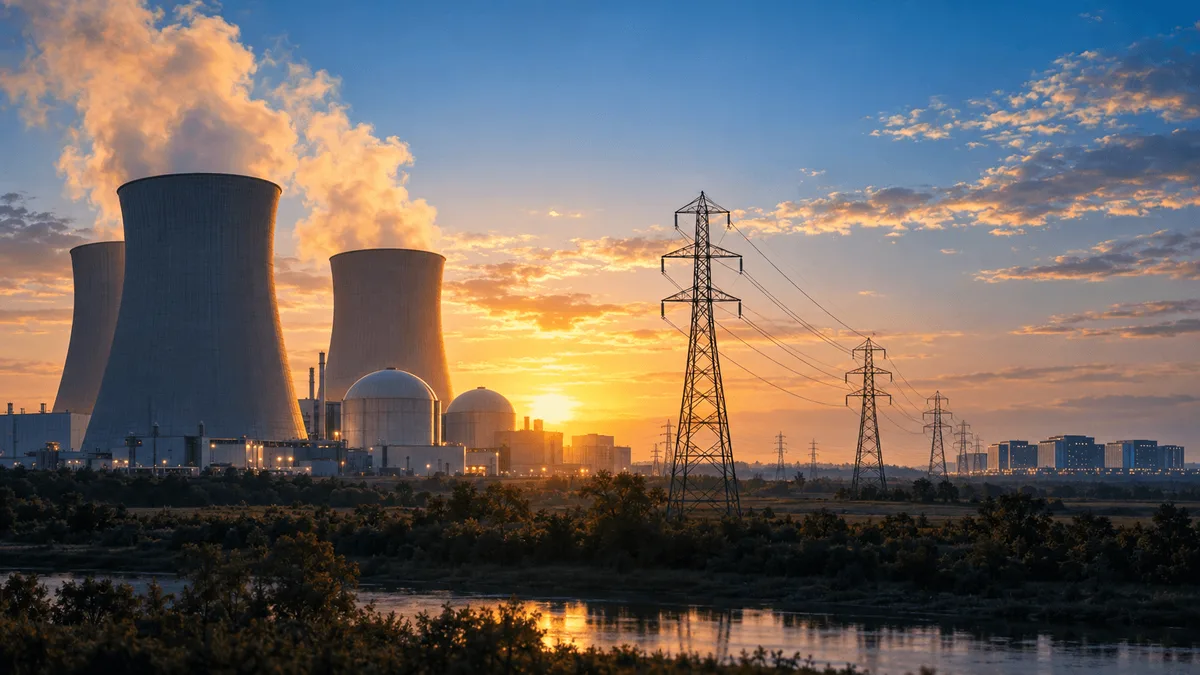
Google and Constellation Energy announced a long-term clean energy collaboration on October 6 that pairs a 20-year power purchase agreement funding upgrades at 11 nuclear units with a separate 15-year agreement covering an additional 2,700 megawatts (MW) from Constellation's broader PJM fleet, according to a joint release from Constellation Energy and Google. The companies say the PPA will add 890 MW of new nuclear capacity to the PJM grid, which serves 67 million people across 13 states.
Two Agreements, Two Purposes
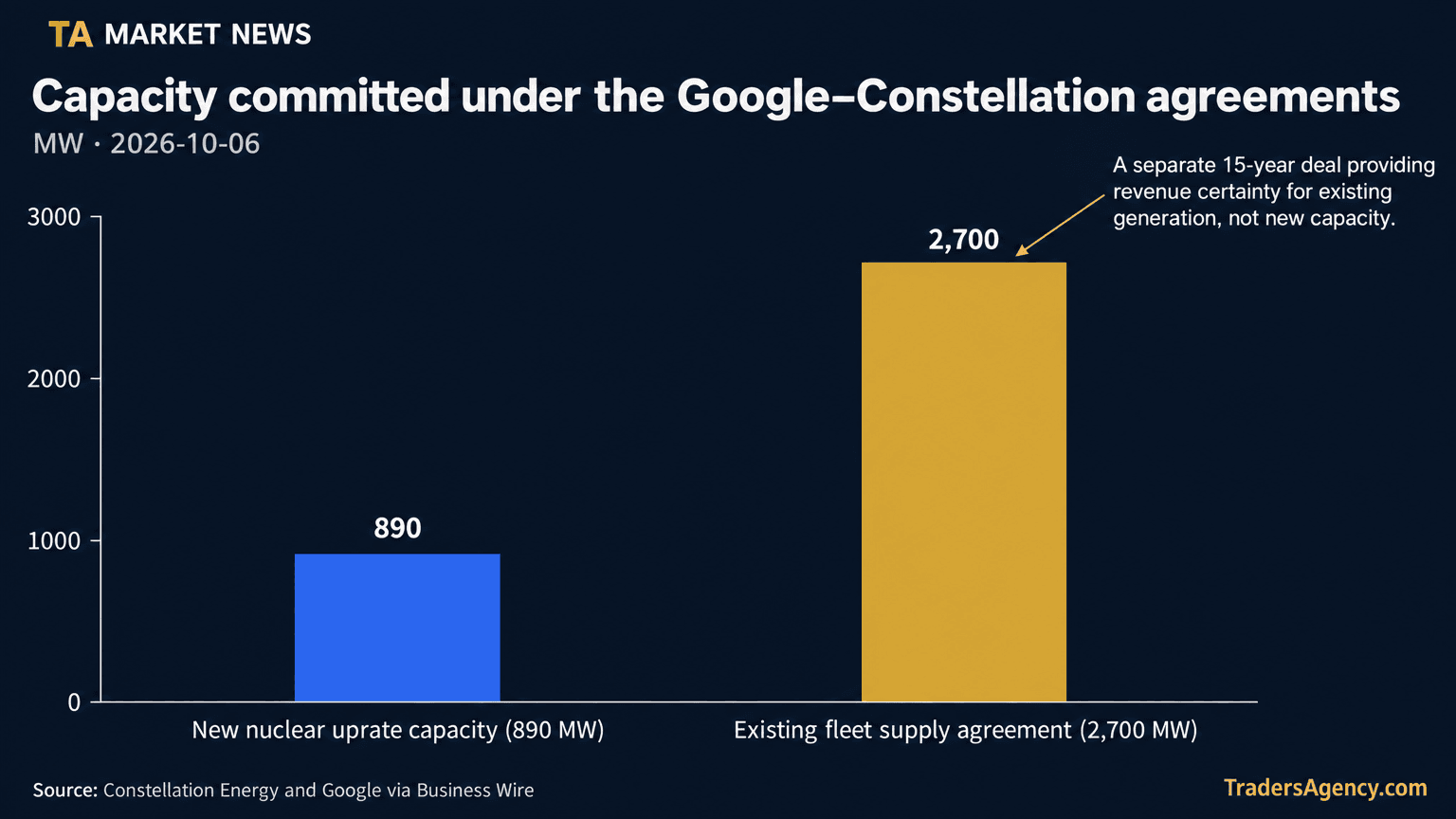
The first piece is the 20-year PPA, which the companies say will enable investments in new equipment and technology at 11 Constellation-owned nuclear units in Illinois, Pennsylvania and New Jersey, raising thermal and electrical efficiency to unlock additional firm power, per the joint release. Those upgrades span six nuclear sites and represent more than $4.3 billion of new investment by Constellation, the companies said, though neither party disclosed a site-by-site capex schedule or named the individual reactors in the released materials.
Separately, Constellation and Google entered a 15-year energy supply agreement for an additional 2,700 MW drawn from Constellation's existing PJM fleet. The companies describe this second deal as revenue certainty that keeps existing generating assets economically viable without removing them from the grid, rather than new capacity. As a rough comparison of the two headline figures, our calculation shows the 890 MW uprate commitment is about 67% smaller than the 2,700 MW supply agreement (890 minus 2,700, divided by 2,700), underscoring that the bulk of the contracted megawatts is tied to keeping current output flowing rather than adding new output.
Timeline, Jobs and Scale
Constellation and Google said the first uprate is expected to be delivered by 2028, with all 890 MW of firm capacity added to the grid before the end of 2032. The companies frame that incremental capacity as roughly equivalent to the output of several small modular reactors or one large new conventional reactor, and say it can be delivered years faster than building a plant from the ground up, according to the joint release and Google's blog post.
The companies also point to workforce effects: the agreement is expected to sustain roughly 4,400 existing jobs and create approximately 7,200 new construction jobs during the building period, per the joint release. Our calculation shows the 4,400 existing jobs sustained is about 39% below the 7,200 construction jobs cited ((4,400 − 7,200) / 7,200) — an interpretation that reflects the scale of temporary physical work involved in uprating six operating plants, not a claim about net long-term employment.
Executive Framing and Policy Context
Constellation CEO Joe Dominguez said the arrangement "can serve as a model for how technology companies and the energy industry can work together to responsibly develop the digital economy and invest in our nation's energy infrastructure in a way that delivers grid-wide benefits for all, funded by private entities," according to the companies' joint release. Google's global head of energy and power, Amanda Peterson Corio, said the agreement "will strengthen the PJM grid, which serves 67 million people, all while protecting energy affordability and supporting local union jobs."
Both companies emphasized that other grid customers bear none of the uprate costs, tying the structure to PJM's "Bring Your Own Power" proposal, the federal UPRISE program, and the White House Ratepayer Protection Pledge, per the release. Google also said its cumulative enabled U.S. nuclear capacity, counting uprates and restarts across multiple deals, now exceeds 1.5 gigawatts, and that the Department of Energy has set a goal of 5 GW of domestic nuclear expansion by 2030 through similar mechanisms, which Google expects its agreements to cover nearly 25% of by decade's end.
Broader Google Nuclear Push and AI Tie-In
Google's blog post listed other nuclear-related commitments, including an agreement with Georgia Power covering uprates across four reactor units that Google says is expected to enable approximately $900 million in ratepayer benefits, a collaboration with NextEra Energy to restart the Duane Arnold Energy Center in Iowa (adding over 600 MW), and advanced reactor work with Kairos Power and the Tennessee Valley Authority.
Alongside the power agreements, Constellation selected Google Cloud and Gemini Enterprise under an expanded five-year technology alliance intended to build an "AI for energy" blueprint covering uprate planning, asset dispatch optimization and infrastructure security, according to the joint release. The companies also agreed to a strategic framework for evaluating new clean generation, storage and demand-response projects across the U.S., with near-term priority given to PJM, and the deal includes demand-flexibility provisions allowing load-shaping and demand response during high-stress grid events.
Market Reaction
Constellation Energy shares jumped 7.2% premarket Tuesday following the announcement, according to Seeking Alpha. The released materials and available reporting do not disclose the contracted price terms for either the PPA or the 2,700 MW supply agreement, nor do they quantify incremental annual revenue for Constellation, name the specific reactors receiving uprates, detail NRC approval requirements, describe reaction among other independent power producers, or indicate whether the agreements change Constellation's existing capital plan, guidance or dividend and buyback capacity.
Bottom Line
The announcement combines a capacity-expanding uprate program with a separate fleet-wide revenue agreement, both framed by the companies as privately funded mechanisms to meet rising data-center demand without shifting costs to other ratepayers. The scale of the headline figures, $4.3 billion in investment, 890 MW of new capacity and 2,700 MW of contracted existing supply, points to a substantial long-term commercial relationship, though the financial terms that would let investors assess the deal's economics in detail have not been disclosed in the materials reviewed.
DISCLAIMER: Traders Agency does not offer financial advice. The information provided is for educational purposes only and should not be considered financial advice. Traders Agency is not responsible for any financial losses or consequences resulting from the use of the information provided. Trading carries inherent risks and may not be suitable for all individuals. You are advised to conduct your own research and seek personalized advice before making any investment decisions, recognizing the potential risks and rewards involved.
- Seeking Alpha Market News: Constellation, Google confirm nuclear energy deal tied to 890 MW of new PJM capacity · accessed Oct 6, 2026
- Google: Why we're backing America's existing nuclear plants · accessed Oct 6, 2026
- Constellation Energy and Google via Business Wire: Google and Constellation Announce Landmark Agreement to Bring 890 MW of New Nuclear Capacity to PJM Grid as Part of Long-Term Power Deal · accessed Oct 6, 2026
See more from Traders Agency on Google
Make us a preferred source and our market analysis will appear more prominently in your Google Search, Top Stories, and AI results.
Add to Preferred Sources