A security incident disclosed by Binance in late October 2026 has emerged as one of the largest cryptocurrency thefts on record, built not on a cryptographic break but on a suspected human-engineering failure. According to the exchange's own update and outside reporting, attackers appear to have combined access to an internal signing environment with a relatively obscure Ethereum feature to drain several hot wallets within minutes, setting off a scramble among stablecoin issuers and blockchain analysts to freeze what they could.
The Scale of the Incident and Early Estimates
Binance's security update, published in the early hours of October 30, put the total affected value at roughly $6.3 billion, with about $3 billion frozen shortly after the exploit was detected. That leaves a meaningful gap, somewhere in the neighborhood of $3.3 billion, that had not been frozen as of the company's disclosure. It is important to separate these categories: money that is affected is not the same as money that is permanently lost, and funds that remain unfrozen are not necessarily funds the attackers will ever be able to spend. Investigators were still reconciling the final numbers, and earlier public estimates circulating before Binance's own statement ranged as low as $5.5 billion in gross exposure, underscoring how fluid these figures were in the hours after the breach became public.
Even with that uncertainty, contemporaneous reporting described the episode as potentially the largest cryptocurrency theft to date, surpassing the widely covered 2025 Bybit hack. Binance has also pointed to a suspected social-engineering campaign in which fake recruiters or coding-test offers may have been used to get malicious software onto employee machines, a method investigators associate with North Korea-linked operations in past incidents. That attribution remains a working theory from the company and outside investigators rather than an independently confirmed conclusion, and Traders Agency analysts are watching for further forensic detail before treating it as settled.
The Suspected Attack Path: From a Laptop to the Wallets
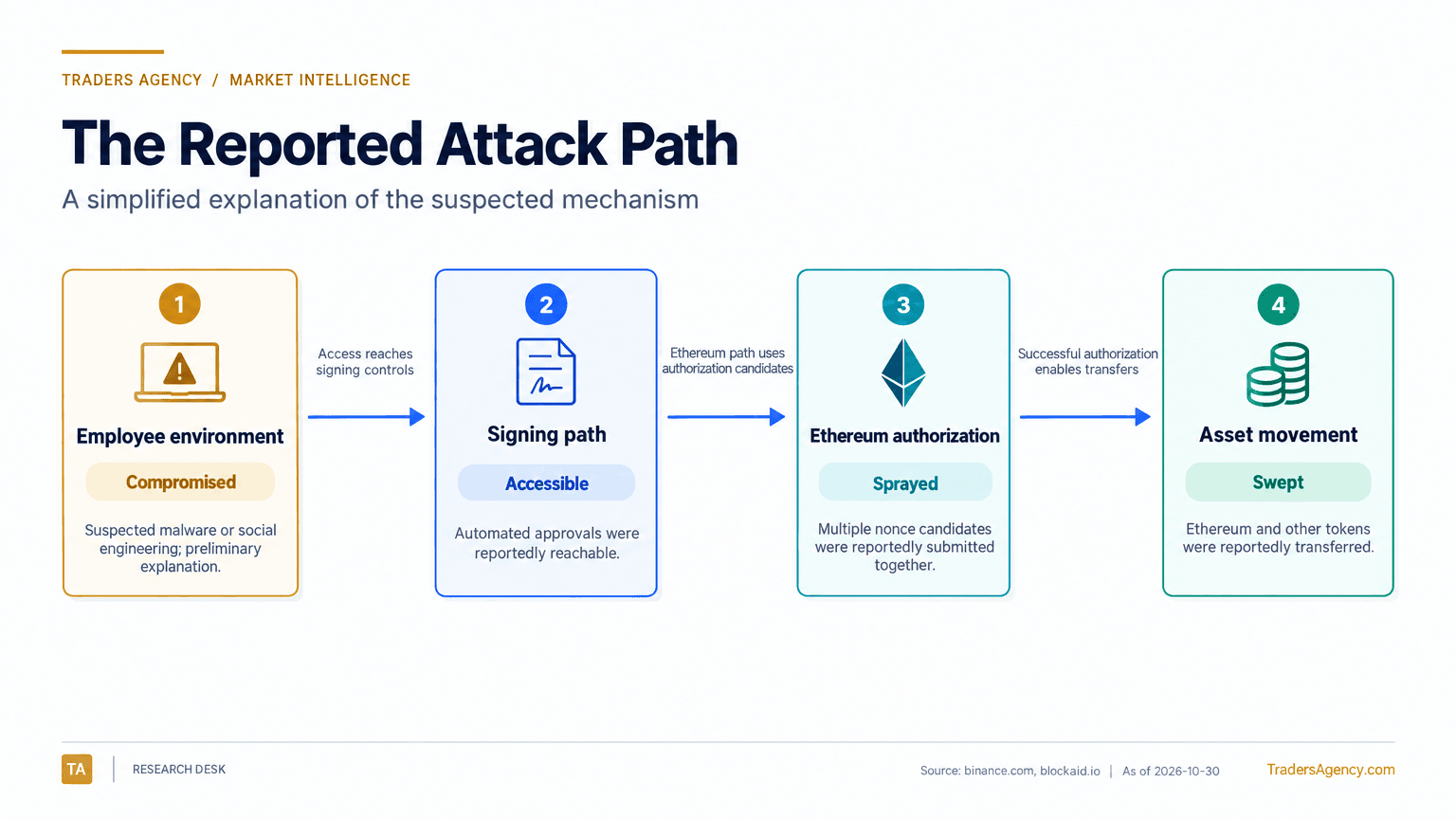
Binance's initial investigation reportedly pointed to a compromised laptop belonging to a DevOps engineer as the entry point. That access allegedly reached a service container used to process withdrawal approvals, the kind of automated signing system exchanges rely on so customers do not wait hours for a human to approve every trade. Once inside that environment, the normal distinction between an employee's device and the systems that actually move money broke down. Binance has said it found no evidence that private keys themselves leaked, which suggests the attackers exploited process access rather than stealing cryptographic secrets outright, though this remains a preliminary explanation rather than a finalized forensic finding.
Hot wallets exist because they need to be reachable by transaction systems in real time. That connectivity is precisely what makes them attractive targets once an attacker has a foothold inside the network that talks to them.
Why Ethereum Needed a Special Trick
Most of the tokens taken in this incident could likely have been moved simply because the attackers had reached an authorized signing path. Ethereum was reportedly the exception, because transactions there require a specific sequential reference number, similar to writing checks in order. Guess wrong and the transaction fails outright, which risks triggering security alarms before much money moves.
The attackers appear to have used a mechanism tied to Ethereum Improvement Proposal 7702, a 2025 network upgrade, to submit roughly 50 authorization candidates covering a range of possible sequence numbers in a single attempt. Only one needed to match for the transaction to succeed, letting them slip through without the telltale pattern of repeated failures that might have tipped off monitoring systems earlier.
Want expert trading insights delivered daily?
Join thousands of traders who rely on Traders Agency for market analysis and trade ideas.
Join Traders AgencyMinute by Minute: How the Funds Moved
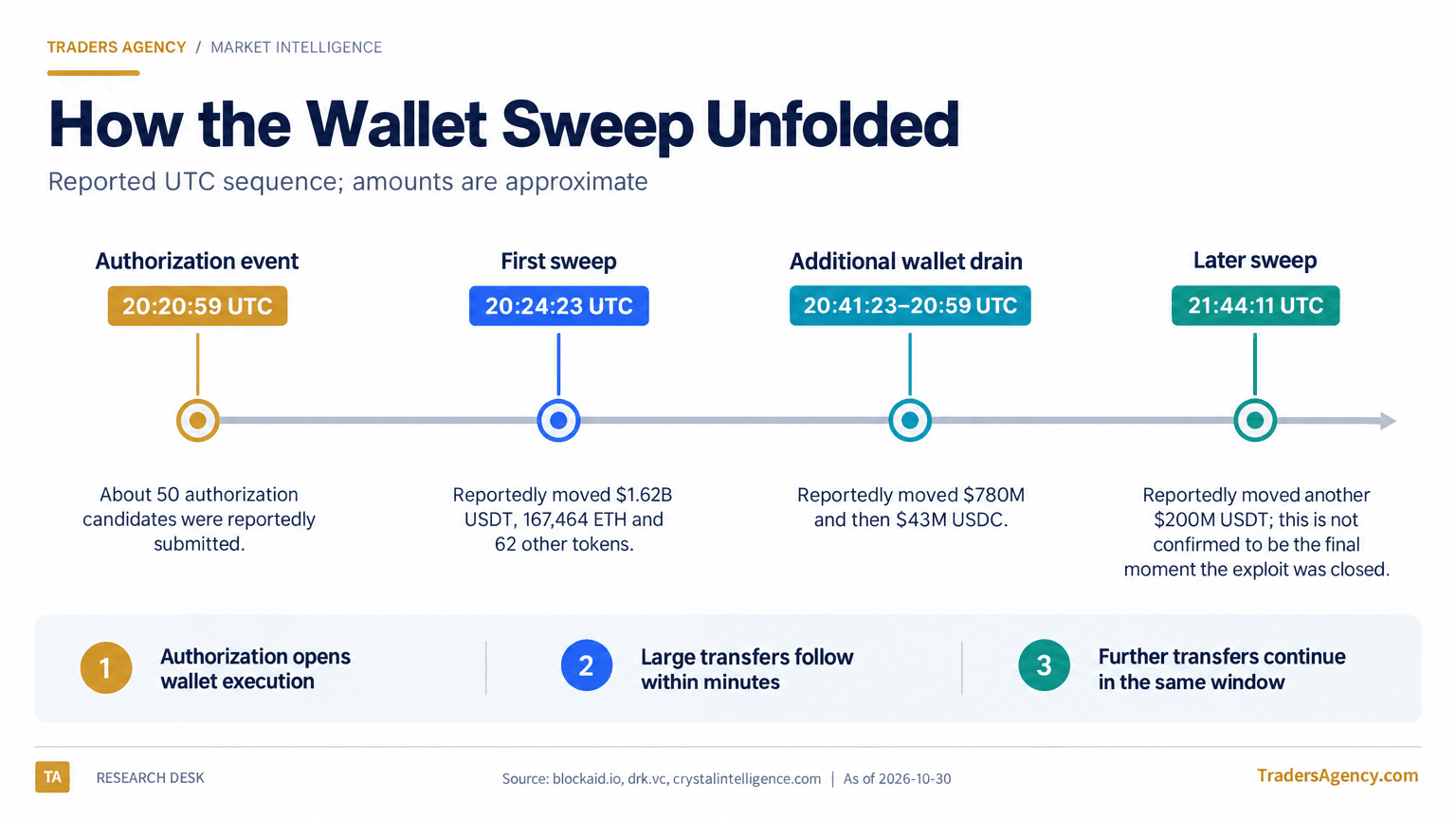
On-chain activity described in forensic write-ups suggests the attackers began preparing roughly 37 hours before the main sweep, including transactions through the Tornado Cash mixing service to fund gas fees and the deployment of contracts used to consolidate stolen assets. The bulk of the theft then happened astonishingly fast.
Within about four minutes of the authorization event, roughly $2.5 billion left one Binance hot wallet, including approximately 167,000 ETH and $1.6 billion in USDT, alongside dozens of other tokens. Additional transfers followed over the next hour or so, including further USDC withdrawals and a later sweep of roughly $200 million. Reported descriptions of how long the vulnerability stayed open have varied between about 80 and 84 minutes depending on the starting point used, and a separate reconstruction places the actual closure of the exploited authorization well after that window, so the precise moment Binance fully shut the door is still being clarified.
The Race to Freeze the Money
Stablecoin issuers moved quickly once the theft was detected. Tether reportedly froze more than $1.5 billion and Circle more than $800 million, while Binance co-CEO Yi He said Ripple froze roughly $200 million tied to the incident. World Liberty Financial said it worked with custody firm BitGo to help freeze related funds as well.
Not everything moved quickly enough to catch. Attackers reportedly converted volatile tokens such as Uniswap and Pepe into Ethereum to get ahead of freezes, and separately posted about $60 million in stolen stablecoins as collateral on the lending platform Aave, borrowing against it before Aave's markets were paused. The borrowing reportedly happened in the narrow window just before the broader freeze took effect, illustrating how close the response and the exploit ran to each other.
Market Reaction and the Overhang Ahead
Crypto markets moved lower in the hours after the breach became public, though untangling how much of that decline reflects the hack itself versus ordinary volatility, including leveraged positions getting liquidated, is not something that can be cleanly separated from the available data. A more durable concern raised by market watchers is the overhang of unrecovered assets: if attackers gradually convert and sell holdings over an extended period rather than all at once, that could create a slow drip of selling pressure on major tokens for months, independent of any single news event.
Custody Lessons for Everyday Investors
This incident complicates both halves of the usual crypto security debate. Hot wallets are exposed because they must stay connected to transaction systems, but cold-storage hardware wallets are not automatically immune either, since firmware flaws or supply-chain tampering can in principle turn an offline device into a liability. Binance maintains that its proof-of-reserves reporting shows customer assets are backed one to one, but proof of reserves is a point-in-time snapshot rather than a full financial audit, and it does not by itself establish how losses across multiple blockchains would be absorbed in a worst-case scenario. That distinction matters for anyone relying on an exchange's reserve disclosures as a safety signal, though it is not evidence of an actual shortfall at Binance.
The more actionable takeaway is operational: separating the devices engineers use day to day from any system capable of approving transactions, and avoiding concentration of long-term holdings in a single wallet, device batch or location. For investors who find multi-wallet self-custody impractical, regulated products such as crypto ETFs offer a different tradeoff, built on securities regulation and brokerage-level protections like SIPC coverage, though at the cost of direct asset control. There is no single correct answer, only a set of tradeoffs between convenience, custody risk and oversight.
The Bottom Line
The Binance incident is less a story about broken cryptography than about the fragility of the human systems sitting between an exchange and its hot wallets. A single compromised laptop, paired with a protocol quirk that let attackers brute-force their way past a sequencing check, was reportedly enough to move billions of dollars before stablecoin issuers and blockchain analysts could react. As final loss figures and attribution details continue to firm up, the episode is a reminder that custodial and self-custodial crypto storage each carry distinct operational risks, and that neither approach eliminates the need for careful security design.
Want expert trading insights delivered daily?
Join thousands of traders who rely on Traders Agency for market analysis and trade ideas.
Join Traders AgencyDISCLAIMER: Traders Agency does not offer financial advice. The information provided is for educational purposes only and should not be considered financial advice. Traders Agency is not responsible for any financial losses or consequences resulting from the use of the information provided. Trading carries inherent risks and may not be suitable for all individuals. You are advised to conduct your own research and seek personalized advice before making any investment decisions, recognizing the potential risks and rewards involved.
- Security Incident Update | Binance Support
- Binance halts trading after biggest-ever crypto hack
- The largest theft in history: North Korea likely behind the $6.4 billion Binance hack | Elliptic
- Binance $5.5B Hack: Using Advanced AI Models, Blockaid Detects the Biggest Theft in Crypto History
- Four Hours, 20 Freezes, One Attacker: Inside the Race to Freeze the Binance Hack, Second by Second
- How Binance 14 was emptied through an EIP-7702 delegation
- Binance hack: what we know & what teams should do now
- Binance Hot Wallet Hack: The EIP-7702 Takeover Traced | Ondology Labs
- Hackeo de Binance: cómo robaron 6.300 M$ con EIP-7702
- Binance flags 'potential security issue,' says approximately $6.3 billion impacted
- Binance says $2.54 billion in assets frozen as it probes security incident
- Binance Hot Wallet Exploit: Aave's Response
- Binance Hacker Hunts for Exit Ramps as DeFi Exchanges Pause Markets
- Engineering a backdoored bitcoin wallet
- Proof of Reserves
- Investor Advocate: Exercise Caution With Third-Party Verification/Proof of Reserve Reports
- SIPC - For Investors - What SIPC Protects
- How SIPC Protects You
See more from Traders Agency on Google
Make us a preferred source and our market analysis will appear more prominently in your Google Search, Top Stories, and AI results.
Add to Preferred Sources