
IV crush after earnings happens when the implied volatility priced into an option collapses right after a company reports its results, causing option premiums to drop sharply even when the stock moves in the direction a trader predicted. This single mechanic explains why so many options buyers watch a correct earnings call turn into a losing trade. We're going to show you exactly how it works, walk through a detailed example, and cover the strategies our team uses to trade around it instead of getting caught by it.
By the end of this guide, you'll understand what causes an IV crush, how to calculate it before you place a trade, and which strategies are built to profit from the volatility collapse rather than suffer from it.
What Is an Implied Volatility (IV) Crush?
Bottom Line: IV crush is predictable and priceable, so the real edge comes from knowing whether you're buying or selling volatility before earnings and checking that your breakeven math still holds at post-earnings IV levels. Defined-risk trades like iron condors tend to be easier to manage around this event than undefined-risk positions like straddles.
An IV crush is the sudden drop in an option's implied volatility, and therefore its price, that occurs once a known uncertain event (like an earnings report) has passed. The meaning boils down to this: option prices bake in uncertainty ahead of time, and once that uncertainty resolves, the premium tied to it disappears fast.
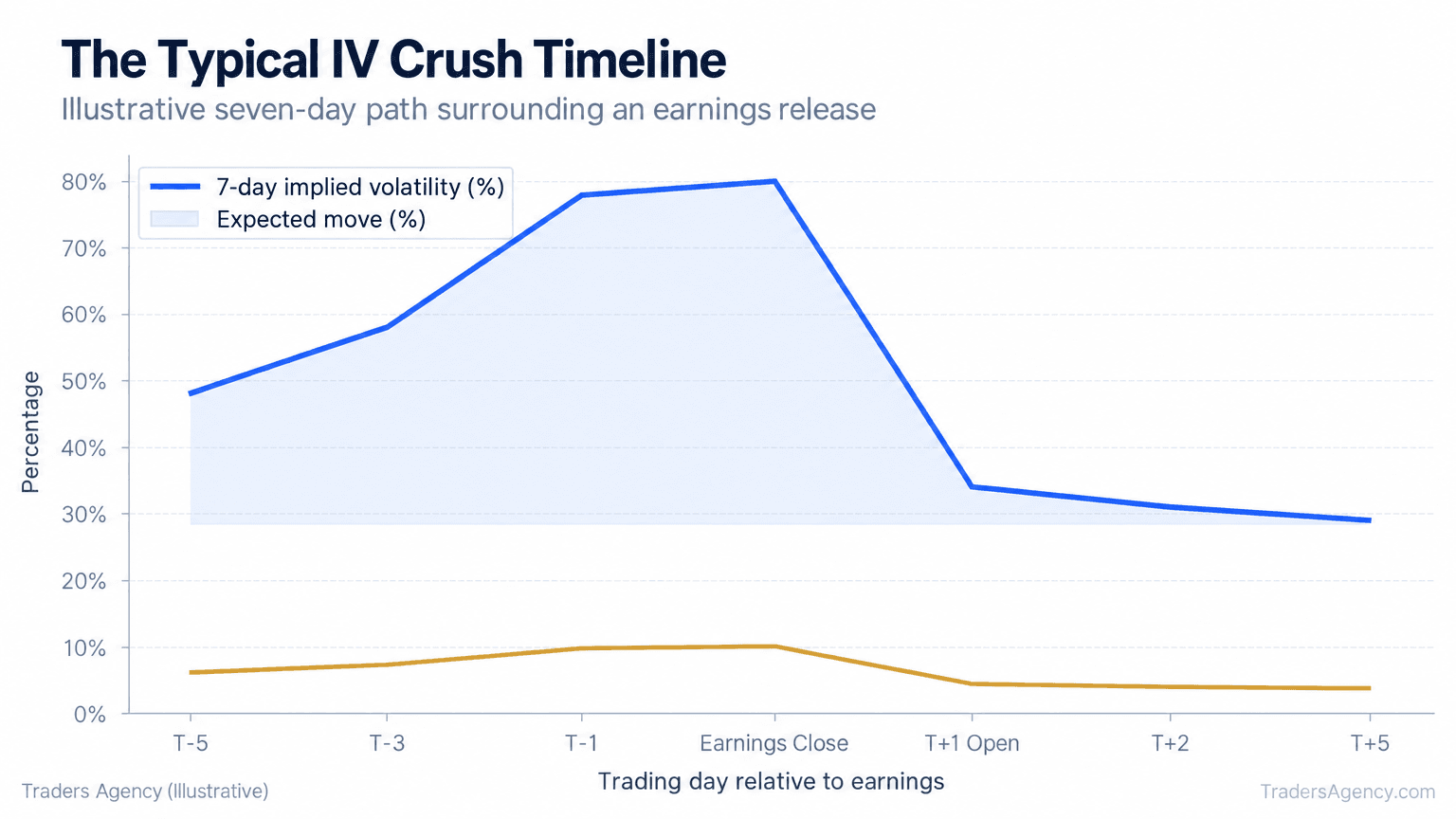
Implied volatility (IV) is the market's forecast of how much a stock is likely to move, expressed as an annualized percentage. Before earnings, nobody knows if a company will beat or miss, so options sellers demand more premium to take on that risk. That extra premium inflates IV, sometimes doubling or tripling a stock's normal level in the days before a report.
The moment the earnings number hits the tape, that uncertainty is gone. The stock might still move, sometimes a lot, but the unknown part of the equation has been resolved. IV drops back toward its normal range almost instantly, often within minutes of the print.
Key Concept: You are never just buying stock direction when you buy an option into earnings. You're also buying volatility. Direction can be right and volatility can still take the trade away from you.
What Causes IV Crush?
IV crush is caused by the resolution of a scheduled uncertain event, most commonly a quarterly earnings report, which removes the risk premium options sellers had priced in.
We like to explain implied volatility as insurance pricing before a hurricane. Insurers charge more when a storm is approaching because the outcome is unknown. Once the storm passes and the damage is assessed, that uncertainty premium has no reason to exist anymore. Options work the same way: elevated IV before earnings reflects unresolved risk, and once the report is out, that risk premium evaporates regardless of which way the stock actually moves.
When Does an IV Crush Happen?
IV crush typically happens within hours, sometimes minutes, of a company releasing earnings, especially when results come out after the market close or before the opening bell.
It isn't limited to earnings. Any scheduled binary event, like an FDA decision, a court ruling, or a major economic data release, can trigger the same pattern. But quarterly earnings are the most predictable and most widely traded version, which is why so many retail traders encounter it there first, often the hard way.
How Much Does IV Crush After Earnings?
IV crush after earnings can reduce implied volatility by 40% to 70% in a single session, though the exact drop depends on the stock, the sector, and how surprising the results were.
A stock carrying 90% IV heading into earnings might settle back to 30% to 40% the next morning. That's not a small adjustment. It's often the single largest one-day volatility move an option will ever experience outside of a market crash.
| Stage | At-the-Money IV | What It Reflects |
|---|---|---|
| Normal (no event pending) | 30% to 40% | Baseline expected movement |
| Two days before earnings | 80% to 90% | Unresolved binary risk premium |
| Morning after the report | 28% to 40% | Uncertainty resolved, premium gone |
Want expert trading insights delivered daily?
Join thousands of traders who rely on Traders Agency for market analysis and trade ideas.
Join Traders AgencyWhat Does an IV Crush After Earnings Look Like?
Here's the concrete example our team uses when teaching this concept to members.
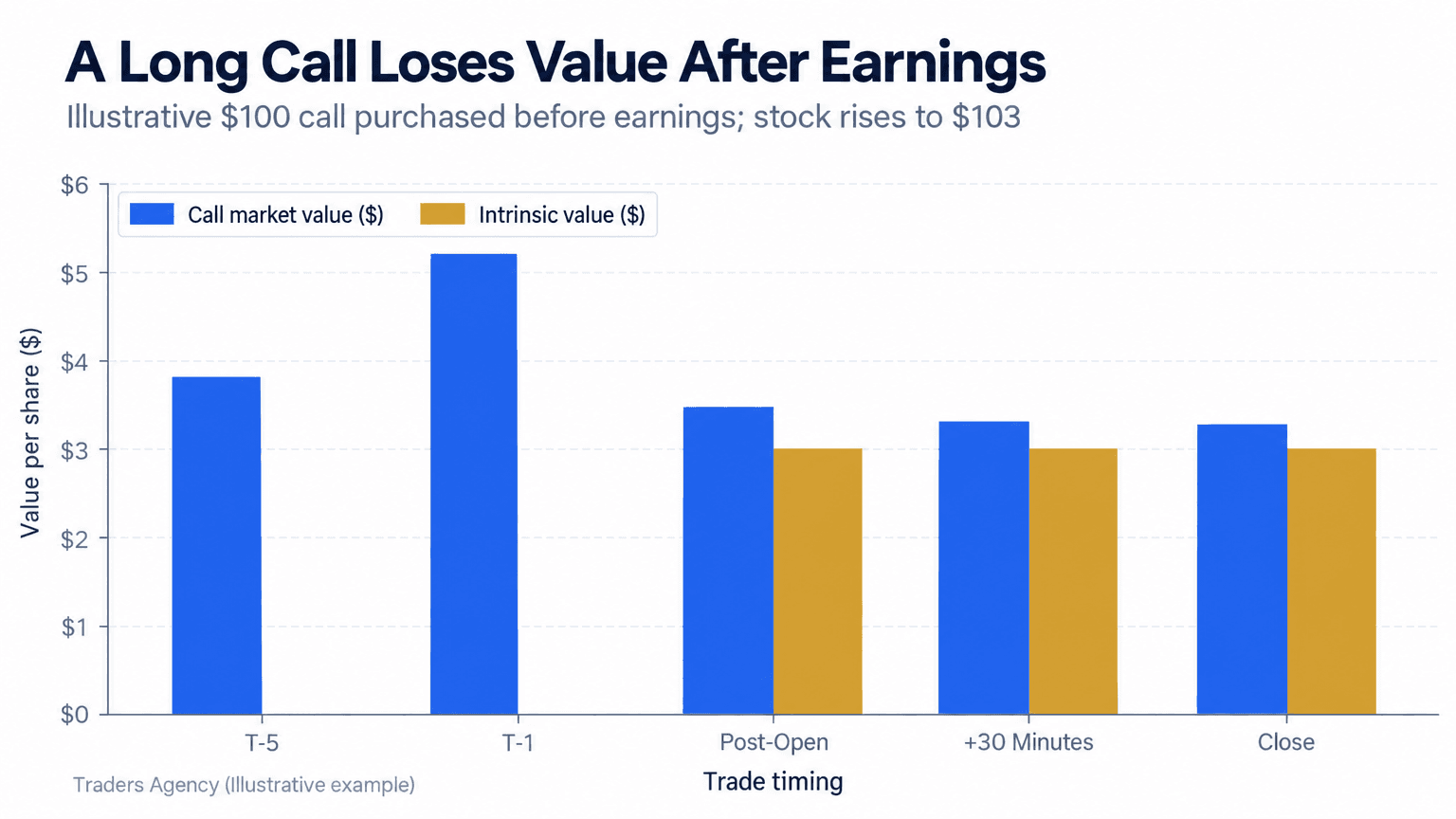
Say a stock trades at $100 two days before earnings. Implied volatility on the front-month at-the-money call sits at 85%, pushing the premium on the $100 strike call to $5.20. A trader buys that call, betting the company beats expectations.
Earnings come out and the company does beat. The stock gaps up to $103. On direction alone, the trader was right. But implied volatility collapses from 85% down to 28% overnight. The call that cost $5.20 is now worth roughly $3.25, almost all of it intrinsic value, even though the stock moved in the trader's favor.
| Parameter | Before Earnings | After Earnings |
|---|---|---|
| Stock Price | $100 | $103 |
| At-the-Money IV | 85% | 28% |
| $100 Call Premium | $5.20 | $3.25 |
| Position Result (1 contract) | Cost: $520 | Value: $325 (-$195) |
That's the trade you see described constantly in earnings discussion threads: "the stock did exactly what I thought and I still lost money." The stock needed to move far enough to outrun the volatility collapse, and in this case it simply didn't move enough.
Watch Out: Being right on direction is not enough into an earnings print. Your stock has to move further than the premium you paid just to break even on a long single-leg option, and the volatility collapse strips out the time value you were counting on.
Step-by-Step: How to Calculate IV Crush Before You Trade
Here's the pre-trade checklist we walk members through every earnings season:
- Step 1: Check current IV against the stock's 30-day historical average using your options chain or an IV calculator. If current IV is double the baseline, you're paying an event premium.
- Step 2: Estimate the expected move the market is pricing in. Most brokers display this directly on the earnings date, and you can also approximate it from the at-the-money straddle price.
- Step 3: Compare your target move to the premium you would pay. If your forecast move is smaller than that premium, the trade is unlikely to overcome the IV crush.
- Step 4: Model the post-earnings IV using a comparable prior quarter as your reference point, then reprice your option at that lower volatility level.
- Step 5: Decide whether you're buying or selling volatility. If the answer is "buying," make sure the expected move math actually supports it. If not, structure a premium-selling trade instead.
Plenty of free tools automate this comparison for you, but you can run every step manually with any standard options chain. We prefer that members do it by hand at least a few times so the relationship between IV, premium, and breakeven becomes second nature.
How Can You Profit From an IV Crush?
Rather than buying options into elevated IV, our team prefers strategies structured to sell that inflated premium and benefit when it collapses.
- Short straddle: Sell a call and a put at the same strike, collecting maximum premium. High reward, but undefined risk if the stock makes a large move.
- Iron condor: Sell a call spread and a put spread around the current price, defining your maximum loss up front. Lower reward than a straddle, but far more manageable risk.
- Calendar spread: Sell a near-term option and buy a longer-dated option at the same strike, profiting from the faster volatility collapse in the front month, with maximum loss limited to the net debit paid.
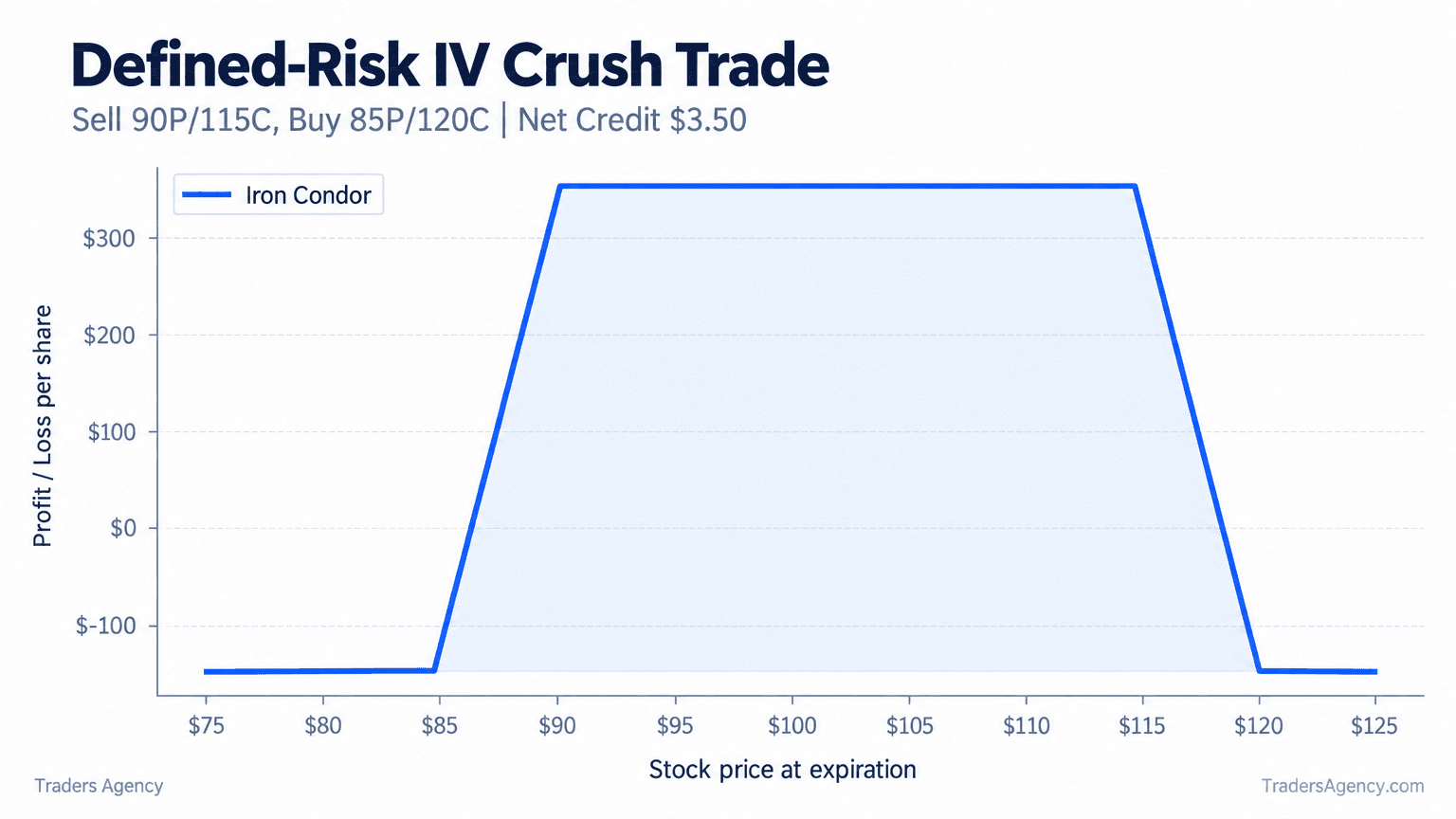
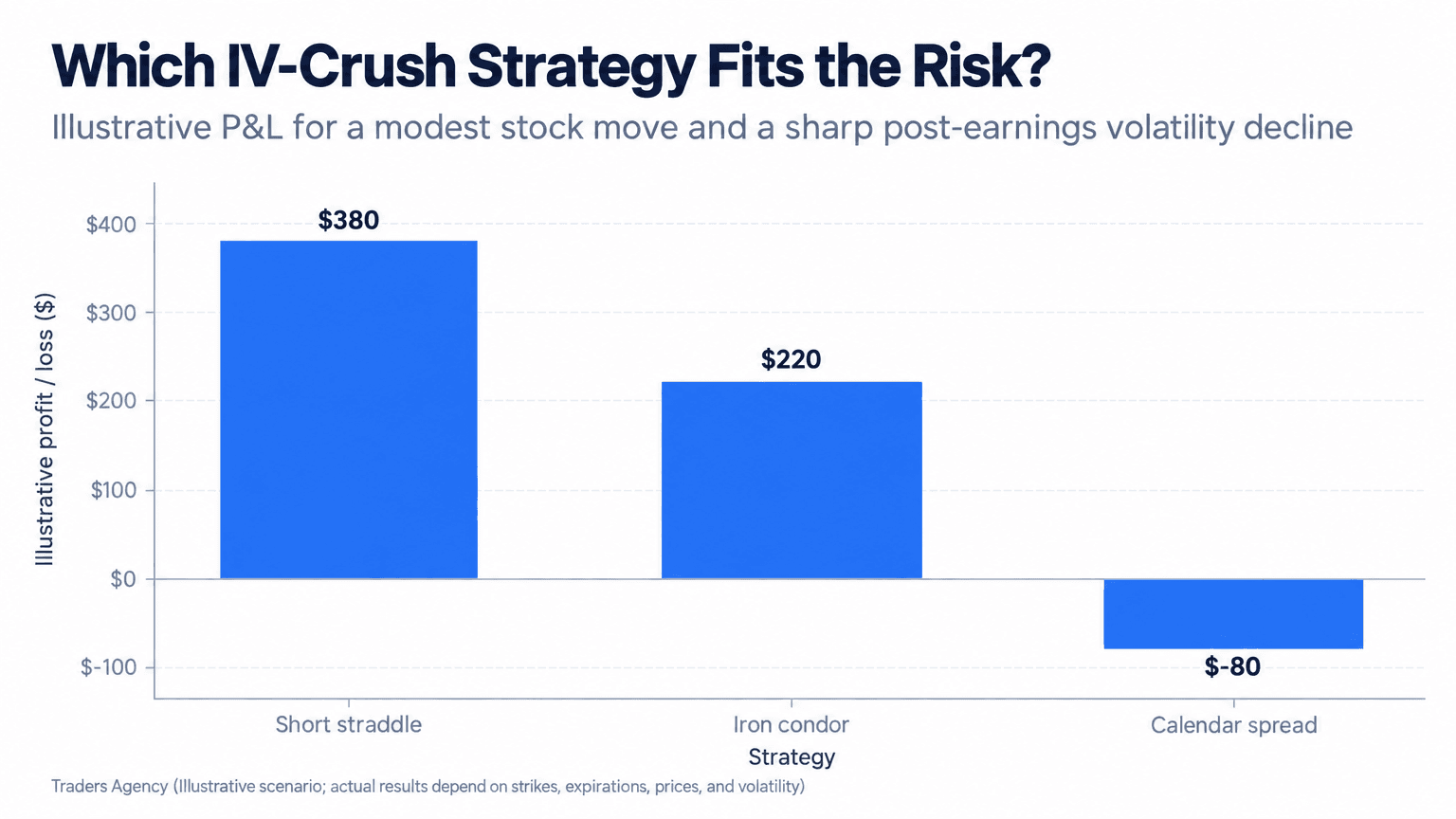
For members just starting out with earnings volatility trades, we point them toward iron condors first. The defined risk makes position sizing far more predictable than an undefined-risk straddle, and predictable sizing is what keeps a single bad print from doing real damage to an account.
Watch Out: A short straddle can look brilliant right up until a stock gaps 15% on a surprise guidance change. If you can't define and size your worst case before entry, don't put the trade on.
How Can You Avoid Getting Hurt by IV Crush?
Knowing how to avoid IV crush is often more valuable than knowing how to profit from it, especially for traders who primarily buy options. Here are the filters we apply:
- Avoid buying single-leg options directly before earnings unless you've specifically accounted for the volatility collapse in your breakeven math.
- Check open interest and bid-ask spreads. Low-liquidity names make it hard to exit a defined-risk trade at a fair price.
- Skip stocks with pending binary events beyond earnings, like litigation outcomes or FDA rulings stacked on top of the report date.
- Watch macro risk. A Federal Reserve announcement or major economic data release in the same week can distort the "pure" earnings volatility crush you're trying to trade.
- Never allocate more than a small percentage of your account to any single earnings volatility trade, regardless of strategy.
Options exchanges like the Cboe publish historical implied volatility data you can use to sanity-check whether a stock's pre-earnings IV is genuinely elevated or simply following its normal seasonal pattern. The Federal Reserve calendar is worth a glance too, so you know whether a macro event is sitting on top of your earnings date.
Implied Volatility (IV) Crush Key Takeaways
- IV crush after earnings is the rapid drop in implied volatility once a scheduled uncertain event resolves, regardless of which way the stock moves.
- Buying single options directly before earnings is often a losing trade because the stock has to travel further than the premium paid while implied volatility collapses at the same time.
- Short straddles, iron condors, and calendar spreads are structured to benefit from the volatility collapse instead of fighting it.
- Defined-risk strategies like iron condors are generally more manageable for intermediate traders than undefined-risk straddles.
- Always check liquidity, open interest, and any overlapping binary events before entering an earnings volatility trade.
Remember This: Before every earnings trade, ask one question: am I buying volatility or selling it? If you can answer that clearly and your breakeven math still works at post-earnings IV, you're trading the event instead of gambling on it.
Want expert trading insights delivered daily?
Join thousands of traders who rely on Traders Agency for market analysis and trade ideas.
Join Traders AgencyDISCLAIMER: Traders Agency does not offer financial advice. The information provided is for educational purposes only and should not be considered financial advice. Traders Agency is not responsible for any financial losses or consequences resulting from the use of the information provided. Trading carries inherent risks and may not be suitable for all individuals. You are advised to conduct your own research and seek personalized advice before making any investment decisions, recognizing the potential risks and rewards involved.
See more from Traders Agency on Google
Make us a preferred source and our market analysis will appear more prominently in your Google Search, Top Stories, and AI results.
Add to Preferred Sources