
You place a market order on your phone, it fills in a fraction of a second, and you move on with your day. What actually happened in that moment involves a firm you've probably never thought about, and understanding it changes how you think about every trade you place.
Market maker dynamics refers to the pricing behavior, inventory management, and order flow routing that firms like Citadel Securities and Virtu Financial use to provide continuous buy and sell quotes in a security. These firms profit from the spread between what they're willing to pay and what they're willing to sell for, while managing the risk of holding inventory. By the end of this guide, you'll know what a market maker actually does, how retail order flow gets routed and filled, and why the "they're rigging my trades" narrative misses most of what's really going on.
We built this guide because the topic gets tangled up in social-media conspiracy theories. Our team wants you to understand the mechanics well enough to separate legitimate criticism from noise, and to put that knowledge to work in your own trading.
What Is Market Maker Dynamics?
Bottom Line: Market makers like Citadel Securities and Virtu profit from the bid-ask spread while managing inventory risk, and their order flow routing is governed by regulated incentives, not a hidden scheme to rig individual trades. Understanding how fills actually happen lets traders read their executions accurately and focus on position sizing and volatility-based stops instead of chasing conspiracy explanations.
Market maker dynamics is the study of how liquidity providers set quotes, manage inventory risk, and adjust pricing in response to order flow and volatility. It's the operational logic behind every bid and ask you see on your trading screen.
A market maker's core job is simple to state and hard to execute: always be willing to buy and sell. They post a bid (what they'll pay) and an ask (what they'll charge), and they make money on the difference, called the spread. The catch is that they're doing this across thousands of symbols simultaneously, adjusting prices in milliseconds based on supply, demand, and risk.
This is different from a typical trader's approach. You decide when to enter and exit based on a thesis. A market maker provides a two-sided market constantly, regardless of their own directional view, and manages the resulting risk through hedging and inventory limits. That structural difference is why understanding the market maker model helps you read price action more clearly, especially around the open, the close, and high-volatility events.
Key Concept: A market maker is paid to be the other side of your trade, not to beat you on it. Their revenue comes from the bid-ask spread and exchange liquidity rebates. Wholesalers pay brokers for order flow rather than receiving those payments, and their primary risk is the inventory they're forced to carry.
Who Are Citadel and Virtu in the Market Maker Hierarchy?
Citadel Securities and Virtu Financial are two of the largest electronic market makers in US equities, handling a significant share of retail order flow alongside firms like Susquehanna, Jane Street, and Two Sigma Securities.
If you're searching for a list of market makers, these names come up constantly because they operate at massive scale across stocks, options, and ETFs. When people ask who are the biggest market makers, the honest answer is that it's a short list of highly capitalized, technology-driven firms rather than a single dominant player.
These firms aren't banks in the traditional sense. They don't take deposits or make loans. Their business is quoting prices, managing inventory, and capturing spread and rebate revenue across enormous volume. Virtu's own public filings describe a model built on taking small amounts of risk across an enormous number of trades, which is a fair summary of how most modern electronic market makers operate. You can read those filings directly through the SEC's EDGAR database.
How Do Market Makers Profit From the Bid-Ask Spread?
A market maker profits by buying at the bid and selling at the ask, capturing the difference on each completed round trip. On a stock with a one-cent spread and millions of shares traded daily, that adds up fast even though each individual capture is tiny.
Here's a concrete walkthrough. Say a stock is quoted $50.00 bid / $50.02 ask. A retail buyer and a retail seller both route through the same market maker in the same minute.
| Parameter | Value |
|---|---|
| Quoted Market | $50.00 bid / $50.02 ask |
| Fill 1 (buy from retail seller) | $50.00 |
| Fill 2 (sell to retail buyer) | $50.02 |
| Gross Spread Captured | $0.02 per share |
| Net Directional Exposure | Zero (position is flat) |
| On 20 million shares/day | Scale, not size, drives the revenue |
Multiply that two-cent capture across a stock that trades 20 million shares a day and you see why spread capture is the backbone of the business. Wider spreads mean more revenue per trade, but they also tend to appear in less liquid or more volatile names, where the market maker takes on more inventory risk to earn that wider spread.
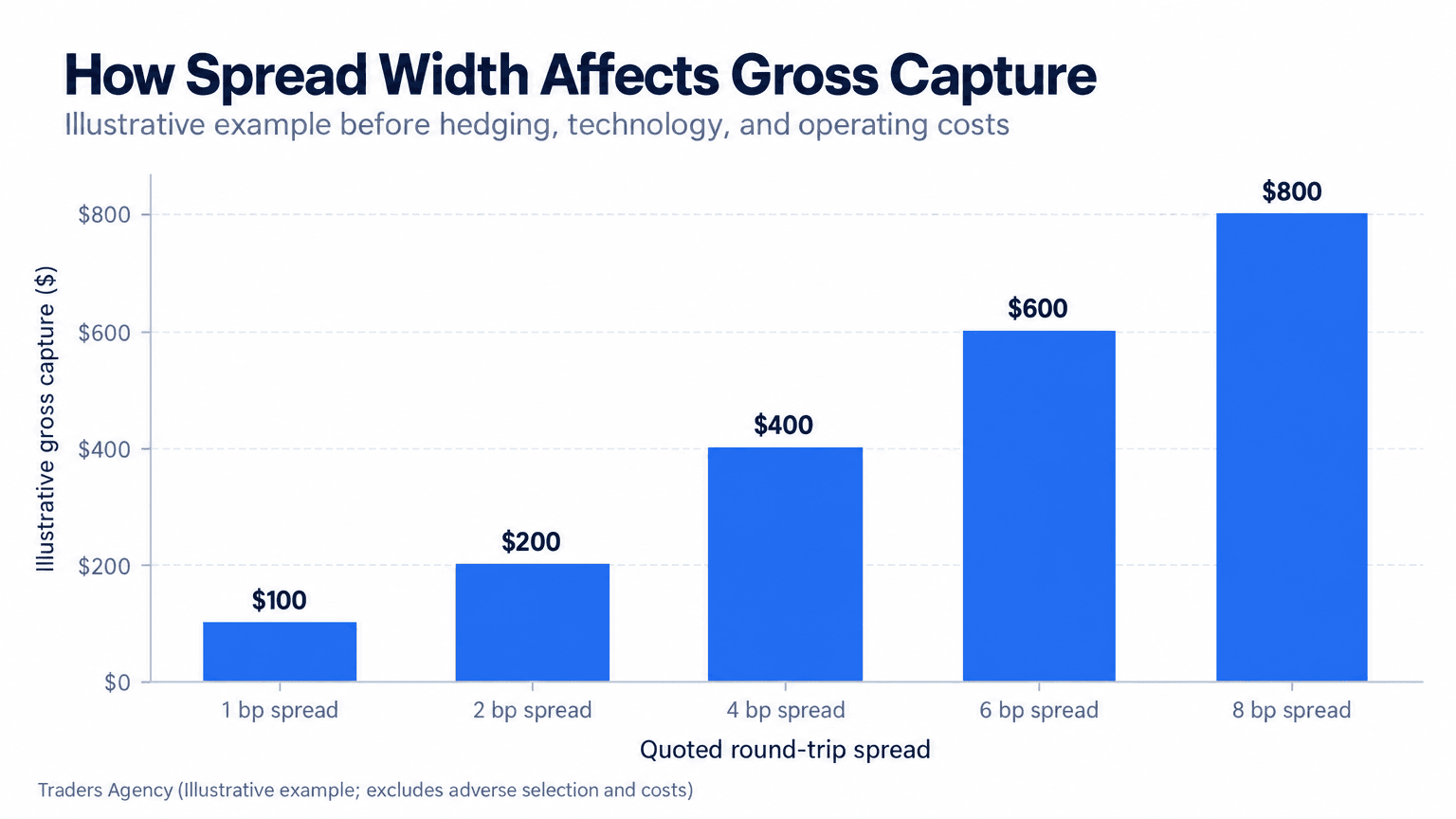
That chart simplifies things. In practice, wider spreads often come with adverse selection, meaning the market maker is more likely to be trading against someone with better information, which eats into that gross number. Spread capture is the headline, but it's never the full profit and loss picture.
The Role of Designated Market Makers
A Designated Market Maker (DMM) is a firm assigned by an exchange, such as the NYSE, to maintain fair and orderly markets in specific listed stocks, including managing openings, closings, and volatility pauses. This is distinct from the off-exchange wholesalers that handle most retail stock orders today.
DMMs operate under exchange obligations: they must maintain a presence in the market and step in during unusual volatility, in exchange for certain benefits like parity in order allocation and preferential fee treatment. Off-exchange market makers like Citadel Securities and Virtu don't carry the same formal exchange obligations, but they compete for order flow by offering price improvement, meaning they fill retail orders at better prices than the public quote.
This dual structure is one reason the market maker dynamics strategy conversation has gotten more complicated over the past decade. Liquidity now comes from both exchange-designated roles and a separate layer of wholesale internalizers, and retail traders rarely see which one filled their order.
Active vs Passive Market Making Strategies
Passive market making means consistently posting resting bid and ask quotes and waiting for orders to arrive, earning the spread with minimal directional risk. Active market making involves adjusting quotes aggressively based on short-term signals, order flow imbalances, and correlated instruments, taking on more inventory risk for potentially higher reward.
| Approach | How It Works | Risk Profile |
|---|---|---|
| Passive | Posts tight two-sided quotes on liquid names and lets both sides fill naturally | Lower margin per trade, high volume, near-flat end-of-day inventory |
| Active | Widens or skews quotes after detecting one-sided flow or correlated signals | Higher potential reward, larger inventory swings, speed-dependent |
A passive strategy looks like this: a firm quotes a tight spread on a liquid ETF, lets both buy and sell orders fill naturally, and nets out close to flat inventory by the end of the day. It's steady and high-volume with thin margins on each fill.
An active approach looks different. The firm might widen or skew quotes after detecting heavy one-sided order flow, anticipating that prices will move and protecting itself from being picked off. This is where the overlap with high-frequency trading shows up most clearly, since reaction speed determines whether the firm gets ahead of the move or gets stuck holding bad inventory.
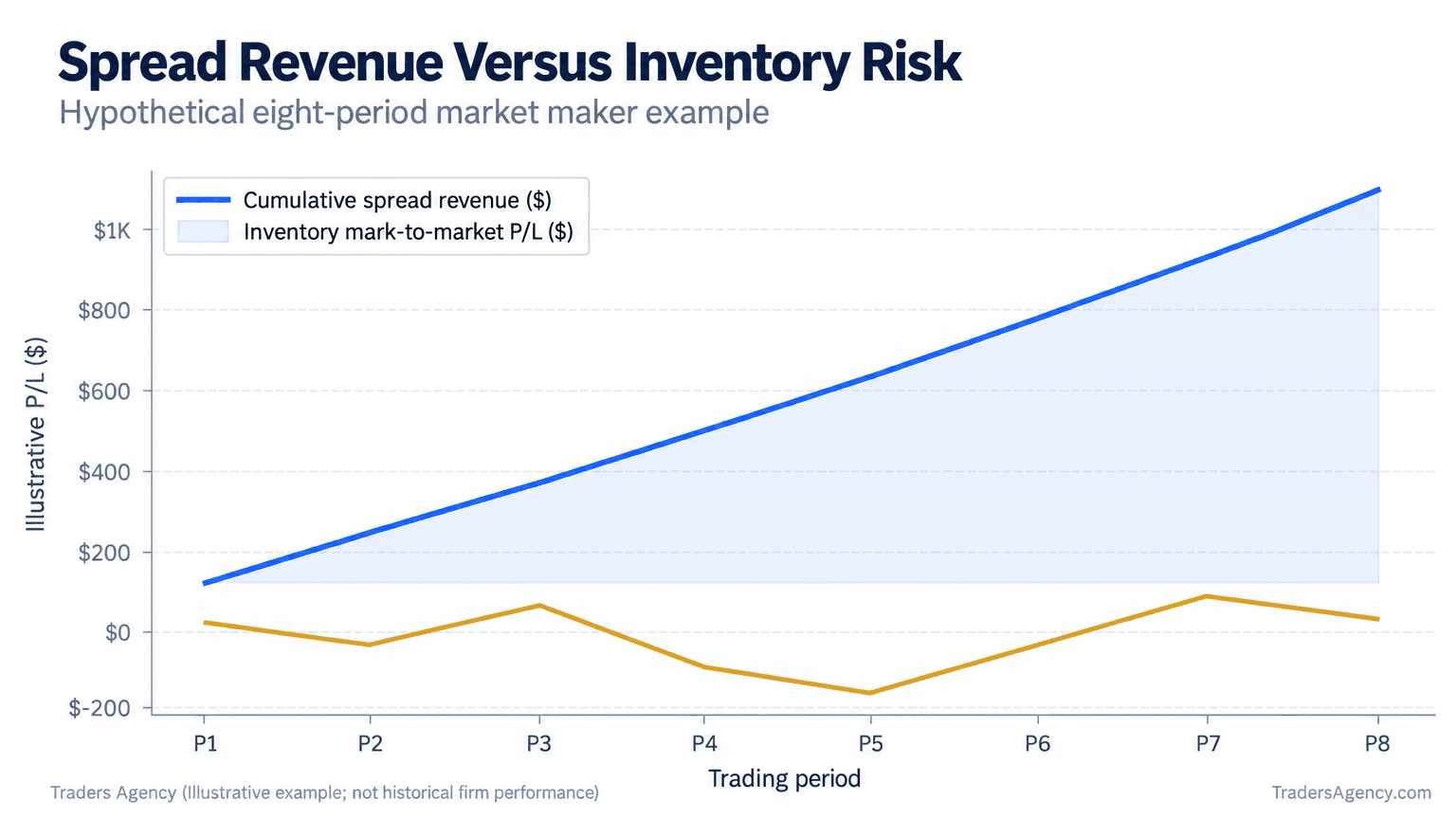
Here's a market making strategy example worth internalizing: imagine a firm carries a long inventory position of 50,000 shares after a wave of sell orders. If the stock keeps falling, spread income gets wiped out by the mark-to-market loss on that inventory. This is exactly why inventory limits and hedging matter more to these firms than the spread itself.
Watch Out: The spread is the revenue line, but inventory is where the losses live. Any market maker that stops hedging or ignores position limits can give back weeks of spread capture in a single fast move.
Want expert trading insights delivered daily?
Join thousands of traders who rely on Traders Agency for market analysis and trade ideas.
Join Traders AgencyHow Does Retail Order Flow Get Internalized?
Retail order flow internalization happens when a broker routes customer orders directly to a wholesale market maker instead of sending them to a public exchange. The market maker fills the order internally, often at a price slightly better than the public quote, and pays the broker for that flow.
Here's the path your order actually takes:
- Step 1: You submit the order. You tap "buy" in your brokerage app and the order leaves your account as an instruction, not as an exchange-bound trade.
- Step 2: Your broker routes it. Instead of sending it to the NYSE or Nasdaq, the broker routes it to a wholesaler like Citadel Securities or Virtu under a standing routing arrangement.
- Step 3: The wholesaler fills internally. The firm fills your order against its own inventory or quotes, frequently at a price slightly inside the public bid-ask spread.
- Step 4: The broker gets paid. The wholesaler sends a small payment back to the broker for the flow. This is payment for order flow (PFOF).
- Step 5: You see the confirmation. Your fill shows up in milliseconds, with no visibility into which venue handled it unless you pull the execution reports.
The SEC has published educational material and rule proposals specifically addressing this practice because of how dominant it has become in retail execution.
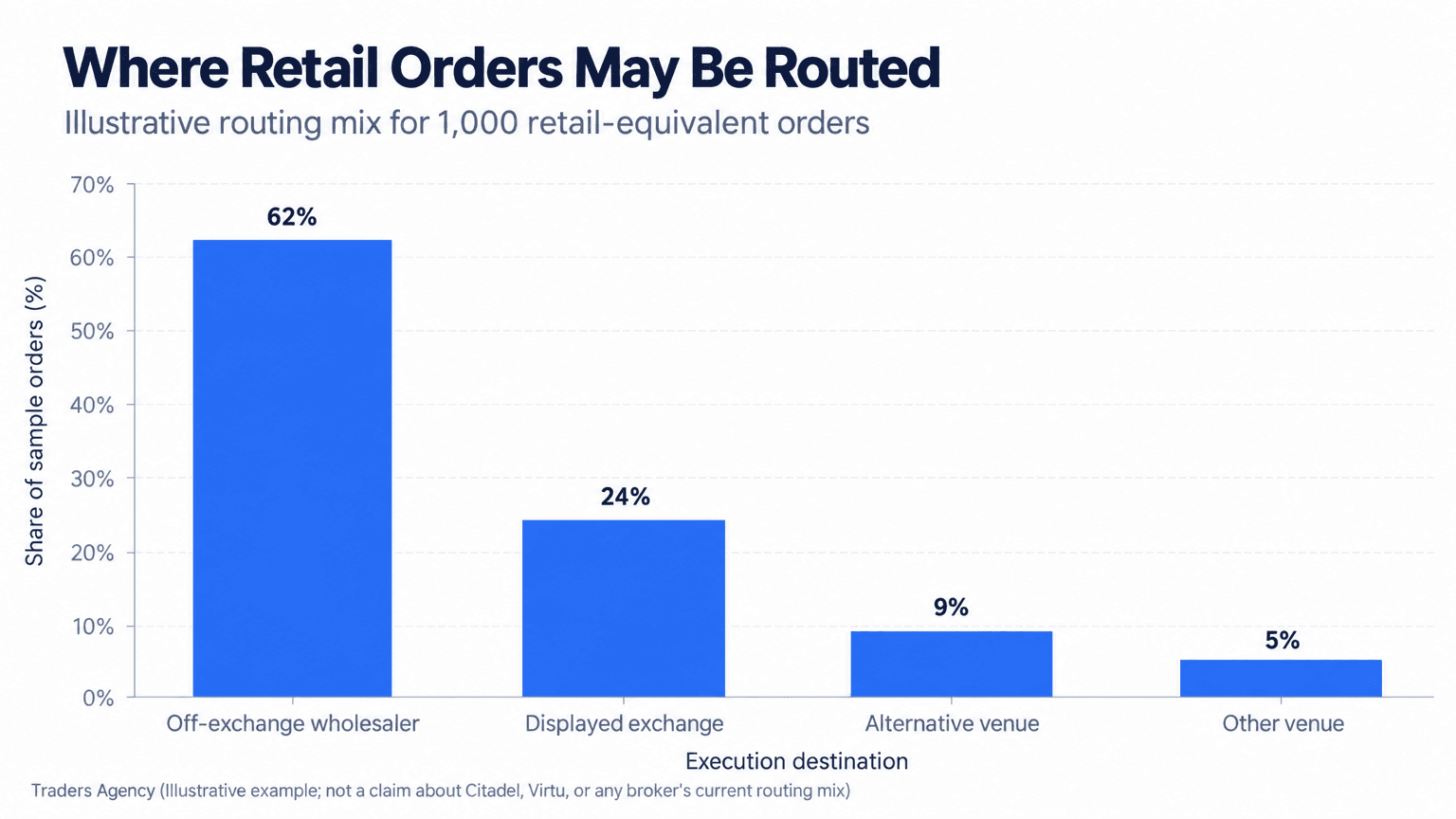
The debate centers on a legitimate tension. Wholesalers compete to offer price improvement, which can genuinely help retail traders get filled at slightly better prices than the quoted spread. At the same time, critics argue brokers should have stronger incentives to seek the absolute best execution rather than the best payment arrangement for themselves. Both things can be true at once, and we think traders are better served knowing that than picking a side.
What Does a Market Maker Actually Do?
A market maker provides continuous two-sided quotes, manages inventory risk through hedging, and fills incoming orders, earning revenue primarily from the bid-ask spread and from exchange liquidity rebates, while paying brokers for the retail order flow they receive. They are not making directional bets on your specific trade.
Day to day, this means constant quote adjustment, risk monitoring across correlated positions, and managing exposure limits so no single stock's move can blow up the firm's book. It's closer to running an insurance operation than it is to stock picking.
What Are Common Misconceptions About Market Maker Dynamics?
The most persistent misconception is that market makers manipulate individual retail trades to guarantee losses for small traders. That's not how the business works at the scale these firms operate.
Here's what's actually happening versus what gets assumed on social media:
- "They see my order and trade against me specifically." In reality, these firms process enormous volumes of flow algorithmically. Individual retail orders aren't singled out for manipulation.
- "Payment for order flow means my broker is selling me out." It means your broker is paid for routing, which creates a real conflict of interest worth watching, but it doesn't mean your fills are worse by design.
- "Market makers always win." Firms do lose money on inventory when markets move sharply against their positions, and that risk is disclosed in their own filings.
- "High-frequency trading and market making are the same thing." They overlap heavily but aren't identical. Not all HFT firms are registered market makers, and not all market makers rely on ultra-high-speed strategies.
If you want to go deeper on mechanics, a market maker strategy pdf published by an exchange or a regulator's educational site will get you far closer to accurate information than forum threads will.
When Should You Apply This Knowledge as a Trader?
Understanding market maker dynamics helps most around volatile open and close periods, earnings releases, and low-liquidity names where spreads widen noticeably. Watching spread behavior in these windows tells you something real about live liquidity conditions.
Our team suggests putting this knowledge to work in a few practical ways:
- Avoid market orders in thin, volatile names where spreads can widen sharply right when you're trying to get filled.
- Watch spread width as a liquidity signal before entering size, especially in small caps or low-volume options.
- Use limit orders during high-volatility events like earnings, when wholesalers may widen quotes to manage their own risk.
- Don't assume a bad fill means manipulation. Check the spread at the time of your trade before concluding something was off.
Watch Out: Avoid building trading decisions around market maker conspiracy narratives. If a stock moves against you, the far more common explanation is ordinary supply and demand, not a wholesaler targeting your account. Keep your position sizing disciplined and set stops based on volatility, not on assumptions about who filled your order.
The mechanics here aren't a secret, and they aren't a trick. They're a plumbing system with real incentives, real conflicts, and real risk on both sides. Traders who understand that system read their fills more accurately and waste far less energy on explanations that don't hold up.
The Traders Agency education team publishes new strategy guides and market analysis every week.
Want expert trading insights delivered daily?
Join thousands of traders who rely on Traders Agency for market analysis and trade ideas.
Join Traders AgencyDISCLAIMER: Traders Agency does not offer financial advice. The information provided is for educational purposes only and should not be considered financial advice. Traders Agency is not responsible for any financial losses or consequences resulting from the use of the information provided. Trading carries inherent risks and may not be suitable for all individuals. You are advised to conduct your own research and seek personalized advice before making any investment decisions, recognizing the potential risks and rewards involved.
See more from Traders Agency on Google
Make us a preferred source and our market analysis will appear more prominently in your Google Search, Top Stories, and AI results.
Add to Preferred Sources