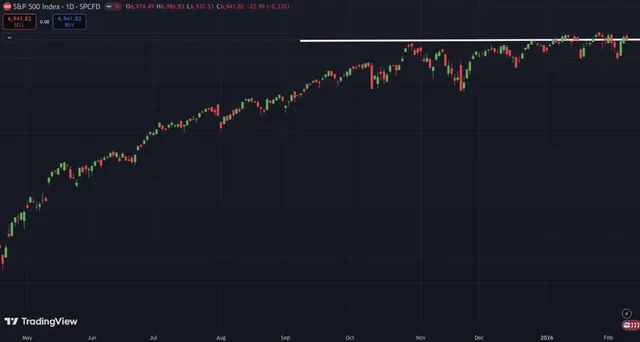
Netflix's latest earnings period reignited a familiar debate: is the streaming giant's slowing growth a genuine warning sign, or a distraction from a business that is still generating record cash and buying back stock at an aggressive pace? The same earnings window also brought updates from SpaceX and Intuitive Surgical, plus a reminder of why hostility-driven market commentary deserves a skeptical read.
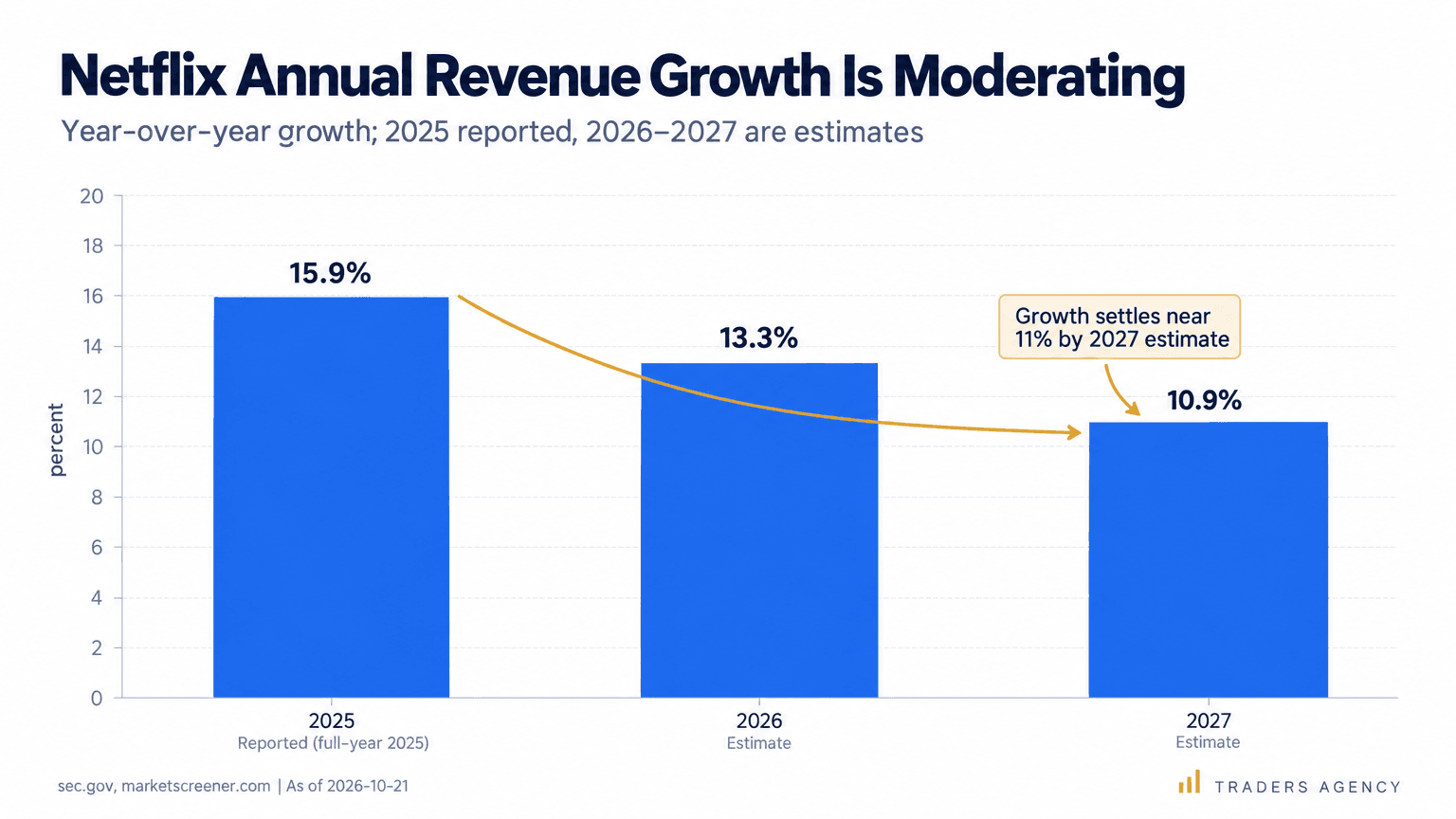
Netflix Annual Revenue Growth Is Moderating
Netflix's quarterly revenue growth reaccelerated after a rough 2022, when price hikes and the ad-supported tier pushed year-over-year growth back above 15%, a level Wall Street tends to reward with premium valuations. That streak has since cooled. In its third-quarter 2026 shareholder letter, Netflix reported 11.8% year-over-year revenue growth, rounded to roughly 12%, and guided toward about 11.5% growth for the fourth quarter. On an annual basis, the company grew revenue by roughly 16% in 2025; current estimates point to growth near 13% in 2026, easing further toward roughly 11% in 2027. That path, from mid-teens growth toward a more moderate low-double-digit pace, is the central concern weighing on the stock, since many investors in today's market treat top-line growth as the dominant signal, sometimes ahead of profitability or cash generation.
Profits, Buybacks and a Messy Comparison Year
Despite slower growth, Netflix's underlying profitability remains strong, though 2026's figures come with an asterisk. Earlier in the year, Netflix recognized a $2.8 billion termination fee tied to its decision not to raise its offer for Warner Bros. Discovery, and that one-time item flowed into other income, lifting first-quarter net income and free cash flow to an unusually high $5.1 billion. Stripping that out, Netflix's third-quarter free cash flow of roughly $2.9 billion appears to be the strongest quarter yet for the underlying business, though Netflix has not formally labeled this a normalized record. Netflix is also repurchasing shares aggressively, with trailing-twelve-month buybacks near $12.9 billion, a pace partly flattered by the one-time cash inflow but still elevated underneath it. A lower share price can actually make a steady buyback program more effective, since fewer dollars are needed to retire each share, increasing remaining shareholders' claim on future earnings, assuming the company keeps repurchasing rather than offsetting those buybacks with new stock-based compensation.
That same Warner Bros. Discovery fee complicates year-over-year earnings-per-share comparisons for 2026. Removing that fee's effect from first-quarter net income, estimated underlying EPS growth comes out closer to 20% annually across 2026 through 2028. That figure is an illustrative estimate built on excluding a one-off item, not guidance Netflix itself has issued, and it depends on assumptions about taxes and comparability that could shift.
Why YouTube's Rise Doesn't Automatically Mean Netflix Loses
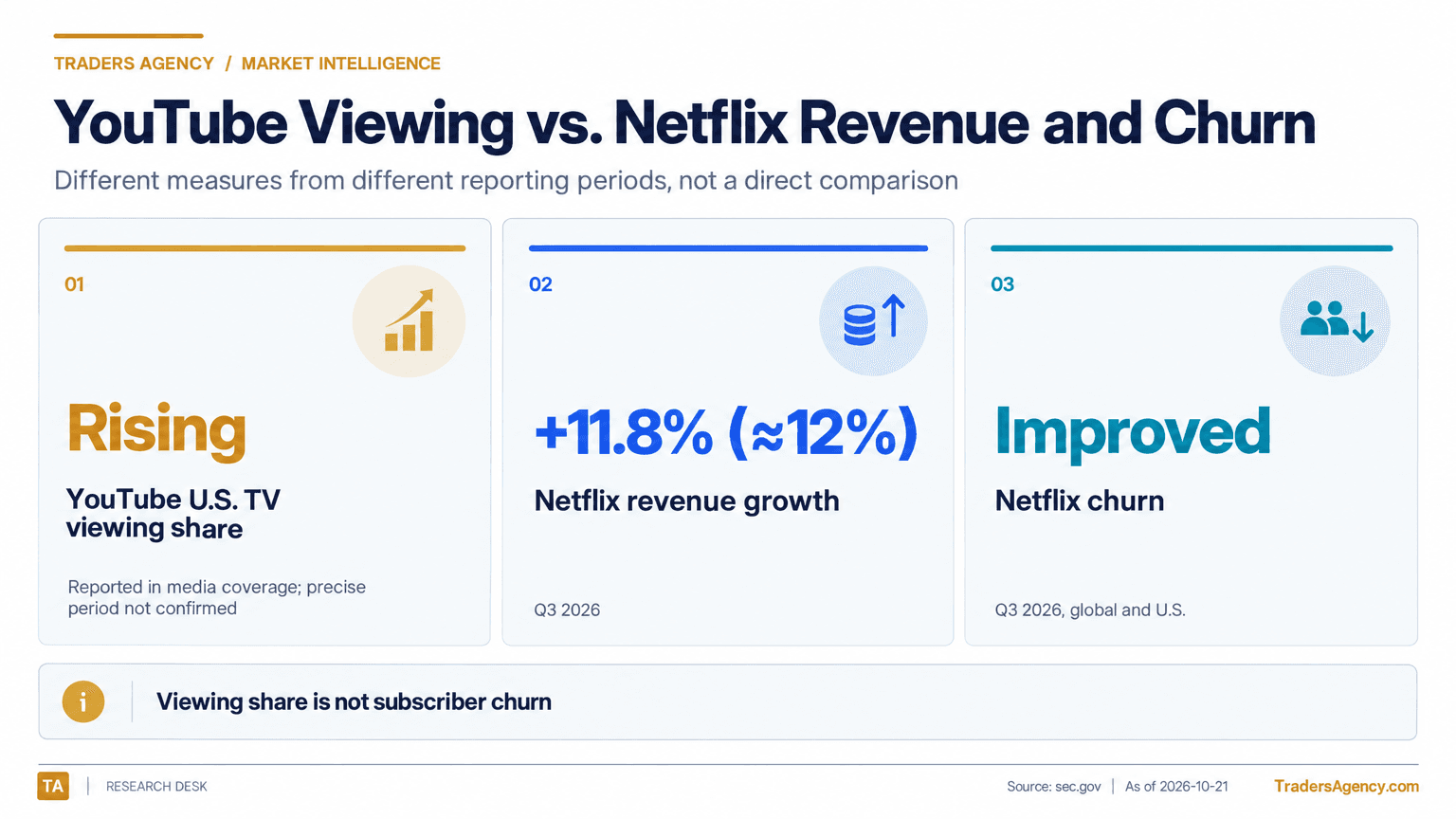
Much of the negative narrative around Netflix in recent quarters traces back to media coverage, including a Wall Street Journal report, showing YouTube's share of US television viewing continuing to climb while Netflix's own viewing time looked comparatively flat. The implied story is that Netflix is losing the attention war. But attention and subscription are not the same thing. Netflix's revenue still grew roughly 12% year over year in the third quarter of 2026, and management said churn, the share of subscribers canceling, actually improved both globally and in the US compared with a year earlier.
The explanation is less mysterious than it sounds. YouTube tends to serve frequent, casual viewing, the kind of content people put on during a commute or lunch break, while Netflix is built around appointment-style storytelling that households watch together or look forward to finishing. A household can expand its YouTube time without canceling Netflix, particularly if even one show makes the monthly subscription feel worthwhile. That doesn't make YouTube irrelevant; it clearly competes for a finite amount of leisure time. But the more decisive factor for Netflix is whether it can consistently produce programming people feel they must see. Earlier breakout hits like Bridgerton, Squid Game and Stranger Things defined prior years of its slate; more recently, comparable global breakouts have been harder to point to, though that assessment is inherently more qualitative than Netflix's churn and revenue figures.
A Content Reset Behind the Leadership Shake-Up
Alongside earnings, reporting around Netflix described a leadership change in its content organization. According to that coverage, longtime content chief Bella Bajaria was removed from her role, with Peter Rice, whose background spans 20th Century Fox, Fox Searchlight and Disney-related television units behind shows such as This Is Us, Abbott Elementary, The Bear and Shogun, taking on a senior creative role. Netflix has not issued a detailed public statement confirming these specifics, so the change should be treated as reported rather than officially confirmed.
The interpretation offered alongside this reporting is that the move signals a push toward more ambitious, prestige-caliber programming rather than a straightforward cost-cutting exercise, given Rice's history with awards-oriented film and television. That reading is plausible but remains an inference rather than a rationale Netflix has stated publicly. Separately, Netflix was reported to be in early talks with two former Warner Bros. executives, Michael DeLuca and Pam Abdi, both associated with hits including One Battle After Another and Weapons. Those discussions were explicitly described as speculative, not confirmed hires, and should be read that way for now.
Want expert trading insights delivered daily?
Join thousands of traders who rely on Traders Agency for market analysis and trade ideas.
Join Traders AgencyValuation: A Lower Multiple With Built-In Skepticism
Netflix's pullback has also compressed its valuation. Around the time of the earnings report, a third-party financial dashboard showed the stock trading near 18.5 times trailing earnings, with a free cash flow yield of roughly 4.2% and a trailing operating margin above 30%. Those figures move daily with the share price and reflect that dashboard's own methodology rather than Netflix's guidance, but they illustrate why some investors see less downside priced into the stock at current levels, with the upside case resting largely on Netflix's ability to return to a steadier cadence of must-watch programming.
SpaceX's Connectivity and AI Growth
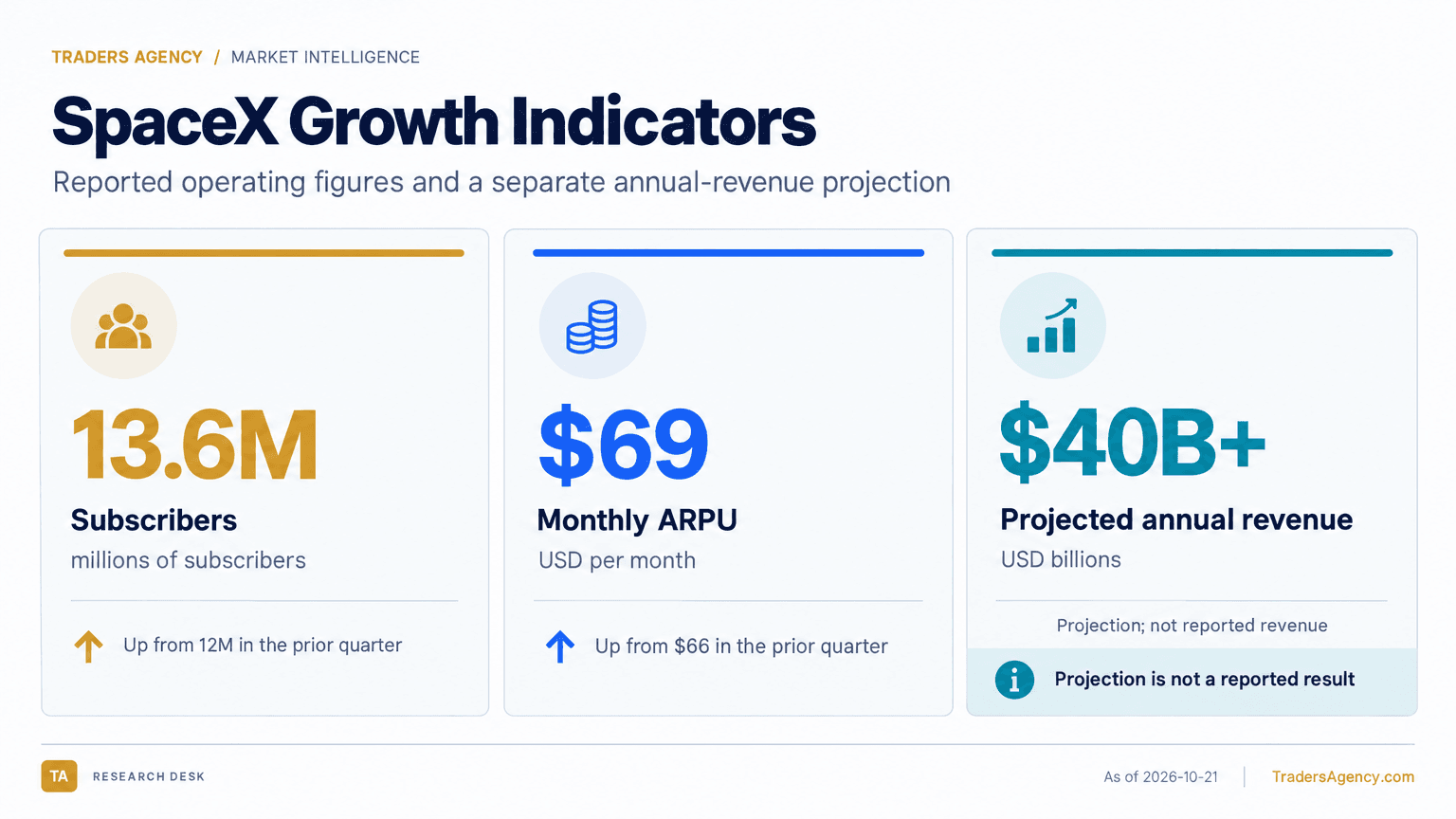
The same earnings window brought an update from SpaceX, which does not publicly disclose audited financials but was described in reporting as having grown quarterly revenue from about $7 billion to $14.5 billion, alongside a forward projection toward $40 billion to $50 billion in annual revenue. Because SpaceX is privately held, these figures cannot be independently verified against a primary filing and should be read as reported detail and a forward-looking projection rather than audited results.
The business was described as splitting into two parts: a profitable satellite-connectivity operation, where subscriber counts reportedly grew from 12 million to 13.6 million in a quarter and monthly revenue per user rose from $66 to $69, and a newer artificial-intelligence infrastructure business built around large server farms. The company's rocket and launch operations were characterized as strategically important but secondary to these two commercial drivers. None of this comes from an audited public filing, so it is best treated as reported detail rather than confirmed segment financials.
Intuitive Surgical's Platform Advantage
Intuitive Surgical, maker of the da Vinci surgical systems, also reported during the period. Its business model extends well beyond hardware: once a system is installed, hospitals and surgeons become customers for replacement instruments, service contracts, upgrades and training, creating switching costs tied to clinical familiarity with the platform. A dashboard tracking the company's trailing-twelve-month results showed revenue growth of roughly 20% over one year and about 21% over two years, alongside real operating leverage. The company has also been lowering prices on some systems in certain markets to gain share, a tradeoff that could pressure near-term margins even as the broader growth trend stays healthy.
When Analysis Is Driven by Animosity
Finally, the period included a notable example of weak analytical process. AI skeptic Ed Zitron published commentary attributing recent increases in RAM and consumer-electronics prices to what he described as an artificially engineered supply shortage, directing pointed criticism at Nvidia's Jensen Huang and other hyperscaler executives. These are Zitron's own attributed claims about supply-chain conduct, not independently established findings.
The more useful takeaway is about process rather than the specific allegation. When commentary is driven primarily by personal hostility toward a company's leadership, it risks becoming an exercise in confirmation bias, where evidence gets selected to support a conclusion reached beforehand rather than tested against it. That critique of tone and motivation does not, on its own, settle the separate and legitimate debate over whether current AI infrastructure spending is a bubble. Investors weighing AI-bear arguments are generally better served separating the economic thesis from the rhetoric surrounding it.
The Bottom Line
Netflix's growth deceleration is real and explains much of the stock's recent pressure, but the company's cash generation, buyback program and underlying earnings trajectory, once the one-time Warner Bros. Discovery item is excluded, remain considerably stronger than the headline growth numbers suggest. The more consequential question for long-term investors is whether Netflix's leadership changes translate into a steadier pipeline of culturally significant programming, since that, more than YouTube's rising viewership, is what will determine whether growth can reaccelerate. Traders Agency analysts will be watching Netflix's next content releases and any further executive confirmations for evidence the reset is working, alongside how SpaceX's AI infrastructure build-out and Intuitive Surgical's market-share push against pricing develop in coming quarters.
Want expert trading insights delivered daily?
Join thousands of traders who rely on Traders Agency for market analysis and trade ideas.
Join Traders AgencyDISCLAIMER: Traders Agency does not offer financial advice. The information provided is for educational purposes only and should not be considered financial advice. Traders Agency is not responsible for any financial losses or consequences resulting from the use of the information provided. Trading carries inherent risks and may not be suitable for all individuals. You are advised to conduct your own research and seek personalized advice before making any investment decisions, recognizing the potential risks and rewards involved.
See more from Traders Agency on Google
Make us a preferred source and our market analysis will appear more prominently in your Google Search, Top Stories, and AI results.
Add to Preferred Sources