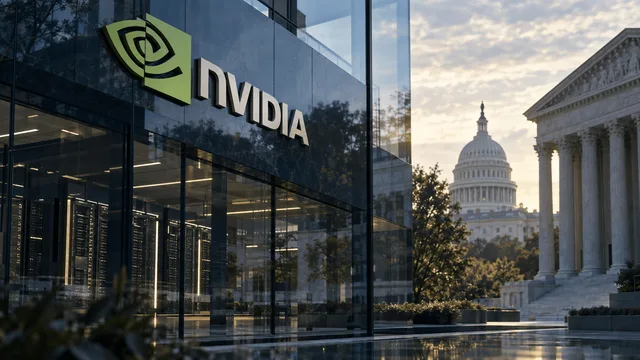
Nvidia closed out another blockbuster quarter with revenue more than doubling year over year, margins near 75 percent, and tens of billions in fresh operating cash flow. At the same time, reports of a Securities and Exchange Commission inquiry into the company’s disclosures have introduced a new layer of uncertainty just as investors try to gauge how long the AI infrastructure buildout can keep accelerating.
A Quarter That Blew Past Expectations
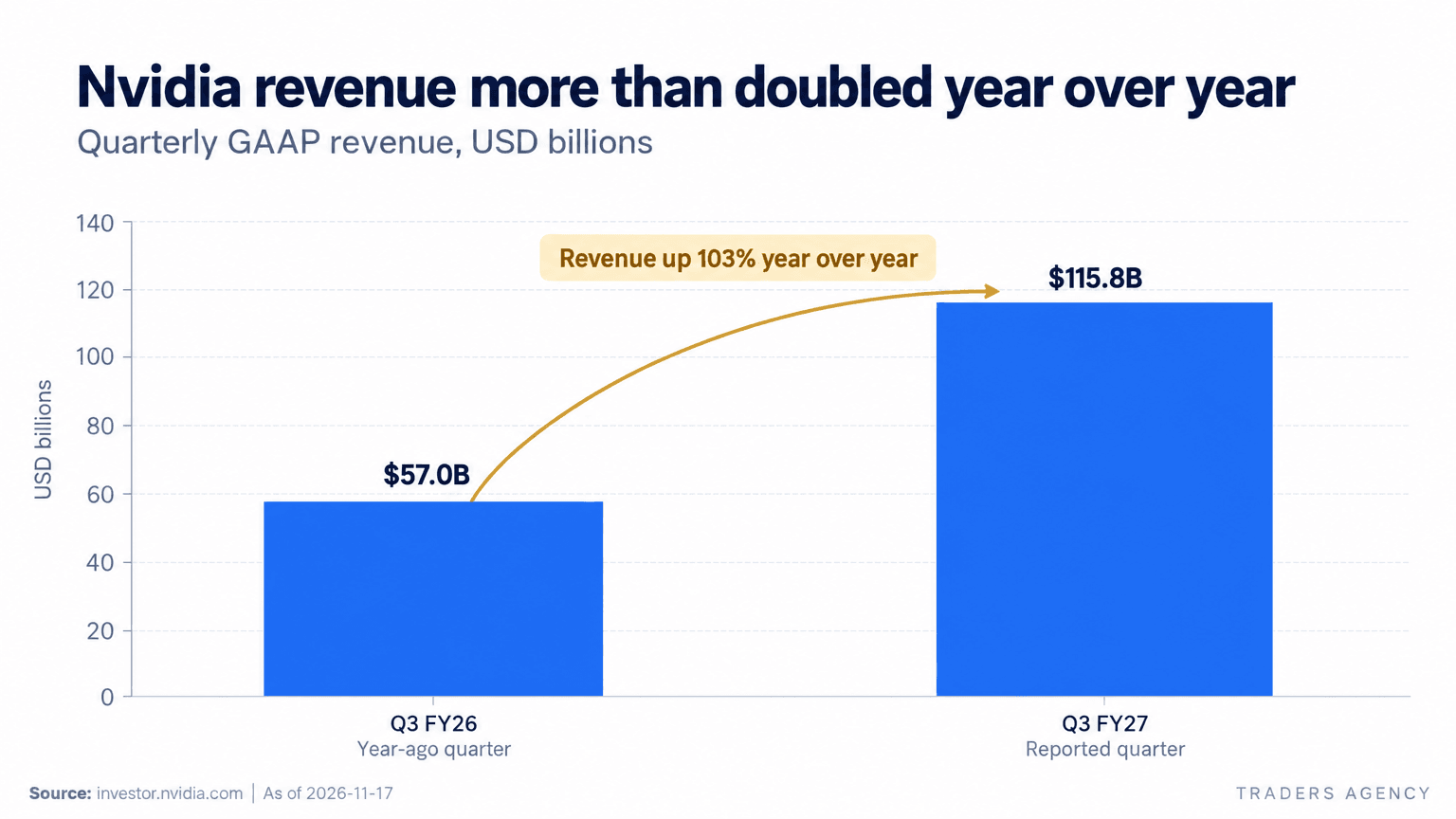
Nvidia reported quarterly revenue of approximately $115.8 billion, up from roughly $57.0 billion in the year-ago period, a gain of about 103 percent. Gross margin came in near 74.8 percent, and operating income rose to roughly $77.5 billion. Operating cash flow for the quarter totaled approximately $48.25 billion, a substantial sum that underscores how much cash the AI chip cycle is generating for the company in real time.
Those figures point to a business that is scaling revenue faster than it is scaling costs, a dynamic that typically signals strong demand and solid execution. Cost of revenue rose about 92.4 percent year over year, while GAAP operating expenses, which include research and sales, grew a comparatively modest 56.8 percent. The gap between revenue growth and expense growth is the clearest evidence of operating leverage in the release.
Pricing Power Claim Deserves a Closer Look
It is tempting to read that gap as straightforward pricing power, the idea that Nvidia is simply charging more for the same chips. That interpretation is plausible but not the full story. Nvidia’s own management has attributed the year’s gross-margin improvement largely to a shift in product mix toward higher-value systems, rather than price increases on existing products. Operating leverage is well supported by the numbers; pricing power in the sense of charging more for comparable products is a more debatable inference.
A useful point of comparison raised in discussions of this earnings season is Ubiquiti, a networking hardware company whose revenue has reportedly grown faster than its cost of goods sold even as memory and component costs have risen industry-wide. No precise figures were available for that comparison, so it should be read as a qualitative data point rather than a matched benchmark, but it illustrates that Nvidia is not alone among hardware companies managing rising input costs while still expanding margins.
Demand Visibility: $390 Billion in Commitments
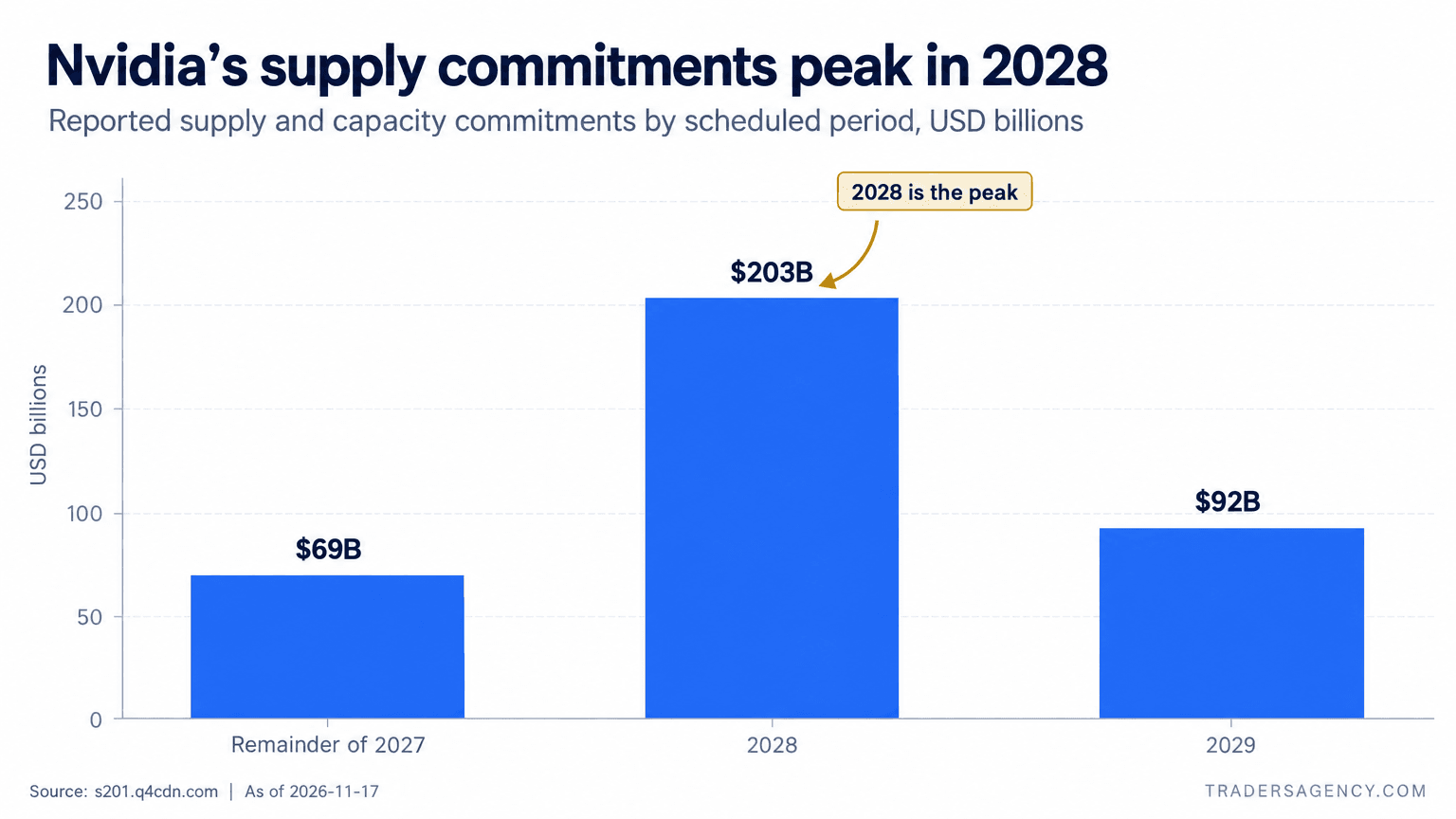
The headline figure drawing the most attention is Nvidia’s total supply and capacity commitments, which rose from $279 billion in the prior quarter to roughly $390 billion as of October 25, 2026, an increase of nearly 40 percent in a single quarter. That schedule extends through fiscal 2032 and beyond, not simply through 2030, and breaks down into approximately $69 billion for the remainder of fiscal 2027, $203 billion in fiscal 2028, $92 billion in fiscal 2029, and smaller amounts tapering into the early 2030s.
It is worth being precise about what these numbers represent. Supply and capacity commitments are procurement obligations scheduled across multiple years, not recognized revenue and not guaranteed customer orders. They reflect Nvidia’s own plans to secure chip production and data-center capacity, which is a meaningful signal of expected demand but not proof that demand will materialize on schedule. The operative question, as several analysts following the AI buildout have framed it, is whether enough data centers can actually be constructed fast enough to absorb the chips Nvidia is committing to produce. Traders Agency analysts will be watching construction and deployment timelines from major cloud providers as a check on whether this commitment growth converts into delivered, revenue-generating capacity.
Want expert trading insights delivered daily?
Join thousands of traders who rely on Traders Agency for market analysis and trade ideas.
Join Traders AgencyBalance Sheet Strength, With Caveats
Nvidia’s balance sheet remains unusually strong for a company of its size. At quarter end, cash, cash equivalents, marketable securities and net receivables totaled approximately $178.8 billion, against total liabilities of $105.5 billion and reported debt of $32.4 billion. That is a comfortable cushion, though it is worth noting that the $178.8 billion figure blends several distinct balance-sheet categories rather than representing pure cash on hand, and the $105.5 billion in total liabilities is a broader figure than debt alone.
On the investing side, Nvidia purchased roughly $15.7 billion of equity securities and $11.4 billion of debt securities during the quarter. A comparison sometimes drawn against a prior $21.8 billion debt-security purchase figure is not quite apples to apples, since that earlier number covers the first six months of the fiscal year rather than a single prior quarter. Even accounting for that, it is plausible that Nvidia’s pace of debt-security buying has slowed, which could reflect fewer attractive opportunities, rising borrowing costs across the market, or simply a shift in capital allocation. None of those explanations is inherently negative, but the trend is worth watching as a signal of how the broader AI financing ecosystem is evolving.
Vera Rubin and the Race to Keep the Infrastructure Lead
Nvidia’s next-generation Vera Rubin CPU-and-GPU platform began shipping in the quarter, and the company describes it as its fastest product ramp to date. Maintaining that pace matters competitively, since staying ahead on performance is central to Nvidia’s pricing position in AI infrastructure. The company also highlighted deployments and collaborations spanning CoreWeave, Google Cloud, Microsoft Azure, Oracle, Meta and Anthropic, along with forthcoming capacity tied to SpaceXSI. A separate collaboration with Palantir integrates customized Nemotron open models into a sovereign-AI supply-chain stack that initially serves Nvidia’s own operations. These partnerships support the narrative of broad-based demand, though the distinction between announced collaborations and fully realized revenue-generating deployments is not always clear from public disclosures.
The SEC Inquiry: What’s Actually at Stake
Alongside the earnings beat, reports from the Wall Street Journal indicate that the SEC has opened a civil inquiry examining whether Nvidia’s investor disclosures complied with applicable requirements. It is important to understand what that kind of inquiry typically evaluates. The SEC generally does not judge whether an investment turned out to be profitable; its focus is on whether a company adequately disclosed material facts and conflicts of interest to investors. Nvidia’s own filings already contain standard risk-factor language warning that employees, contractors, suppliers, customers or agents could violate applicable laws or internal controls, exposing the company to fines or reputational harm. That language is boilerplate common to many large filers and does not by itself establish that it addresses the specific matter under review.
The inquiry also surfaces alongside media reports touching on leadership-transition questions at Nvidia, a detail the available reporting does not fully clarify. Until the scope, subject and status of the SEC inquiry are confirmed through official channels, it is best treated as an open reporting thread rather than a resolved finding of any kind.
Macro Crosscurrents: China Policy and Anthropic’s IPO
Two additional developments could shape sentiment around the broader AI trade in the near term. Chinese chip export restrictions remain a live policy issue, and one scenario floated is that tighter curbs could push China-based demand toward leasing capacity from U.S. hyperscalers instead, though that outcome depends on export-control enforcement and legal access that remain uncertain. Separately, Anthropic’s expected public offering is drawing attention as a gauge of investor appetite for AI-native companies beyond the chip layer itself. Both developments are catalysts worth tracking, but neither has resolved in a way that allows for confident forecasting.
The Bottom Line
Nvidia’s quarter shows a company firing on nearly every operational cylinder: rapid revenue growth, expanding margins, strong cash generation and a record pipeline of supply commitments stretching into the next decade. None of that resolves the harder questions investors still face, namely whether data-center construction can keep pace with chip output, how a slower pace of debt-security investment might ripple through AI financing, and what a reported SEC inquiry into disclosure practices could eventually reveal. The fundamentals argue for continued demand strength. The unresolved items argue for patience before assuming the path forward is free of friction.
Want expert trading insights delivered daily?
Join thousands of traders who rely on Traders Agency for market analysis and trade ideas.
Join Traders AgencyDISCLAIMER: Traders Agency does not offer financial advice. The information provided is for educational purposes only and should not be considered financial advice. Traders Agency is not responsible for any financial losses or consequences resulting from the use of the information provided. Trading carries inherent risks and may not be suitable for all individuals. You are advised to conduct your own research and seek personalized advice before making any investment decisions, recognizing the potential risks and rewards involved.
- NVIDIA Announces Financial Results for Third Quarter Fiscal 2027
- Supplemental Financial Information — Quarter Ended October 25, 2026
- CFO Commentary on Third Quarter Fiscal 2027 Results
- NVIDIA Form 10-Q — Second Quarter Fiscal 2027
- SEC is probing Nvidia amid departure of CEO Jensen Huang
- NVIDIA and Palantir Bring Sovereign Intelligence to Critical Supply Chains
- Anthropic, PBC — Form S-1/A, November 17, 2026
- Kalshi Research — AI and Data Centers
See more from Traders Agency on Google
Make us a preferred source and our market analysis will appear more prominently in your Google Search, Top Stories, and AI results.
Add to Preferred Sources