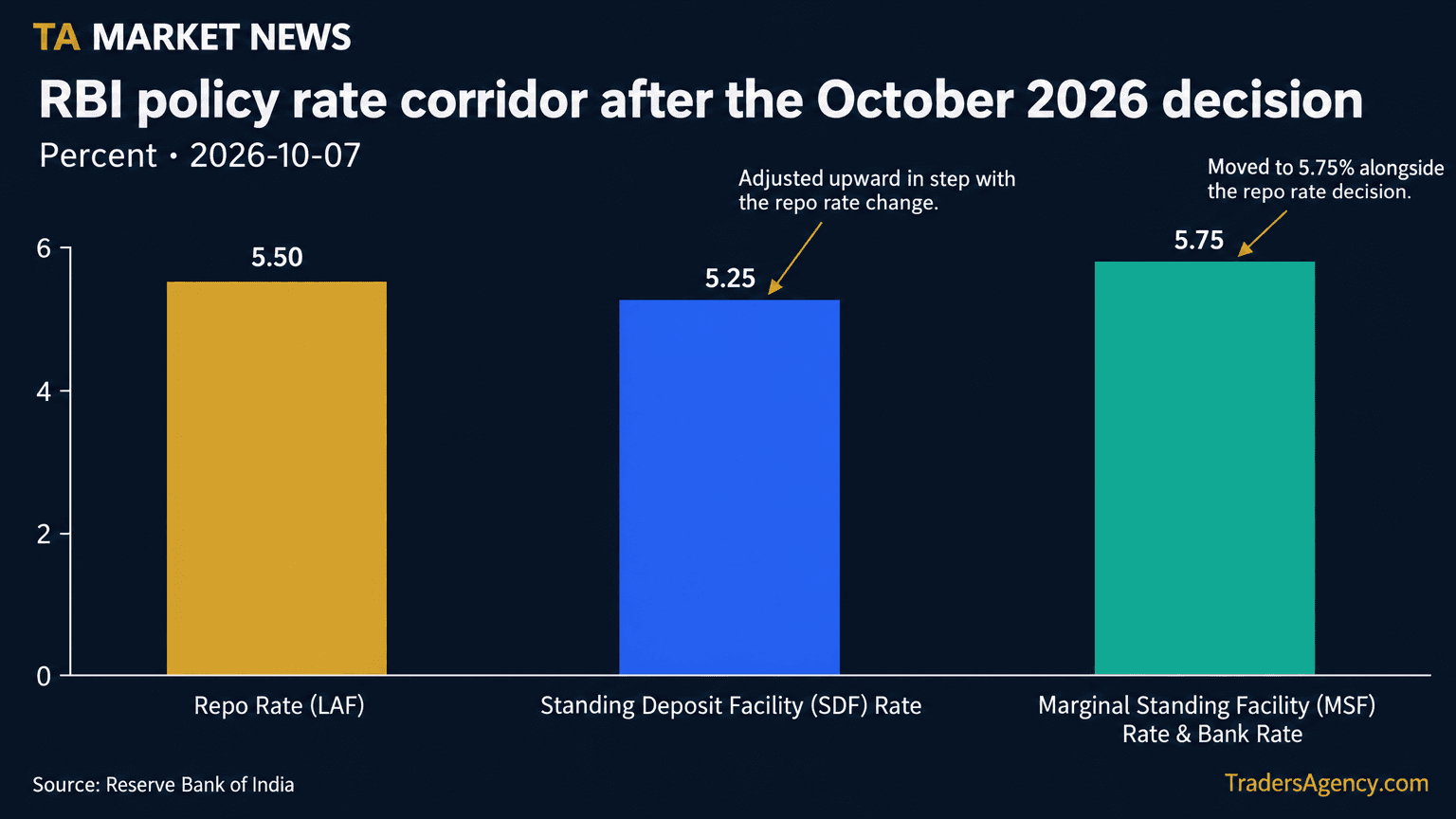
The Reserve Bank of India's Monetary Policy Committee voted unanimously on October 7, 2026 to raise the policy repo rate by 25 basis points to 5.50%, the central bank's first rate increase since 2023, and changed its policy stance to "calibrated tightening," according to the Reserve Bank of India. The standing deposit facility rate was adjusted to 5.25%, and the marginal standing facility rate and Bank Rate moved to 5.75%, the RBI said.
CNBC reported the move was in line with expectations from economists polled by Reuters and took the repo rate to a one-year high.
Why the RBI Moved
The hike follows a run of hotter inflation readings. CPI inflation rose to 4.8% in August 2026 from 4.5% in July, the central bank said, a level above the RBI's medium-term target of 4%, according to CNBC, which also noted that retail inflation has now risen for ten straight months. The RBI also flagged that price pressures are broadening: core inflation rose to 4.2% in August, or 2.9% excluding precious metals, and the weighted share of headline CPI items with inflation above 4% climbed to about 37%.
Even so, the RBI said the evidence of entrenched pressure remains mixed, noting "only limited signs of supply side pressures getting embedded in pricing behaviour" and "limited evidence of demand side pressures," while cautioning that strong growth in monetary and credit aggregates still poses risks, per the central bank's resolution.
Governor Sanjay Malhotra framed the decision by pointing to growth resilience alongside firmer price pressure, saying "inflation and its outlook are not benign, as they were last year," according to CNBC and language echoed in the MPC's own resolution, which cited headline CPI inflation expected to average almost 5.8% over the next three quarters.
Growth and Inflation Projections
The RBI projects CPI inflation at 5.2% for 2026-27, with quarterly readings of 4.9% in Q2, 6.0% in Q3 and 5.7% in Q4, before easing to 5.6% in the first quarter of 2027-28. The central bank described the risks to that path as evenly balanced. Core inflation is projected at 4.4% for 2026-27.
On growth, the RBI projects real GDP expansion of 7.1% for 2026-27, with Q2 at 7.2%, Q3 at 6.9% and Q4 at 6.8%, and 7.1% again in the first quarter of 2027-28, also with risks evenly balanced. The central bank's projection follows an unexpectedly strong first quarter: real GDP grew 7.8% in Q1 of 2026-27, supported by private consumption, fixed investment and a rebound in merchandise exports, according to National Statistics Office estimates cited by the RBI.
CNBC reported that the growth estimate was raised by 40 basis points to 7.1%, which the outlet attributed to resilient economic activity, even as the central bank flagged protracted geopolitical tensions, trade frictions, tighter financial conditions and elevated commodity prices as headwinds.
'Hike or Pause': Malhotra on the Path Ahead
Malhotra was explicit about what the stance shift does and does not signal. "Given the current conditions, rate cuts are off the table in the near term, and policy action ahead can only be a rate hike or a pause," he said, according to CNBC, in language that matches the RBI's own statement. The MPC added that the duration and extent of any further tightening "would be contingent on the actual growth-inflation developments and outlook, especially that of underlying inflation, the extent of broadening of price pressures and second round effects of the supply shock, as also the impact of demand impulses," per the central bank.
While the rate decision itself was unanimous, two MPC members, Dr. Nagesh Kumar and Prof. Ram Singh, favored keeping the stance at neutral rather than shifting to calibrated tightening, the RBI disclosed.
Market Reaction
Markets moved modestly after the decision. The benchmark 10-year Indian government bond yield rose 5 basis points to 7.243%, while the Nifty 50 index fell 0.7%, CNBC reported.
External Pressures and Outside Expectations
The RBI's resolution cited the re-escalation of conflict in West Asia and resulting crude oil price volatility as a source of global uncertainty since the August meeting. CNBC noted India imports nearly 85% of its fuel needs, making it among the economies most exposed to supply disruptions tied to the conflict. The RBI also flagged a deficient south-west monsoon and strong El Niño conditions as risks to agriculture and rural demand, though it said a healthy buffer of foodgrains and government policy interventions should help offset the impact.
Separately, the World Bank said in a Tuesday report, as cited by CNBC, that India had its fourth-driest June-August period since 1960, which could push food prices higher, and projected India's growth would slow to 7.1% in the financial year ending March 2027 from 7.8% the prior year.
The RBI's resolution also pointed to a broader global tightening backdrop: the U.S. Federal Reserve raised rates by 25 basis points in September, and the RBI said tightening by other major central banks has reinforced expectations of higher global policy rates, with global bond yields at record highs. CNBC separately reported that the Bank of Japan raised rates to a 31-year high and that South Korean and European central banks have also hiked in the past two months.
Looking ahead, HSBC and Goldman Sachs expect the RBI to raise rates again in December, according to CNBC. HSBC said in a Monday report that markets need to see a "credible" hike demonstrating the RBI's ability to keep raising rates to contain inflation, warning that a move perceived as dovish amid rising inflation would hurt India's standing with global investors, CNBC reported.
The RBI said the minutes of the October meeting will be published on October 21, 2026, and that the next MPC meeting is scheduled for December 2 to 4, 2026.
Bottom Line
The RBI's first hike since 2023 reflects a central bank responding to ten straight months of rising inflation and broadening price pressures, even as it keeps its growth outlook firm at 7.1% for the current fiscal year. Governor Malhotra's framing that policy can now only move toward a hike or a pause, not a cut, sets a more hawkish baseline heading into December, when outside forecasters including HSBC and Goldman Sachs are already penciling in another increase. With two MPC members still preferring a neutral stance, how firmly the committee holds this tightening bias in the face of geopolitical and monsoon-related risks will be a key signal to watch at the next meeting.
DISCLAIMER: Traders Agency does not offer financial advice. The information provided is for educational purposes only and should not be considered financial advice. Traders Agency is not responsible for any financial losses or consequences resulting from the use of the information provided. Trading carries inherent risks and may not be suitable for all individuals. You are advised to conduct your own research and seek personalized advice before making any investment decisions, recognizing the potential risks and rewards involved.
- CNBC Top News: India’s central bank hikes rates for the first time since 2023 as inflation risks build · accessed Oct 7, 2026
- Reserve Bank of India: Official Website of Reserve Bank of India · accessed Oct 7, 2026
See more from Traders Agency on Google
Make us a preferred source and our market analysis will appear more prominently in your Google Search, Top Stories, and AI results.
Add to Preferred Sources