
The U.S. economy expanded at a 3.4% annual rate in the third quarter of 2026, accelerating from 2.2% growth in the second quarter, according to the advance estimate released by the U.S. Bureau of Economic Analysis. The pickup was driven by stronger consumer spending and a sharp rise in business investment, even as housing continued to struggle under high mortgage rates.
Consumer Spending and Investment Lead the Advance
Consumer spending rose at a 3.8% pace in the third quarter, according to reporting by WSLS, which also reported that business investment, excluding housing, climbed 12.7%. The BEA's own release identifies investment, consumer spending, and government spending as the main contributors to the quarter's growth, partly offset by a decline in exports, while imports, which subtract from GDP, also rose.
Real final sales to private domestic purchasers, which the BEA defines as the sum of consumer spending and gross private fixed investment, increased 4.9% in the third quarter, up from 4.6% in the second quarter, per the BEA. Because the measure excludes trade, inventories and government spending, it is often watched as a cleaner read on underlying private domestic demand.
Where the Investment Dollars Went
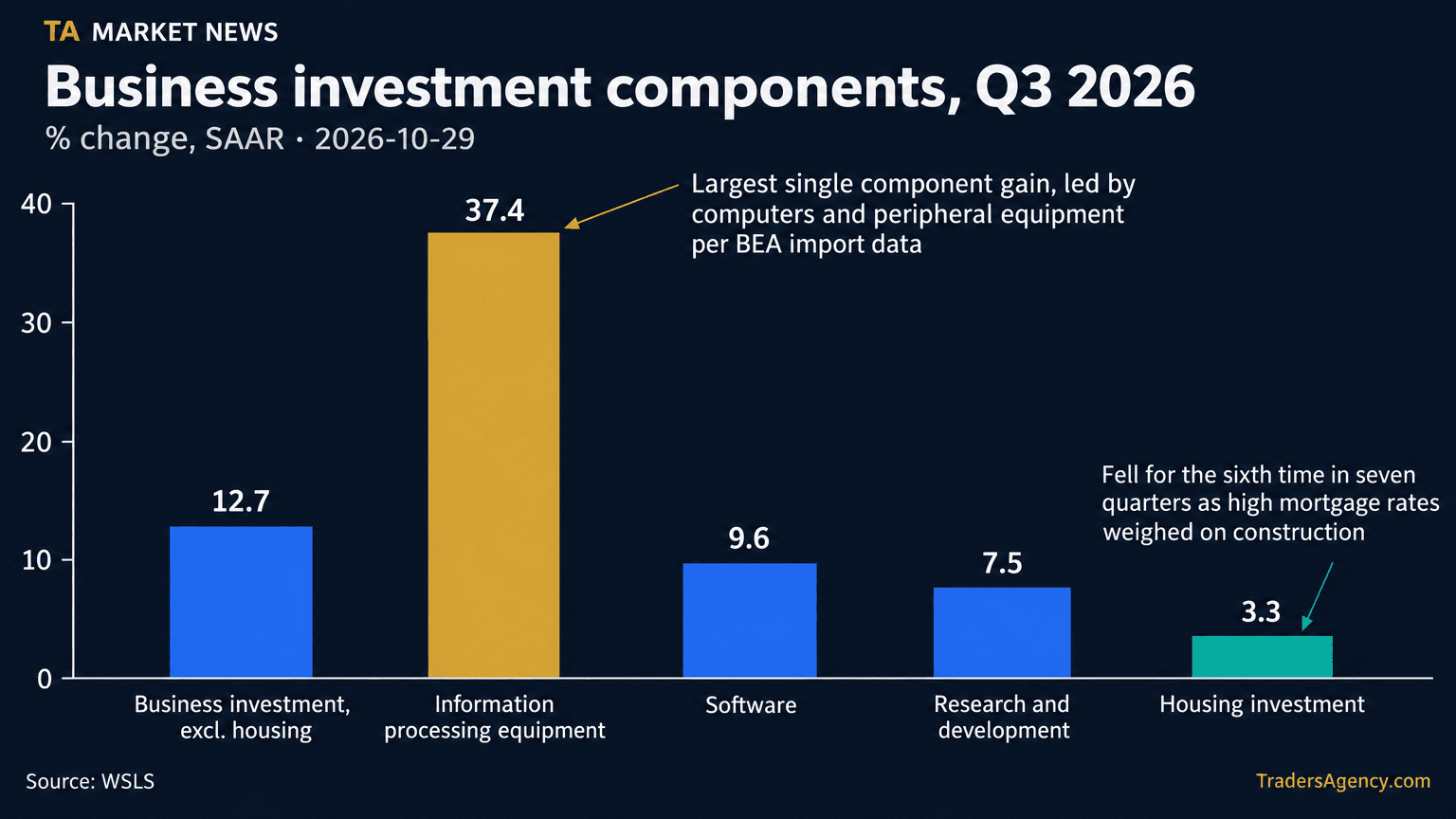
Within the investment surge, WSLS reported that information processing equipment investment jumped 37.4%, software investment rose 9.6%, and research and development spending increased 7.5%. Housing investment told a different story, falling 3.3% and marking the sixth decline in the last seven quarters, which WSLS attributed to the continued drag of high mortgage rates.
- Business investment, excluding housing: +12.7%
- Information processing equipment: +37.4%
- Software: +9.6%
- Research and development: +7.5%
- Housing investment: -3.3%
WSLS's reporting framed the investment strength as reflecting an "AI investment boom." The BEA's own technical notes offer a more granular, and narrower, explanation: the agency states that the increase in investment primarily reflected private inventory investment and equipment spending, with the largest contributors to inventory growth coming from wholesale trade and manufacturing, led by nondurable goods industries, based on Census Bureau inventory data. Within equipment, the BEA attributes the increase to information processing equipment, mainly computers and peripheral equipment, based primarily on import data. The agency's release does not single out artificial intelligence data centers or semiconductor capital expenditure as a distinct line item. That distinction matters for readers trying to gauge how much of the quarter's investment strength is specifically AI infrastructure build-out versus a broader rebound in equipment and inventory spending; the available data supports strong growth in computer and information-processing equipment, but not a precise breakdown of AI-specific versus general technology capex.
Inflation Measures Cooled From the Second Quarter
Price pressures eased relative to the prior quarter. The personal consumption expenditures (PCE) price index rose 2.1% in the third quarter, down sharply from 5.0% in the second quarter, the BEA reported. Core PCE, which excludes food and energy, increased 2.5%, down from 3.3% in the prior quarter. The price index for gross domestic purchases rose 3.0%, compared with 5.6% in the second quarter. Current-dollar GDP, which is not adjusted for inflation, increased 5.6% in the third quarter.
Interpretation: the pairing of faster real growth with slower quarterly price gains — real GDP at 3.4% against a 2.1% PCE price index reading, versus 2.2% and 5.0% respectively in the second quarter — is an unusual combination within a single report. The BEA release is a statistical publication and does not offer commentary on policy implications.
Resilience Amid Energy Price Pressure
WSLS's reporting characterized the U.S. economy, which it described as the world's largest, as having proven resilient in the face of higher energy prices tied to fighting involving Iran. That characterization comes from WSLS's own reporting rather than from the BEA's official release.
An Advance Estimate, With More Data to Come
Thursday's release was the first of three scheduled government estimates of third-quarter growth. The BEA's advance estimate will be followed by a second estimate, which will include corporate profits data, scheduled for release on November 25, 2026. As with any advance estimate, the headline 3.4% growth figure, along with the investment and spending components beneath it, is subject to revision as more complete source data becomes available in the weeks ahead. Readers should treat today's figures as an initial read rather than a final accounting of the quarter.
Bottom Line
The third-quarter advance estimate shows an economy that accelerated on the back of robust consumer spending and a notable jump in business investment, particularly in information-processing equipment, even as housing investment continued to contract and inflation measures moderated from the second quarter's pace. The degree to which the investment gains reflect artificial intelligence infrastructure specifically, as opposed to a broader equipment and inventory rebound, is not fully resolved by the BEA's own data breakdown. With two more GDP estimates still to come for this quarter, the current 3.4% figure remains a first look rather than a settled number.
DISCLAIMER: Traders Agency does not offer financial advice. The information provided is for educational purposes only and should not be considered financial advice. Traders Agency is not responsible for any financial losses or consequences resulting from the use of the information provided. Trading carries inherent risks and may not be suitable for all individuals. You are advised to conduct your own research and seek personalized advice before making any investment decisions, recognizing the potential risks and rewards involved.
- WSLS: US economy grows at brisk 3.4% pace in third quarter on strong consumer spending and AI investment · accessed Oct 29, 2026
- U.S. Bureau of Economic Analysis: GDP (Advance Estimate), 3rd Quarter 2026 · accessed Oct 29, 2026
- U.S. Bureau of Economic Analysis: Gross Domestic Product · accessed Oct 29, 2026
- U.S. Bureau of Economic Analysis: GDP (Advance Estimate), 3rd Quarter 2026 · accessed Oct 29, 2026
See more from Traders Agency on Google
Make us a preferred source and our market analysis will appear more prominently in your Google Search, Top Stories, and AI results.
Add to Preferred Sources