The Office of the U.S. Trade Representative has determined that the acts, policies and practices of 14 economies relating to "structural excess capacity and production in manufacturing sectors" are unreasonable and burden or restrict U.S. commerce, and has proposed responsive Section 301 tariff actions for public comment. CNBC reported that the proposed rates mostly range from 15% to 20%; USTR's own release sets the highest proposed default rate at up to 35%, for Vietnam. The 14 economies named are China, the European Union, Singapore, Switzerland, Indonesia, Malaysia, Cambodia, Thailand, Korea, Vietnam, Taiwan, Bangladesh, Japan and India, according to a USTR press release.
What USTR Determined
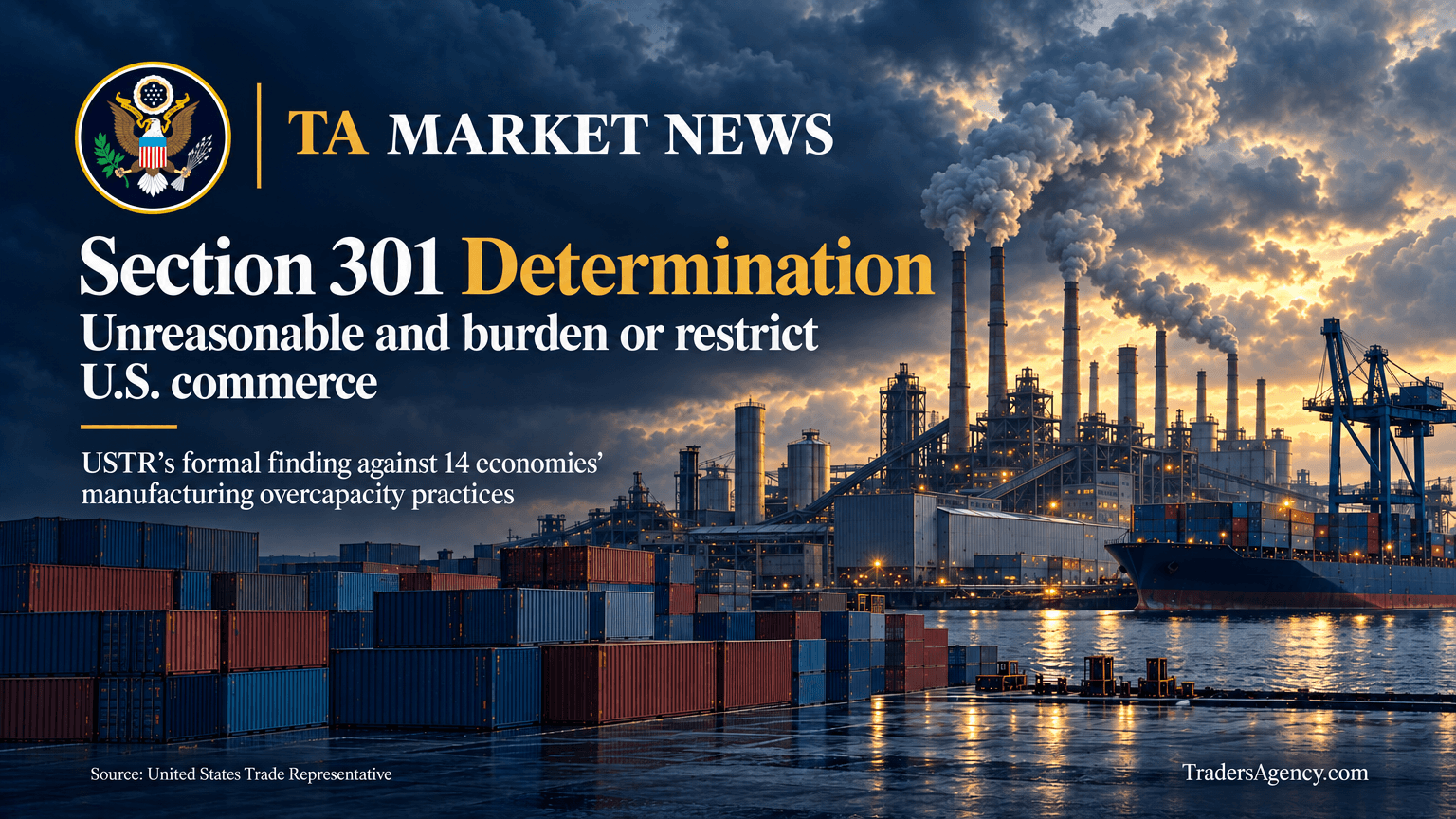
U.S. Trade Representative Jamieson Greer determined under Section 301 of the Trade Act of 1974 that the practices of the 14 economies related to manufacturing overcapacity are actionable under Section 301(b) of the statute, USTR said. The agency is now proposing responsive tariff actions and opening them to public comment before any duties take effect.
USTR said it received testimony from nearly 140 witnesses and 1,070 written comments during the public process, which covered all 16 economies originally investigated.
Country-Specific Proposed Rates
The proposed rates vary by economy and are structured to account for duties already in place. For Japan, USTR proposed tariffs of up to 15%, described as net of most-favored-nation rates and existing Section 301 tariffs, with exemptions for certain products; USTR said this accounts for other existing Section 301 and Section 232 duties, ongoing consultations with Japan, and commitments under the U.S.-Japan framework agreement.
For China, USTR proposed tariffs of up to 20%, net of the rate already applied under the separate Section 301 forced-labor investigation, on goods not identified in specific annexes to the relevant Federal Register notice, and up to 10% on goods identified in a separate annex, with exemptions for certain other goods. USTR said this proposal accounts for the 20% tariff commitments from the Kuala Lumpur Joint Arrangement reached by President Trump and President Xi Jinping on October 30, 2025.
Vietnam faces a proposed default rate of up to 35%, net of existing Section 301 tariffs, with exemptions for certain goods, according to USTR. That rate could fall to 20% if Vietnam reaches an Agreement on Reciprocal Trade with the United States that is responsive to the determinations in the investigation. India's proposed default rate is up to 25%, net of existing Section 301 tariffs, with exemptions for certain goods, but could be reduced to 17% under a similar negotiated agreement. USTR said Singapore's proposed default rate could also be lowered if it reaches a negotiated Agreement on Reciprocal Trade.
Timeline for Comment and Implementation
Written comments on the proposed actions are due by January 5, 2027, USTR said, and the agency will hold hearings on the proposals starting January 25, 2027, continuing as appropriate. USTR has not announced a date when any of the proposed tariffs would take effect.
U.S. Trade Representative Jamieson Greer told CNBC that the new tariffs likely will not take effect for months and that he views the policy as largely "baked in" after discussions with trading partners. "I think a lot of this is baked in, and I don't think any of these would actually take effect earlier than a couple months from now," Greer said, according to CNBC.
How the New Duties Interact With Existing Tariffs
Greer told CNBC the new rates are "not really additive" and generally will not stack on top of existing duties, instead functioning as a limited addition. "In effect, it'll look more like a top up," Greer said, per CNBC. "When it all nets out, it really will just top up a few percentage points."
That framing is consistent with the "net of" language USTR used for Japan, China, Vietnam and India, which explicitly subtracts existing Section 301, Section 232 or MFN duties from the proposed new rate rather than layering a flat new tariff on top.
China is a partial exception. A senior U.S. official told CNBC that the new 20% China rate will come on top of separate forced-technology-transfer-related tariffs of roughly 25% implemented during Trump's first term, bringing total U.S. tariffs on Chinese goods to about 45%, give or take for different goods. That combined figure is the official's own characterization as reported by CNBC, not an independent calculation.
CNBC also reported that the overcapacity levies are being imposed under Section 301 of the Trade Act of 1974, the same statute the administration used to launch separate investigations into 60 economies over alleged forced-labor issues, which led to broad tariffs of 10% to 12.5% on goods from dozens of countries covering 99.4% of U.S. imports. CNBC further reported that shortly after the Supreme Court's ruling, Trump invoked Section 122 of the Trade Act to impose a 10% global tariff that expired after 150 days and was immediately replaced with the forced-labor-related duties, and that an ongoing lawsuit accuses the administration of citing forced-labor issues as a "pretext" in pursuit of reviving Trump's worldwide tariff regime. Ahead of the official reports' release, China's foreign ministry disputed the overcapacity allegations, saying the "so-called 'overcapacity' does not really exist," according to CNBC. Bottom line: these remain proposals, not effective duties, with written comments due January 5, 2027, hearings scheduled to begin January 25, 2027, and no implementation date announced.
DISCLAIMER: Traders Agency does not offer financial advice. The information provided is for educational purposes only and should not be considered financial advice. Traders Agency is not responsible for any financial losses or consequences resulting from the use of the information provided. Trading carries inherent risks and may not be suitable for all individuals. You are advised to conduct your own research and seek personalized advice before making any investment decisions, recognizing the potential risks and rewards involved.
- CNBC Top News: U.S. unveils new Section 301 tariffs targeting China, EU and others · accessed Nov 25, 2026
- United States Trade Representative: USTR Makes Determinations and Proposes Actions in 14 Section 301 Investigations Relating to Structural Excess Capacity and Production in Manufacturing Sectors | United States Trade Representative · accessed Nov 25, 2026
See more from Traders Agency on Google
Make us a preferred source and our market analysis will appear more prominently in your Google Search, Top Stories, and AI results.
Add to Preferred Sources