Any idiot can make investing complicated. Making it simple — that takes real genius.
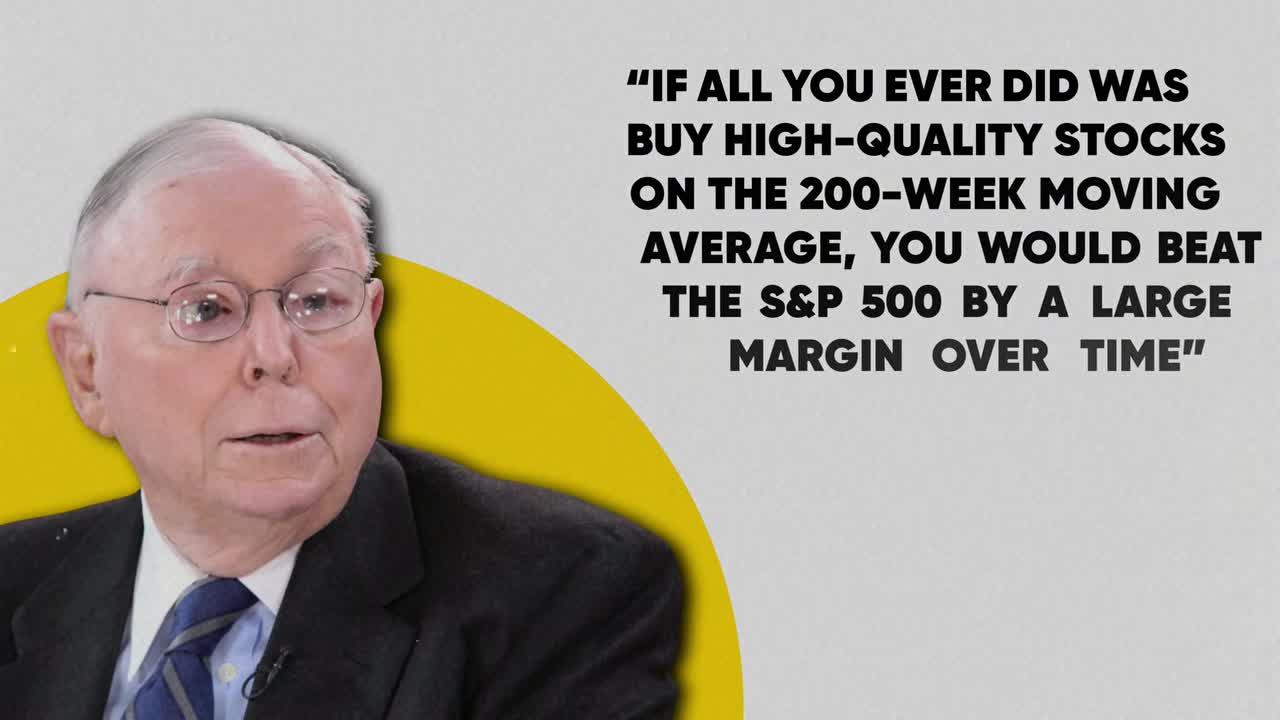
Charlie Munger was Warren Buffett’s best friend and business partner for more than 47 years. He joined Berkshire Hathaway in 1978 as Buffett’s number two and transformed the company from a failing textile mill into a $780 billion conglomerate. During one of their annual shareholder meetings, Munger delivered a single sentence that revealed exactly how to outperform the stock market using one simple strategy.
Most people ignore this because they want a complex system. They want algorithms and high-frequency trading models. But the real secret to beating the indexes for decades relies on a single, highly disciplined technical rule.
What Is Charlie Munger’s 200-Week Moving Average Strategy?
Munger was famous for his blunt, no-nonsense approach. A master at simplifying investment decisions.
Before Munger’s heavy influence, Buffett’s firm operated much differently. They followed a strategy taught by Buffett’s mentor — buying broken companies on the cheap. They called these “cigar butt investments.” You find a discarded company with one last puff of value, buy it for pennies, and extract whatever is left.
Munger changed all of that. He transformed Buffett’s approach into one that bought wonderful businesses at fair prices — businesses they could hold forever. The duo was known for deep fundamental research, famously disciplined about only buying stocks trading at low multiples of sales and earnings.
But the strategy Munger shared? It’s a technical one.
The Buy Signal: 200-Week Moving Average
Munger advises buying on the 200-week moving average. If you’re not familiar with moving averages, they’re straightforward. Take the closing price of a stock each week for the last 200 weeks, add them up, divide by 200. That’s it — the average price over roughly four years.
Take Nvidia as an example. It trades for $177 a share. The 200-week moving average sits all the way down at $89 a share — roughly half the current price. This is not a buying opportunity you see very often. It reflects a stock trading well off its highs, one that has endured some form of temporary hardship and is selling at a steep discount.
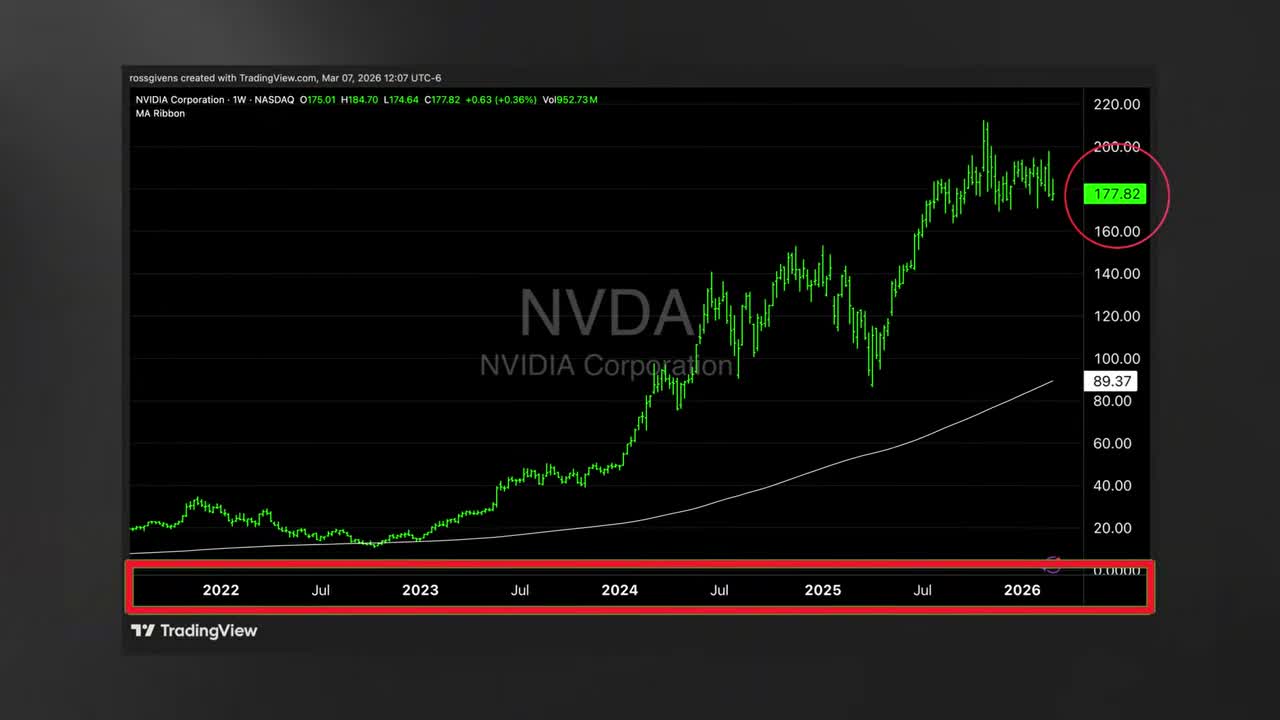
Zoom out on Nvidia’s chart to the last 10 years in log scale. Notice where every major dip stopped dipping — right there on Munger’s 200-week moving average.
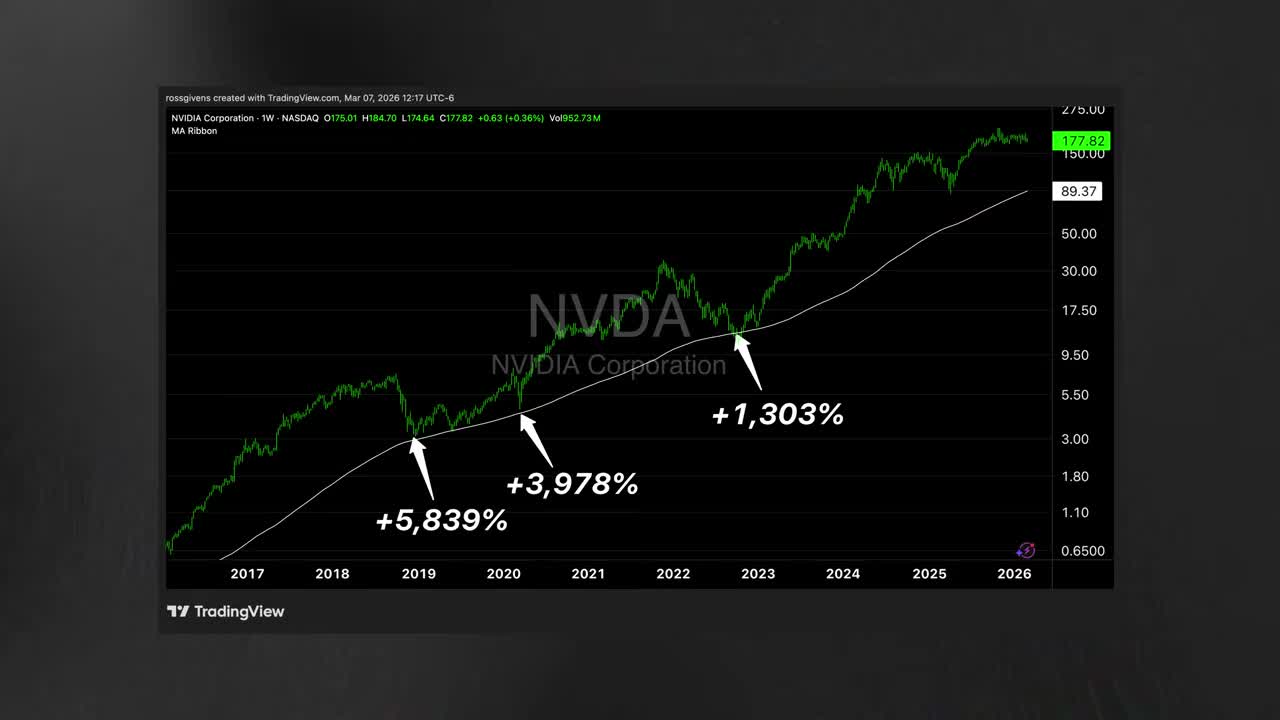
Granted, this is Nvidia. But you get the idea. These were arguably the best buying opportunities of the decade — all from following Munger’s simple one-rule strategy.
How to Use the 200-Week Moving Average to Buy High-Quality Stocks
You don’t want to buy just any stock trading on the 200-week MA. This is the part most people overlook. Munger was only looking to buy high-quality stocks.
So what does that mean? Thousands of books have been written trying to answer this question. Depending on who you ask, you’ll get very different answers. But having read just about everything Buffett and Munger have ever written, the type of high-quality stocks they’ve bought over the last 50 years at Berkshire comes down to two things:
The Moat, Explained
Warren Buffett loved the moat analogy. All he meant was that a company has a substantial barrier to entry that competitors can’t breach.
Amazon is a perfect example. According to market research, 40 cents of every dollar spent online is spent on Amazon. A whopping 68% of Americans have a Prime membership. They own e-commerce — and no amount of money could take them down. Hand someone a trillion dollars tomorrow and they’d never dethrone Amazon. That is a moat.
Disney is another. Even though they’ve gone a little woke over the last few years, the company has a content library a hundred years deep. They released Snow White and the Seven Dwarves in 1937. Kids have been going to Disney theme parks since 1955. The company is part of the fabric of American culture. That’s a massive moat.
Get an entire year of live weekly mentoring sessions, my newsletter, indicators, bonus reports, tons more. Click the link and I’ll see you in the next live session.
Profit Margins Reveal the Moat
One way to measure a stock’s moat: look at its profit margins. If a company can raise prices without losing market share — without its sales falling — that’s a strong signal of a durable moat.
Think about it this way. Imagine you sell watermelons out of the back of a truck on the side of the road. You buy them for $5, sell them for $10, making $5 profit on each one. If you got wildly successful, competitors would pop up down the road. They’d start selling the same watermelons for $8, maybe $7. Suddenly you’re not moving as many melons — customers just buy them 30% cheaper from the other guy.
But if customers still chose your watermelons — if they’d rather pay $10 for yours than $7 from the competition — you must have some pretty special melons. Weird example, but that is a moat.
Survivorship as a Moat Signal
For publicly traded companies, moats often show up in the form of survivorship. The older the company, the greater the odds it has a sustainable economic moat.
The oldest companies are typically found in the Dow Jones index. Stocks like Coca-Cola, Caterpillar, and Procter & Gamble have been around for 100 years or more. This makes the Dow a great list of stocks to watch for buying opportunities using Munger’s strategy.
Examples of Stocks That Bounced From the 200-Week Moving Average
A scan was built to find stocks Charlie Munger would buy today. The list included all 30 Dow stocks plus roughly a hundred others meeting these criteria:
- Publicly traded for more than 50 years
- A multi-decade history of rising sales and profits
- Industry-leading profit margins
- Trading at or near the 200-week moving average
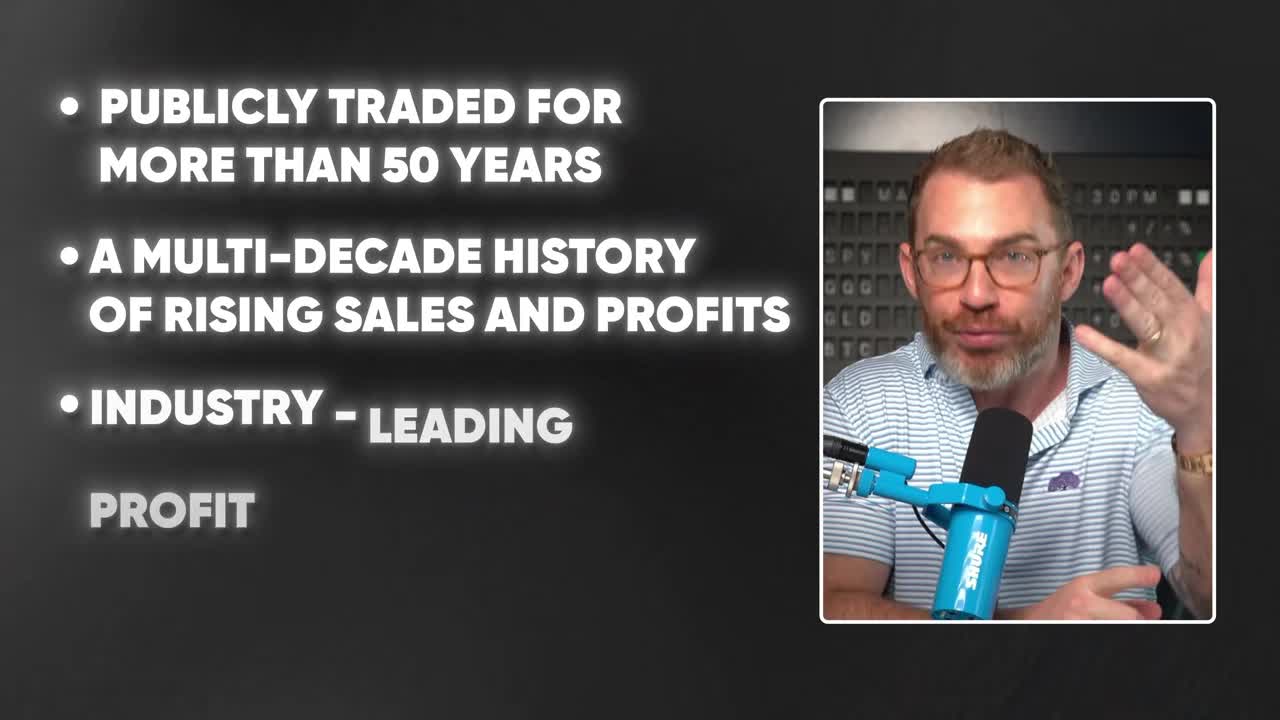
Four stocks meet every criterion:
What About Newer Companies?
Broaden the search to include newer companies and it generates many more names. Palo Alto Networks (PANW), for example, just bounced off its 200-week moving average. Software stocks have been getting killed as AI advancements bring their valuations into question.
Palo Alto Networks went public in 2012. Buffett and Munger liked buying stocks they could hold forever — and they’d likely argue that 14 years is not a long enough time horizon to establish a true moat, especially in the tech space. Something they famously admitted they did not understand.
But the world is changing fast. So, who knows?
Get an entire year of live weekly mentoring sessions, my newsletter, indicators, bonus reports, tons more. Click the link and I’ll see you in the next live session.
DISCLAIMER: Traders Agency does not offer financial advice. The information provided is for educational purposes only and should not be considered financial advice. Traders Agency is not responsible for any financial losses or consequences resulting from the use of the information provided. Trading carries inherent risks and may not be suitable for all individuals. You are advised to conduct your own research and seek personalized advice before making any investment decisions, recognizing the potential risks and rewards involved.