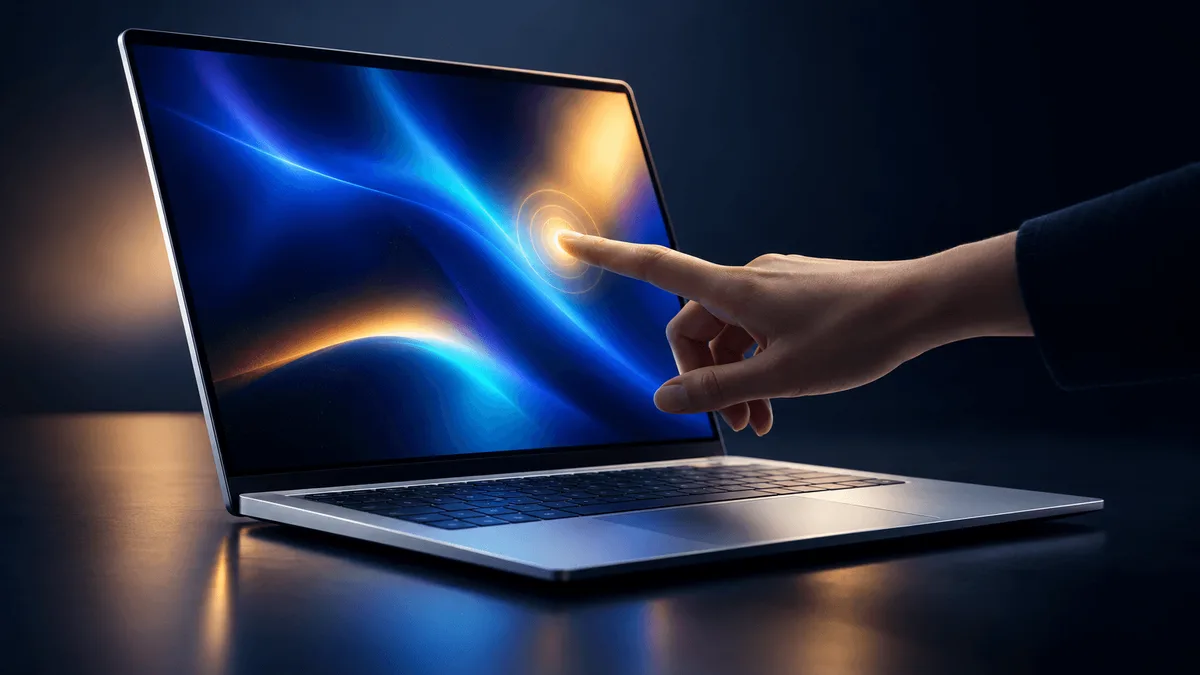
Apple on October 28, 2026 introduced its first touchscreen laptop, the MacBook Pro with ProLED XDR Display, ending years of public skepticism from its own executives about mixing touch input with the Mac. The new machines pair a touch-enabled tandem OLED panel with macOS rather than a mobile operating system, go on sale November 6, and carry what CNBC called notable price increases over existing MacBook Pro models, according to CNBC and Apple's product announcement.
What Apple Announced
Apple said the new laptop features what it calls breakthrough tandem OLED technology, branded ProLED XDR Display, and confirmed the touch sensor is built directly into the display panel rather than layered on top of it, a design Apple says reduces latency so touch input feels closer to direct contact with on-screen content, per Apple's newsroom post. The company also brought its Dynamic Island interface, previously exclusive to iPhone, to the Mac for the first time, positioning it as the home for Spotlight search, Live Activities and Siri AI.
Despite the touch hardware, CNBC noted the machine is still running macOS rather than a version of iOS or iPadOS, a distinction Apple underscored in describing the launch. Apple's newsroom material states that macOS automatically translates touch input into clicks so most existing software works with touch without modification, while new system gesture APIs let developers build touch-specific interactions. Apple listed a range of third-party apps committing to Touch support at launch, including Notion, Canva, Zoom, Microsoft Word, Excel, PowerPoint and Outlook for productivity; Adobe Lightroom and DaVinci Resolve for creative work; Blender, Cinema 4D, ZBrush and Shapr3D for 3D modeling; and djay Pro for music.
A Reversal of Apple's Own Position
The launch marks a public reversal for Apple leadership. CNBC reported that current CEO John Ternus, speaking as Apple's hardware chief, had previously argued the iPad was optimized for touch while "the Mac is totally optimized for indirect input." Apple software chief Craig Federighi made a similar case in 2018, telling audiences that the ergonomics of a touchscreen laptop would fatigue users, according to CNBC's reporting. Ternus himself acknowledged the shift directly, telling CNBC, "Yes, for the very first time, we are bringing touch to the Mac."
Industry analysts framed the move cautiously. Ryan Reith, IDC's vice president for worldwide device trackers, told CNBC that touchscreens have existed on Windows laptops for years but function as a secondary feature rather than a primary reason consumers buy a machine. IDC data cited by CNBC shows only 17% of notebook PCs shipped globally this year are expected to include touchscreens, and that touch-enabled laptops have carried a slightly lower average selling price than non-touch models, a dynamic Apple's premium pricing runs counter to. Separately, unnamed analysts cited by CNBC characterized the addition as primarily a user interface and software development rather than a hardware breakthrough, a framing that may explain why Apple waited this long to ship the feature.
Pricing and a Rough Laptop Market
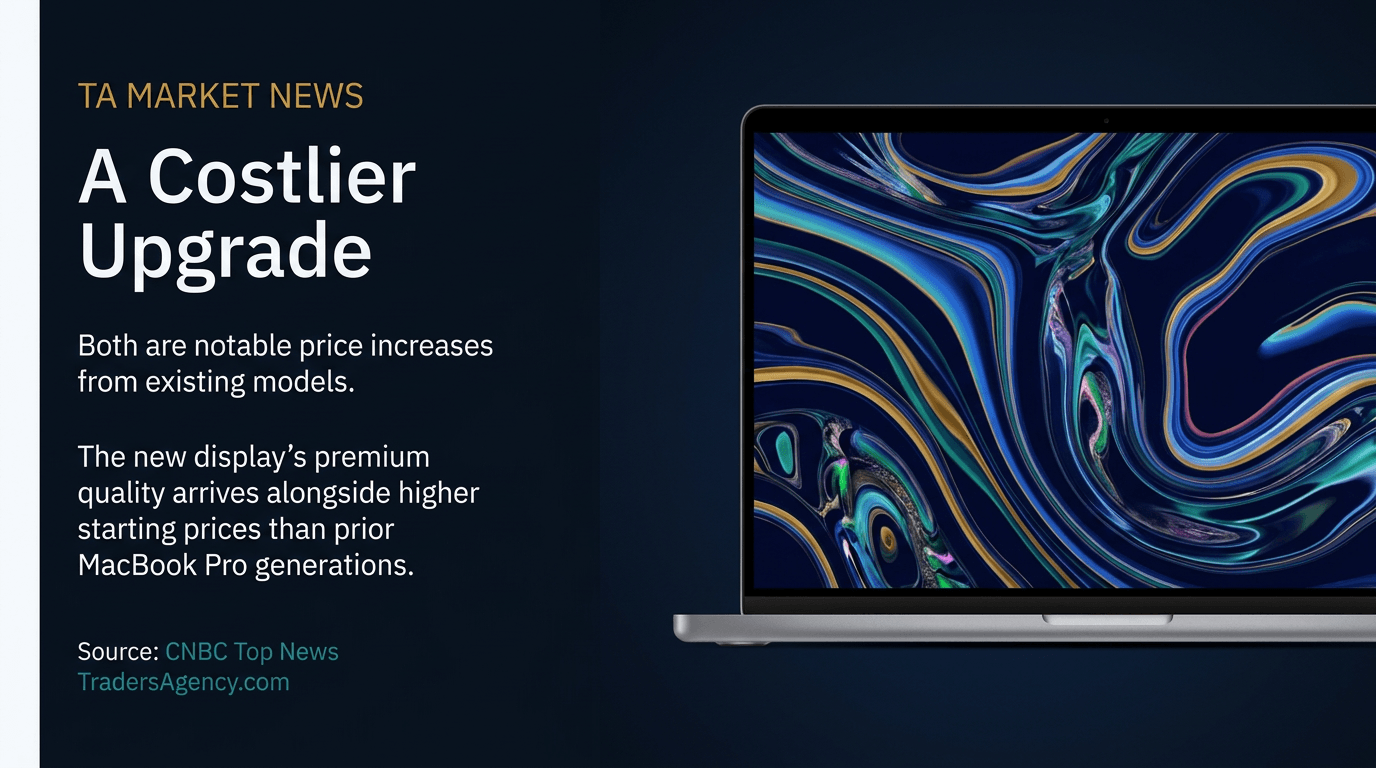
The 14-inch MacBook Pro with ProLED XDR Display and M5 Pro starts at $2,899, while the 16-inch version starts at $3,399, according to both CNBC and Apple's own pricing sheet; Apple also listed education pricing of $2,749 and $3,199 respectively. Higher-end M5 Max configurations start at $4,499 for the 14-inch model and $4,799 for the 16-inch model. CNBC described both base prices as notable increases over prior MacBook Pro generations.
The launch lands in a difficult stretch for the broader laptop industry. CNBC reported that overall laptop shipments are expected to fall 11% this year, part of what it called one of the laptop market's worst-ever slumps, a decline analysts cited by CNBC linked to an AI-driven global memory shortage that has pushed laptop prices higher and dampened demand. Former Apple CEO Tim Cook warned this summer that the memory pricing situation was "unsustainable," and CNBC noted nearly every current Mac, including Mac Minis introduced in August, received price increases this year, with the Mac Mini alone rising $300.
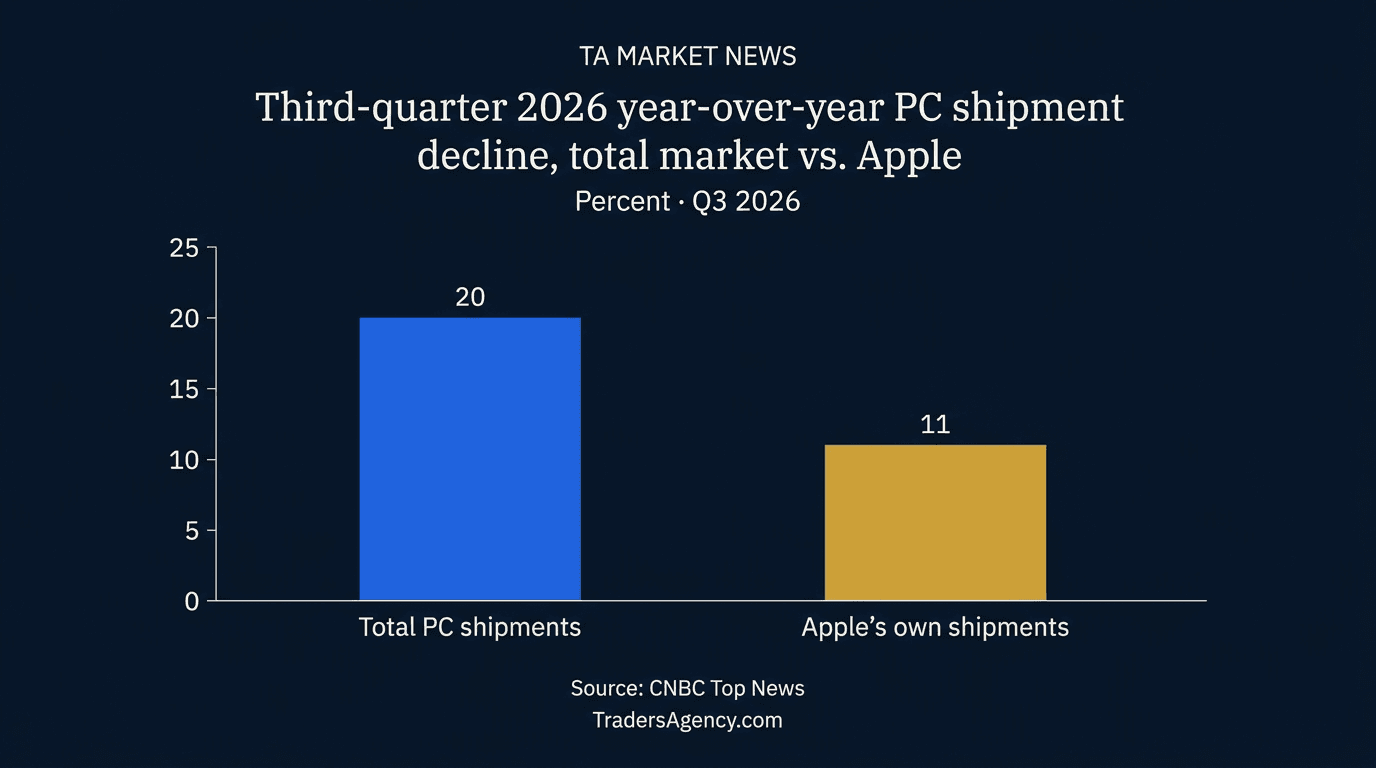
Separate IDC data reported by CNBC showed the scale of the recent downturn more specifically: total PC shipments dropped 20% year over year in the third quarter of 2026, while Apple's own shipments fell 11% over the same period. Based on those two reported figures, Apple's shipment decline was roughly 9 percentage points smaller than the broader market's (20 minus 11, our calculation), and the overall market's decline was about 82% larger in relative terms than Apple's (20 minus 11, divided by 11, multiplied by 100, our calculation). That comparison reflects only the specific quarter cited and should not be read as a trend forecast.
Part of a Faster Product Cadence
CNBC described the touchscreen MacBook Pro as Apple's third major product launch under Ternus, who it said has adopted a faster cadence for hardware releases than his predecessor. The outlet tied the launch to a busy two-month stretch that also included new iMac and MacBook Pro models with M6 chips, an iPad Mini starting at $699 (versus $599 for its predecessor), the company's first foldable phone, the iPhone Duo, launched in September, and a smart speaker and display called HomeView built around a redesigned version of Siri.
CNBC also pointed to the Mac's growing weight inside Apple's business, noting the company reported $10.35 billion in Mac sales in its most recent quarter, just under 10% of total company revenue. The outlet linked that figure to Apple's broader push to position Macs for on-device AI workloads, citing Meta's AI model development team buying hundreds of Mac Minis this year to test agents, and a joint announcement earlier this month between Apple and Meta that large AI models can run across networked clusters of Macs, letting developers run agentic code without relying on Anthropic or OpenAI infrastructure.
Bottom Line
Apple has finally added touch to the Mac after years of its own executives arguing against it, pairing the feature with a new low-latency display design and a software layer meant to make existing apps work without changes. The launch arrives with higher prices, inside a market that IDC data cited by CNBC shows contracted faster overall than Apple's own shipments in the third quarter of 2026, and as part of a visibly quickened product rollout under CEO John Ternus. Whether touch becomes a meaningful purchase driver for Mac buyers, rather than the secondary feature IDC's Ryan Reith says it has remained on Windows machines, is not established by the available data.
DISCLAIMER: Traders Agency does not offer financial advice. The information provided is for educational purposes only and should not be considered financial advice. Traders Agency is not responsible for any financial losses or consequences resulting from the use of the information provided. Trading carries inherent risks and may not be suitable for all individuals. You are advised to conduct your own research and seek personalized advice before making any investment decisions, recognizing the potential risks and rewards involved.
- CNBC Top News: Apple brings touch to the Mac · accessed Oct 28, 2026
- Apple: Apple unveils groundbreaking MacBook Pro with PROLED XDR Display · accessed Oct 28, 2026
See more from Traders Agency on Google
Make us a preferred source and our market analysis will appear more prominently in your Google Search, Top Stories, and AI results.
Add to Preferred Sources