The Federal Reserve's Federal Open Market Committee voted on October 28, 2026 to keep the benchmark federal funds rate in a target range of 3.75% to 4%, leaving it where it has been since September's quarter-point increase. Two of the 12 voting members, Governor Lisa Cook and Cleveland Fed President Beth Hammack, dissented in favor of raising rates by another quarter point, according to CNBC. Fed Chair Kevin Warsh also used his post-meeting press conference to announce changes to the Committee's meeting calendar beginning in 2027.
A Split Committee
CNBC reported that the dissents from Cook and Hammack reflected underlying disagreement on the Committee over how aggressively it needs to raise rates to combat rising prices. The report did not detail individual reasoning beyond that both wanted a quarter-point hike rather than a hold.
CNBC noted this was Cook's first dissent since she joined the Fed in 2022 as an appointee of President Joe Biden, and that it came amid a continuing controversy in which President Donald Trump has sought to remove her from office over allegations concerning information she provided on home loan applications. Separately, CNBC's live-updates coverage cited unnamed commentary suggesting Cook's dissent could have been "a protest vote" tied to the administration's push to get her to resign, a characterization offered as outside speculation rather than a confirmed motive.
What the Statement Said
The FOMC's post-meeting statement, as quoted by CNBC, said inflation "remains elevated" and that "the accumulation of more information will help the Committee determine the policy stance appropriate to ensure a timely return of inflation to the Committee's 2 percent goal." The statement also affirmed that "the Committee will deliver price stability."
CNBC's reporting on the statement's language described an upgrade in the characterization of economic activity to "expanding at a strong pace," compared with "solid" in the September statement, with no other substantial textual changes apart from the removal of a sentence that had explained September's rate increase.
On balance-sheet policy, the Federal Reserve's own Implementation Note directed the Open Market Desk to roll over at auction all principal payments from the Fed's Treasury holdings, reinvest all principal payments from agency securities into Treasury bills, and, when appropriate, increase System Open Market Account holdings through Treasury bill purchases (and other short-dated Treasury securities if needed) to maintain an ample level of reserves.
Warsh's Meeting-Schedule Overhaul
Warsh announced that the FOMC will continue to meet eight times a year, but beginning in 2027 one of those eight meetings will be devoted exclusively to broad monetary policy strategy, with neither a rate vote nor a policy statement expected, according to remarks reported by CNBC. He said the remaining meetings each year will continue as regular policy-setting sessions, and that he expects the 2028 calendar to include two strategy-focused meetings and six policy-setting meetings.
Asked what the Fed would communicate publicly after the strategy sessions, Warsh said it was "not obvious yet," per CNBC's live coverage, and reiterated he does not anticipate a rate decision or statement from those meetings. He framed the change as an institutional choice to preserve space for longer-horizon strategic deliberation separate from the near-term, data-driven discussions at regular policy meetings, saying the Committee needs to reserve time "for thinking anew about big questions, looking out over longer time horizons." Warsh also said that in normal times, with the underlying economy as strong as it currently is, he does not favor forward guidance.
Market and Rate-Path Reaction
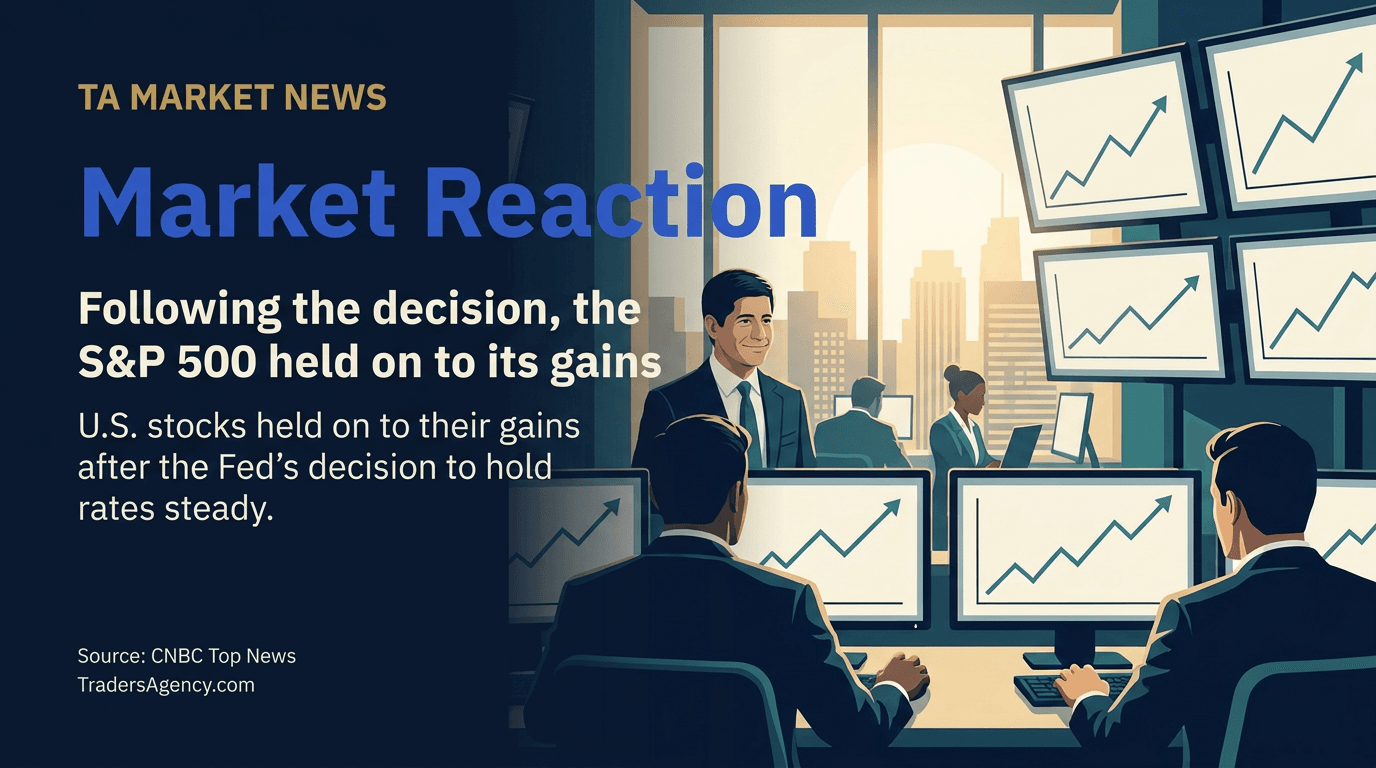
CNBC reported that the S&P 500 held on to its gains following the decision. DataTrek Research cofounder Nicholas Colas was cited by CNBC noting that since Warsh became Fed chair in May, stocks have generally fallen on Fed meeting days and then posted gains the day after, with the S&P 500 in particular rallying at least 1% on each of the three post-meeting days of his tenure, an observation offered as market commentary rather than a forecast.
The hold itself came as little surprise. CNBC cited CME Group's FedWatch tool showing markets had priced in less than a 10% chance of a hike ahead of the meeting, with futures showing a nearly 93% likelihood of a hold versus less than 30% a month earlier. CNBC's reporting also noted that futures pricing after the decision indicated a strong possibility of another hike at the December FOMC meeting, and perhaps one or two more in 2027, framed as market-implied probabilities rather than Fed guidance. Goldman Sachs economists, as cited by CNBC, said the apparent support for hiking every other meeting sets a high bar to deviate from that pattern through year-end, which they said should limit the near-term impact of Fed communication.
Economic and Credit Backdrop
Fed Vice Chair Philip Jefferson and New York Fed President John Williams both indicated policymakers have time to evaluate conditions before their next move, with Williams saying there is "no need for urgency" after September's hike, the first in three years. Jefferson said Committee members would "need to come to our own judgment, which may take more time," and noted that yields rose after the September decision, according to CNBC.
The Atlanta Fed's GDPNow tracker pointed to 3.4% annualized growth in the third quarter, which CNBC described as the strongest pace in a year. Warsh said financial and credit conditions have tightened for some businesses and households since September's hike, calling that consistent with expectations, though he declined to characterize conditions as broadly "tight," saying instead they are helping create a path toward price stability. He also said higher rates have affected the AI infrastructure buildout, with some credit spreads widening, while adding that capital-expenditure strength is "not just strong, but it is broadening" across sectors. Warsh further said he heard no discussion of politics or the midterm elections among his colleagues during the meeting and does not believe politics played a role in the decision.
Borrowing costs for households continued to climb. CNBC, citing MND data, reported the average 30-year fixed mortgage rate rose to 7.33% from 7.12% the prior month, while Bankrate data cited by CNBC showed home equity loan rates rising to 8.77% from 8.28% in September.
Bottom Line
The Fed's hold at 3.75%-4% marks a pause after September's hike, but the two dissents in favor of raising rates underscore a Committee still debating how forcefully to address elevated inflation even as officials describe the economy as expanding strongly. Warsh's calendar change does not alter near-term rate-setting mechanics; it restructures how the Fed allocates its eight annual meetings starting in 2027, carving out dedicated strategy sessions without rate votes or statements. Market pricing cited by CNBC suggests traders see a reasonable chance of resumed hikes into December and 2027, though that remains a probability reflected in futures markets rather than a Fed commitment.
DISCLAIMER: Traders Agency does not offer financial advice. The information provided is for educational purposes only and should not be considered financial advice. Traders Agency is not responsible for any financial losses or consequences resulting from the use of the information provided. Trading carries inherent risks and may not be suitable for all individuals. You are advised to conduct your own research and seek personalized advice before making any investment decisions, recognizing the potential risks and rewards involved.
- CNBC Top News: Fed holds rates steady · accessed Oct 28, 2026
- CNBC Top News: Fed meeting today: Live updates · accessed Oct 28, 2026
- Federal Reserve: Implementation Note issued October 28, 2026 · accessed Oct 28, 2026
See more from Traders Agency on Google
Make us a preferred source and our market analysis will appear more prominently in your Google Search, Top Stories, and AI results.
Add to Preferred Sources