
A covered call is an options strategy where you own at least 100 shares of a stock and sell a call option against those shares to collect cash upfront. It's one of the first strategies we teach because it blends something you already understand, owning stock, with the basics of selling options. By the end of this guide, you'll know how to set one up, calculate your breakeven and maximum profit, and judge whether the strategy fits your goals.
We wrote this guide because too many beginner explanations jump straight into jargon without showing the math. Our team wants you to walk away able to run the numbers yourself on any stock sitting in your portfolio. Here's how the mechanics work.
What Is a Covered Call?
Bottom Line: A covered call strategy trades upside potential for upfront income, so it works best when you expect a stock to stay flat or rise only moderately, not spike sharply. Running the breakeven and max profit math before placing the trade, and setting an exit rule in advance, keeps the strategy's risk contained to what you can accept losing on the shares.
A covered call has two parts working together: owning 100 shares of stock and selling one call option against those shares. The stock you own "covers" the obligation created by the option you sold, which is why we classify it as a lower-risk options strategy compared to selling calls with no shares behind them.
This is very different from simply buying a call option. When you compare a covered call vs. buying a call, the difference is the direction of the cash flow. A call buyer pays a premium hoping the stock rips higher. A covered call seller collects a premium and hopes the stock stays flat or rises moderately.
There's also a mirror-image strategy called a covered put, where a trader who is short shares sells a put option against that short position. We won't go deep on it here, but it's worth knowing the term exists.
Key Concept: A covered call means owning 100 shares of a stock and selling one call option against that position to collect premium income today in exchange for capping your upside.
Why This Strategy Exists
The logic is straightforward: if you already plan to hold a stock and wouldn't mind selling it at a higher price, you might as well get paid while you wait. Think of it like renting out a spare room in a house you already own. You aren't giving up the house. You're collecting extra income on an asset you already hold, in exchange for agreeing to sell it if someone meets your price.
How Does a Covered Call Work?
A covered call works by selling a call option on stock you already own, which means agreeing to sell those shares at a set strike price if the stock climbs above it before expiration. In exchange, you immediately receive a cash payment called the premium.
Here's the sequence of events, step by step:
- Step 1: Own the Shares - You hold 100 shares of a stock, since every standard options contract represents 100 shares.
- Step 2: Sell One Call - You sell one call option against those shares, choosing a strike price above the current stock price.
- Step 3: Collect the Premium - The premium hits your account immediately, and it's yours to keep no matter what happens next.
- Step 4: Stock Stays Below the Strike - The option expires worthless, and you keep both your shares and the premium. You can sell another call and repeat.
- Step 5: Stock Rises Above the Strike - Your shares may be "called away," meaning you sell them at the strike price and walk away with the premium plus the stock gain up to that strike.
That entire process is what traders mean when they talk about selling a covered call. It's the core action behind the strategy.
What Is a Call Option?
A call option is a contract giving the buyer the right, but not the obligation, to buy 100 shares of stock at a specific price (the strike price) before a specific date (expiration). When you sell a call against shares you own, you take on the obligation rather than the right. That single mechanical flip is the part beginners most often miss.
What Does a Covered Call Example Look Like?
Let's run a concrete covered call example with real numbers so you can see exactly how the math lands.
Say you own 100 shares of a stock trading at $50 per share, giving you a cost basis of $5,000. You sell one call option with a $55 strike price and collect a $2.00 premium per share, or $200 total, since each contract covers 100 shares.
The Setup
| Parameter | Value |
|---|---|
| Stock Price | $50.00 per share |
| Shares Owned | 100 (cost basis $5,000) |
| Call Sold | $55 strike, $2.00 premium |
| Premium Collected | $200 total |
| Expiration | 30 days out |
The Execution
Because you already own the shares, there's only one order to place: sell to open one call contract at the $55 strike with your chosen expiration. The $200 premium credits your account right away.
Want expert trading insights delivered daily?
Join thousands of traders who rely on Traders Agency for market analysis and trade ideas.
Join Traders AgencyWhat Are the Max Profit, Breakeven, and Max Loss?
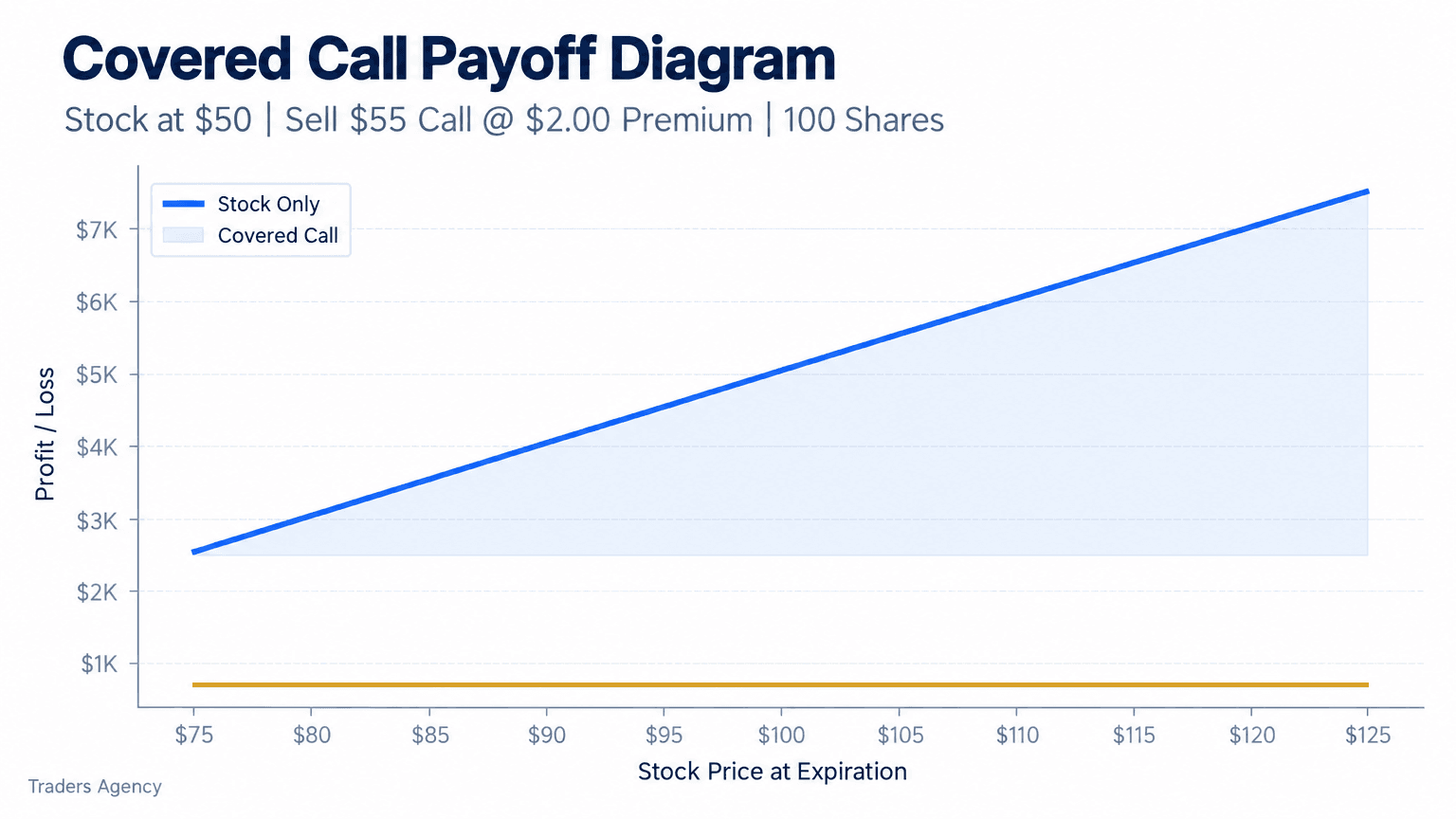
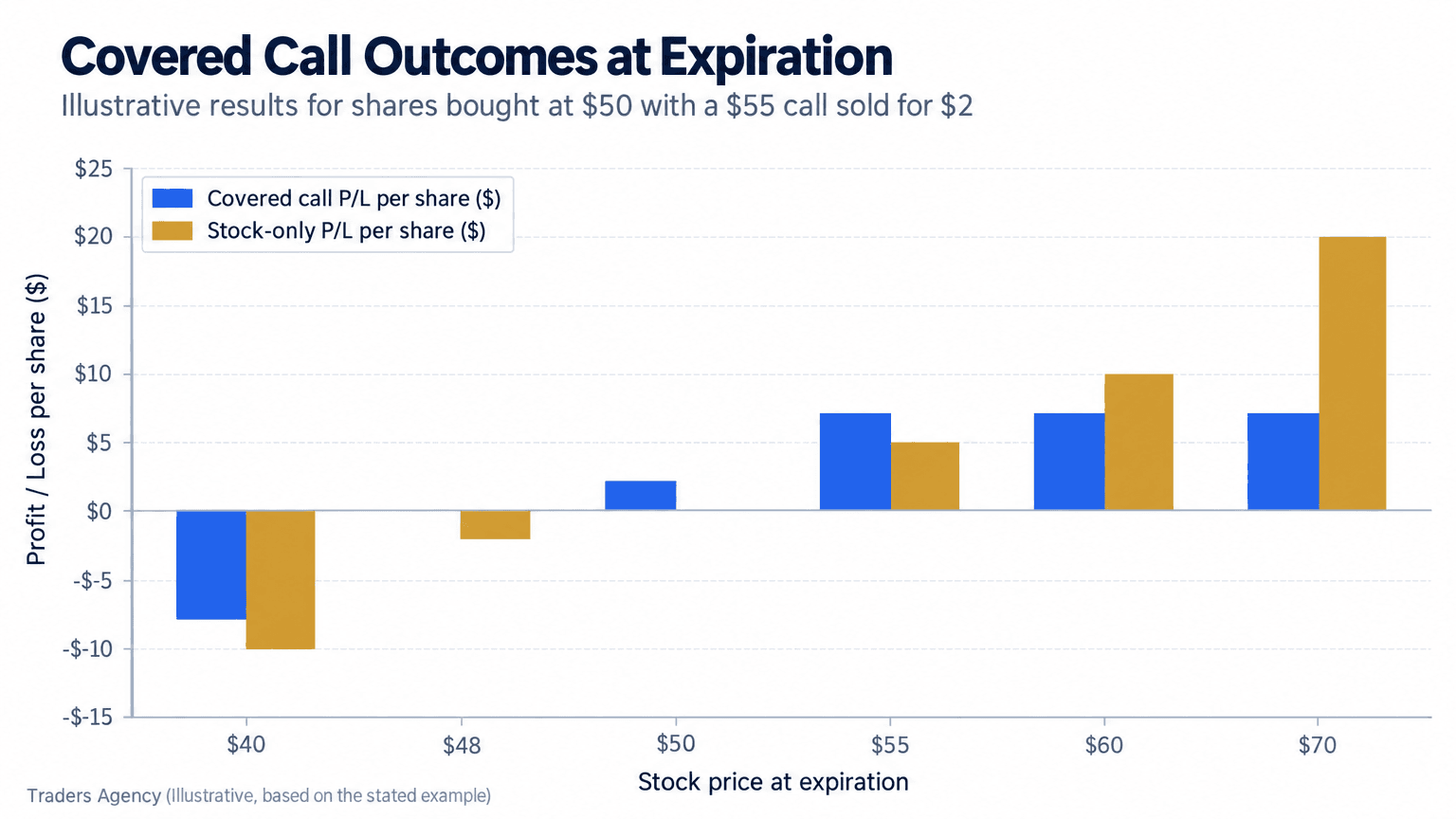
In our $50 stock example with a $55 strike and $2.00 premium, the breakeven is $48, the max profit is $700, and the max loss is $4,800 if the stock went all the way to zero. We teach traders to calculate these three numbers before placing any covered call.
| Metric | Formula | Result |
|---|---|---|
| Breakeven | Stock cost minus premium ($50 - $2) | $48.00 |
| Max Profit | (Strike - cost + premium) x 100 shares | $700 |
| Max Loss | Cost basis minus premium ($5,000 - $200) | $4,800 |
A little more detail on each one:
- Breakeven ($48): Below this price you're losing money on the position even after counting the premium.
- Max profit ($700): This is your hard ceiling. Even if the stock rockets to $80, you don't make a dollar more, because your shares get called away at $55.
- Max loss ($4,800): This only happens if the stock goes to $0. A total wipeout is rare, but the number makes the point clearly: owning the stock is the real risk in this trade, not the option you sold.
Can You Ever Lose Money on a Covered Call?
Yes, and the loss comes from the stock itself, not the option. The premium you collect only offsets declines down to your breakeven, so any drop below $48 in our example produces a net loss.
This is the most common misunderstanding we see. Selling the call doesn't shield you from a falling stock. It cushions the fall slightly and caps your upside in exchange. If the stock slides to $40, you're down $10 per share on the shares, offset by only $2 of premium, for a net loss of $800 on the position.
Watch Out: A covered call is not downside protection. You still carry the full risk of owning 100 shares, reduced only by the premium you collected. Never sell a call on a stock you wouldn't be comfortable holding through a pullback.
Why Would Someone Buy My Covered Call?
The buyer on the other side believes the stock will rise above your strike before expiration and wants leveraged upside exposure without paying for 100 shares outright. They're risking a small premium for a shot at a large gain. You're accepting a capped gain in exchange for guaranteed income today. Both sides can be perfectly rational.
Are Covered Calls a Bad Strategy?
Covered calls aren't inherently bad, but they can underperform simply holding the stock when shares rally hard past your strike. The tradeoff is real: you trade unlimited upside for premium income. In powerful bull runs, covered call sellers regularly leave gains on the table compared with shareholders who sold nothing.
How Do the Greeks Affect a Covered Call?
Three option Greeks matter most to a covered call seller: delta, theta, and vega. You don't need advanced math, just a working feel for what each one is telling you.
- Delta measures how much the option's price moves relative to the stock. A call with a delta near 0.30 has roughly a 30% chance of finishing in the money, and that's the rough guide many covered call sellers use when picking a strike.
- Theta measures time decay, or how much value the option loses each day purely from the calendar moving. This works in your favor as a seller: every quiet day chips value off your short call.
- Vega measures sensitivity to implied volatility. Higher volatility means fatter premiums when you sell, but it also means bigger potential swings in the stock working against you.
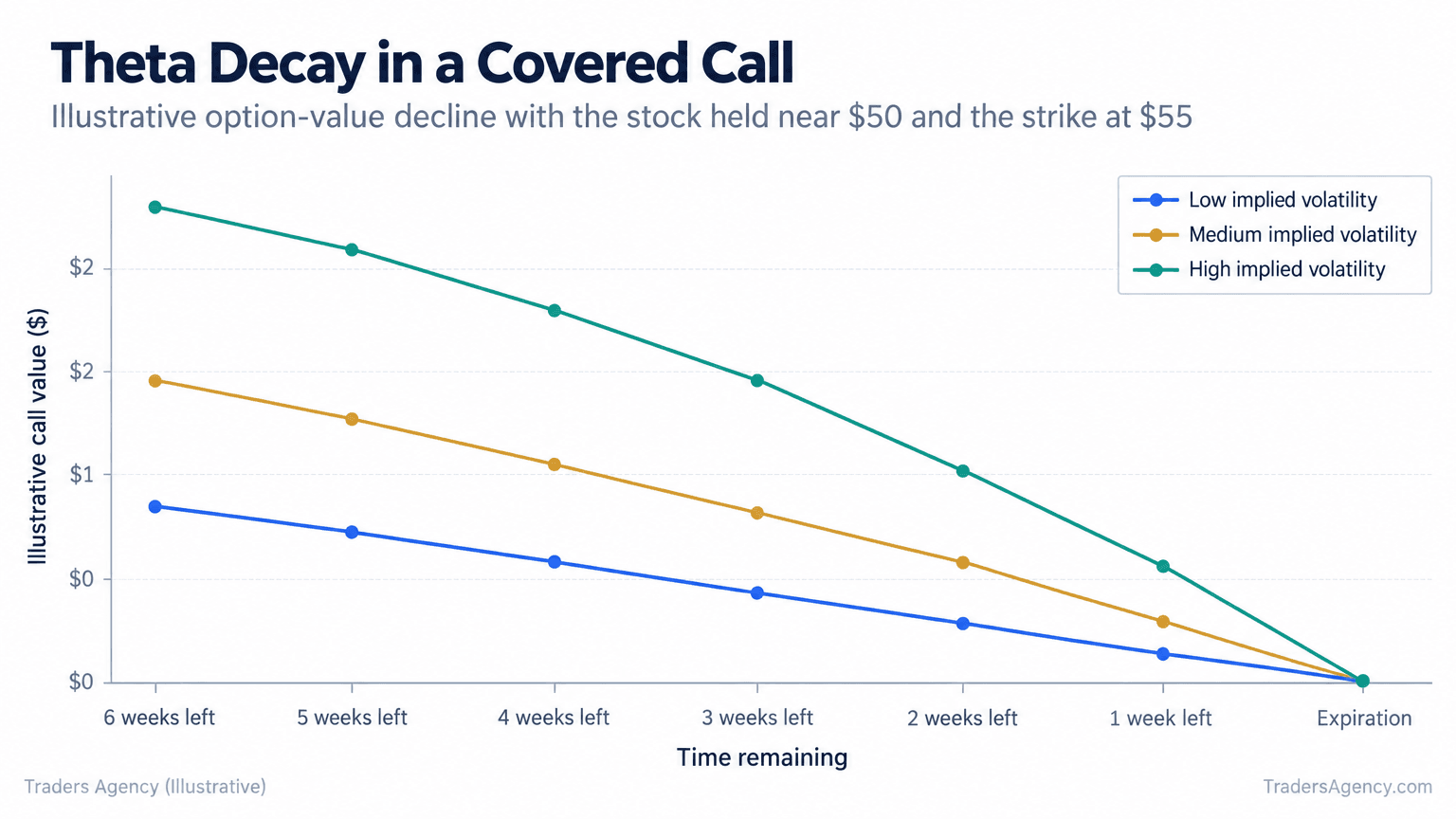
Because theta decay accelerates into expiration, many covered call sellers close or roll the position before the final day rather than letting it ride. Rolling means buying back the current call and selling a new one at a different strike or expiration, usually to avoid having shares called away or to collect additional premium.
When Is the Covered Call Strategy Ideal?
The covered call strategy performs best in flat to moderately bullish conditions, where you don't expect a large move in either direction. It's a poor fit if you're anticipating a big rally, since you'll cap your gains, or if you're unsure about holding the stock at all.
Good Conditions for This Strategy
- You already own shares and are comfortable holding them longer
- You expect the stock to trade sideways or grind higher slowly
- You want extra income on shares you aren't planning to sell soon
- Implied volatility is elevated, which boosts the premium you collect
When to Avoid It
- You expect a major upside event such as an earnings surprise, product launch, or buyout rumor
- You're not genuinely willing to sell your shares at the strike price
- The stock is highly volatile and could gap sharply against your position
Some traders prefer a covered call ETF rather than managing individual positions. These funds run the strategy across a basket of holdings automatically, which can simplify the process for beginners who want the income concept without choosing strikes and expirations themselves.
Risk Management Basics
- Only sell calls on shares you'd happily part with at the strike price you chose.
- Size the position sensibly so no single covered call represents an outsized share of your account.
- Set an exit rule in advance, such as closing or rolling once the option has lost roughly 50% of its value.
- Check the calendar for earnings dates and other news events before selling, since a sharp gap can blow past your strike in a single session.
For additional background on contract mechanics, expiration rules, and standard risk disclosures, the Cboe Options Exchange publishes free educational material that pairs well with what we've covered here.
Our education team publishes new strategy guides and market analysis every week.
Want expert trading insights delivered daily?
Join thousands of traders who rely on Traders Agency for market analysis and trade ideas.
Join Traders AgencyDISCLAIMER: Traders Agency does not offer financial advice. The information provided is for educational purposes only and should not be considered financial advice. Traders Agency is not responsible for any financial losses or consequences resulting from the use of the information provided. Trading carries inherent risks and may not be suitable for all individuals. You are advised to conduct your own research and seek personalized advice before making any investment decisions, recognizing the potential risks and rewards involved.
See more from Traders Agency on Google
Make us a preferred source and our market analysis will appear more prominently in your Google Search, Top Stories, and AI results.
Add to Preferred Sources