
If you hold ETH and want it working for you instead of sitting idle in a wallet, staking is the most direct way to put it to use. This guide walks through how Ethereum staking rewards actually work, what kind of yield you can realistically expect, and how to decide whether staking fits your portfolio or not.
Ethereum staking rewards are the payments validators earn for helping secure the Ethereum network by locking up ETH and confirming transactions. Rewards are typically expressed as an annual percentage yield (APY), which has generally ranged between 3% and 5% depending on network conditions. By the end of this guide, you'll understand the mechanics behind staking yield, the tradeoffs between solo staking, pooled staking, and exchange staking, and the tax and risk factors that often catch new stakers off guard.
We built this guide for traders who already understand basic market concepts but are new to Proof of Stake systems specifically. Staking is not a get-rich-quick setup. It's closer to earning interest on a savings account, except the "bank" is a decentralized network and the "interest rate" moves with network activity.
What Is Ethereum Staking and How Does It Work?
Bottom Line: Ethereum staking rewards generally fall between 3% and 5% APY and shift with network participation and fee activity, so they're not fixed. The method you choose, solo, pooled, or exchange staking, trades off yield against convenience, and tax treatment plus platform risk can matter as much as the headline rate.
Ethereum staking is the process of locking up ETH to help validate transactions and secure the network under its Proof of Stake (PoS) consensus system. Validators who stake ETH are chosen to propose and confirm new blocks, and in return they earn newly issued ETH plus a share of transaction fees.
Ethereum moved away from energy-intensive mining in 2022 when it switched from Proof of Work to Proof of Stake. Instead of miners competing with computing power, validators now compete by putting capital at risk. Running a full solo validator requires 32 ETH, a steep barrier for most individual traders, which is why pooled and exchange-based staking options exist.
The logic behind staking rewards is simple: the network needs validators to stay honest and online, so it pays them for doing so. Validators who go offline lose ETH through small inactivity penalties, and validators that commit provable offenses like double-signing blocks can have a portion of their stake forcibly removed, a penalty called slashing. That's the core trade we teach every new staker to understand: you earn yield for locking capital and running honest infrastructure, and you accept some downside risk if things go wrong.
Key Concept: Staking rewards exist to pay validators for securing the network honestly. The yield you earn is compensation for locked capital and operational risk, not a guaranteed return.
How Much Do You Earn Staking Ethereum?
Most stakers currently earn between 3% and 5% APY on their staked ETH, though the exact rate depends on total network participation, validator performance, and transaction fee activity. Solo validators and liquid staking participants generally see different net yields after fees.
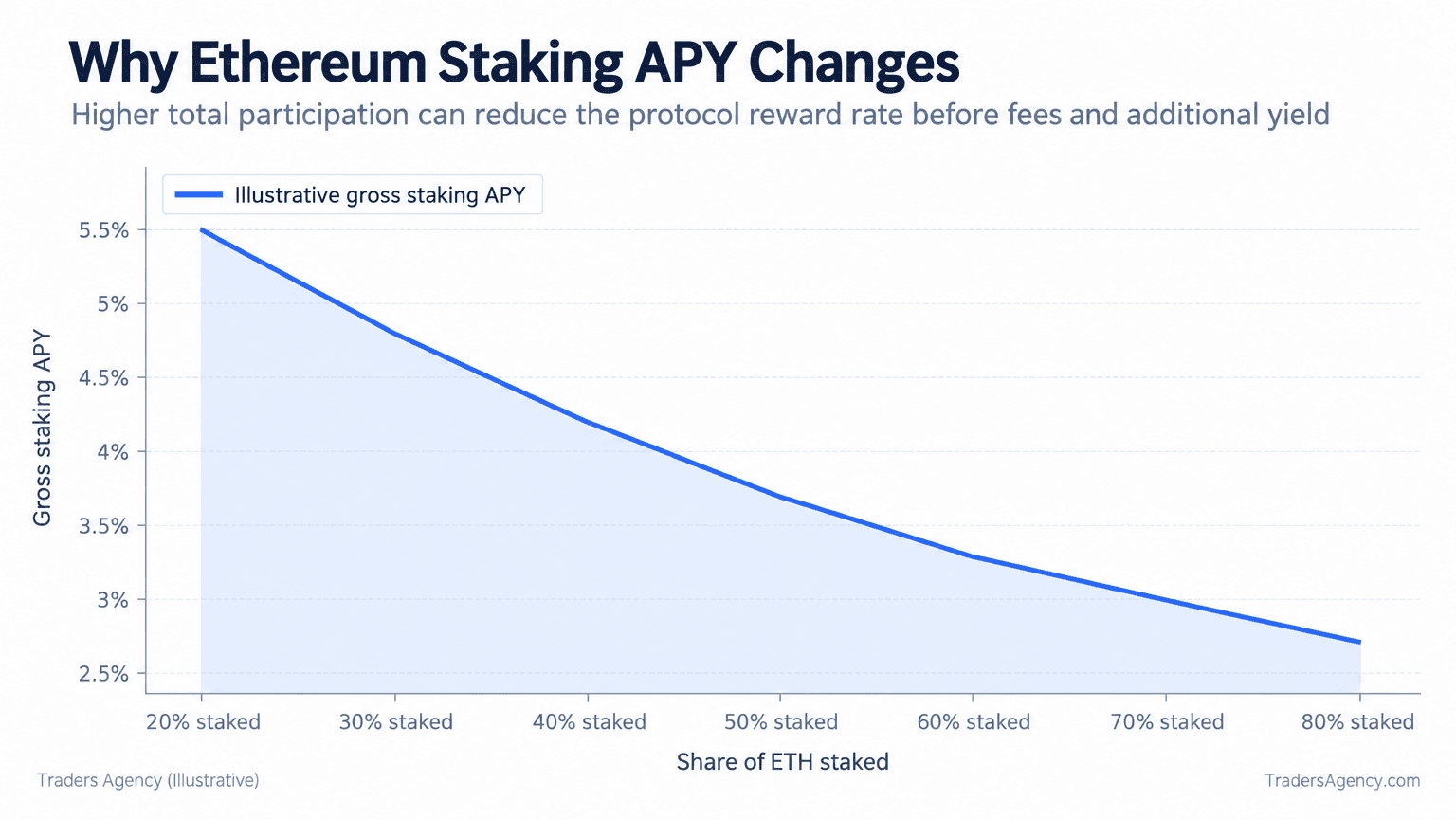
The Ethereum staking APY isn't fixed. It adjusts based on how much total ETH is staked across the network. When fewer validators are staking, each one earns a larger slice of the reward pool. When more ETH joins the staking pool, rewards get split thinner across more participants.
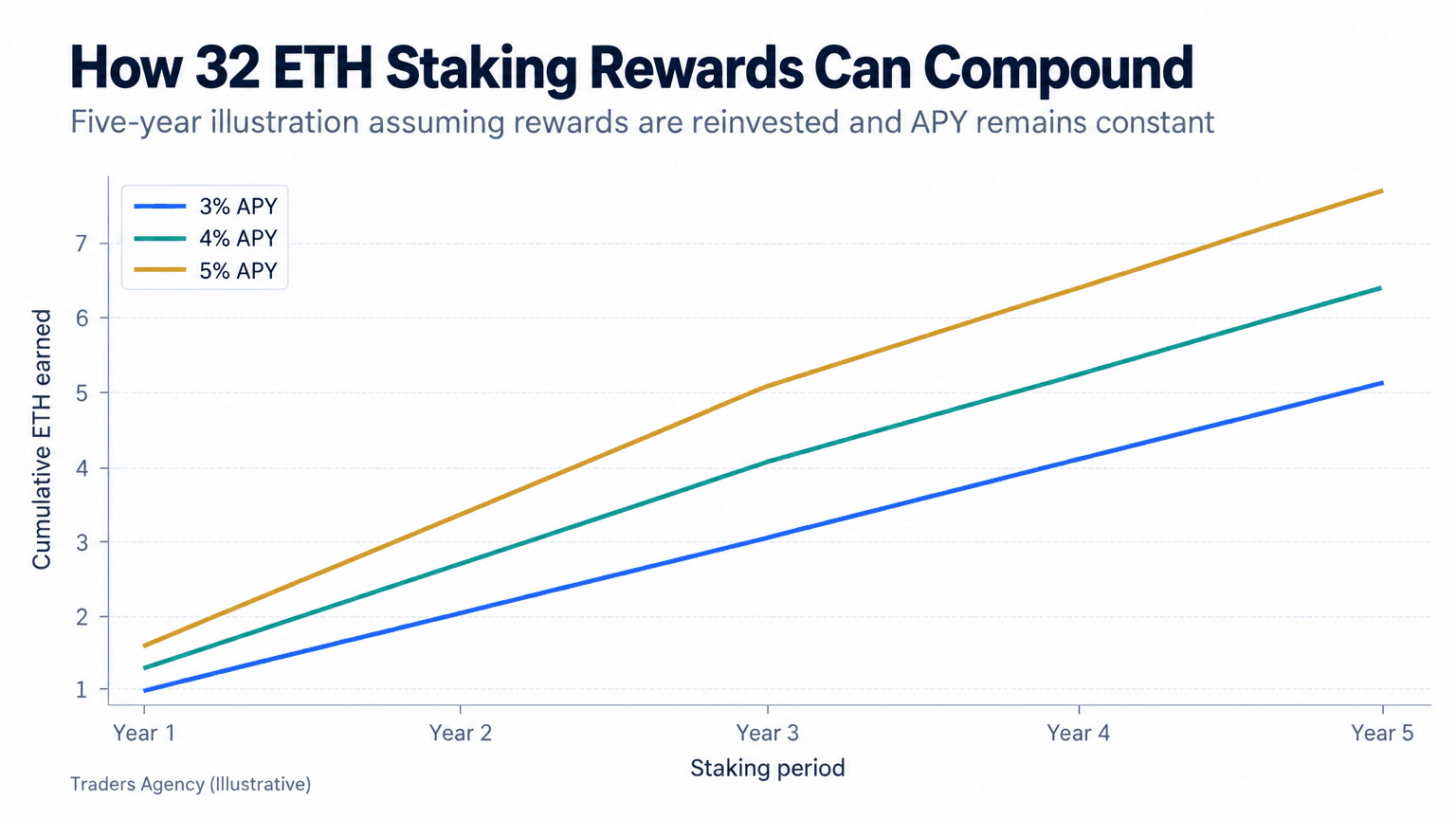
Here's how the math plays out on 32 ETH at different assumed rates, assuming no compounding and ignoring fees:
| Assumed APY | Staked Amount | Estimated Annual Reward |
|---|---|---|
| 3% | 32 ETH | ~0.96 ETH |
| 4% | 32 ETH | ~1.28 ETH |
| 5% | 32 ETH | ~1.6 ETH |
These numbers assume rewards are not compounded and ignore fees, which is rarely how it plays out in practice for pooled or exchange staking.
Using an Ethereum Staking Rewards Calculator
An Ethereum staking rewards calculator lets you plug in your ETH amount, an assumed APY, and a time horizon to project cumulative rewards. Most calculators also let you toggle compounding, which matters a lot over multi-year periods. Here's the walkthrough we recommend:
- Step 1: Enter your staked amount, for example 32 ETH.
- Step 2: Choose an assumed APY based on current network conditions, commonly 3% to 5%.
- Step 3: Select a time horizon, such as 1 year or 5 years.
- Step 4: Compare compounded versus non-compounded outputs to see the difference restaking makes.
Running this exercise at 3%, 4%, and 5% over a five-year window shows how much small APY differences compound into meaningfully different outcomes.
How Network Participation Affects Ethereum Staking Rewards
The relationship between total staked ETH and individual yield is inverse. As more ETH joins the validator pool, the Ethereum staking APY tends to drift lower because total issuance grows more slowly than the amount of ETH staked, so each validator's share of rewards shrinks.
This is why chasing the highest ETH staking rewards headline number can be misleading. A rate advertised during a period of low network participation may compress significantly once more validators come online.
What's the Difference Between Solo, Pooled, and Exchange Staking?
There are three main paths into staking, and each one trades off control, cost, and convenience differently.
Solo staking requires running your own validator with 32 ETH and maintaining hardware or a cloud node. You keep the full reward rate minus your own operating costs, but you also carry full responsibility for uptime and configuration.
Pooled staking lets you stake any amount of ETH, even fractions, by joining with other participants through a staking protocol. You receive a proportional share of rewards minus a protocol fee, and this is where liquid staking tokens typically come into play.
Exchange staking, like products offered through major exchanges, is the simplest entry point. You stake directly through the exchange interface with no technical setup, but the exchange takes a cut of your rewards and you're trusting their custody and infrastructure.
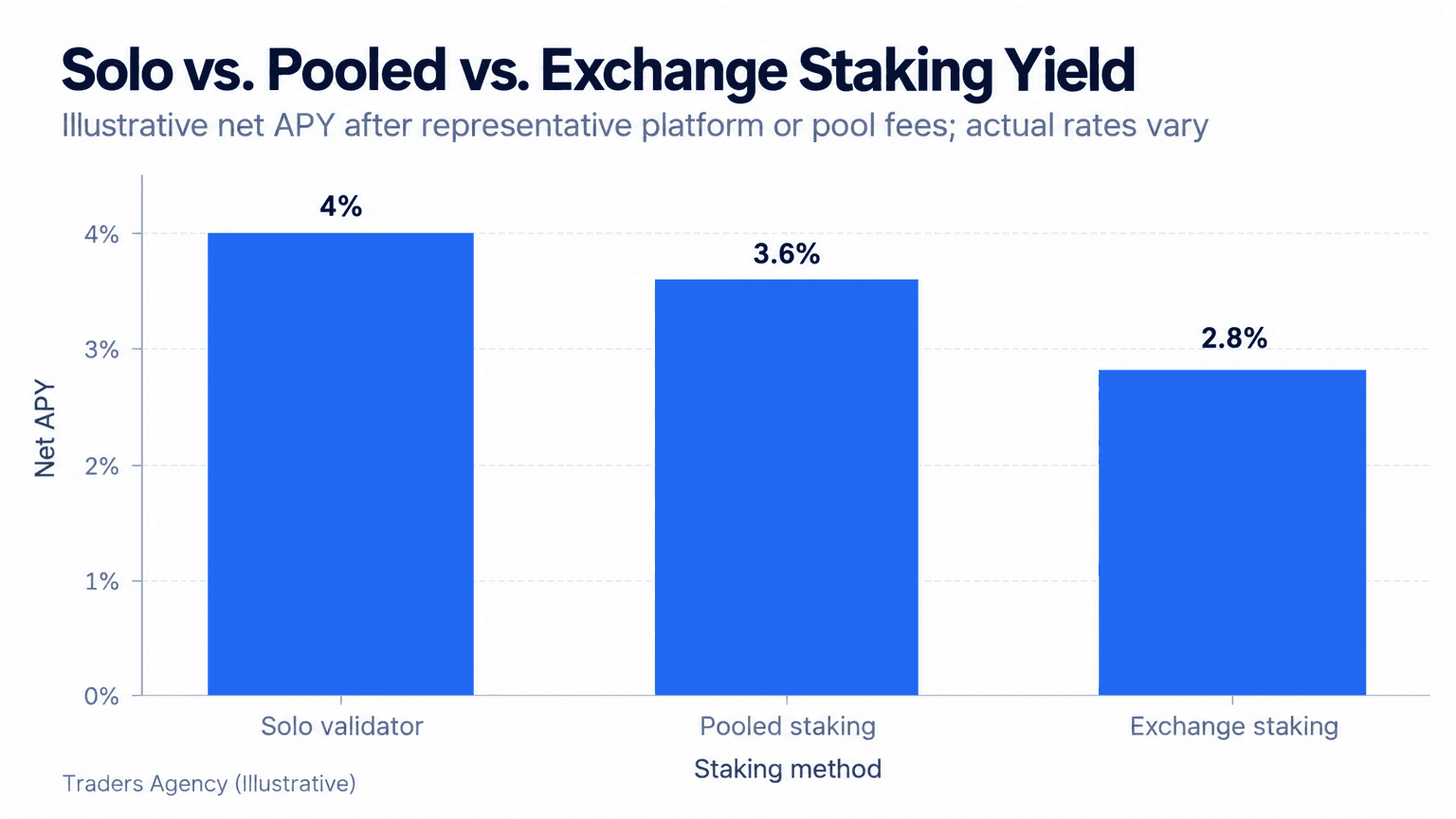
Our team generally sees it this way: solo staking suits traders with technical comfort and enough capital to meet the 32 ETH threshold. Pooled staking suits traders who want flexibility and liquidity. Exchange staking suits traders who prioritize simplicity over maximizing net yield.
Want expert trading insights delivered daily?
Join thousands of traders who rely on Traders Agency for market analysis and trade ideas.
Join Traders AgencyWhat Are Liquid Staking Tokens Like stETH?
Liquid staking tokens solve one of staking's biggest drawbacks: locked capital. When you stake ETH through a liquid staking protocol, you receive a token like stETH that represents your staked position and accrues rewards automatically.
The advantage is that stETH can still be traded, used as collateral, or deployed elsewhere in decentralized finance while your underlying ETH keeps earning staking rewards in the background. This gives you yield without fully sacrificing liquidity.
The tradeoff is added complexity. The value of stETH is meant to track the underlying ETH plus accrued rewards, but it can temporarily trade at a discount during periods of market stress, since it's technically a separate tradable asset governed by supply and demand.
What Are the Risks of Ethereum Staking?
Staking rewards come with real risk, and skipping this section is the most common mistake we see new stakers make.
- Slashing and penalty risk: Validators that act maliciously can be slashed and forcibly exited, losing a portion of their staked ETH, while validators that simply go offline accrue smaller inactivity penalties.
- Lock-up periods: Depending on the method, withdrawing staked ETH can take time, and during periods of high network demand for exits, queues can extend further.
- Smart contract risk: Pooled and liquid staking protocols rely on smart contracts, and any code vulnerability or exploit in that contract puts staked funds at risk.
- Price risk: Staking rewards are paid in ETH, so if the price of ETH falls, the dollar value of your position can decline even while your ETH balance grows.
- Custody risk: Exchange staking requires trusting a third party with custody of your assets, which adds counterparty risk on top of protocol risk.
Watch Out: Yes, you can lose staked ETH, through slashing penalties, smart contract failures, or exchange insolvency. Well-run solo and pooled staking setups minimize slashing risk through redundant infrastructure and careful validator management, but no staking method is risk-free.
How Are Staking Rewards Taxed?
In most jurisdictions, staking rewards are treated as ordinary income at the fair market value of the ETH when you receive it, not when you eventually sell it. That initial value also becomes your cost basis for calculating capital gains or losses later.
This creates a two-step tax event. First, you owe income tax on the reward when received. Second, when you eventually sell that ETH, you owe capital gains tax on any appreciation above the basis you already recognized as income.
Keeping detailed records of the date, amount, and fair market value of each reward is essential, since staking rewards often accrue daily or weekly rather than as one lump payment. We always tell our members to check current guidance from their national tax authority, since treatment can vary and has shifted as regulators catch up with staking mechanics.
Is Ethereum Staking Worth It?
Whether staking is worth it for you depends on your time horizon, liquidity needs, and conviction on holding ETH long term, since staking only makes sense if you were planning to hold the asset anyway rather than trade it actively.
Staking fits well for traders who already hold ETH as a long-term portfolio position and want to generate yield on an asset they weren't planning to sell soon. It fits poorly for traders who need quick liquidity or who are actively trading ETH price swings, since lock-up periods and exit queues can conflict with short-term trading plans.
When Staking Doesn't Make Sense
- You need the ETH liquid for active trading or margin requirements.
- You're uncertain about ETH's price direction and want full flexibility to exit immediately.
- You're staking through an unfamiliar protocol without understanding its smart contract or custody risk.
Portfolio Fit
Crypto assets like ETH generally show periods of both correlation and divergence with equity markets, often moving with risk appetite broadly but with much higher volatility. Staking doesn't change that price risk, it simply adds a yield layer on top of whatever price exposure you already have.
Key Concept: Treat staked ETH as a long-term holding with an income component, not a hedge against ETH's own price swings. Size your allocation the same way you would size any single volatile asset position, typically a small percentage of a diversified portfolio.
Frequently Asked Questions
How much do you earn staking Ethereum?
Most stakers earn between 3% and 5% APY, depending on network participation levels and which staking method you use.
Is Ethereum staking worth it?
It can be worth it for long-term ETH holders seeking yield, but it's less suitable for traders who need liquidity or are actively trading price movements.
Can I lose my ETH if I stake it?
Yes. Slashing penalties, smart contract failures, and exchange custody issues can all result in losing staked ETH.
What is the minimum amount needed to stake ETH?
Solo staking requires 32 ETH, but pooled and exchange staking allow much smaller amounts.
How do liquid staking tokens like stETH work?
They represent your staked ETH position and accrue rewards automatically while remaining tradable, giving you yield without fully locking your capital.
Are staking rewards taxed as income or capital gains?
In most jurisdictions, rewards are taxed as ordinary income when received, and the same value becomes your cost basis for future capital gains calculations.
Does staking APY stay fixed over time?
No. The Ethereum staking APY moves with total network participation and transaction fee activity, so it fluctuates rather than staying constant.
What's the difference between solo, pooled, and exchange staking?
Solo staking requires 32 ETH and technical setup for the highest net yield, pooled staking allows flexible amounts through a shared protocol, and exchange staking offers the simplest setup at the cost of lower net rewards.
Want expert trading insights delivered daily?
Join thousands of traders who rely on Traders Agency for market analysis and trade ideas.
Join Traders AgencyDISCLAIMER: Traders Agency does not offer financial advice. The information provided is for educational purposes only and should not be considered financial advice. Traders Agency is not responsible for any financial losses or consequences resulting from the use of the information provided. Trading carries inherent risks and may not be suitable for all individuals. You are advised to conduct your own research and seek personalized advice before making any investment decisions, recognizing the potential risks and rewards involved.
See more from Traders Agency on Google
Make us a preferred source and our market analysis will appear more prominently in your Google Search, Top Stories, and AI results.
Add to Preferred Sources