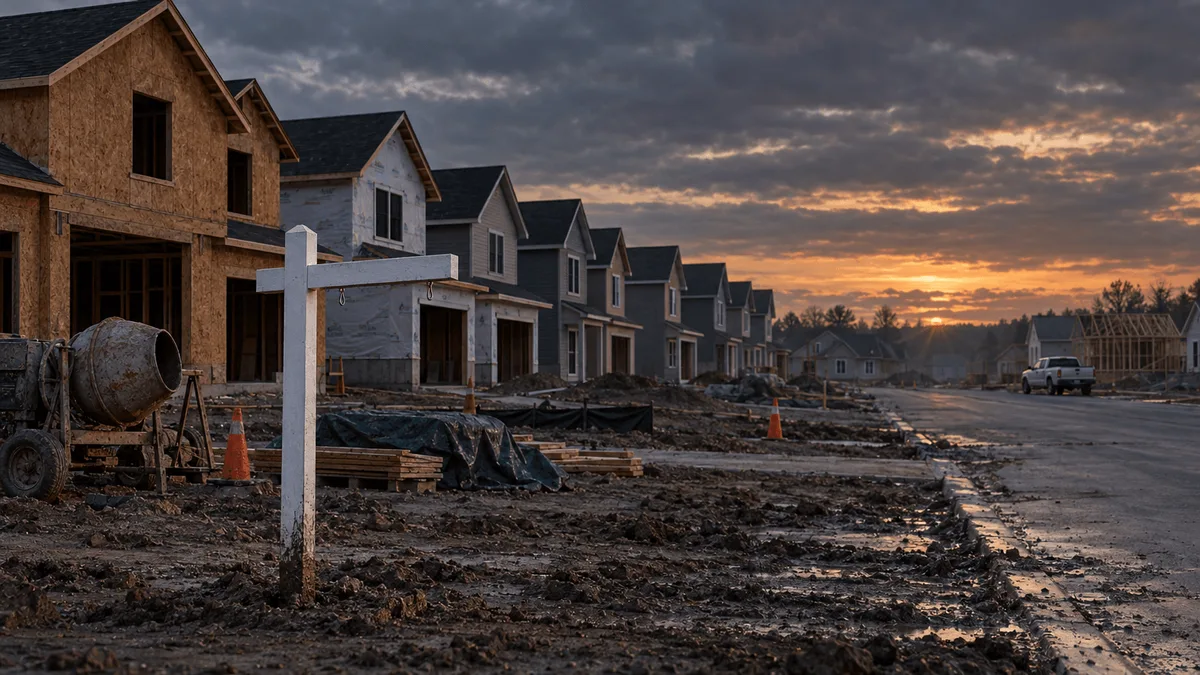
Confidence among U.S. homebuilders fell to its lowest level since April 2012 in November, according to the NAHB/Wells Fargo Housing Market Index (HMI), as 46% of builders cut prices and 68% leaned on sales incentives to move inventory — both post-Covid highs, per NAHB. The reading, reported the same week the Census Bureau released October construction data, underscores how affordability pressure and softer buyer traffic are squeezing builders even as some supply-side figures moved in the opposite direction.
Price Cuts and Incentives Reach Post-Covid Highs
In November, 46% of builders reduced prices, the highest share of the post-Covid period, according to the NAHB and reported by CNBC. The average price reduction held at 6% for an eighth consecutive month, suggesting builders have settled into a steady discounting pattern rather than escalating cuts further.
Incentives told a similar story: 68% of builders offered sales incentives in November, also a post-Covid high, marking the 20th straight month in which at least 60% of builders used them, per NAHB. The persistence of both elevated discounting and incentive use points to a market where builders are prioritizing absorption over price, a pattern that has now held for well over a year and a half.
All Three HMI Components Decline
Each of the HMI's three components weakened in November. The gauge of current sales conditions fell six points to 28, and the index of sales expectations for the next six months dropped two points to 30, according to NAHB. Prospective buyer traffic fell two points to 16, its lowest level in 15 years excluding the start of the pandemic in 2020, both NAHB and CNBC reported. Our read is that the traffic component, which reflects builder-reported foot traffic at their communities, is the most forward-looking of the three, making its 15-year low the most cautionary element of the survey.
Weakness Broad Across Regions
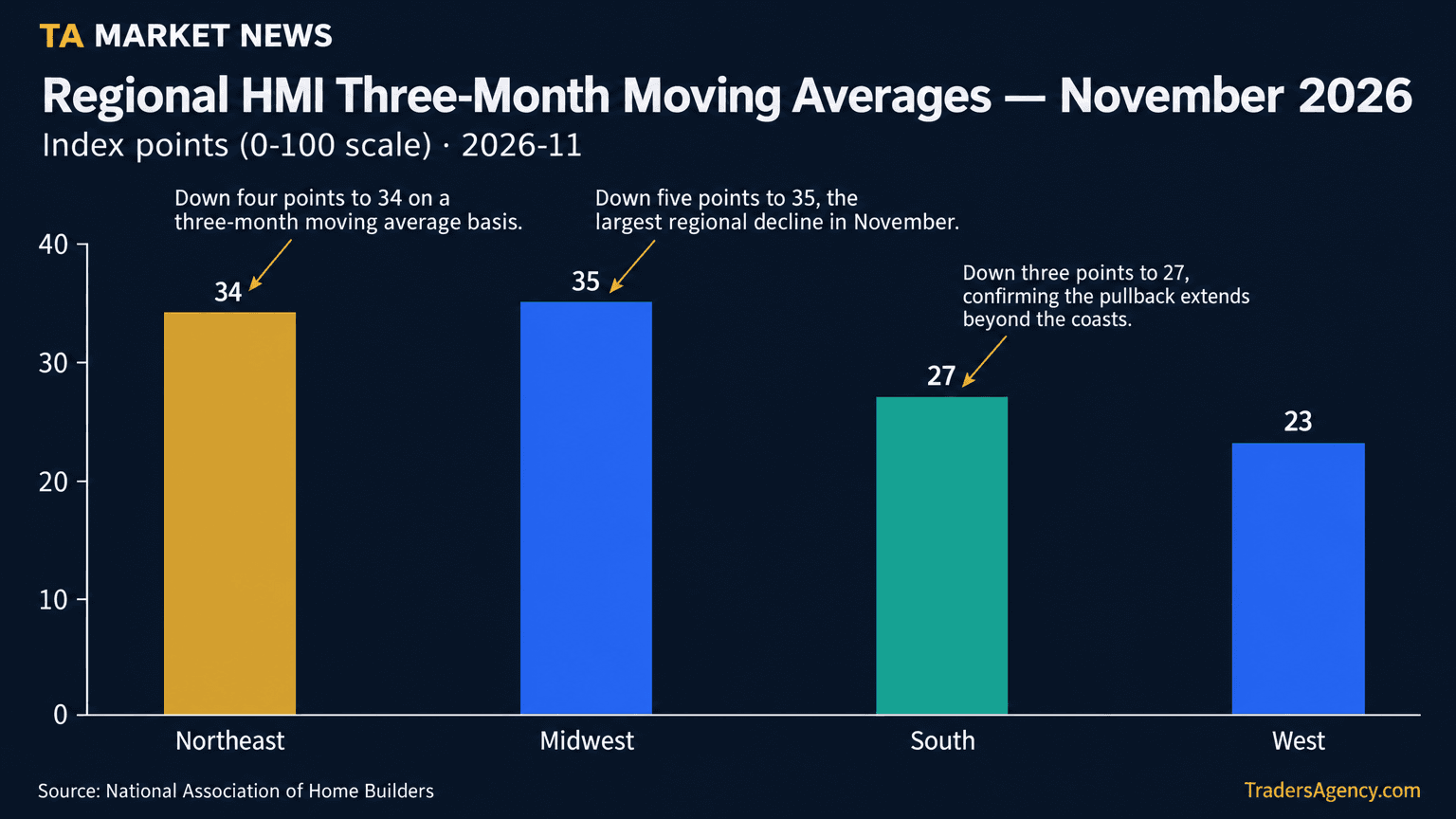
On a three-month moving average basis, every U.S. region recorded declines in November, according to NAHB. The Northeast dropped four points to 34, the Midwest fell five points to 35, the South fell three points to 27, and the West posted a three-point decline to 23. In our reading, the breadth of the pullback — covering the South and West as well as the Northeast and Midwest — suggests the sentiment decline is not confined to a single region but reflects the national affordability and demand pressures cited by NAHB.
Builders Cite Labor, Tariffs and Mortgage Rates
NAHB Chairman Bill Owens, a home builder and remodeler from Worthington, Ohio, attributed part of the strain to labor and cost pressures. "Builders are confronting multiple challenges in today's economy," Owens said in the NAHB release. "Stepped-up immigration enforcement is keeping legal workers off job sites, deepening labor shortages and driving up costs. Higher fuel prices are prompting subcontractors to raise their rates sharply, and with fewer buyers in the market, more builders are scaling back construction."
NAHB Chief Economist Robert Dietz pointed to a broader set of supply-side and demand-side headwinds. "The housing market faces a range of supply-side challenges, including building material costs pushed higher by tariffs, an ongoing shortage of construction workers and excessive regulations that undermine housing affordability," Dietz said in the release. "Mortgage rates above 7%, softer consumer confidence and an uncertain economic outlook are holding buyers back."
Mortgage rates added to the pressure around the survey period. According to CNBC, citing Mortgage News Daily, rates pulled back slightly in October but surged again in the week before the report's release, with the average 30-year fixed rate at 7.51% on Monday, compared with 6.38% a year earlier. That increase of roughly 1.13 percentage points year-over-year (7.51% minus 6.38%) raises monthly financing costs for prospective buyers even as builders cut list prices.
Permits Fall While Starts Rise
The sentiment slump arrived alongside a mixed signal from the Census Bureau's October 2026 construction report, released November 18. Privately-owned housing units authorized by building permits came in at a seasonally adjusted annual rate of 1,295,000, down 7.4% from the revised September rate of 1,398,000 and down 8.7% from the October 2025 rate of 1,418,000, per the Census Bureau. Housing starts, by contrast, rose to a seasonally adjusted annual rate of 1,309,000, up 9.9% from the revised September estimate of 1,191,000 and up 2.8% from the October 2025 rate of 1,273,000, though the Census Bureau's own margins of error on the starts figures (plus or minus roughly 17 percentage points) are wide enough to caution against reading too much into the monthly swing.
Taken together, the divergence between falling permits and rising starts complicates any single narrative about the sector's near-term trajectory. Permits, which reflect builders' forward intentions, moved down in the same direction as sentiment, while starts, which can reflect projects already in the pipeline, moved up. We would characterize the permit decline as more consistent with the sentiment data than the starts increase, though a single month of starts data is not necessarily indicative of a trend reversal.
Bottom Line
Builder sentiment's drop to a 14-year low, paired with record post-Covid levels of price-cutting and incentive use, reflects a housing market where affordability, labor costs and mortgage rates above 7% are weighing heavily on both builders and buyers. The simultaneous decline in building permits reinforces the cautious tone in the sentiment survey, even as a single month's rise in housing starts and wide statistical margins leave room for a more mixed read on where construction activity heads next.
DISCLAIMER: Traders Agency does not offer financial advice. The information provided is for educational purposes only and should not be considered financial advice. Traders Agency is not responsible for any financial losses or consequences resulting from the use of the information provided. Trading carries inherent risks and may not be suitable for all individuals. You are advised to conduct your own research and seek personalized advice before making any investment decisions, recognizing the potential risks and rewards involved.
- CNBC Top News: Homebuilder sentiment hits 14-year low, more builders drop prices · accessed Nov 18, 2026
- National Association of Home Builders: NAHB/Wells Fargo Housing Market Index (HMI) · accessed Nov 18, 2026
- National Association of Home Builders: Builder Sentiment Continues to Fall on Affordability Concerns · accessed Nov 18, 2026
- U.S. Census Bureau and U.S. Department of Housing and Urban Development: newresconst_202610.pdf · accessed Nov 18, 2026
- Meritage Homes Corporation: 0000833079-26-000135.pdf · accessed Nov 18, 2026
- Lennar Corporation: q3-2026-len-earnings-call-transcript.pdf · accessed Nov 18, 2026
See more from Traders Agency on Google
Make us a preferred source and our market analysis will appear more prominently in your Google Search, Top Stories, and AI results.
Add to Preferred Sources