
Stop-loss orders are standing instructions you place with your broker to automatically sell (or buy) a security once it reaches a specific price, capping how much a single trade can cost you. Learning how to use stop-loss orders well means more than knowing where the button is. You need to know where to set the trigger, which order type fits the situation, and why a stop sometimes fills at a price you didn't expect. By the time you finish this guide, you'll be able to place stop orders on stocks and forex pairs, choose a smart stop distance, and sidestep the setup mistakes that cost new traders real money.
We've watched traders lose sleep over positions that could have been protected with a two-minute order setup. Our goal here is to make that setup automatic for you.
What Are Stop-Loss Orders and How Do You Use Them?
Bottom Line: A stop-loss works only if the trigger price and order type match the trade, placed calmly before you're in the position rather than decided in a panic. Knowing the mechanics, where to set the distance, which order type fits, and the common setup mistakes, turns a stop-loss from a vague safety net into a reliable, automatic exit plan.
A stop-loss order tells your broker to sell or buy a security automatically once price reaches a level you set in advance. You enter a trigger price when you open or manage a position, and the order sits dormant until the market trades at that level.
Here's why we teach this early: emotions are expensive. A trader sitting on a losing position tends to hope for a bounce instead of cutting the loss, and that hope turns a small setback into a serious one. A stop-loss order takes the decision out of the heat of the moment, because you made the call earlier, while you were thinking clearly.
Key Concept: Think of a stop-loss like the circuit breaker in your home's electrical panel. It doesn't prevent every problem, but it cuts the connection before a small issue becomes a fire.
Stop-Loss vs. Stop-Limit Orders: What's the Difference?
A stop-loss order (sometimes called a stop-market order) turns into a market order once triggered, so it executes at the best available price even if that price has moved. A stop-limit order turns into a limit order once triggered, so it only executes at your specified price or better, which means it might not execute at all.
This distinction matters more than most beginners expect. With a plain stop-loss, you're guaranteed an exit but not a price. With a stop-limit, you're guaranteed a price floor but not an exit.
| Order Type | How It Behaves | Best For |
|---|---|---|
| Stop-loss (stop-market) | Triggers at your set price, fills at the next available market price | Traders who prioritize getting out over getting a specific price |
| Stop-limit | Triggers at your set price, fills only at your limit price or better | Traders worried about a bad fill in a slow or thinly traded security |
| Trailing stop | Moves with price in your favor, holds steady when price falls | Locking in gains on a trending position without manual edits |
Three Types of Stop Orders You'll Actually Use
- Stop-loss sell order: Protects an existing long position by selling if price falls to your trigger.
- Stop-loss buy order: Protects a short position (or confirms a breakout entry) by buying if price rises to your trigger.
- Trailing stop order: Automatically adjusts the trigger price as the market moves in your favor.
How Do You Set an Appropriate Stop-Loss Distance?
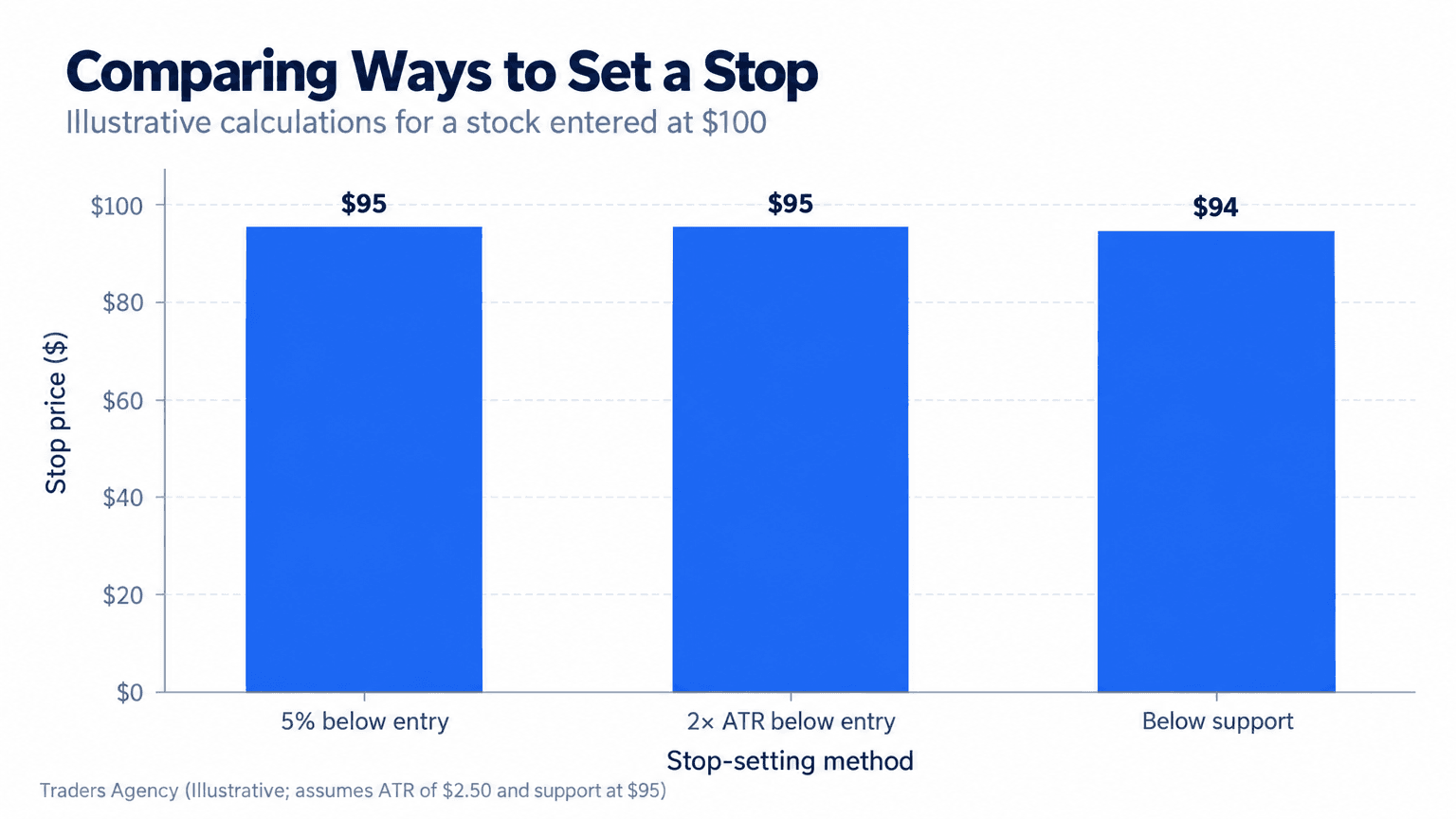
The right stop distance comes from the stock's typical price swings, not from a round number that feels comfortable. We teach three methods: the percentage method, the ATR method, and the support-level method. Each one gives you a trigger price, and in many cases those prices land close together.
1. The Percentage Method
The simplest approach. Pick a fixed percentage below your entry price, commonly 5% to 10%. Buy a stock at $100, apply a 5% stop, and your trigger sits at $95.
2. The ATR Method
ATR stands for Average True Range, an indicator that measures how much a stock typically moves in a day. If a stock carries an ATR of $2.50, a common setup is a stop at 2x ATR below entry, which on a $100 entry also lands near $95.
3. The Support-Level Method
This one uses the chart. You place your stop just below a recent support level, a price zone where buyers have previously stepped in. If support sits at $95, you might set your stop at $94 to allow a small buffer.
| Method | Inputs Used | Resulting Stop |
|---|---|---|
| Percentage (5%) | $100 entry | $95.00 |
| ATR (2x) | $100 entry, ATR $2.50 | $95.00 |
| Support level | Support at $95, $1 buffer | $94.00 |
Notice how all three methods clustered in this example. When that happens, it's a good sign your stop level is well reasoned instead of arbitrary. When the three methods disagree sharply, we treat that as a signal to re-check the chart or reduce position size.
Want expert trading insights delivered daily?
Join thousands of traders who rely on Traders Agency for market analysis and trade ideas.
Join Traders AgencyStep-by-Step: A Stop-Loss Sell Order Example
Let's walk a concrete stop-loss sell order example from setup to exit.
- Step 1: Open the Position – You buy 100 shares at $100 per share, a $10,000 position.
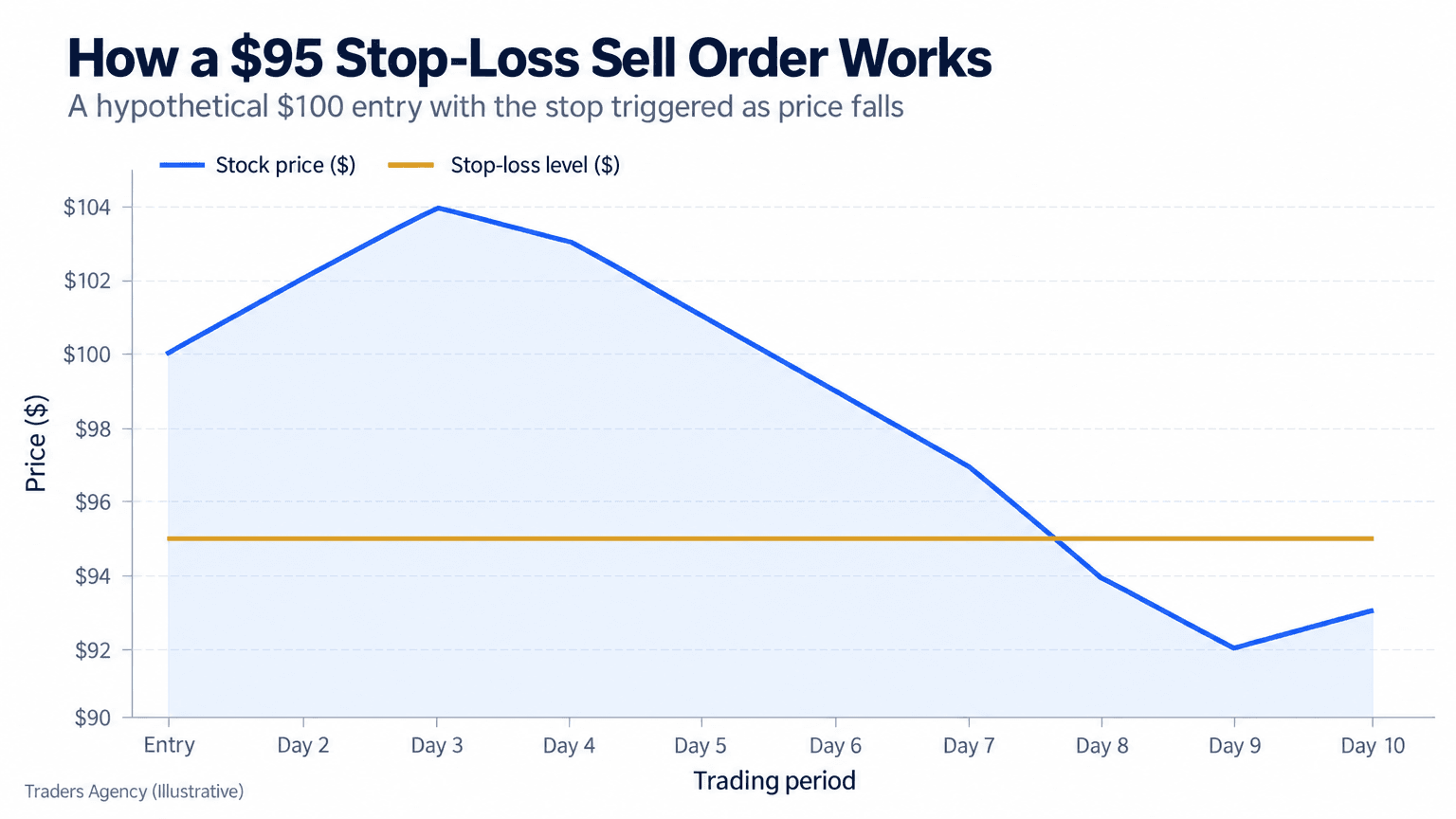
- Step 2: Choose Your Stop Distance – Using the 5% percentage method, your trigger price lands at $95.
- Step 3: Place the Order – Select "stop" or "stop-loss" as the order type, enter $95 as the trigger, set the quantity to 100 shares, and confirm.
- Step 4: Let It Work – If price falls to $95, the order triggers and sells your shares, capping the loss near $500 (5% of $10,000) before commissions and slippage.
| Parameter | Value |
|---|---|
| Entry | 100 shares at $100 |
| Position Size | $10,000 |
| Stop Method | 5% percentage method |
| Stop Trigger | $95.00 |
| Approximate Risk | $500 (before commissions and slippage) |
Now flip it around for a stop-loss buy order example, which comes up constantly when traders learn how to use stop-loss orders in forex. If you're short a currency pair at 1.1000 and want to limit damage if the pair rises, you place a buy-stop at 1.1050, roughly 50 pips of risk. If price climbs to that level, the order triggers, buys back your position, and closes the short.
What Is Gap Risk, and Why Might Your Stop Not Fill at the Right Price?
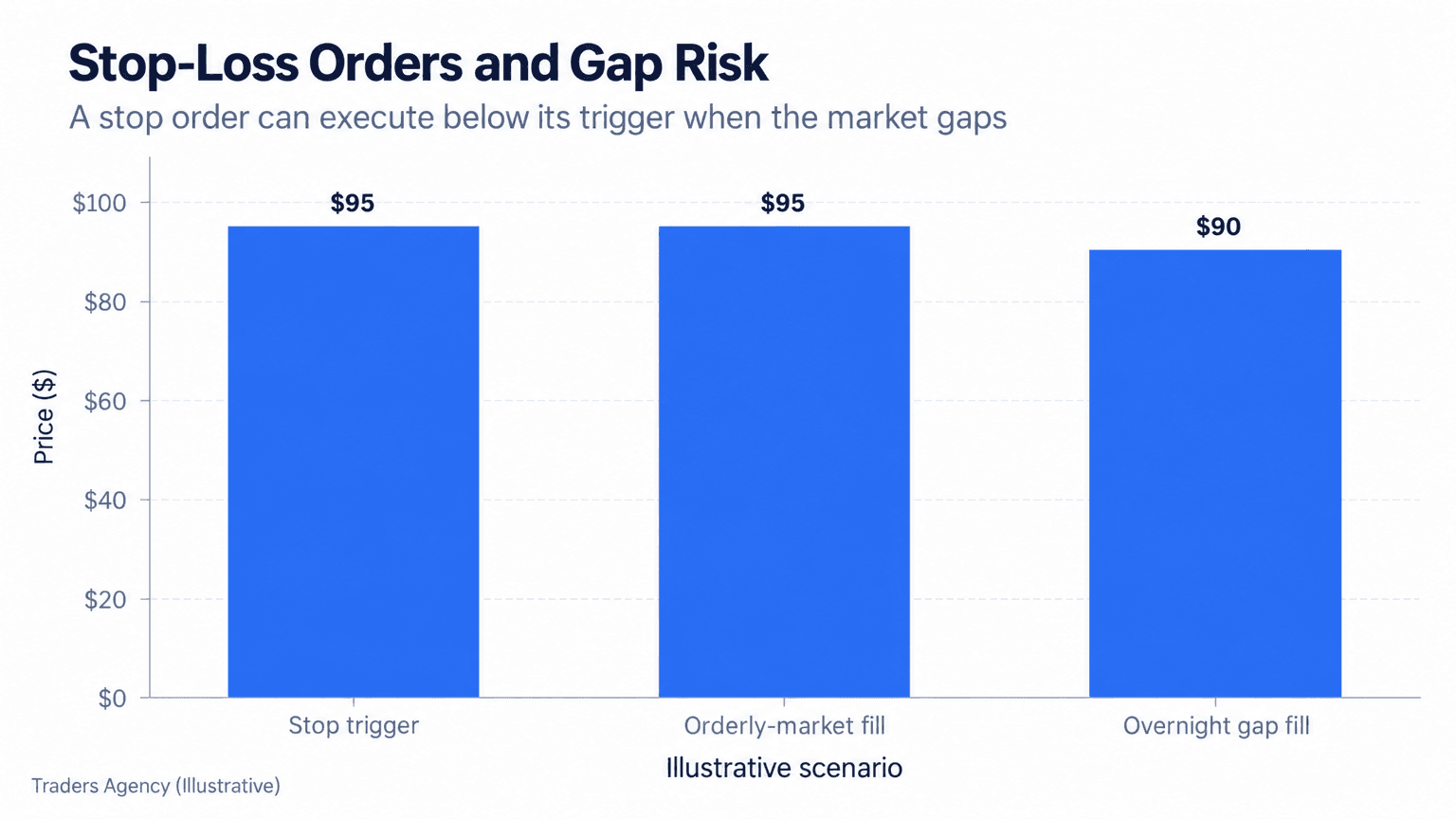
Gap risk is the chance that price jumps straight past your trigger without trading at the levels in between, usually because news hit outside market hours. Your stop-loss sell order still triggers, but it fills at the next available price, which can be meaningfully worse than the level you had in mind.
Say your stop sits at $95, the company reports disappointing earnings overnight, and the stock opens at $90. Your stop-market order becomes a market order the moment trading resumes, and it fills near $90, not $95.
| Scenario | Fill Price | Loss on 100 Shares |
|---|---|---|
| Orderly market | About $95 | About -$500 |
| Gap down on earnings | About $90 | About -$1,000 |
Watch Out: A stop order sets your trigger price, not your fill price. Once triggered, a stop order becomes a market order with no guaranteed execution price, a point the U.S. Securities and Exchange Commission makes in its investor guidance on order types. Plan your position size around that reality instead of assuming a perfect fill.
Gap risk is a real limitation worth planning around, not a reason to trade without stops. Our team sizes positions smaller ahead of earnings precisely because the stop can't do all the work.
What is a trailing-stop order?
A trailing stop-loss order moves your trigger price higher as the stock rises, then stays fixed when price falls. It locks in profit without forcing you to log in and edit the order every day.
Say you buy at $100 and set an 8% trailing stop. If price climbs to $110, your stop rises with it to roughly $101.20 (8% below the new high). If the stock then pulls back to $98, the trailing stop has already triggered near $101.20, protecting a gain instead of letting it evaporate.
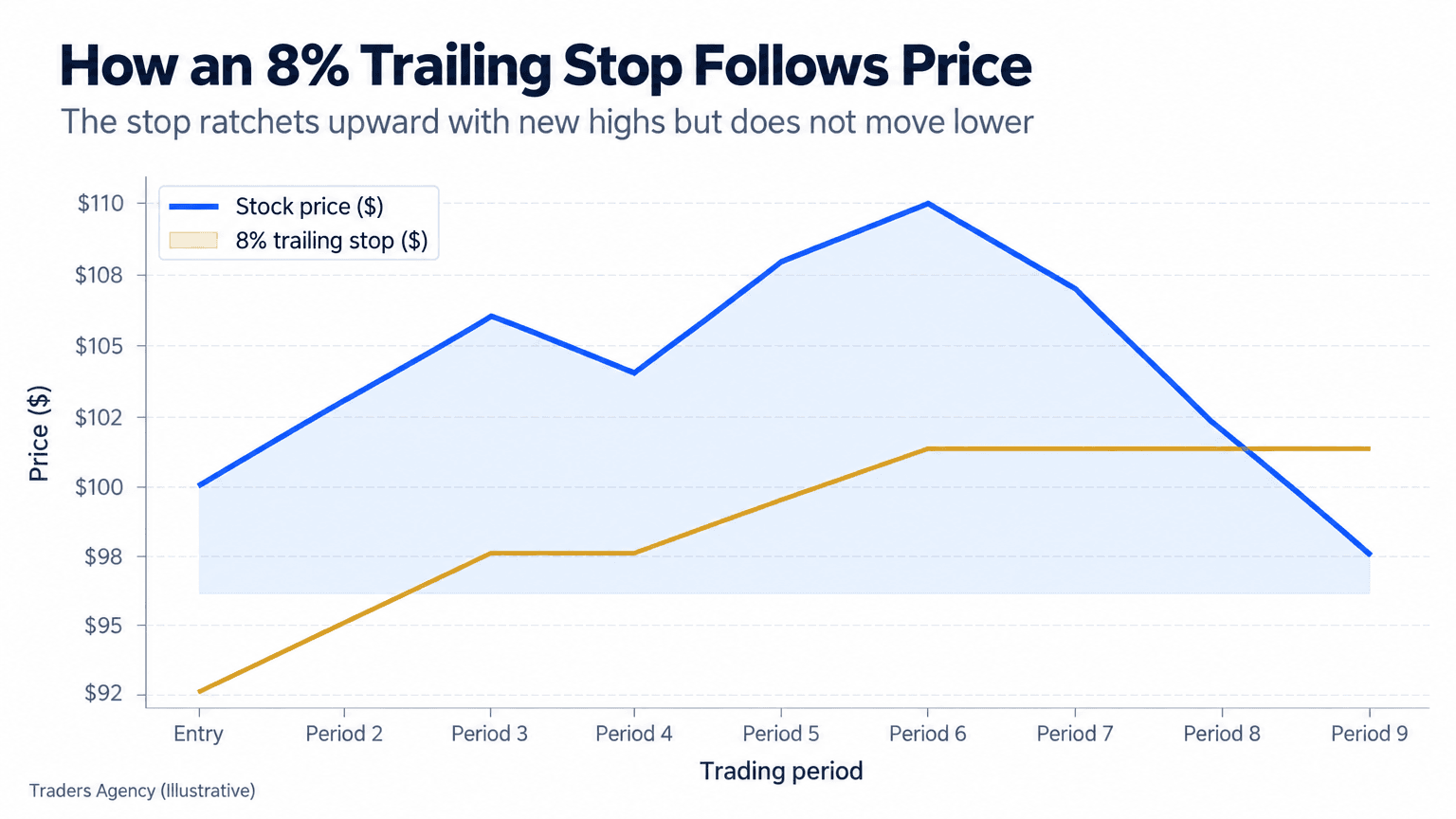
We like trailing stops on trending stocks because they let winners run while keeping an automatic exit plan in place.
What are the most common stop-loss mistakes?
Most of the damage traders blame on stop-loss orders comes from setup errors, not from the tool. These are the five we correct most often:
- Setting the stop too tight. A stop just 1% to 2% below entry usually gets hit by normal daily noise rather than a genuine trend reversal.
- Ignoring volatility. Applying the same percentage stop to a calm blue-chip and a jumpy small-cap ignores how differently those two stocks actually move.
- Parking stops at obvious round numbers. Orders cluster at prices like $50 and $100, and brief wicks through those levels can trigger your exit right before price recovers.
- Forgetting gap risk. Overnight news and earnings releases can push your fill well away from your trigger.
- Never adjusting the stop as the trade develops. A static stop on a winning trade leaves profit unprotected when a trailing stop would do the job for you.
What Is the 7% Rule for Stop-Loss?
The 7% rule is a widely used guideline: sell a stock if it falls 7% below your purchase price, before the loss has a chance to compound. It's a simplified version of the percentage method, and it works well for newer traders who want one consistent number across every trade while they build experience.
When Should You Use Stop-Loss Orders, and When Should You Skip Them?
Stop-loss orders perform best in liquid markets with steady volume, where price moves in relatively smooth steps. They're less dependable around earnings announcements, in low-volume penny stocks, and during thin overnight forex sessions, which is exactly where gap risk peaks.
Our recommendation: use a stop on every position you can't watch continuously, which describes most traders most of the time. We'd avoid tight stops on core long-term holdings you intend to hold through ordinary volatility, since getting shaken out of a good investment by short-term noise defeats the purpose.
On position sizing, we keep risk to 1% to 2% of total account value per trade, measured from entry down to the stop price. If that math forces your stop uncomfortably close to entry, shrink the position instead of tightening the stop.
Key Concept: Set the stop where the chart says the trade is wrong, then size the position so that distance costs you no more than 1% to 2% of your account. Never reverse the order of those two decisions.
Frequently Asked Questions
Why do some traders say stop losses are a bad idea?
Stop losses aren't inherently bad, but they work against you when set too tight, when triggered by routine volatility, or when a price gap fills your order well below your intended trigger.
What is the 7% rule for stop-loss?
The 7% rule suggests exiting a position once it falls 7% below your purchase price. It's a simplified take on the percentage-based stop distance method.
What are the most common stop-loss mistakes?
Setting stops too tight, ignoring a stock's volatility, placing stops at obvious round numbers, and failing to account for overnight gap risk.
How do you put in a stop-loss order?
Most brokers let you choose "stop" or "stop-loss" as the order type, then enter your trigger price, set the share quantity, and confirm, typically right alongside your existing position.
How do you use stop-loss orders in forex?
In forex, you place a stop-loss buy or sell order at a specific exchange rate, usually measured in pips from entry, so the position closes automatically if the pair moves against you.
What is a stop-loss buy order?
A stop-loss buy order triggers a purchase once price rises to a set level. Traders use it to cap losses on a short position or to confirm entry on a breakout.
The Traders Agency education team publishes new strategy guides and market analysis every week.
Want expert trading insights delivered daily?
Join thousands of traders who rely on Traders Agency for market analysis and trade ideas.
Join Traders AgencyDISCLAIMER: Traders Agency does not offer financial advice. The information provided is for educational purposes only and should not be considered financial advice. Traders Agency is not responsible for any financial losses or consequences resulting from the use of the information provided. Trading carries inherent risks and may not be suitable for all individuals. You are advised to conduct your own research and seek personalized advice before making any investment decisions, recognizing the potential risks and rewards involved.
See more from Traders Agency on Google
Make us a preferred source and our market analysis will appear more prominently in your Google Search, Top Stories, and AI results.
Add to Preferred Sources