
A sharp one-day market swing has reignited a debate worth watching closely: is investor money shifting away from the chip, memory and power-equipment companies that built the AI boom's infrastructure, toward the platforms that actually own the customers using it? One market commentator who tracks this trade argues the answer is yes, pointing to Duolingo's post-earnings surge and Uber's quarterly growth as evidence that customer-facing businesses still have room to run even as data-center politics complicate the picture for cloud giants.
A Rotation Signal, or Just One Strong Session?
The argument centers on a single trading day in which so-called "bottleneck" names such as Micron, ASML, SanDisk and Bloom Energy fell while larger platform companies including Amazon, Microsoft, Meta and Mastercard advanced. The source framed this as the start of a broader rotation: capital moving out of cyclical suppliers of AI hardware and into businesses with subscription revenue, advertising models, payment networks and recurring cloud relationships.
It's a compelling narrative, but Traders Agency analysts would caution against reading too much into one session. Daily moves this large can reflect earnings surprises, valuation resets or short-term positioning rather than a durable change in how investors price AI exposure. The semiconductor and memory names that pulled back have still posted outsized gains this year, and cyclical businesses routinely see sharp pullbacks after strong runs without that marking a permanent rotation away from them. The broader thesis, that platforms with existing customer relationships can monetize AI investment more durably than suppliers tied to hardware cycles, is a reasonable long-term debate, but it's one still being tested rather than settled.
Duolingo's Quiet Operating Recovery
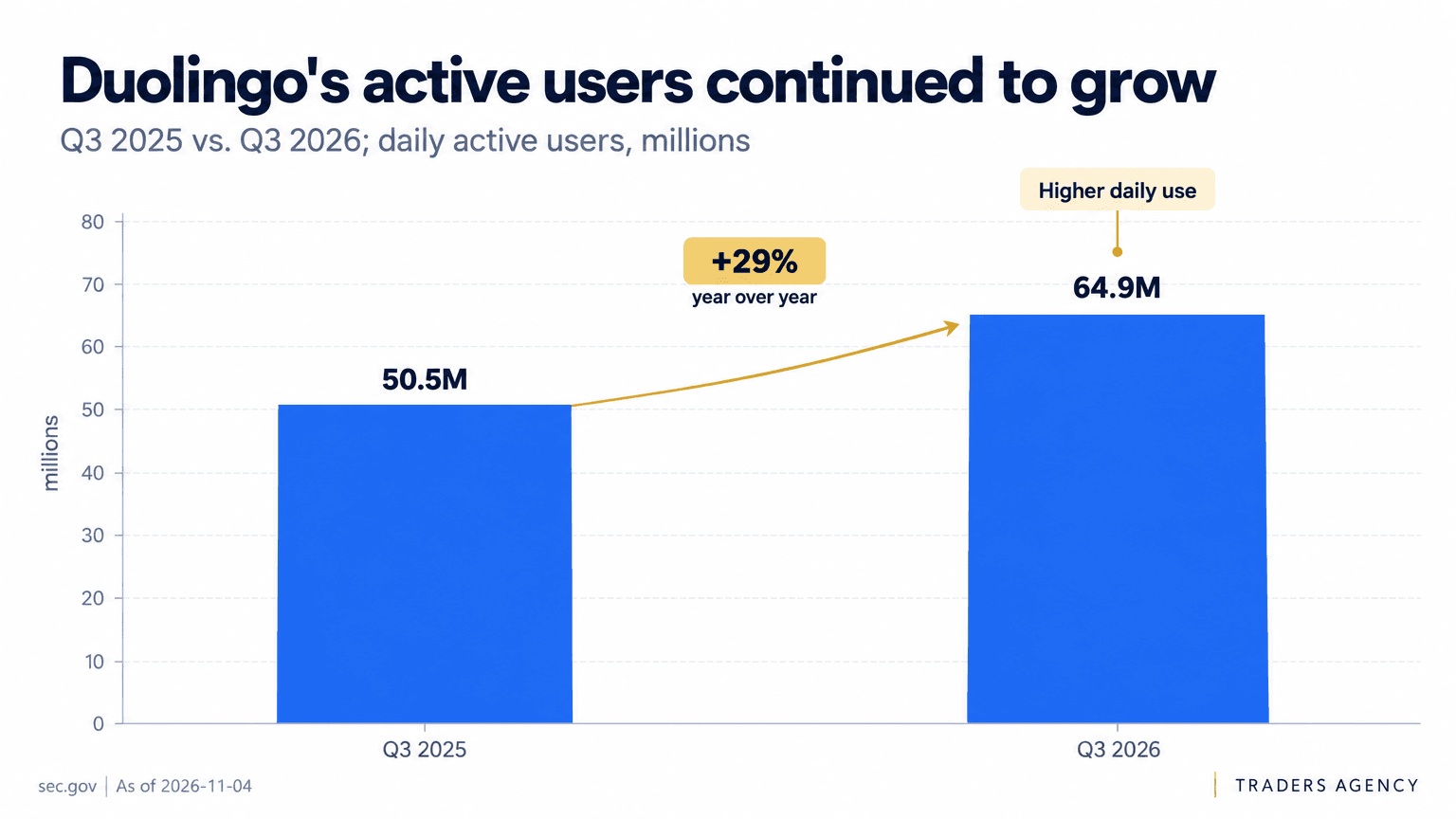
Duolingo's stock move drew particular attention after the company's latest earnings report. According to the shareholder letter, daily active users rose from 50.5 million a year earlier to 64.9 million, a 29% year-over-year increase, while paid subscribers grew 14% to 13.1 million. Sequentially, average daily active users climbed from 58.7 million in the prior quarter to 64.9 million, a notable step up in engagement momentum rather than a count of newly acquired users in three months. The company also reported that the share of monthly users converting to daily use has continued to rise.
Those figures matter because they speak directly to a persistent bear case: that generic AI chatbots could easily replace a dedicated language-learning app. The counterargument is that Duolingo's value isn't just translation, it's the structured curriculum, streaks, rankings, retention mechanics and recognizable characters that a basic AI clone doesn't replicate. The latest user growth lends some support to that view, though it doesn't eliminate ongoing questions about valuation, competitive pressure or how AI tools evolve over time.
Duolingo's November 3 shareholder letter also detailed a product change: the company is folding unlimited video calling into its Super tier and will stop selling new subscriptions to its pricier Max tier this month. Existing individual Max subscribers will move to Super family plans at the same price, with legacy Max family plans addressed in 2027. Management expects a minimal effect on near-term bookings, already reflected in fourth-quarter guidance. The company also holds cash equal to more than 10% of its market capitalization, giving it flexibility for buybacks or acquisitions.
On valuation, market-data sources put Duolingo's market capitalization at roughly $7 to $8 billion around the time of this reporting, with quarter-end regulatory disclosures implying a somewhat lower figure near $6.7 billion as of September 30. Worth noting: a smaller market cap doesn't by itself explain the stock's volatility, and a rising market cap isn't the same thing as new capital flowing into the stock. Shares have still been extremely choppy over the past year, reflecting how sentiment on a smaller company can swing sharply in either direction.
Want expert trading insights delivered daily?
Join thousands of traders who rely on Traders Agency for market analysis and trade ideas.
Join Traders AgencyUber's Growth and Its Driverless Ambitions
Uber also reported quarterly results, and CEO Dara Khosrowshahi highlighted gross bookings growth of 20% year-over-year on a roughly $60 billion base, with trips up 16%. He described current demand outpacing driver and courier supply, citing investment in building out supply in markets including India, Brazil and Canada, as well as in the U.S., through driver and courier recruitment, retention and reactivation. Independent reporting has focused mainly on the international supply constraints; the characterization of U.S. conditions remains management's own assessment rather than an independently confirmed figure.
On autonomous vehicles, Uber's management described a long-term strategy built around partnerships rather than going it alone. The company has committed more than $10 billion in capital across partners such as Waymo, Nuro, Avride and Rivian, with a stated target of more than 2,000 fully driverless vehicles by the end of 2027. Company materials describe plans to scale toward more than 10,000 vehicles by 2028 and beyond, though that figure reflects a forward-looking target rather than a locked-in outcome. Management argues that autonomous vehicles are expanding the overall mobility market rather than simply cannibalizing Uber's share, citing faster growth in mature AV markets like California and Texas. That's worth weighing against the obvious risk: if Waymo, Tesla or other robotaxi operators scale independently, Uber's negotiating leverage and economics in this space remain uncertain.
A Counterintuitive Take on Data-Center Politics
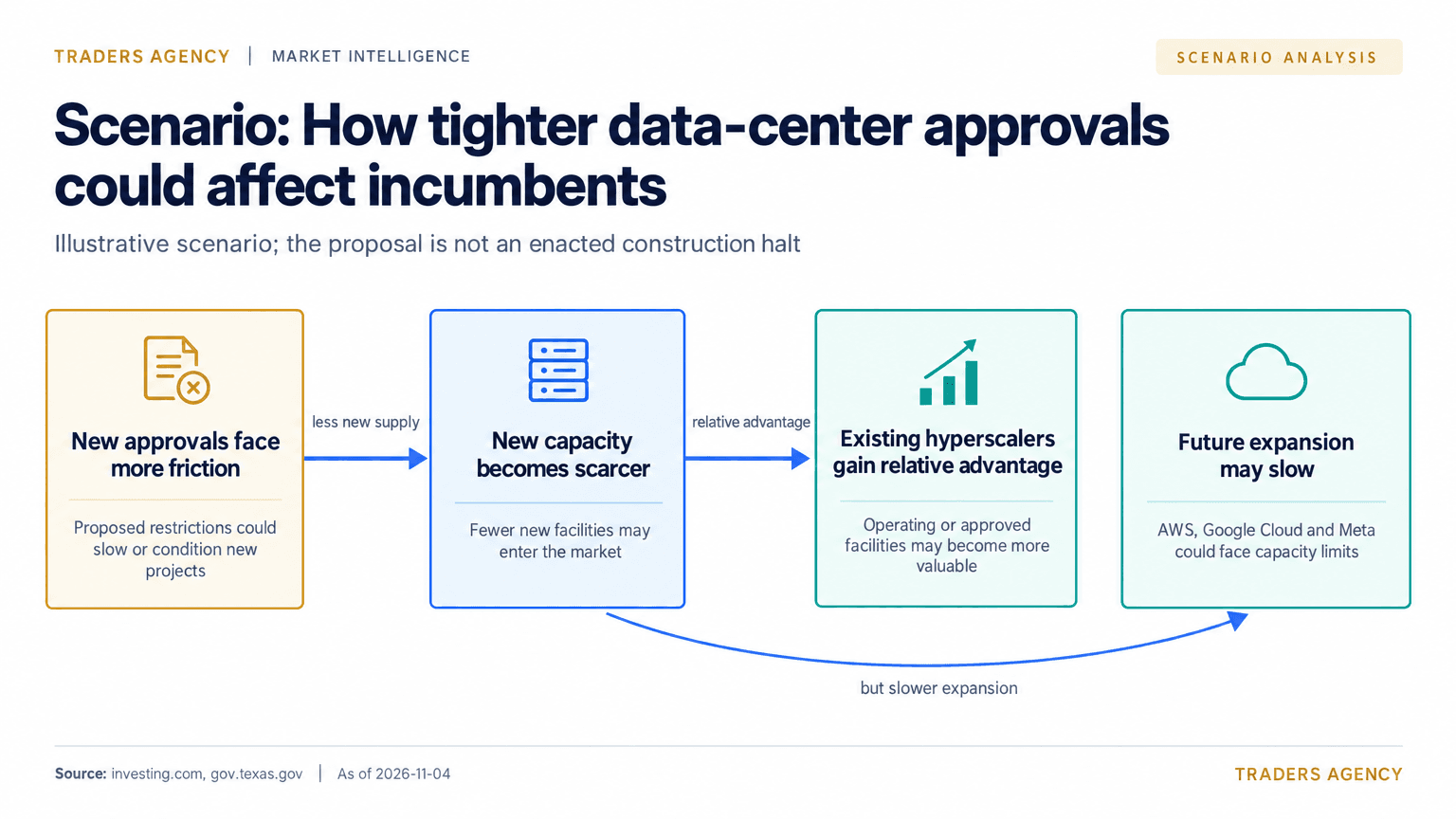
Perhaps the most provocative argument involves recent election results. Reuters reported that Texas governor-elect Gina Hinojosa, who defeated incumbent Greg Abbott, has advocated a statewide data-center moratorium, including halting new approvals until the legislature enacts additional protections. That's a meaningful policy shift to watch, though it's a proposed position rather than an enacted halt to existing construction, and the legal scope of any future moratorium remains unclear. Notably, Abbott himself had already directed state regulators to pause certain data-center permit approvals back in September, suggesting friction in this space predates this election cycle.
The source's argument is that tighter approval processes could, somewhat counterintuitively, benefit companies that already operate or have permitted data centers, since scarcity typically raises the value of existing capacity while raising the bar for new entrants. The flip side is equally real: the same restrictions could constrain future capacity growth for Amazon Web Services, Google Cloud and Meta's infrastructure buildout, trading near-term cash flow advantages for longer-term growth limits. Both outcomes are plausible, and which one dominates will depend heavily on how aggressively any new restrictions are implemented and how much demand for AI and cloud computing continues to grow in the meantime.
What This Means for Investors
The rotation narrative is an interesting lens for thinking about where AI-driven capital might move next, but it remains an interpretation of one strong trading session rather than a confirmed structural shift. Traders Agency analysts will be watching whether platform companies with recurring revenue continue to outperform infrastructure suppliers over multiple quarters, how Duolingo's user growth holds up against evolving AI tools, how Uber's international supply constraints and autonomous-vehicle partnerships develop, and how data-center permitting policy actually plays out at the state level. For now, the safest conclusion is that both the bottleneck and platform sides of the AI trade carry distinct risks and opportunities, and investors should treat any single-day move as a data point rather than a verdict.
Want expert trading insights delivered daily?
Join thousands of traders who rely on Traders Agency for market analysis and trade ideas.
Join Traders AgencyDISCLAIMER: Traders Agency does not offer financial advice. The information provided is for educational purposes only and should not be considered financial advice. Traders Agency is not responsible for any financial losses or consequences resulting from the use of the information provided. Trading carries inherent risks and may not be suitable for all individuals. You are advised to conduct your own research and seek personalized advice before making any investment decisions, recognizing the potential risks and rewards involved.
- Duolingo Market Cap & Net Worth
- Duolingo Q3 2026 Shareholder Letter
- Duolingo Q2 2026 Form 10-Q
- Duolingo Q3 2025 Form 10-Q
- Uber Announces Results for Third Quarter 2026
- Uber Q3 2026 Earnings Prepared Remarks
- Reuters: Uber's profit forecast disappoints as driver shortages, Middle East conflict hurt
- CNBC via TradePrepared: Uber beats on revenue, CEO says company is investing to add drivers
- Uber November 4, 2026 Earnings Call Transcript
- Reuters: Texas data centers face uncertain future after Hinojosa wins governor's race
- Governor Abbott Directs TCEQ To Halt Data Center Permits
See more from Traders Agency on Google
Make us a preferred source and our market analysis will appear more prominently in your Google Search, Top Stories, and AI results.
Add to Preferred Sources