A rough week for mega-cap tech earnings has reopened a familiar debate among long-term investors: how much should a company's current cash flow suffer in exchange for a shot at a much larger future? According to one portfolio analysis built around estimated fair values rather than market prices, Amazon stands out as the clearest example of that trade-off, with reaccelerating revenue growth running headlong into sharply negative free cash flow as the company funnels profits into AI infrastructure.
A Portfolio Built on Estimated Fair Value
The analysis draws a firm line between a stock's trading price, which it describes as driven largely by sentiment, algorithms and short-term momentum, and its fair value, an estimate of intrinsic worth. That estimate blends discounted-cash-flow math with subjective judgments about competitive moats, growth durability and disruption risk. The analyst is explicit that these figures are not precise mathematical conclusions but informed judgment calls that can shift meaningfully after a single earnings report.
Within that framework, the analysis groups its holdings into three broad tiers: companies it views as significantly undervalued, including Amazon, Google, Meta, Netflix, Uber and DoorDash; names trading close to estimated fair value, such as Mastercard, Microsoft, Moody's and Texas Roadhouse; and Costco, which it considers priced at a notable premium even under generous assumptions. Weighted across the full portfolio, the analyst describes the group as roughly 17% undervalued in aggregate, a scenario that assumes every single holding eventually reaches its individually estimated fair value at the same time, an assumption the analysis itself flags as far from guaranteed.
Amazon's Reacceleration Comes With a Cash-Flow Cost
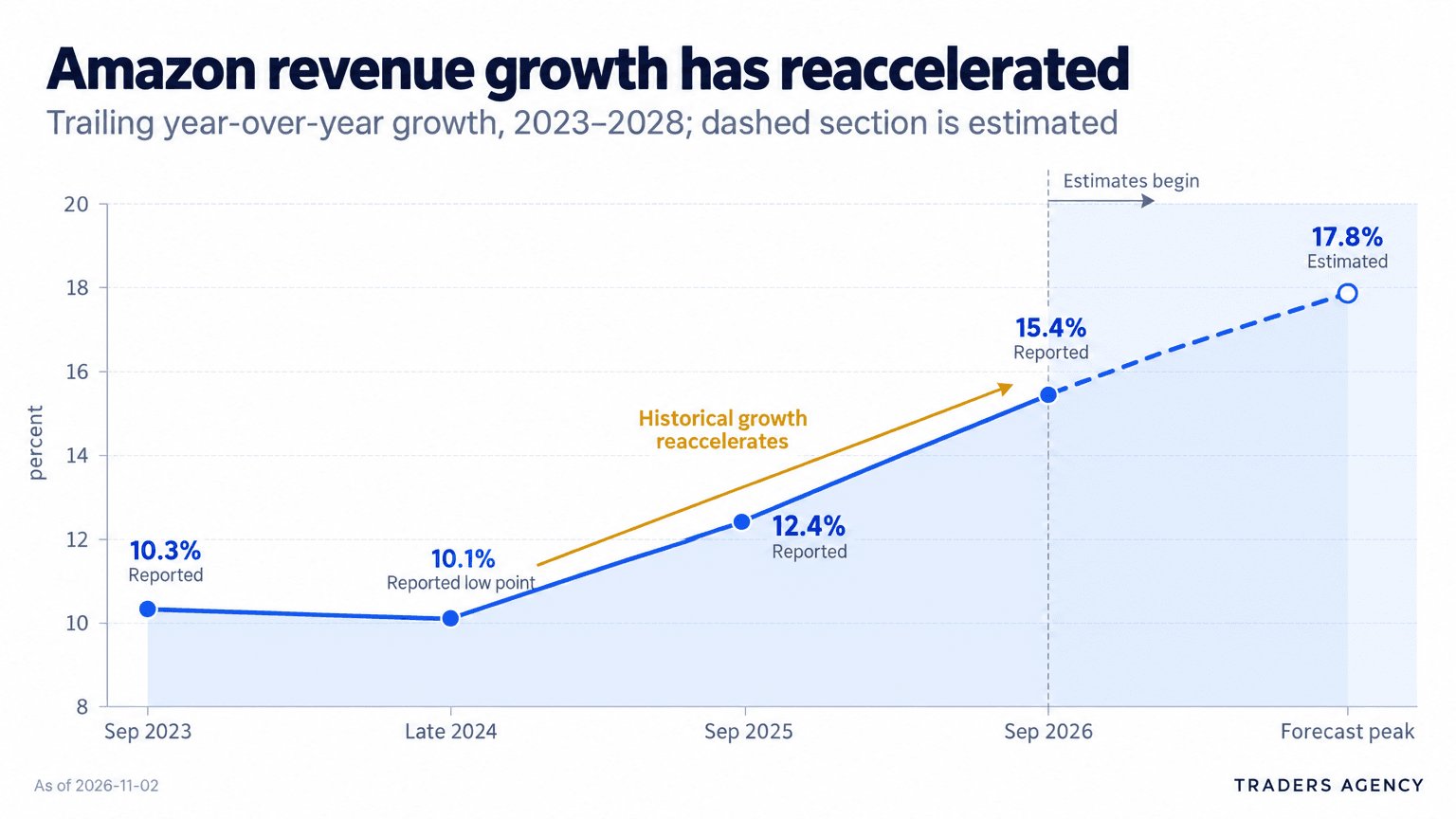
Amazon's stock fell sharply after its latest earnings release before recovering most of that move within days, a pattern the analysis treats as textbook short-term noise rather than a signal about the business. The more important story, in its view, is that revenue growth has been reaccelerating after bottoming out in 2024, with the most recent quarterly growth rate cited at roughly 15.4%, up from about 10% at the prior low point. Forward estimates referenced in the analysis suggest growth could climb further toward the high teens as AWS continues to compound off a much larger base, though those later figures remain projections rather than reported results.
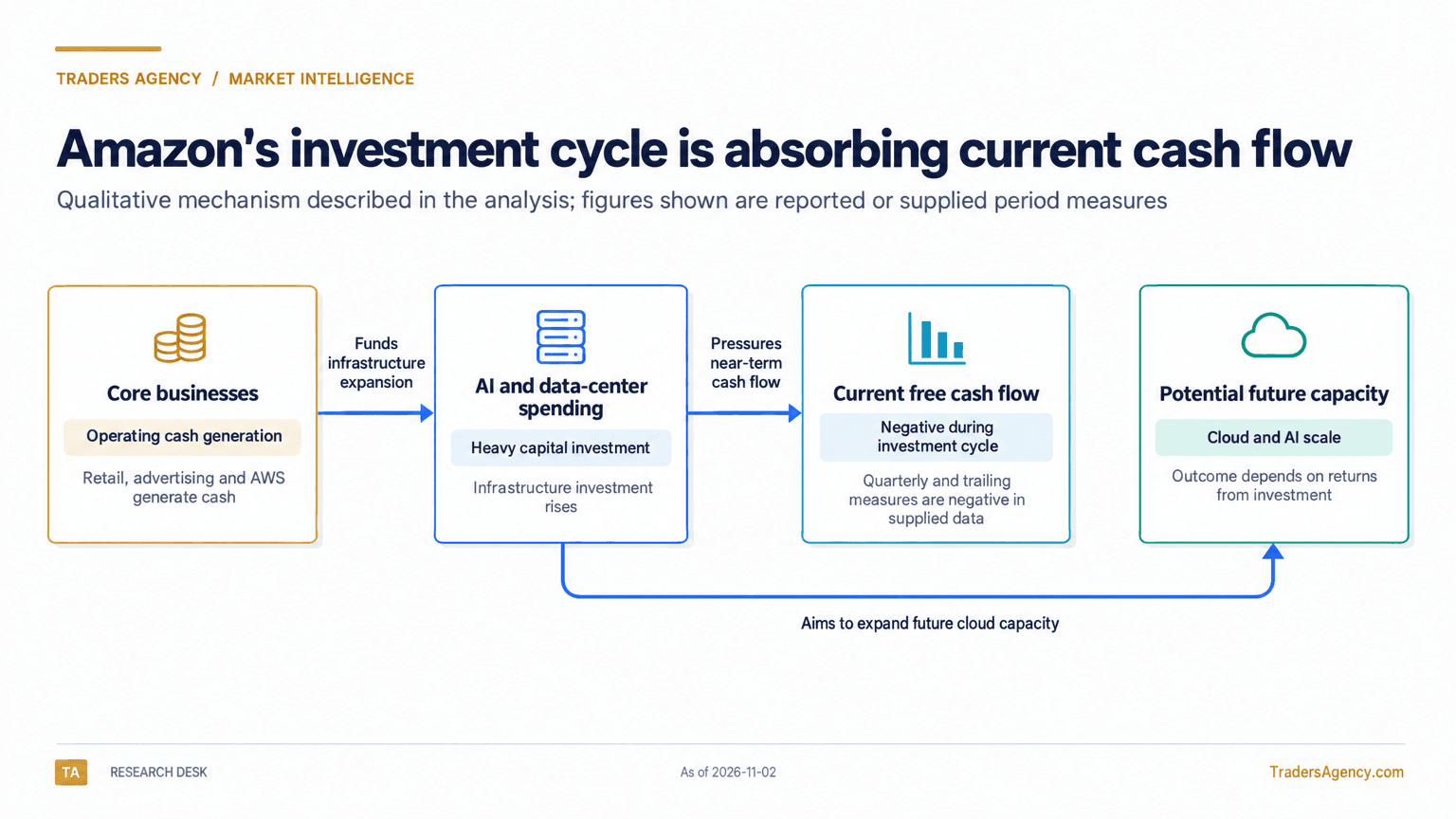
The trade-off shows up in free cash flow, which swung deeply negative in the most recent quarter and over the trailing twelve months as capital expenditures tied to data centers and AI infrastructure climbed sharply. The analysis frames this not as a sign of operational weakness but as a deliberate choice: Amazon's core retail, advertising and AWS businesses are generating substantial cash, and management is choosing to redirect nearly all of it into expanding cloud and AI capacity rather than returning it to shareholders in the near term.
AWS is the engine behind that bet: year-over-year growth ran near 39% in the latest quarter, and management commentary reportedly projects growth above 40% annually through 2027 and 2028. Amazon's chief executive is separately quoted suggesting that a large majority of global IT spending still sits on premises rather than in the cloud, implying a long runway for migration, and offering a long-range projection that AWS alone could eventually become a trillion-dollar revenue business within five to ten years. Those figures are company commentary and management projections rather than independently confirmed outcomes. Against that backdrop, the analysis assigns Amazon a fair value well above its current trading price, framing it as one of the more attractive names in the portfolio, while cautioning that the thesis depends on AI demand and cloud migration continuing to materialize as expected.
Want expert trading insights delivered daily?
Join thousands of traders who rely on Traders Agency for market analysis and trade ideas.
Join Traders AgencyGoogle, Meta and S&P Global: Same Target, Different Risks
Google's stock dropped sharply after its own earnings report, and the analysis assigns it the same dollar fair-value estimate as Amazon, though because Google's share price starts from a higher base, the implied upside is described as meaningfully smaller than Amazon's. The core concern raised is whether Google's advertising business can hold up as AI agents change how people search and shop, a question the analysis treats as unresolved rather than settled in either direction.
Meta is described in similarly bullish terms: heavy spending on AI infrastructure and products like its agentic tools is framed as building long-term strength even though it pressures near-term results, with Meta's cash-generating potential over the next decade treated as the more important variable than this year's capital expenditure. S&P Global rounds out this group as a name the analysis considers undervalued, primarily on concerns that generative AI could erode the value of its information and ratings businesses — concerns it expects to ease over time.
Debating Anthropic's Slowdown
Anthropic's first quarterly disclosure as a reporting company drew sharp commentary from outside observers, most notably investor Steve Eisman, who is quoted in the analysis as arguing that sequential revenue growth slowed dramatically and that a revenue-to-compute ratio declined, which he attributed partly to the end of a short-term spending trend sometimes called token maxing. The analysis pushes back on that interpretation, noting that triple-digit sequential growth rates are mathematically impossible to sustain indefinitely and that deceleration from an unusually high base is a normal pattern rather than evidence of weakening demand.
The analysis also points to a net revenue retention figure described as well above 900%, far exceeding the roughly 130% it characterizes as a strong benchmark among security software companies, as evidence that existing customers are spending more over time rather than pulling back. It further argues that a roughly $5 billion short-term computing expense in the quarter, tied to paying premium rates for compute outside Anthropic's typical long-term contracts, distorted the headline efficiency ratio Eisman cited. Open-weight AI models could pressure pricing over time, the analysis acknowledges, but established providers may retain an edge with enterprise customers who prioritize reliability and support over cost alone. These figures are presented as third-party commentary and company disclosures rather than independently verified facts.
Where the Rest of the Portfolio Stands
Several other holdings illustrate the range of outcomes. Mastercard and Microsoft are both described as excellent businesses trading close to their estimated fair values, leaving modest upside rather than deep discounts. Moody's is characterized similarly, having closed much of its valuation gap after a recent rally. ASML receives a fair-value estimate above its purely mathematical valuation, justified by the difficulty competitors face in replicating its lithography technology. Costco, by contrast, is viewed as expensive even under a generous fair-value assumption, still implying a premium multiple that effectively prices the business as nearly indestructible.
Netflix is framed as a potential mispricing: a scenario in which renewed investor confidence could push shares meaningfully higher is set against a downside scenario if subscriber and revenue growth continue to decelerate. Texas Roadhouse is viewed as modestly undervalued despite concerns about beef and commodity cost inflation. Duolingo's fair-value estimate was lowered after growth slowed more than expected, with an upcoming earnings report explicitly flagged as likely to move that estimate in either direction. Uber and DoorDash are both treated as long-term network-building stories, where today's elevated earnings multiples reflect a deliberate choice to prioritize growth and market share over near-term profitability — a pattern DoorDash's separately reported pursuit of an Instacart acquisition reinforces.
The Bottom Line
None of these figures should be read as price targets to trade around. They are one analyst's judgment-based estimates, built from a mix of discounted cash flow modeling and qualitative views on competitive moats that can change quickly once new earnings land. The throughline across this portfolio is a willingness to tolerate near-term financial pain, whether that is Amazon's negative free cash flow, Meta's infrastructure spending or DoorDash's high current multiple, in exchange for a belief that scale and network effects will eventually translate into outsized returns. Traders Agency analysts will be watching whether Amazon's AWS growth holds above 40% in the coming years and whether free cash flow begins recovering as capital spending plateaus, since that combination would be the clearest real-world test of the thesis described here.
Want expert trading insights delivered daily?
Join thousands of traders who rely on Traders Agency for market analysis and trade ideas.
Join Traders AgencyDISCLAIMER: Traders Agency does not offer financial advice. The information provided is for educational purposes only and should not be considered financial advice. Traders Agency is not responsible for any financial losses or consequences resulting from the use of the information provided. Trading carries inherent risks and may not be suitable for all individuals. You are advised to conduct your own research and seek personalized advice before making any investment decisions, recognizing the potential risks and rewards involved.
See more from Traders Agency on Google
Make us a preferred source and our market analysis will appear more prominently in your Google Search, Top Stories, and AI results.
Add to Preferred Sources