The latest bout of stock-market turbulence has traders asking an old question with new urgency: is this the start of something bigger, or just a sharp, contained wobble? A review of recent market commentary suggests the sell-off looks more concentrated than systemic, tied to leverage unwinds, a handful of shaky technology names and a tense standoff with Iran, rather than to any broad crack in the US economy.
Iran Diplomacy Emerges as the Market's Key Swing Factor
At the center of the current uncertainty sits Iran. According to Al Jazeera, Iranian Foreign Minister Abbas Araghchi said on October 31, 2026, that Tehran had reviewed a letter from US Vice President JD Vance and confirmed that an Iranian aide was in Doha for consultations with Qatari mediators. Araghchi was careful to rule out any imminent direct meeting with US officials, underscoring that the contact so far has run through intermediaries rather than face-to-face talks between Washington and Tehran.
Market commentary following the report characterized the shift in tone from US officials as a potentially encouraging sign, while also flagging the obvious caveat: diplomatic signaling can be exactly that, signaling, without substance behind it. Araghchi himself described the US outreach as a "positive step" but also warned it could be an attempt to sow discord, and Tehran has maintained that its core conditions remain unchanged. In other words, the mood music may have softened, but there is not yet evidence of a negotiated breakthrough. For markets, that distinction matters enormously, because the range of outcomes here is wide: a real de-escalation could remove one of the biggest overhangs on risk assets, while a resumption of military action carries the opposite risk, chiefly through its effect on oil prices.
Beneath the Headlines: Broad-Market Resilience and Hidden Leverage
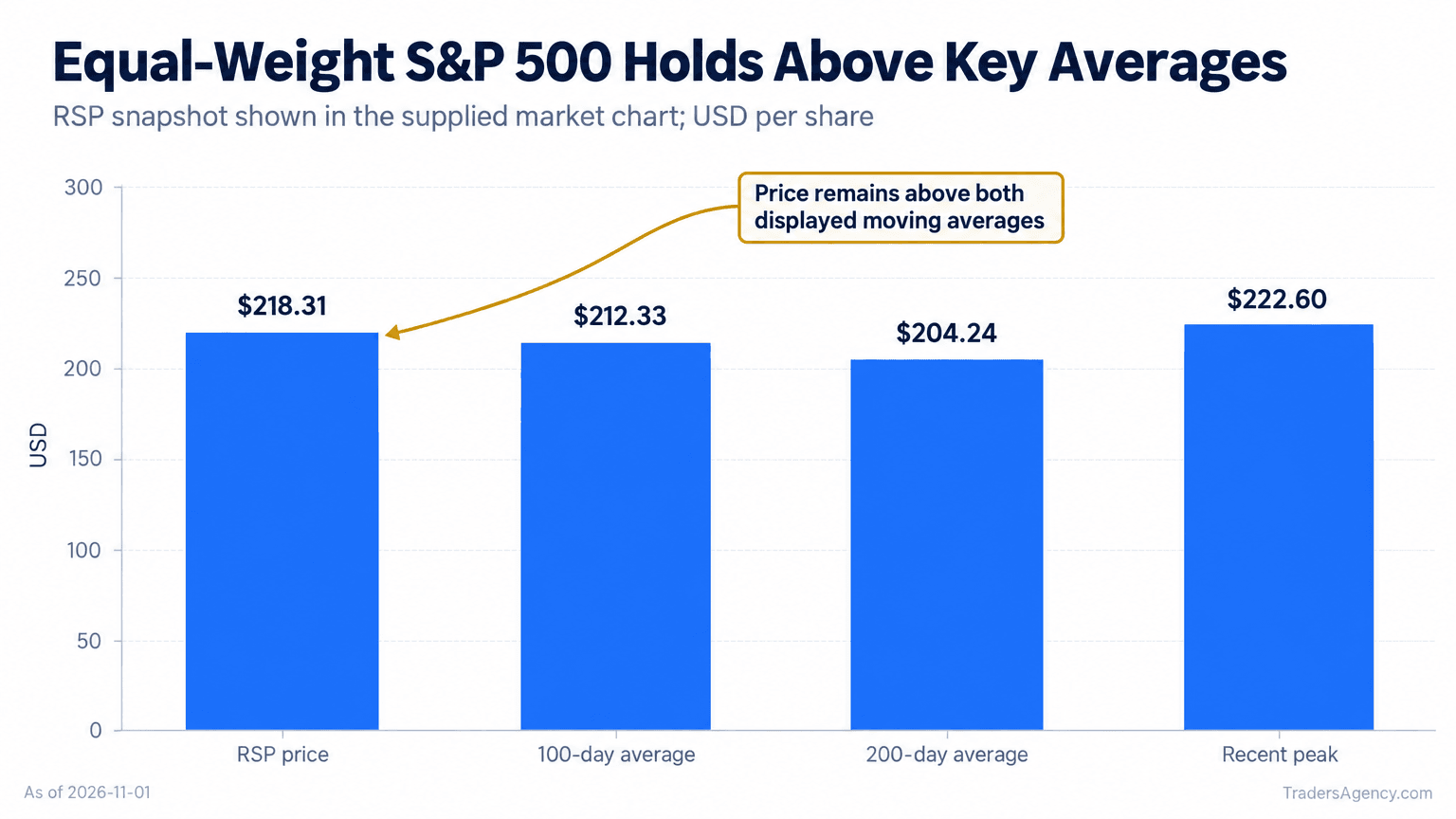
Strip away the technology headlines and the broader market tells a different story than the one dominating the news cycle. The equal-weighted S&P 500, often used by analysts as a cleaner read on how the "average" large-cap stock is doing, has remained close to its highs even as mega-cap technology names and heavily leveraged positions got hit hard. That divergence is a meaningful data point: it suggests the stress has been concentrated rather than broad-based, consistent with forced selling in crowded, leveraged corners of the market rather than a wholesale repricing of US equities.
JPMorgan's research was cited as reinforcing that reading, reportedly shifting to a tactical-growth stance even while its own sentiment gauges showed extreme fear. The bank's commentary pointed to third-quarter GDP growth cited around 3.4% alongside preliminary PMI readings consistent with roughly 5% real growth for a second straight month, arguing those figures sit awkwardly next to the idea of an economy rolling over. JPMorgan was also cited as noting that eight of the market's eleven major sectors had risen over the prior month, led by energy, consumer staples, utilities, healthcare and financials, hardly the breadth one would expect from a market in genuine distress.
Volatility measures told a more nuanced story. The VIX climbed to its highest level since tensions with Iran escalated, and options skew, the relative cost of downside protection versus upside bets, rose alongside the sell-off. Some commentary interpreted that as evidence investors were scrambling to buy hedges rather than simply dumping stock. That is a plausible read, but it is an interpretation rather than a settled fact. Skew can move for several reasons, including shifting volatility expectations and changes in option supply, and without accompanying flow data it does not rule out investors simultaneously unwinding long positions. Separately, some analysts pointed to short positioning in the Nasdaq 100 reportedly reaching its highest level since 2023, and to retail investors reportedly directing record sums into leveraged ETFs, a dynamic that cuts both ways: it can reflect genuine optimism, but it also raises the odds of forced selling if sentiment turns.
AI Trade Jitters: Company-Specific Trouble or Bigger Warning?
Much of the recent angst has centered on a handful of high-profile names. Weakness in shares of Google and Intel has been widely read as evidence that the artificial-intelligence investment cycle is cracking. A closer look suggests a more company-specific story. Intel's soft results were attributed in market commentary to elevated memory-chip prices, which were described as weighing on consumer PC demand — a supply-chain issue rather than a referendum on AI spending broadly. Momentum-driven "AI basket" stocks have also seen sharp pullbacks, which tends to happen mechanically once a crowded trade loses steam, independent of whether the underlying investment theme is actually deteriorating.
That said, the AI story carries a longer-term wrinkle worth watching regardless of near-term price action: the possibility that automation gradually erodes certain categories of employment and pricing power for workers. That is a structural, slow-moving risk rather than a trading signal, but it is a reasonable argument for why investors should track labor-market data alongside quarterly earnings as the AI buildout matures.
Want expert trading insights delivered daily?
Join thousands of traders who rely on Traders Agency for market analysis and trade ideas.
Join Traders AgencyHealthcare's Quiet Outperformance Highlights the Case for Diversification
While hardware and chip stocks have grabbed attention, healthcare has quietly had one of its stronger years. According to recent sector commentary, forward price-to-earnings ratios for major pharmaceutical companies have converged with those of the broader S&P 500, and healthcare has been cited as the second-best-performing sector of the year. That performance has helped offset some of the damage concentrated in hardware-related names for diversified portfolios.
The broader lesson is a familiar one but worth repeating in moments like this: concentration risk cuts both ways. A portfolio tilted heavily toward hardware and chip exposure will feel every tremor in that corner of the market, while a more balanced allocation across sectors can smooth some of that volatility, even though diversification offers no protection against a genuinely broad market decline.
Oil Tail Risk and the Midterm Wildcard
The scenario markets are most wary of is a renewed military escalation involving Iran. TS Lombard was cited as warning that a resumption of conflict after the US midterm elections could create a 1970s-style tail risk for oil, with prices potentially climbing above $140 a barrel in a severe disruption scenario. It is worth stressing that this is a stated downside scenario rather than a base-case forecast, and the probability of such an outcome is highly uncertain given how fluid the diplomatic situation remains.
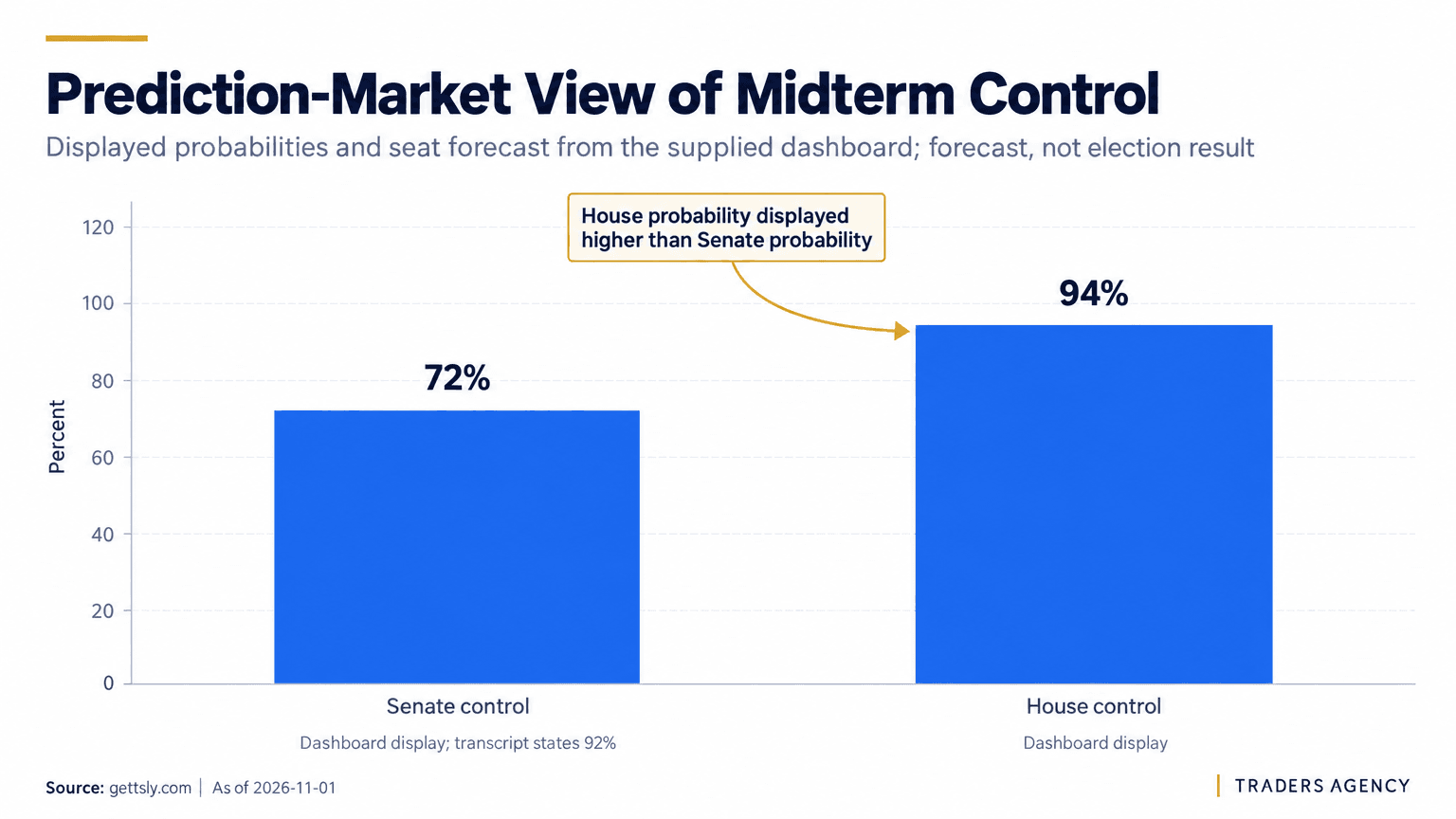
Politics adds another layer of complexity. Goldman Sachs was cited as assigning roughly a 65% probability to a complete Democratic sweep in the midterm elections. A prediction-market dashboard referenced in the same commentary showed a high probability, around 94%, of Democratic control of the House, while estimates for Senate control varied depending on the snapshot cited, underscoring that these are market-implied odds rather than certified outcomes and should be read with appropriate caution. Some commentary speculated that shifting Republican rhetoric toward favoring an Iran deal could be linked to concerns about midterm losses, though that remains speculative framing rather than a confirmed political dynamic.
What Traders Agency Analysts Are Watching
The through-line in this episode is that market stress has so far looked contained to specific pockets, leveraged positioning, momentum-driven AI trades, and headline-grabbing single names, rather than evidence of a broader economic breakdown. Traders Agency analysts will be watching two things closely in the weeks ahead: whether contact between Washington and Tehran moves beyond mediated consultations toward something more substantive, and how oil markets react to any escalation or de-escalation headlines, given how directly that commodity feeds into the broader risk picture. Investors navigating this environment may find it useful to distinguish between genuine economic deterioration and the kind of concentrated, leverage-driven volatility that tends to resolve once crowded positions finish unwinding, while keeping a close eye on how the Iran situation develops from here.
Want expert trading insights delivered daily?
Join thousands of traders who rely on Traders Agency for market analysis and trade ideas.
Join Traders AgencyDISCLAIMER: Traders Agency does not offer financial advice. The information provided is for educational purposes only and should not be considered financial advice. Traders Agency is not responsible for any financial losses or consequences resulting from the use of the information provided. Trading carries inherent risks and may not be suitable for all individuals. You are advised to conduct your own research and seek personalized advice before making any investment decisions, recognizing the potential risks and rewards involved.
- Iran FM says US outreach a ‘positive step’ as delegation in Qatar for talks
- Mediators continue US-Iran negotiations amid war rhetoric: What we know
- Iran and US explore diplomacy amid rising threats of war
- Iran Foreign Update Emerges as a Major Turning Point in the Ongoing Crisis
- 2026 market outlook: A multidimensional polarization
See more from Traders Agency on Google
Make us a preferred source and our market analysis will appear more prominently in your Google Search, Top Stories, and AI results.
Add to Preferred Sources