Wall Street heads into Tuesday's inflation report with two competing stories running in parallel. One is about interest rates: whether a softer Consumer Price Index reading takes pressure off the Federal Reserve ahead of its December meeting. The other is about artificial intelligence: whether the enormous sums hyperscalers are committing to data centers and chips are being matched by real, durable revenue. Both debates are unresolved, and both will shape how investors position through the end of the year.
Tomorrow's CPI Report and the December Rate Decision
Economists cited in market commentary expect headline CPI to rise 0.3% month over month, a step down from 0.6% the prior month, partly reflecting recent softness in oil prices. Core inflation and the breadth of price pressure across categories are expected to matter more to policymakers than the headline figure alone. According to the commentary, the share of inflation categories running at 3% or higher year over year had narrowed from roughly 54% to 50% in recent readings, and a further move toward 45% would be read as a signal that the case for a December hike is weakening.
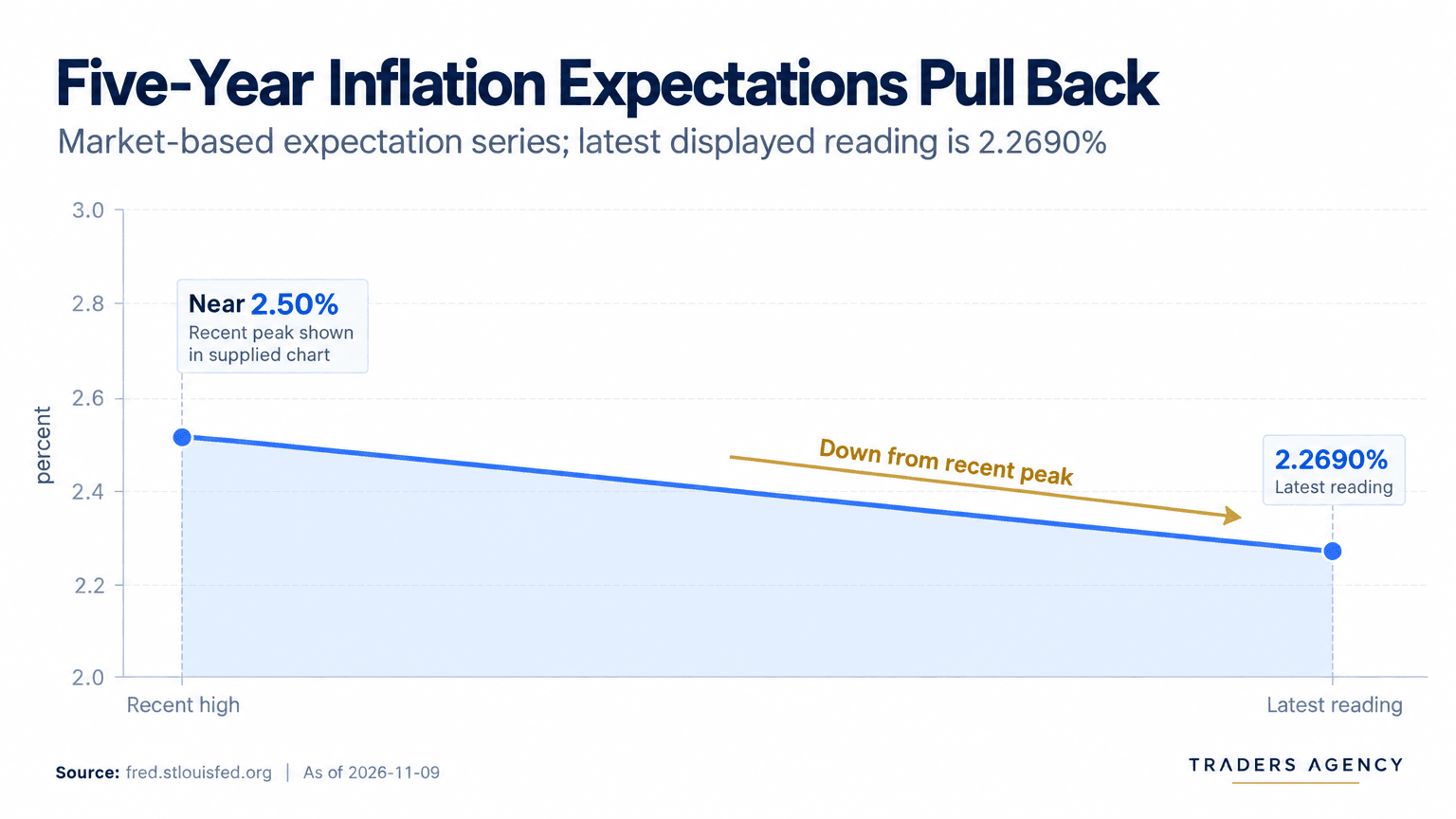
Rate markets have reportedly been pricing a high probability of another Fed hike in December, alongside additional tightening extending into 2027, a view that commentators tie to recent hawkish remarks from Fed officials concerned about persistent inflation and an overheating data-center buildout. At the same time, some analysts argue that tighter financial conditions following last week's equity sell-off, combined with a pullback in five-year inflation expectations toward earlier lows, reduce the urgency for the Fed to tighten further. These are reported market-based signals and interpretations rather than settled outcomes, and Tuesday's data, followed by Friday's Producer Price Index release, is widely seen as the next real test of that narrative.
AI Infrastructure Spending: Demand Versus Regulation
Beyond rates, the bigger structural debate is whether AI infrastructure spending can keep growing at its current pace. Bank of America has argued that end-user demand, rather than regulation, will ultimately determine the trajectory of AI capital expenditure. In that framing, increased regulatory scrutiny following recent midterm election results could slow the investment boom only marginally, with the more decisive factor being whether demand indicators continue to support aggressive spending plans.
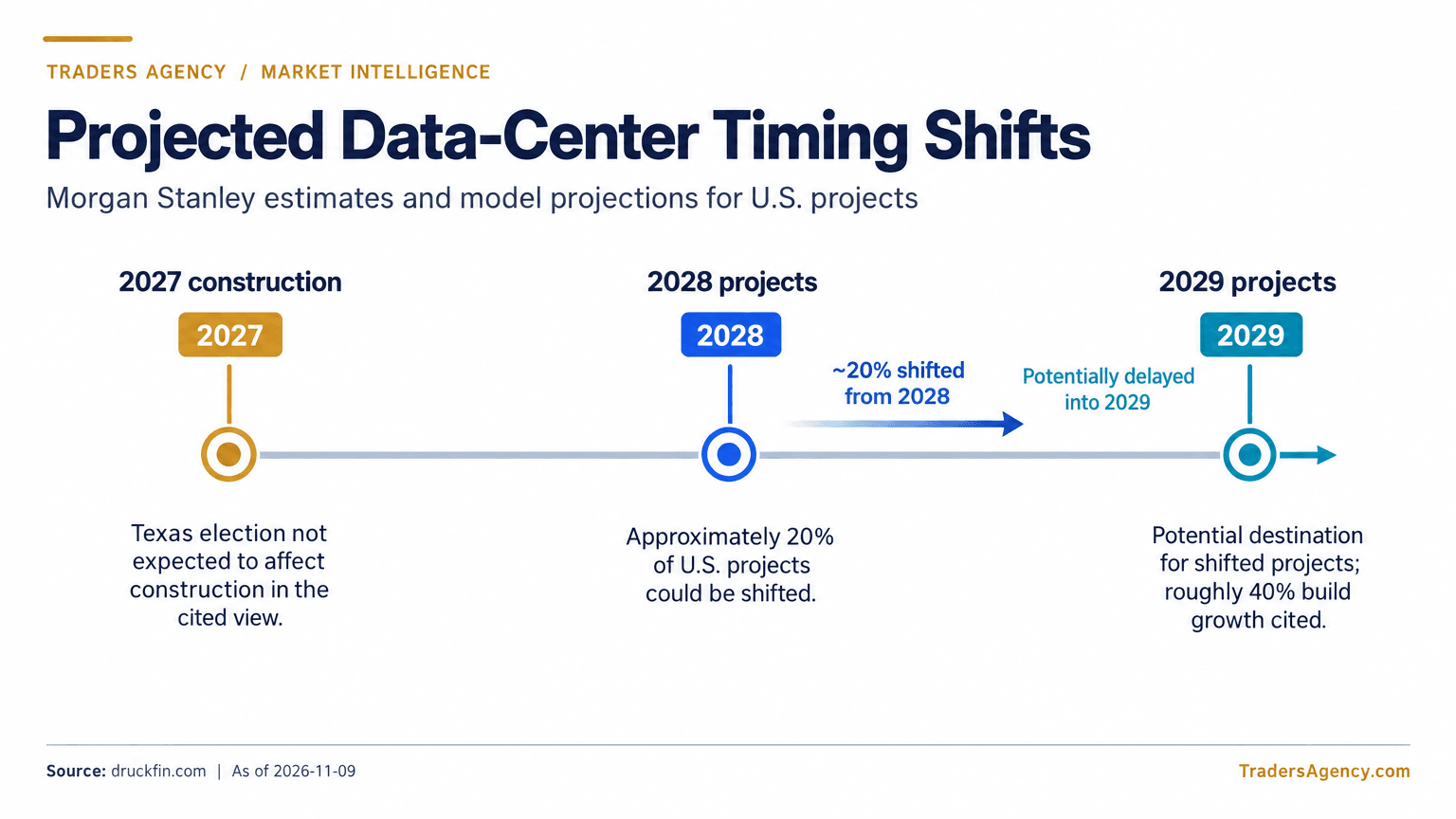
Morgan Stanley's research has offered a similar, more granular view. The firm reportedly does not expect state-level election outcomes to affect data-center construction already underway for 2027, since many of those permits are already approved. It has suggested, however, that a new project review process could push roughly 20% of U.S. data-center builds originally planned for 2028 into 2029, with a model projecting a powered-data-center shortfall of more than 30% through 2028 before construction accelerates again. The firm has reportedly concluded that this scenario favors the largest, best-capitalized technology companies, which are better positioned to absorb delays than smaller competitors.
Hyperscaler Capex and the Push Into Enterprise Software
The scale of spending at the center of this debate is considerable. Market estimates put 2026 capital expenditure at roughly $220 billion for Amazon, $200 billion for Alphabet and $170 billion for Microsoft, underscoring how much is riding on continued demand. Morgan Stanley has reportedly expressed a preference for Amazon, Meta, Microsoft, SpaceX and Nvidia among AI-exposed names, alongside select semiconductor and infrastructure companies it views as advantaged by scale and compute efficiency, though these are third-party research views rather than independently confirmed outcomes.
Part of the bullish logic is that value is shifting from raw model training toward software that helps enterprises actually deploy AI. Meta, for instance, has reportedly begun building a dedicated enterprise sales organization and pursuing relationships with consulting firms and systems integrators to sell AI products to large companies, a strategy commentators compare to how cybersecurity and infrastructure software firms court recurring enterprise revenue. Not every infrastructure relationship is static, either: reporting in early November confirmed that Microsoft is winding down a 2023 arrangement to rent AI cloud capacity from Oracle. Commentary has interpreted that shift as Microsoft recalibrating its infrastructure needs away from training capacity and toward agent-based workloads, though that explanation reflects market interpretation rather than anything the company has confirmed.
Want expert trading insights delivered daily?
Join thousands of traders who rely on Traders Agency for market analysis and trade ideas.
Join Traders AgencyThe Anthropic Debate: Committed Spending Versus Revenue Reality
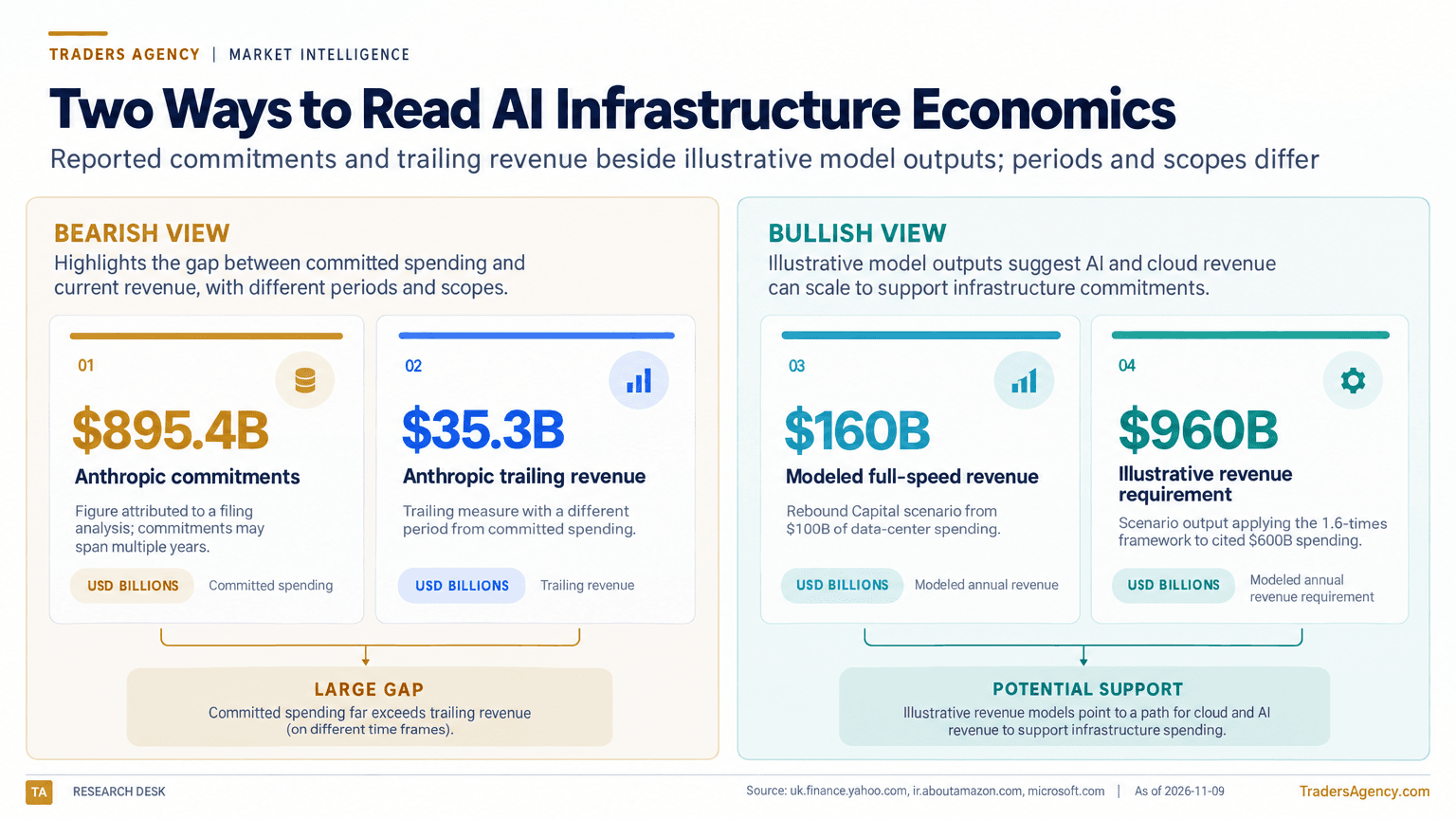
Nowhere is the tension between AI optimism and AI skepticism sharper than in the debate over Anthropic. Critics, including analysis attributed to investor Michael Burry, have pointed to a gap between roughly $895.4 billion in committed spending disclosed in an amended filing and about $35.3 billion in trailing revenue, arguing the mismatch reflects excessive optimism. Supporters counter that Anthropic's spending commitments reportedly extend out to 2045, meaning the near-term cash burden is considerably smaller than the headline figure suggests, and that proceeds from a reportedly anticipated initial public offering could further help bridge the gap, though that IPO remains a forward-looking scenario rather than a confirmed event.
Growth trends add nuance to both sides. Anthropic's quarter-over-quarter revenue growth reportedly slowed to around 46.7% in the third quarter of 2026, down from roughly 144% in the prior quarter, a deceleration bears see as evidence that demand is not keeping pace with spending commitments. Separate analysis has suggested that revenue generated per dollar of compute spending declined from roughly $2.08 to $1.72, with more than 70% of major labs' compute estimated to go unused for paid inference, a pattern that, if accurate, would raise real questions about near-term monetization even as usage grows.
On the bullish side, one model attributed to Rebound Capital assumes that $100 billion of data-center spending can eventually generate about $160 billion of annual revenue once fully utilized, a 1.6-times ratio. Applying that same ratio illustratively to the roughly $600 billion the major cloud providers are expected to spend this year would imply a need for around $960 billion in annual cloud revenue, compared with a cited current run rate near $380 billion. That comparison should be read as a scenario rather than an accounting requirement, since the spending and revenue figures involved cover different scopes and time periods. Separately, consensus estimates cited by Goldman Sachs reportedly show Big Five AI capital-expenditure growth slowing from roughly 96% this year to 44% next year, a deceleration that bulls argue does not necessarily imply slower AI revenue growth, since capex and monetization can move on different timelines.
Copper and the Broader Positioning Debate
The disagreement over AI economics extends into adjacent markets. Citi has reportedly taken a bearish stance on copper, while some commentators expect the metal to become more attractive toward the end of the first quarter of next year, once there is greater clarity on how much a divided Congress can actually constrain infrastructure and growth policy. That view remains a forward-looking scenario rather than a settled forecast, and it illustrates a broader point in this debate: a slower rate of AI capital-expenditure growth would not automatically translate into slower AI revenue growth if demand and monetization continue to improve even as the pace of new building moderates.
Where This Leaves Investors
The next few weeks offer a genuine test of both narratives at the center of this market. A softer CPI print would ease pressure on the Fed and could extend the rebound in AI-sensitive stocks, while a hotter number would revive concerns about a December hike. On the AI side, the real resolution will not come from a single data release but from whether hyperscaler earnings, cloud backlogs and enterprise software adoption continue to show revenue catching up with commitments. Traders Agency analysts will be watching core CPI trends and upcoming hyperscaler capital-expenditure disclosures closely, since both will help determine whether the current optimism around AI infrastructure spending is being validated by demand, or whether the gap between committed spending and realized revenue becomes harder to ignore.
Want expert trading insights delivered daily?
Join thousands of traders who rely on Traders Agency for market analysis and trade ideas.
Join Traders AgencyDISCLAIMER: Traders Agency does not offer financial advice. The information provided is for educational purposes only and should not be considered financial advice. Traders Agency is not responsible for any financial losses or consequences resulting from the use of the information provided. Trading carries inherent risks and may not be suitable for all individuals. You are advised to conduct your own research and seek personalized advice before making any investment decisions, recognizing the potential risks and rewards involved.
- Federal Reserve (Fed) December rate hike probability rises to 84%
- Schedule of Selected Releases 2026
- Consumer Price Index News Release — September 2026
- FRED: Five-Year Breakeven and Forward Inflation Measures
- AI too vital to slow, too fast to regulate: BofA
- Morgan Stanley: The Midterm Shock Pushes 5 GW of US Data Centers Into 2029
- Meta Plans Sales Team, Consulting Partnerships to Win Over Big Companies
- Microsoft Ends Deal to Rent Cloud Servers from Oracle
- Microsoft Winding Down Oracle Deal to Rent AI Cloud Capacity
- Amazon Third Quarter 2026 Earnings Release
- Microsoft Fiscal Year 2027 First Quarter Earnings Conference Call
- Michael Burry says Anthropic is betting its entire existence on optimism
- Anthropic Q3 Revenue Jumps Nearly 50%—So Why Did Pre-IPO Contracts Fall?
- Anthropic revenue per dollar of compute expense
- Goldman Sachs Research Analysis: S&P 500 Q3 Earnings and AI Capex
See more from Traders Agency on Google
Make us a preferred source and our market analysis will appear more prominently in your Google Search, Top Stories, and AI results.
Add to Preferred Sources