
Nvidia enters mid-November 2026 juggling two very different storylines. One involves a personal admission from CEO Jensen Huang and a board-level national-security review. The other involves longstanding questions about whether Nvidia's chips are reaching China through intermediaries despite the company's export restrictions. Neither story, on its own, has been shown to establish wrongdoing by Nvidia. Together, they raise a more practical question for investors: does any of this change the company's leadership, its China strategy, or its financial position enough to matter.
The Admission and the Board's Response
On November 8, 2026, Huang sent a message addressed to his family, Nvidia colleagues, the board, partners and shareholders acknowledging that he had been unfaithful to his wife. The apology, confirmed by Reuters, did not name the other individual but referenced national-security concerns raised in recent news reports. Huang wrote that Nvidia's board had initiated an independent investigation into those concerns and said he would cooperate fully. Nvidia's board separately stated it had no reason to believe U.S. national security or the company's confidential information had been compromised, a qualified assessment rather than a final legal finding.
News reports have identified the other individual as Alice Huang, also known by her Chinese name Huang Le, a Chinese citizen and former executive at Singapore-based Megaspeed International who is not related to Jensen Huang. Congressional correspondence referenced in reporting has described her as a "publicly reported PRC intelligence asset," and some commentators have separately speculated, without confirmation, that the relationship may have grown out of Megaspeed's chip-purchasing ties to Nvidia. Neither the intelligence-asset characterization nor that speculation has been independently established as fact. Separately, in comments reported in late October 2026, Huang described his business interactions connected to Megaspeed as "completely normal and not unusual," a denial tied specifically to the commercial relationship rather than the personal one.
Unanswered Questions About China Chip Access
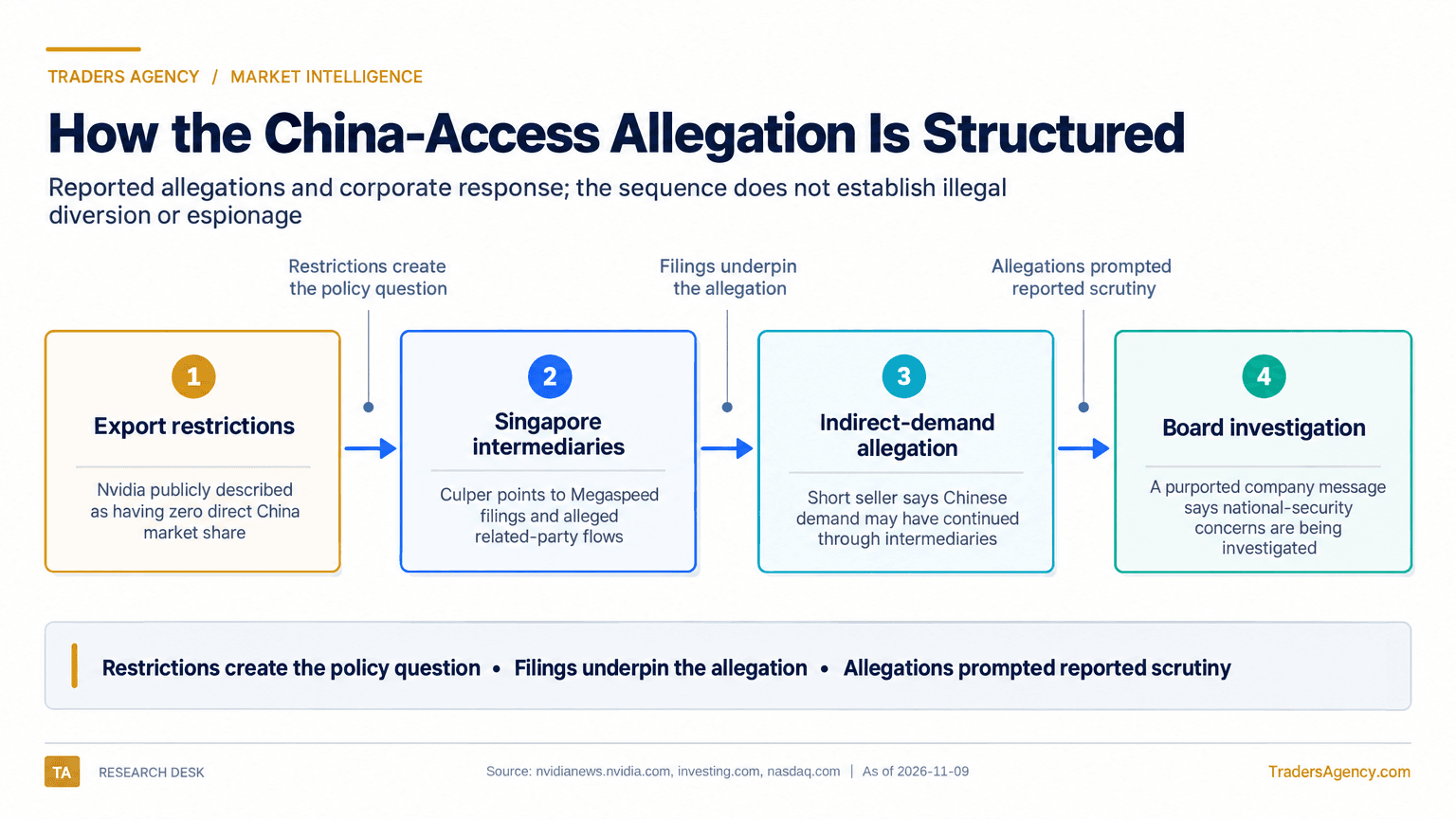
The personal controversy has reignited an older debate. Culper Research, a short seller that disclosed a bearish position in Nvidia earlier in 2026, has argued publicly that Nvidia's stated zero percent China market share may understate real demand. The firm's thesis is that a portion of Chinese compute demand, which it has estimated at more than 20% of Nvidia's fiscal 2026 compute revenue, may continue to reach China indirectly through Singapore-linked companies, including Megaspeed, which has drawn scrutiny over its purchasing relationship with Nvidia. That estimate and the underlying mechanics have not been independently verified, and Culper has a financial incentive in promoting a negative Nvidia narrative. The allegation is worth watching, but it remains a thesis rather than a confirmed finding, and no documentary evidence of illegal diversion has been publicly substantiated.
Want expert trading insights delivered daily?
Join thousands of traders who rely on Traders Agency for market analysis and trade ideas.
Join Traders AgencyExport Policy, Lobbying and the China Calculus
Huang has long argued that continued chip sales to China serve Nvidia's commercial interests regardless of personal entanglements: if Chinese customers can buy Nvidia hardware, the argument goes, they have less incentive to build competing chips domestically. That rationale predates the current controversy and reflects a consistent business position rather than evidence that personal events shaped policy outcomes.
On the regulatory side, the U.S. Bureau of Industry and Security changed its licensing policy on January 13, 2026, moving to case-by-case review for export applications covering Nvidia's H200 and similar chips destined for China, subject to security conditions. That shift allowed conditional, vetted sales rather than a blanket clearance for Chinese manufacturing of those chips. Whether personal lobbying influenced that decision is speculative and not supported by the available record. Separately, some observers argue that restrictions on advanced chipmaking can push competitors toward incremental technical workarounds using older equipment, though the specific scope and economics of any such efforts remain unverified and are not confirmed here.
What a Divorce or Leadership Change Could Mean for Nvidia
Speculation has also turned to Huang's marriage. Reports suggest Huang and his wife do not have a prenuptial agreement, and California's community-property rules would generally treat wealth built during a marriage as jointly owned, absent other arrangements. That has fueled online estimates of how much Nvidia stock a divorce settlement might eventually put in motion, but there is no confirmation that a divorce is occurring or that any shares would be sold.
According to Nvidia's 2026 proxy statement, Huang beneficially owned 870,604,104 shares, or about 3.58% of the company, as of March 23, 2026. Widely circulated online estimates assuming a 50-50 split of roughly half that stake, about 435 million shares, have put the hypothetical spousal share at around 1.35% of Nvidia's stock. That math does not hold up: halving 435 million shares yields roughly 217.5 million shares, or under 1% of shares outstanding using the proxy's denominator. This remains a purely illustrative scenario, not a legal entitlement, and it ignores trusts, settlement terms and other ownership details that would ultimately govern any division.
History offers a counterpoint to assumptions about forced selling. When Jeff Bezos and MacKenzie Scott divorced in 2019, Bezos retained roughly 75% of the couple's Amazon voting power while Scott received a meaningful minority stake. Scott has since sold shares gradually, including about 65 million Amazon shares worth more than $10 billion over a single recent year, largely to fund philanthropy rather than dumping her position at once. Huang, for his part, founded Nvidia and remains deeply identified with its growth; a personal scandal alone is unlikely to force him out, though additional regulatory or congressional scrutiny appears to be a more plausible near-term consequence.
Nvidia vs. AMD: Margins and Market Position
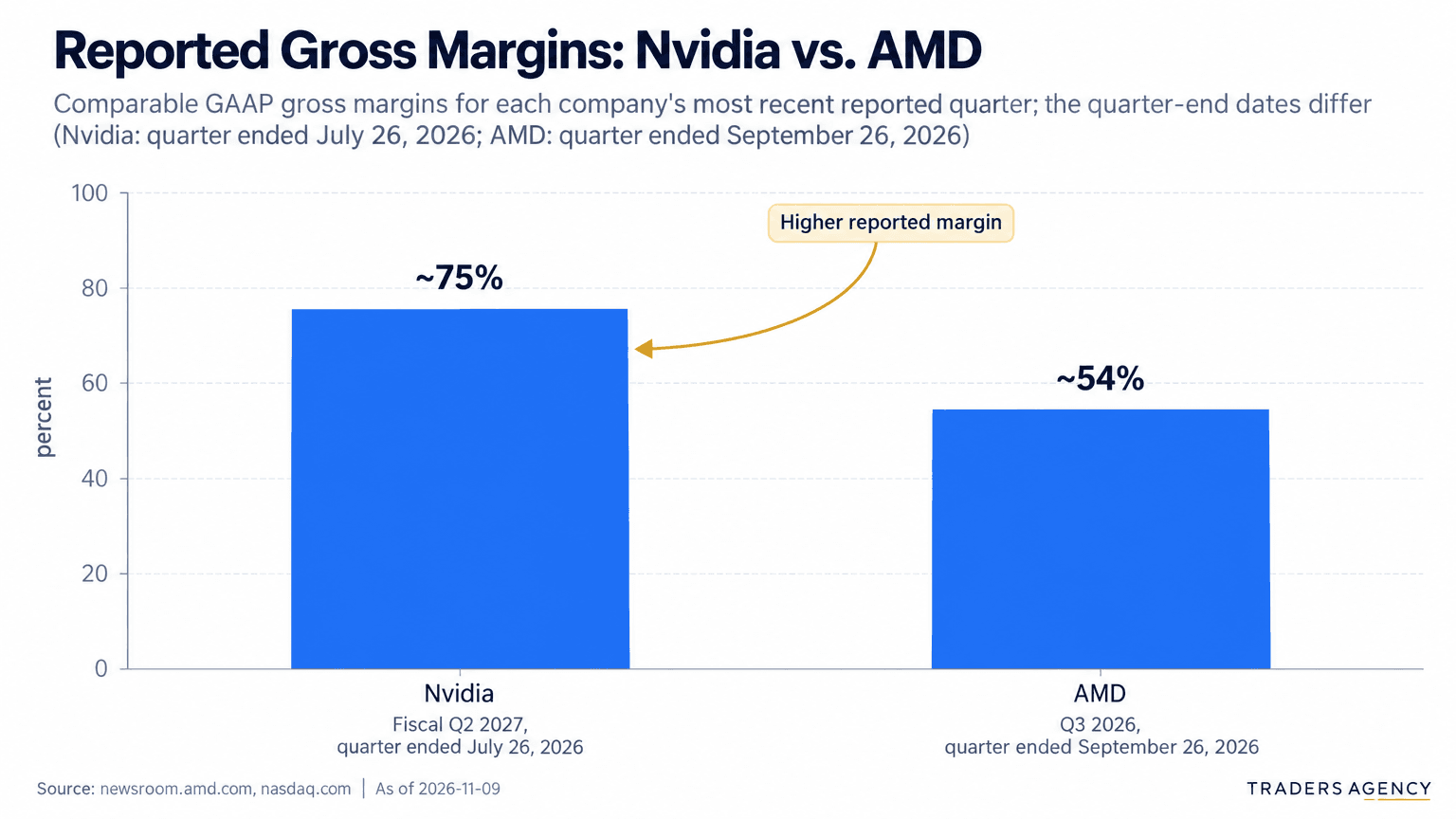
Setting the controversy aside, Nvidia's underlying financial profile still looks considerably stronger than its closest publicly traded AI-chip rival. In its fiscal second quarter of 2027, ended July 26, 2026, Nvidia reported revenue of $96.221 billion and gross profit of $72.142 billion, a gross margin near 75%, up from $46.743 billion in revenue and $33.853 billion in gross profit a year earlier. Data center sales made up roughly 92.5% of that quarter's revenue.
AMD, for its third quarter of 2026, ended September 26, 2026, reported revenue of $13.377 billion and a 54% gross margin, with data center revenue representing roughly 63.5% of sales. Free cash flow for the quarter was about $554 million, derived from $1.202 billion in operating cash flow less $648 million in capital expenditures. The periods and definitions behind these comparisons are not identical, but the gap is wide enough to matter: Nvidia's higher margin and far heavier data-center concentration give it more financial room to absorb reputational noise than a company with thinner margins and a more diversified revenue mix. That same diversification is sometimes framed as a potential long-term advantage for AMD if it narrows the margin gap over time.
Market Reaction and Lingering AI Demand
Market data on the controversy's immediate impact is mixed and not fully reconciled. Nvidia shares closed up about 2.78% at $186.64 in the regular session on Friday, November 6, 2026. Separately, reports describe an overnight decline of roughly 3.5% in Nvidia shares against a nearly flat 0.07% move in the Nasdaq 100, apparently reflecting a different, later trading window around November 8-9. The two observations have not been tied to a single confirmed timestamp, so they should be read as separate data points rather than one clean market reaction.
Anecdotal demand signals, meanwhile, point in a steadier direction. Retail listings for Nvidia's RTX 5090 graphics card have shown asking prices as high as $7,779.79 for a standalone card and $9,020.99 for a prebuilt system, well above launch pricing. These are asking prices rather than confirmed completed sales, but they suggest continued scarcity and demand for AI-capable hardware even as the corporate headlines swirl.
The Bottom Line for Investors
Nothing in the public record currently establishes that Jensen Huang's personal conduct compromised Nvidia's security or that the company knowingly routed chips around export restrictions. Both allegations are serious enough to warrant continued scrutiny, including from Nvidia's own board, but they remain unresolved. Traders Agency analysts will be watching whether the board's investigation produces concrete findings, whether regulators act on the China-routing allegations, and whether AMD's margin and diversification profile narrows the gap with Nvidia over coming quarters. For now, Nvidia's financial fundamentals, not the headlines, appear to be doing most of the work supporting its market position.
Want expert trading insights delivered daily?
Join thousands of traders who rely on Traders Agency for market analysis and trade ideas.
Join Traders AgencyDISCLAIMER: Traders Agency does not offer financial advice. The information provided is for educational purposes only and should not be considered financial advice. Traders Agency is not responsible for any financial losses or consequences resulting from the use of the information provided. Trading carries inherent risks and may not be suitable for all individuals. You are advised to conduct your own research and seek personalized advice before making any investment decisions, recognizing the potential risks and rewards involved.
- Nvidia probes whether CEO Huang was target of foreign spying as he admits affair
- Statement From NVIDIA Board of Directors
- 與捲間諜案中國籍企業主管關係密切?黃仁勳稱彼此往來正常
- Culper Research shorts Nvidia over alleged China trade violations
- NVIDIA Announces Financial Results for Second Quarter Fiscal 2027
- Culper Research shorts Nvidia over alleged China trade violations
- Megaspeed, Singapore firm at centre of US Nvidia chip probe, goes dark
- Export control was a failure: Computex 2025 Q and A
- China Enters 2025 with Big Memory Breakthroughs
- CXMT G4 16Gb DDR5 DRAM Process Analysis
- Department of Commerce Revises License Review Policy for Semiconductors Exported to China
- NVIDIA 2026 Proxy Statement
- Jeff Bezos keeps Amazon voting power in divorce settlement
- MacKenzie Scott sold 65 million Amazon shares worth over $10 billion in the last year
- AMD Reports Third Quarter 2026 Financial Results
- NVIDIA Stock Price History
See more from Traders Agency on Google
Make us a preferred source and our market analysis will appear more prominently in your Google Search, Top Stories, and AI results.
Add to Preferred Sources