
Alex Hormozi has built a sizable following by distilling business advice into short, quotable rules. A recent breakdown of his most popular clips weighs that advice against real-world experience, agreeing with much of it while pushing back on the parts that oversimplify legal setup, local competition, employee retention and sales psychology. The result is a useful map of where Hormozi's frameworks hold up and where business owners need to add their own judgment.
Building Through Mistakes Instead of Starting Over
Hormozi often compares a struggling business to a shaky tower built from mismatched blocks, arguing that sometimes the fastest path to real scale is to tear it down and rebuild on a proper foundation rather than keep stacking on top of something unstable.
The counterargument is that businesses rarely grow the way physical structures do. People learn by making mistakes, and those mistakes become part of the operating foundation rather than a flaw to erase. One example offered in the discussion involved a real-estate business that expanded into licensed construction work, only to discover that contracting for other people carries thin margins and heavy liability compared with agency work. Rather than treating that as a wasted detour, the lesson became a reason to hire specialists on a project basis instead of carrying every trade on payroll, shifting both cost and liability to outside contractors.
There is also a timing argument worth noting. AI tools can now help produce a stronger starting point for contracts, vendor agreements, employment documentation and basic insurance questions than a founder could have assembled alone a few years ago. That does not remove the need for qualified legal, tax or insurance review once a business carries real exposure, but it does make early preparation faster and cheaper than it used to be.
Why Revenue Alone Doesn't Tell the Real Story
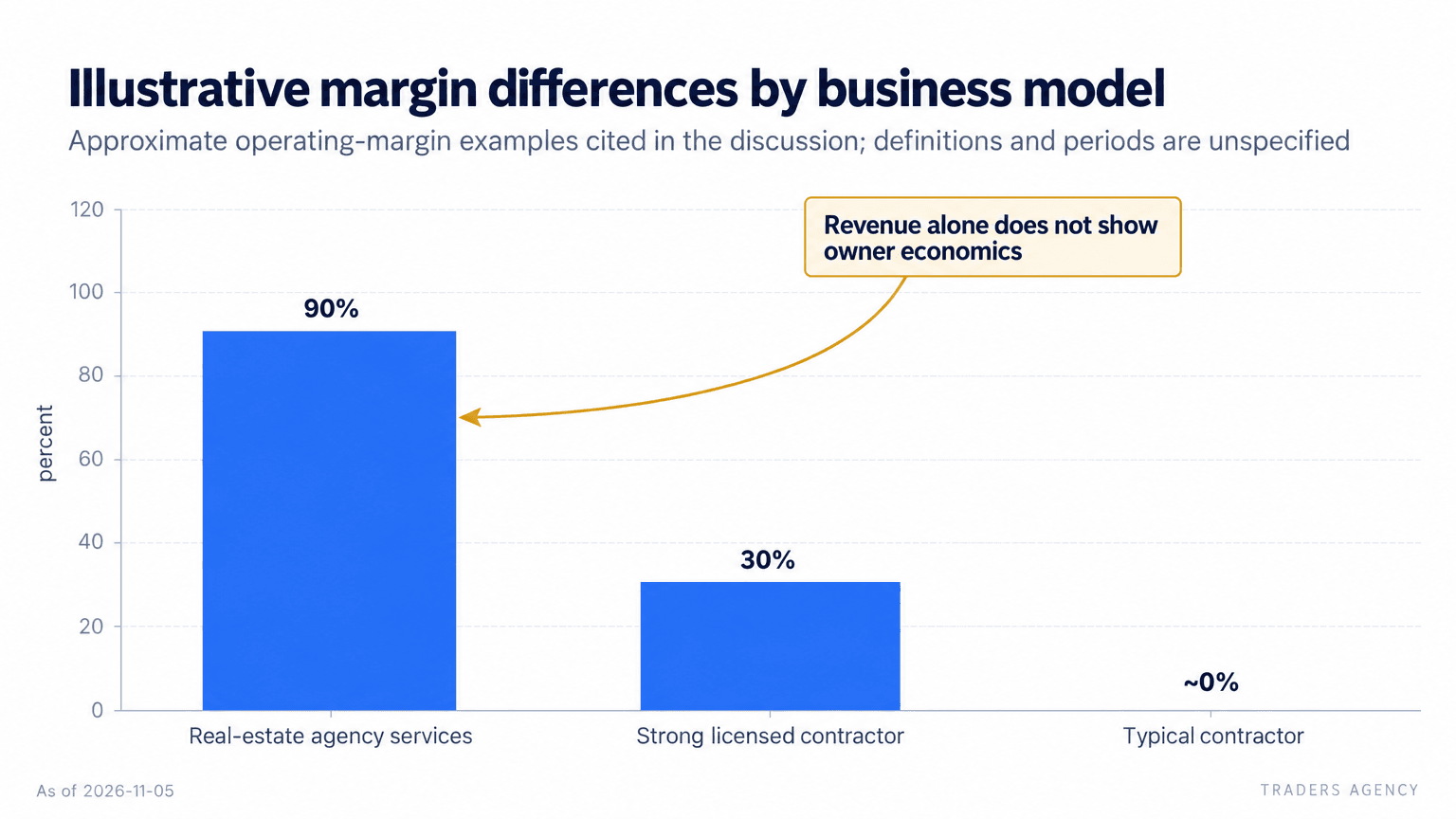
One recurring theme is that top-line revenue can be misleading. In the discussion, real-estate agency services were described, as a rough illustrative example, as running near 90% margins, a strong licensed contractor closer to 30%, and many ordinary contracting operations near break-even once payroll is covered. These figures were offered as general impressions from experience rather than audited financial comparisons, but the direction of the argument holds: labor-intensive businesses and asset-light service businesses can look similar on a revenue line while delivering very different outcomes for the owner.
That point was applied to a hypothetical built around a business selling performance upgrades to German car owners, said to generate about $5 million in annual revenue. Using assumed product costs near 40% of revenue and labor plus overhead near 30%, the scenario suggested an owner might retain roughly $1.5 million. That math depends entirely on the assumptions holding true for the real business, and it was framed in the discussion as an estimate about an unnamed company rather than a confirmed disclosure. The broader lesson for investors and operators alike is that margin quality, not headline revenue, determines what a business is actually worth running or buying.
The Discipline of Closing a Sale
Hormozi's sales advice fares better under scrutiny. Once a customer agrees to buy, the discussion agrees that a seller should stop talking, since continuing to add arguments can reopen objections and unwind a decision that was already made. The second rule, having a way to process payment ready the moment someone agrees to pay, is now easier than ever with mobile payment tools. The third, finishing the transaction in front of you before turning to a new prospect, was framed as a way to protect trust on both sides: the current customer sees they come first, and the next prospect sees a business that honors its commitments.
The caution attached to this advice is that manufactured urgency, pushed too hard or used to pressure rather than serve a customer, can undermine the very trust these rules are meant to protect.
What Selling a Business Doesn't Solve
Hormozi's warning about selling a business carries real weight: owners tend to want what they don't have, and once a business is sold, both its burdens and its benefits disappear together. A non-compete clause can also prevent a former owner from rebuilding the team or relationships that made the business work. Before exiting entirely, it is worth testing whether systems, delegation, remote work or scheduled time away can deliver the freedom an owner is chasing without giving up the enterprise. The right answer still depends heavily on an individual's finances, health, relationships and whether the business can genuinely run without them.
Want expert trading insights delivered daily?
Join thousands of traders who rely on Traders Agency for market analysis and trade ideas.
Join Traders AgencyStarting a Business Before You Feel Ready
Hormozi's four-step sequence for starting a business, form an entity, open a bank account, connect a payment processor, then exchange value with a stranger for money, is presented as something almost anyone can complete quickly. The pushback in the discussion goes further, arguing that someone with little or no net worth should prioritize proving a stranger will pay for a service before spending excessive time on entity formation or administrative setup.
That instinct toward testing demand early is reasonable for a genuinely low-risk venture, but it should not be read as license to skip legal protections altogether. Guidance from the U.S. Small Business Administration supports starting as a sole proprietorship to test a low-risk idea, while making clear that sole proprietors carry personal liability and that licensing, tax and insurance requirements apply based on the activity and location of the business, not on how much net worth the owner has or how large the business eventually becomes. In other words, provide value first if the risk is genuinely small, but check what registration, licensing or insurance rules already apply before assuming they can simply wait.
Local Expertise vs the Global Online Crowd
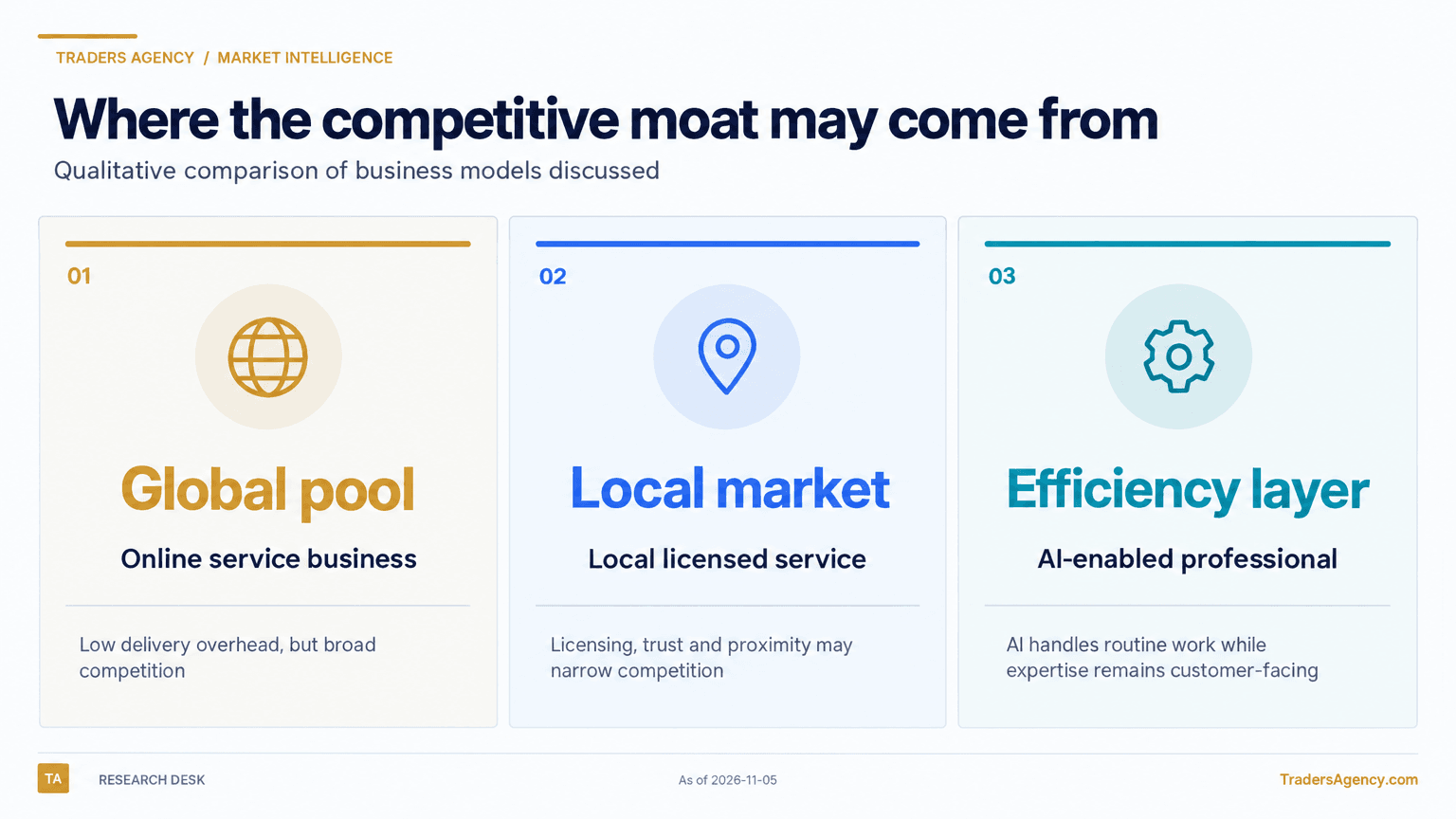
A separate thread compares low-cost online service businesses with local licensed professionals. Online services are cheap to start and can be run from anywhere, but that same flexibility means competition comes from anywhere too. A licensed local professional, such as a real-estate agent, lender, accountant or attorney, may have a sturdier moat because licensing, local trust and physical proximity are harder to replicate from a distance. Layering AI on top of that expertise, so the professional can handle routine work faster without lowering the value of their judgment, was framed as a stronger business design than competing purely as another anonymous online provider. That said, licensing alone does not guarantee demand, and AI can lower barriers for local competitors just as easily as it helps established ones.
Gift Cards, Bundles and Pricing Psychology
Hormozi pointed to figures suggesting that roughly $3 billion in gift cards go unused each year, with unredeemed balances representing somewhere between 10% and 20% of all cards sold. Those numbers are presented here as his stated claim rather than an independently confirmed statistic, since the underlying source and time period were not specified.
On the regulatory side, the discussion referenced a California law requiring cash-back redemption for small remaining gift-card balances. As of late 2026, California generally requires covered gift certificates, including electronic gift cards, with remaining balances below $15 to be redeemable for cash upon request, a threshold that rose from below $10 on April 1, 2026. The law includes statutory exceptions, including certain donated certificates and cards usable across multiple unaffiliated sellers, so the practical effect varies by card type.
On bundling, Hormozi argued that buy-one-get-two-free offers have given way to all-in-one subscriptions, citing Google, Apple and Meta. Google One's storage plans, Apple One's bundle of up to six services in its Premier tier, and Meta's Horizon+ subscription do exist as described, though how broadly bundles have replaced multi-buy promotions across the wider market is more an interpretation than an established fact.
Retaining Talent in Service Businesses
Using a hair-extension salon as an example, breaking a handful of large pay increases into six to twelve smaller career steps gives employees frequent small wins instead of long stretches between raises. Service businesses that win long term tend to be the ones that pay competitively, maintain a strong reputation and keep a steady stream of customers coming through the door, since a staffer with nowhere consistent to send a client has little reason to build a book of business elsewhere. Structured pay steps help, but they are not a substitute for fair total compensation, sound management or a reliable pipeline of customers.
On feedback, the discussion sides firmly with Hormozi's approach: telling someone to simply be less difficult or more charismatic rarely changes behavior, while naming the specific, observable actions that cause a problem, and what to do instead, tends to produce fast, visible improvement.
Speed, Focus and the Line Between Value and Manipulation
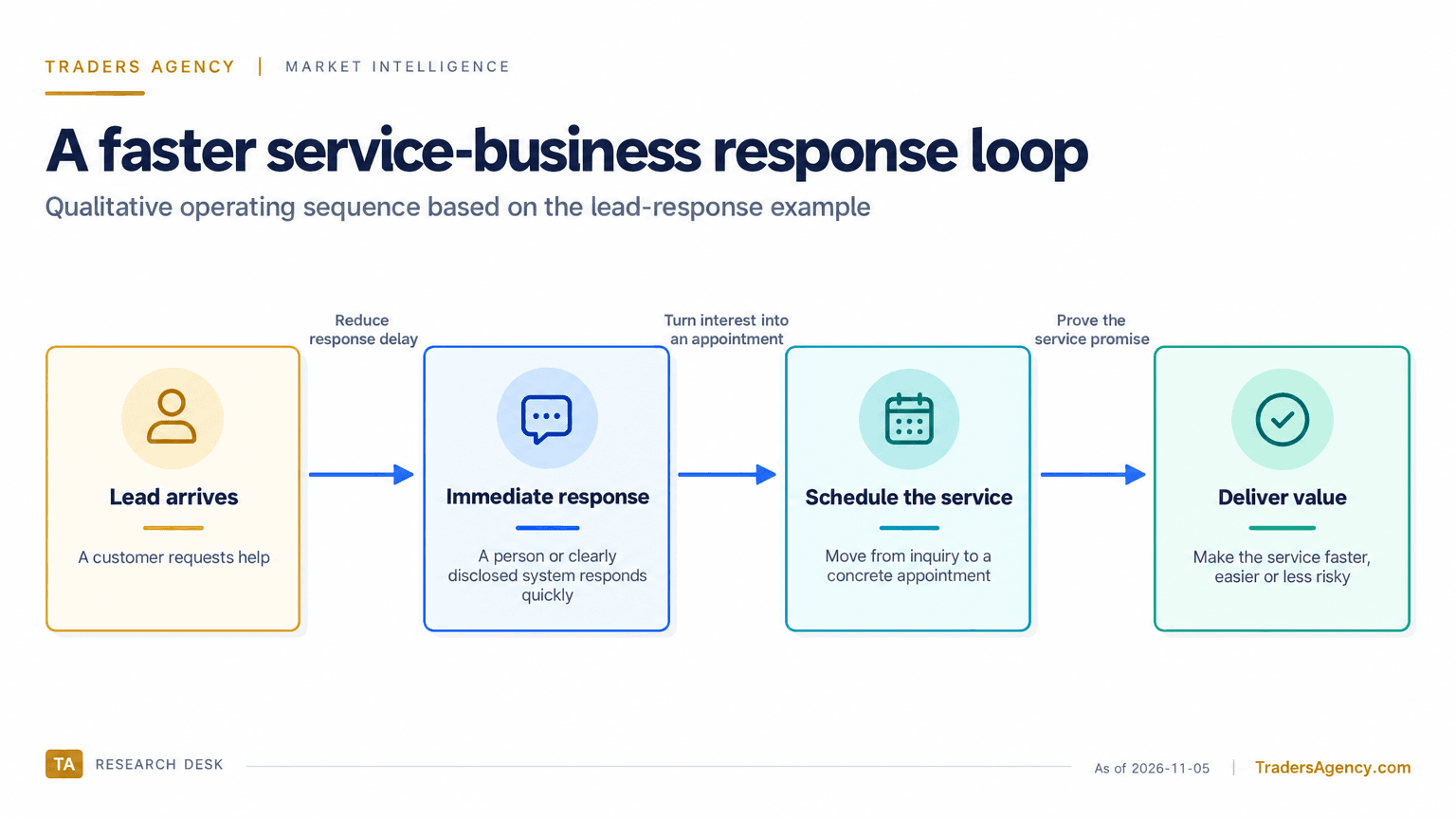
Response speed came up through an anecdote about a restoration-services business reportedly converting more than half of its incoming leads by having one dedicated person call the moment a lead arrived, rather than letting it sit. That figure was described as a third-party disclosure without independent confirmation, but the operating principle behind it is sound for urgent home-service categories: a fast, personal response can matter more than almost anything else once a customer already wants the service.
The discussion also favors personalized, unexpected value, such as sending a seller comparable sales data or a handwritten neighborhood update, as a way to build genuine goodwill over time. It draws a clear line, however, around reciprocity tactics that feel manipulative when they substitute for real service rather than support it.
The closing framework pulls these ideas together: find a service people already buy, make it faster, easier or less risky, ask everyone you know for referrals, price for the value delivered rather than the lowest number on the market, and keep going once the initial novelty of a new venture wears off.
The Bottom Line
Hormozi's advice holds up best where it demands action and discipline, closing sales cleanly, responding fast, giving precise feedback and staying focused on one proven business rather than chasing the next idea. It is weaker wherever it treats legal setup, competitive moats, employee retention or sales psychology as simple formulas, since those areas depend heavily on jurisdiction, industry and individual circumstances. Traders Agency analysts watching small-business and service-sector trends see the more durable takeaway as a balance: test real demand quickly and directly, but build the legal, licensing and operational structure a business actually needs as it grows, rather than treating that structure as optional until the business is already large.
Want expert trading insights delivered daily?
Join thousands of traders who rely on Traders Agency for market analysis and trade ideas.
Join Traders AgencyDISCLAIMER: Traders Agency does not offer financial advice. The information provided is for educational purposes only and should not be considered financial advice. Traders Agency is not responsible for any financial losses or consequences resulting from the use of the information provided. Trading carries inherent risks and may not be suitable for all individuals. You are advised to conduct your own research and seek personalized advice before making any investment decisions, recognizing the potential risks and rewards involved.
- Launch your business — U.S. Small Business Administration
- Americans have left $3 billion on unused gift cards
- Governor Signs Laird Bill Addressing Gift Card Issue for Santa Cruz Beach Boardwalk
- SB 22: Gift certificates — chaptered legislation
- Plans & Pricing to Upgrade Your Cloud Storage — Google One
- Apple One — Apple
- Meta Horizon+ — Meta Store
See more from Traders Agency on Google
Make us a preferred source and our market analysis will appear more prominently in your Google Search, Top Stories, and AI results.
Add to Preferred Sources