
Meta's Superintelligence Lab released two new artificial intelligence models on Monday, Muse Wonder and Muse Wonder Full, which the company describes as its first attempt at a frontier-level model. Unlike Meta's earlier open-weight releases, access to the new models is gated behind paid subscriptions rather than offered for free, according to TechCrunch and CNBC.
Two models, built for complex tasks
Meta said the models are designed to handle tasks such as reviewing legal documents, navigating insurance claims and developing software, according to Seeking Alpha. Compared with Muse Spark, the lightweight, low-latency model Meta released earlier, the Wonder models are larger and said to be more capable, with higher benchmark scores and stronger results on complex tasks like coding, per TechCrunch's reporting on Meta's model card.
The release is the company's first frontier model since Scale AI founder Alexandr Wang restructured Meta's AI efforts in August of last year. Since then, TechCrunch reported, Meta had released only the lightweight Muse Spark model and the Muse agent, largely avoiding the kind of state-of-the-art releases associated with OpenAI and Anthropic. Per TechCrunch's reporting on Meta's launch post, the new models were trained at the company's Prometheus data center in central Ohio, which came online earlier this year.
Benchmark claims: parity, with one stated edge
According to Meta's own testing presented in the model card, as reported by TechCrunch, Wonder and Wonder Full achieve benchmark scores comparable to Fable 5.1 and GPT-6 Astra. That is a claim of rough parity with competing models rather than overall leadership.
The one evaluation where Meta claims an edge is MemoryBench, a benchmark testing continual learning and memory construction. By the company's own testing, cited by TechCrunch, Muse Wonder scores higher on MemoryBench than Fable, Opus or Astra. Meta placed particular emphasis on the models' ability to retain and synthesize information supplied by users, a property it calls "active memory." Research scientist Kavya Kopparapu said in a video accompanying the launch: "We put a tremendous amount of effort into making sure your model can remember what's important to you over days, weeks, months, and beyond."
Pricing: API costs versus subscriptions
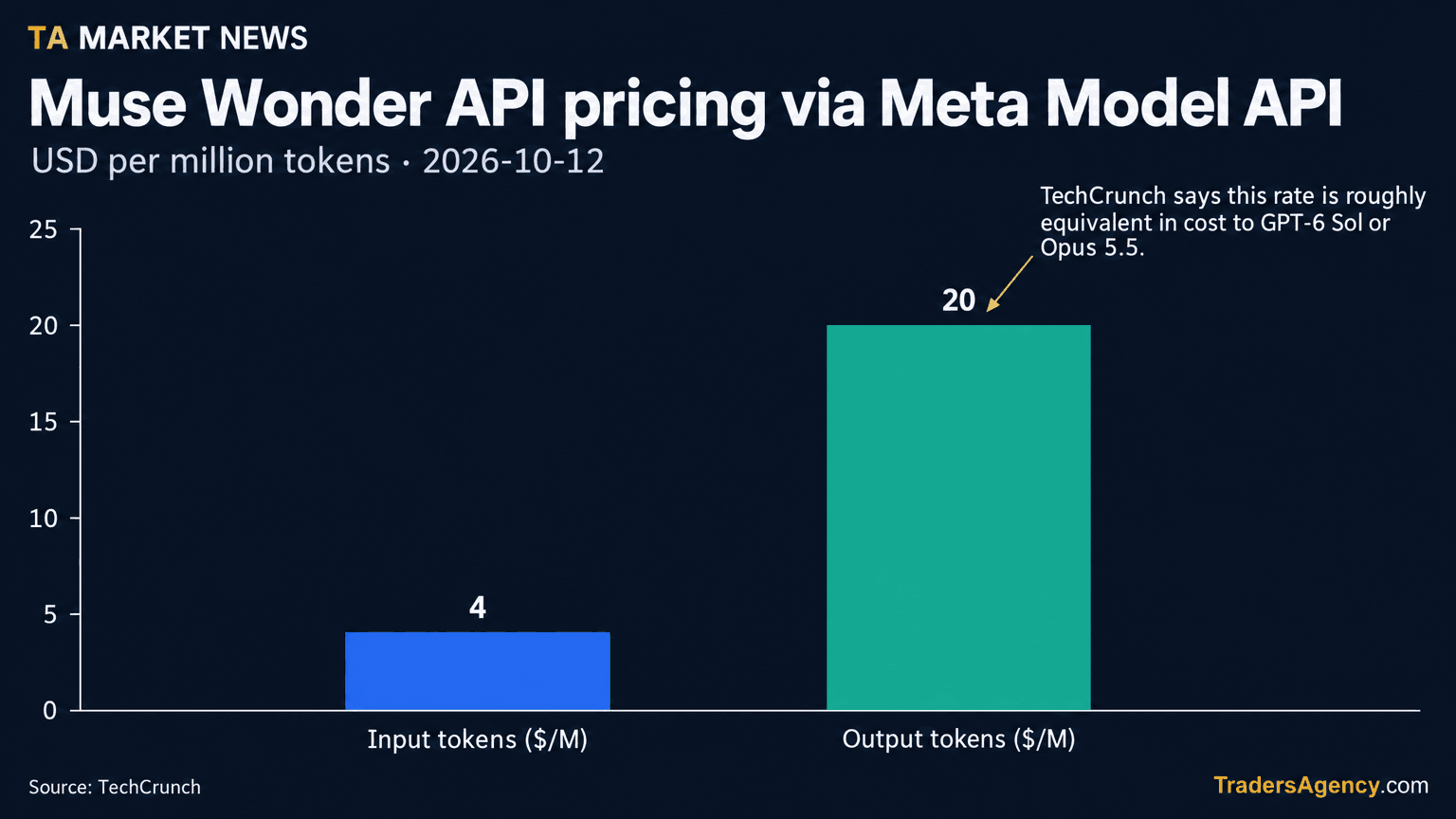
Accessed through the Meta Model API, Wonder costs $4 per million input tokens and $20 per million output tokens, TechCrunch reported, describing that as roughly equivalent in cost to GPT-6 Sol or Opus 5.5. On those two figures, the input rate sits $16, or 80%, below the output rate (4 − 20 = −$16; (4 − 20) / 20 × 100 = −80%) — our calculation from TechCrunch's reported pricing.
Wang told CNBC that the API offering will cost more than the standard subscriptions because Muse Wonder is a "much larger model and at frontier level," but said it will still be priced "meaningfully below" leading models from OpenAI and Anthropic. Separately from API access, CNBC reported that users of the Muse personal agent app need to sign up for a monthly subscription of $20 or $100 to access the model. The Muse app itself, introduced last month, is free, with subscription plans available for more usage; CNBC noted the app shot to the top of Apple's App Store after its introduction.
Agent behavior, safeguards and user complaints
Wang, who said the model was codenamed Watermelon, told CNBC that Meta built Wonder to improve "personal and professional agents" so they do not stumble on tasks like booking dinner reservations or checking availability. "When you do real-world tasks, you're going to get roadblocks and you're going to get things that come up or various setbacks," he said. "We specifically tried to train the model to be able to try other approaches instead of stalling and then checking back in with the user at any time."
Meta said in a blog post, per CNBC, that the model "offers our strongest safeguards to date" against "cyber misuse," and that those protections for now come only with the paid model. Wang also told CNBC that Meta's AI team has been monitoring agent-related "incidents or issues" with Muse in order to understand and resolve problems. Separately, CNBC reported that some users have complained on social media that the agent accessed personal messages without authorization, a claim the company has disputed. On those complaints, Wang said: "I think there are certainly instances users have authorized various communications or whatnot earlier in a conversation, and then may have forgotten about that," adding that Meta is educating users "to ensure that consumers can trust the product going forward."
A shift in distribution strategy
CNBC framed Monday's release as a test of users' willingness to pay for Meta's AI products, calling it part of the company's effort to create AI-derived revenue outside its core online advertising business. Meta's blog post, cited by TechCrunch, described the two models as marking "the next step on our scaling ladder and a major leap toward personal superintelligence." The subscription-gated structure marks a departure from the posture TechCrunch described Meta as having maintained since last year's AI reorganization, when it held back from matching the frontier releases of OpenAI and Anthropic.
Bottom Line
Meta's Muse Wonder launch pairs a parity-level benchmark claim, with one stated advantage in memory-related testing, against a pricing structure that charges separately for API access ($4/$20 per million tokens) and consumer app subscriptions ($20 or $100 monthly). Wang's framing, that frontier-level pricing will still sit below OpenAI and Anthropic rates, and CNBC's characterization of the release as a willingness-to-pay test, both point to monetization as the central question Meta is now probing with paying users rather than through open distribution.
DISCLAIMER: Traders Agency does not offer financial advice. The information provided is for educational purposes only and should not be considered financial advice. Traders Agency is not responsible for any financial losses or consequences resulting from the use of the information provided. Trading carries inherent risks and may not be suitable for all individuals. You are advised to conduct your own research and seek personalized advice before making any investment decisions, recognizing the potential risks and rewards involved.
- Seeking Alpha Market News: Meta says new Muse Wonder AI models can handle complex tasks · accessed Oct 12, 2026
- CNBC Top News: Meta debuts Muse Wonder AI model in test of users' willingness to pay · accessed Oct 12, 2026
- TechCrunch: Meta releases its first frontier model, Muse Wonder · accessed Oct 12, 2026
See more from Traders Agency on Google
Make us a preferred source and our market analysis will appear more prominently in your Google Search, Top Stories, and AI results.
Add to Preferred Sources