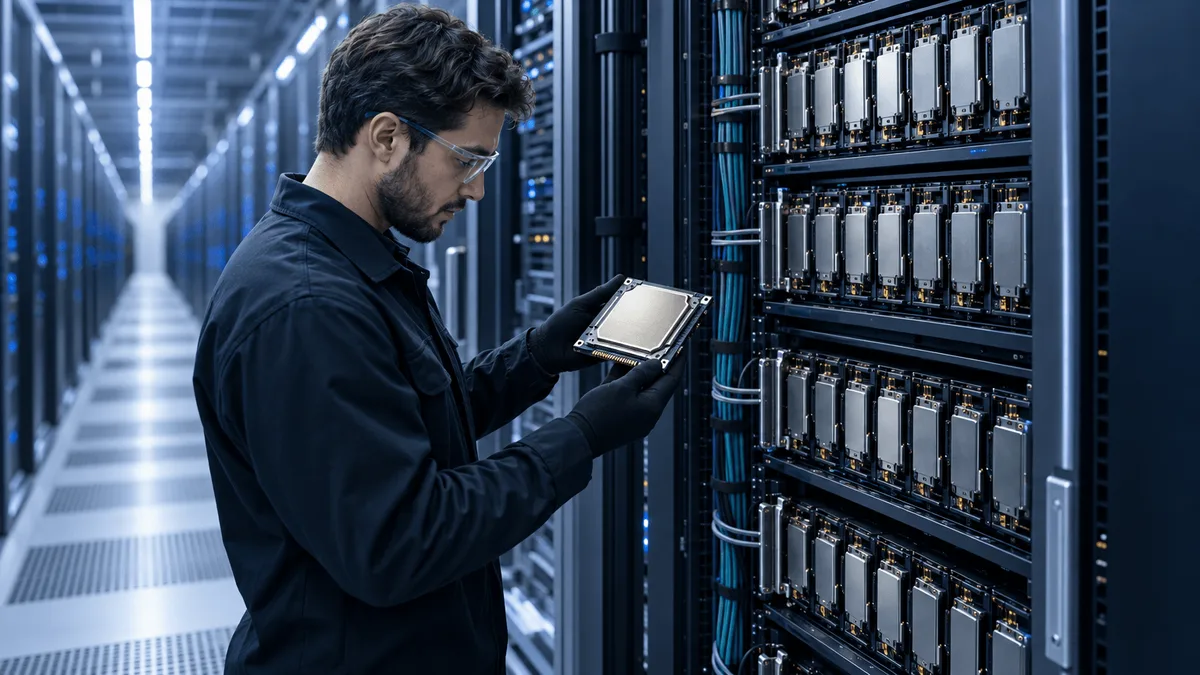
Microsoft said this week that starting with its third-generation Maia AI accelerator, unveiled Monday, it will mainly rely on its own silicon to handle incoming AI inference requests, marking a shift after years of depending heavily on Nvidia graphics processing units, according to CNBC.
What Microsoft Announced
Production of the Maia 300 is set to start in 2027, CNBC reported, citing Microsoft. The company expects to pack 96 Maia 300 chips into each datacenter rack, double the number used for the Maia 200, the outlet said. Microsoft is targeting multi-gigawatt deployments across the Maia chip family, according to a blog post from Executive Vice President Scott Guthrie cited by CNBC, though Alistair Speirs, a Microsoft general manager, declined to give a deployment timeline.
Speirs told CNBC that Microsoft is preserving flexibility in its silicon mix: "We reserve a little bit of optionality there, because this is an industry that's changing very fast, and we want to deploy the right silicon for the right models that we're using at the right time as well." He also linked the new architecture to operating costs, saying "you can think of power translating pretty directly into operational cost for something like a data center as well," per CNBC.
The Maia 200 Groundwork
The Maia 300 push builds on the Maia 200, which Microsoft detailed in a company blog post in January. Microsoft said the Maia 200 is deployed in its US Central datacenter region near Des Moines, Iowa, with the US West 3 region near Phoenix, Arizona, coming next and further regions to follow. Each Maia 200 chip delivers over 10 petaFLOPS in 4-bit precision (FP4) and over 5 petaFLOPS of 8-bit (FP8) performance within a 750-watt SoC power envelope, Microsoft said on its blog. Using those two stated figures, the gap between the precision modes is 5 petaFLOPS (10 − 5), a 100% relative difference ((10 − 5) / 5 × 100); that arithmetic is our own interpretation and illustrates how much additional throughput Microsoft reports at lower numerical precision, a routine inference tradeoff rather than evidence of real-world task performance. Microsoft's blog post also states that each Maia 200 chip contains over 140 billion transistors, while semiwiki.com, summarizing reporting from The Information, put the figure at 100 billion transistors — a discrepancy in reported specifications that has not been reconciled in the available reporting.
Which Workloads Move to Maia
Jim Kleewein, a Microsoft technical fellow, told CNBC that parts of Microsoft 365 Copilot should speed up with Maia 300. For the Maia 200, Microsoft said on its blog that the chip serves multiple models, including OpenAI's GPT-5.2, bringing performance-per-dollar gains to Microsoft Foundry and Microsoft 365 Copilot. Microsoft also said its Superintelligence team, led by Mustafa Suleyman according to CNBC's January report, uses Maia 200 for synthetic data generation and reinforcement learning to improve next-generation in-house models.
Unlike Google's Tensor Processing Units or Amazon's Inferentia and Trainium chips, Microsoft's accelerators cannot currently be rented by other companies. "Nobody has tested them outside of Microsoft yet," Patrick Moorhead, CEO of Moor Insights and Strategy, told CNBC. Microsoft's Scott Guthrie said in a blog post cited by CNBC that there will be "wider customer availability in the future" for the Maia 200, and the company is inviting developers, AI startups and academics to explore an early Maia 200 software development kit.
Capacity Targets and the Cost Argument
Before the Maia 300 unveiling, The Information reported, as relayed by Yahoo Finance and semiwiki.com, that Microsoft was negotiating with TSMC for manufacturing capacity covering 300,000 Maia 300 chips for delivery in 2027, with ambitions exceeding one million units. Andrew Wall, general manager for Azure Maia, disputed those production figures, saying in a statement cited in those reports that Microsoft "continues to invest in custom silicon as part of our long-term AI infrastructure strategy," and that the reported numbers "don't reflect the scale of our program."
Evercore ISI analysts, in a note to clients cited by CNBC, estimated Maia will represent about 10% of Microsoft's spending on AI chips by the first quarter of 2027; the firm recommends buying Microsoft shares, according to CNBC. Finance chief Amy Hood said at a Goldman Sachs conference, as reported by CNBC, that use of Microsoft's own chips has helped with "margin improvement over the course of a decade." Separately, Goldman Sachs analysts, cited by TradingKey, said self-developed chips both reduce Microsoft's dependence on Nvidia and help improve Azure AI's gross margin, in a period when Microsoft has guided to roughly $190 billion in annual capital expenditure by the end of calendar 2026, per TradingKey's report.
Nvidia and AMD Still in the Mix
CNBC reported that Nvidia remains central to Microsoft's plans: CEO Jensen Huang appeared at an event where Microsoft announced a Surface laptop containing an Nvidia processor, and for training models, Microsoft continues to partner with both Nvidia and AMD, Speirs told CNBC.
Microsoft's Position Against Google and Amazon
Microsoft's own blog claims the Maia 200 is the most performant first-party silicon of any hyperscaler, with three times the FP4 performance of Amazon's third-generation Trainium and FP8 performance above Google's seventh-generation TPU. TradingKey cautioned that these performance and cost figures currently come mainly from Microsoft's own channels and lack comprehensive third-party testing, so they should be treated as official claims rather than independently verified conclusions.
On commercialization, TradingKey reported that Microsoft has fallen behind Alphabet and Amazon in building out custom silicon as a business: Google began booking Tensor Processing Unit sales revenue in the quarter that closed in June, and Amazon's Trainium chips have been gaining traction with customers, per TradingKey. Microsoft, by contrast, was in early talks to supply Maia 200 chips to Anthropic for its Claude models, though no deal had been finalized, TradingKey reported. Semiwiki.com noted that building chips in-house gives Microsoft tighter control over hardware, networking, compilers and AI software, but the company must still secure advanced packaging, high-bandwidth memory and power capacity while achieving high utilization across Azure.
Bottom Line
Microsoft has said it will shift the bulk of its AI inference workload onto homegrown Maia silicon starting with the Maia 300 in 2027, while keeping Nvidia and AMD in the picture for model training, according to CNBC. Evercore ISI's estimate that Maia will account for about 10% of Microsoft's AI chip spending by the first quarter of 2027, together with the production figures Microsoft disputes, suggests the transition will be gradual and contested on specifics — and independent benchmarking of Microsoft's performance claims against Google's and Amazon's custom chips has not yet been published, based on the available reporting.
DISCLAIMER: Traders Agency does not offer financial advice. The information provided is for educational purposes only and should not be considered financial advice. Traders Agency is not responsible for any financial losses or consequences resulting from the use of the information provided. Trading carries inherent risks and may not be suitable for all individuals. You are advised to conduct your own research and seek personalized advice before making any investment decisions, recognizing the potential risks and rewards involved.
- CNBC Top News: Microsoft will mainly use its Maia chips for AI inference · accessed Oct 12, 2026
- blogs.microsoft.com: Maia 200: The AI accelerator built for inference · accessed Oct 12, 2026
- semiwiki.com: Microsoft plans to unveil next-generation AI chip in September · accessed Oct 12, 2026
- www.youtube.com: - YouTube · accessed Oct 12, 2026
- finance.yahoo.com: Microsoft to unveil Maia 300 AI chip this fall, targets 300,000 units · accessed Oct 12, 2026
- www.cnbc.com: Microsoft reveals Maia 200 AI chip, will use it in house · accessed Oct 12, 2026
- www.tradingkey.com: Microsoft Build 2026 In-Depth Analysis: In-House Chip Maia 200, MAI Model and Azure’s Cost Counterattack, and Ackman’s Long-Term Logic for a Large Position in Microsoft · accessed Oct 12, 2026
- www.seattletimes.com: Microsoft plans production boost for AI chips, report says · accessed Oct 12, 2026
- learn.microsoft.com: Windows message center · accessed Oct 12, 2026
- learn.microsoft.com: October 2026 announcements · accessed Oct 12, 2026
See more from Traders Agency on Google
Make us a preferred source and our market analysis will appear more prominently in your Google Search, Top Stories, and AI results.
Add to Preferred Sources