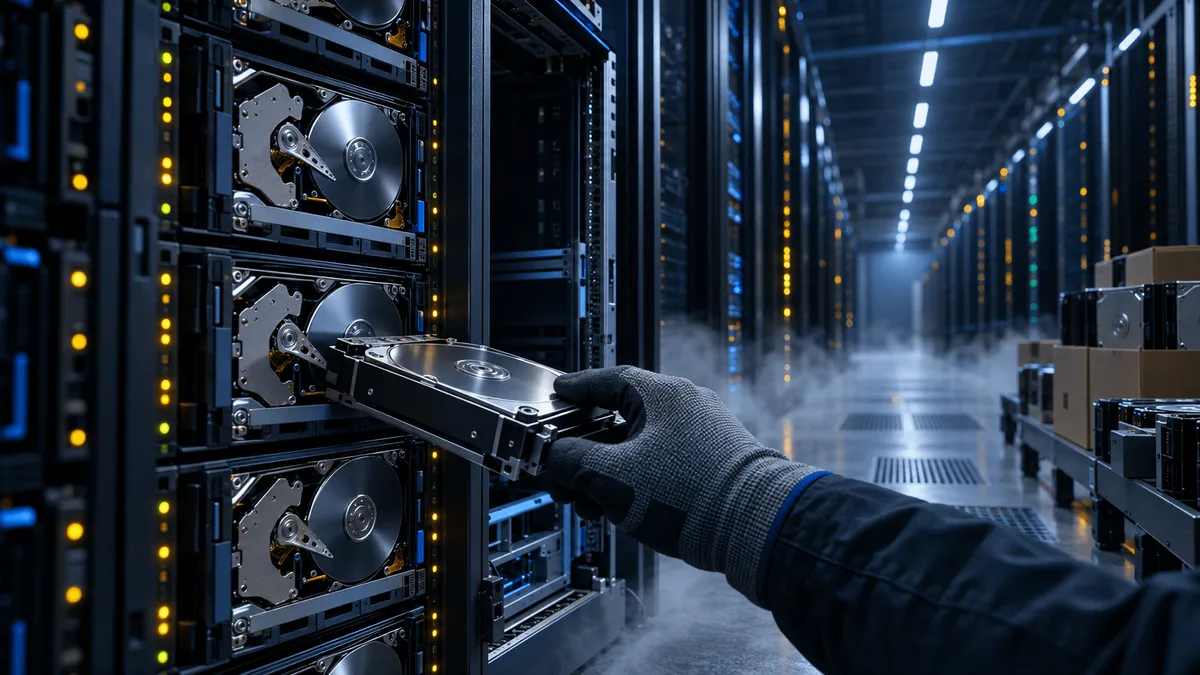
Toshiba intends to double its production capacity for hard disk drives used in artificial intelligence data centers by fiscal 2027, backed by a roughly $380 million expansion of its Philippines manufacturing facilities, according to a Nikkei report published Friday and cited by Yahoo Finance. The news sent shares of rivals Seagate and Western Digital sharply lower, even as both companies have said the bulk of their high-capacity nearline drive supply is already committed years into the future.
What Nikkei Reported
Toshiba will invest about 60 billion yen, or roughly $380 million, to expand its HDD manufacturing facilities in the Philippines, which Nikkei described as the company's first major drive-related investment in roughly five years, per the Yahoo Finance report and TrendForce's coverage of the same Nikkei account. Toshiba, one of the world's three largest HDD makers alongside Western Digital and Seagate, is reported to be targeting an increase in its market share by storage capacity from just over 10% to 30% over the medium term, according to Nikkei.
The expansion is also said to include new production lines capable of up to 40% higher per-unit capacity, supporting Toshiba's reported plans for mass production of 65-terabyte-class HDDs by 2030 and, eventually, 100-terabyte-class products. TrendForce's account of the Nikkei report adds that Toshiba plans to automate more inspection and cleanroom operations at the Philippine plant, a step expected to cut the additional workforce normally required for such an expansion by about 40% while improving yield rates.
Every figure above is attributed to Nikkei's reporting as relayed by Yahoo Finance and TrendForce, rather than to a direct Toshiba announcement.
Seagate, Western Digital Shares Slide
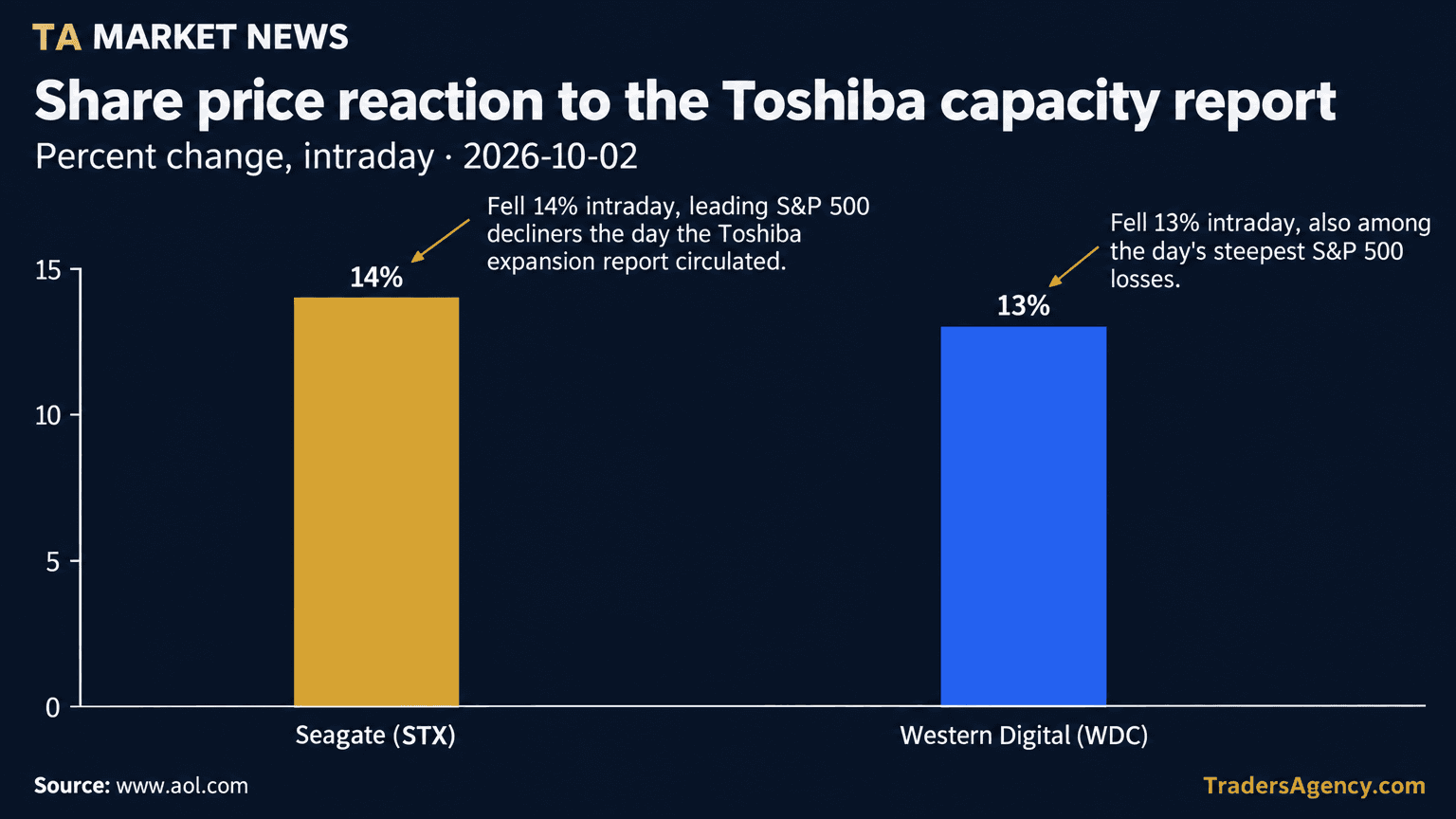
Seagate and Western Digital, the two biggest players in the HDD space, were recently down 14% and 13%, respectively, leading S&P 500 decliners, according to AOL's report on the selloff. By comparison, the broader DRAM ETF was down less than 1% at the same point, while the S&P 500 moved higher, underscoring that the drop was specific to the two HDD makers rather than the storage or memory sector broadly.
By our calculation, Seagate's 14% decline was one percentage point steeper than Western Digital's 13% drop, a 7.7% relative difference (14 minus 13, divided by 13). Even after the selloff, AOL reported that Seagate and Western Digital shares were up roughly 200% and 135%, respectively, since the start of the year. That gap, by our calculation, amounts to a 65-percentage-point spread, or a 48.1% relative difference (200 minus 135, divided by 135), highlighting how large the prior rally had been relative to the single-day pullback.
Why Nearline Capacity Is the Flashpoint
The report lands against a backdrop in which nearline HDD supply, the high-capacity tier used heavily in AI data centers, is described as tightly committed for years. TrendForce, citing TechNews, reported that Seagate says the vast majority of its nearline capacity is already allocated through 2028, with some customers planning demand into 2029 and beyond. Western Digital has reportedly committed most of its 2027 supply under long-term agreements, with portions of 2028 and 2029 capacity already covered, per the same TrendForce account.
Nearline drives account for more than 60% of HDD shipments today, according to Nidec, the world's largest supplier of HDD motors, as cited by Tom's Hardware. Toshiba has separately said HDDs store about 80% of the data handled by data centers. The demand backdrop is also shaped by cost: Nikkei notes that solid-state drives read and write faster than HDDs but cost around 20 times more, which the Yahoo Finance report says has encouraged data centers to deploy more high-capacity HDDs as AI infrastructure expands.
TrendForce's report also frames the Toshiba expansion against an ongoing memory supply crunch that is further driving demand for nearline HDDs, stating that the shortage is expected to persist for the time being. That is an attributed expectation from the report rather than an independently verified forecast.
Rivals and Suppliers Are Also Spending
Toshiba is not alone in adding capacity. Nikkei separately reported, per TrendForce, that Western Digital plans to invest about $1 billion in Japan over five years through 2030 on advanced technologies, production techniques, talent acquisition, and research collaboration. Further up the supply chain, Nitto Denko, which TrendForce says holds more than 90% of the global market for CISFLEX components used in HDD magnetic-head suspensions, plans to invest 28 billion yen to raise capacity 40% by the end of fiscal 2028 compared with fiscal 2025, according to MoneyDJ's citation of Nikkei relayed by TrendForce.
For broader context on industry growth, Nidec estimates that global HDD shipments rose from 119 million units in its fiscal 2023 (ended March 31, 2024) to 125 million units in fiscal 2024, a gain of 6 million drives (125 minus 119), per Tom's Hardware's report. Gartner, cited in the same report, predicts data center storage capacity requirements will grow at a 19.5% compound annual rate between 2024 and 2029, reaching 3.19 zettabytes. These are third-party estimates and projections, not guarantees of future demand.
Bottom Line
Toshiba's reported plan to double AI-data-center HDD capacity by fiscal 2027, paired with a $380 million Philippines investment, coincided with an outsized same-day selloff in Seagate and Western Digital shares, even though statements from both companies, as relayed by TrendForce citing TechNews, point to nearline supply already committed well into 2028 and 2029. Our reading of that juxtaposition is that the market reaction ran ahead of any near-term supply change; whether a multi-year capacity build from the smallest of the three major makers meaningfully loosens that scarcity remains an open question the available reporting does not resolve.
DISCLAIMER: Traders Agency does not offer financial advice. The information provided is for educational purposes only and should not be considered financial advice. Traders Agency is not responsible for any financial losses or consequences resulting from the use of the information provided. Trading carries inherent risks and may not be suitable for all individuals. You are advised to conduct your own research and seek personalized advice before making any investment decisions, recognizing the potential risks and rewards involved.
- finance.yahoo.com: Toshiba to double hard disk output capacity amid AI data centre demand - Nikkei · accessed Oct 2, 2026
- www.trendforce.com: [News] Toshiba to Double AI Data Center HDD Capacity by FY2027 With $380M Expansion as AI Storage Demand Surges · accessed Oct 2, 2026
- www.aol.com: Seagate, Western Digital Shares Sink on Toshiba Production Report · accessed Oct 2, 2026
- www.tomshardware.com: High-capacity HDD roadmap: the race to 100TB and zettabyte-scale storage - Toshiba, Seagate and WD outline three distinct strategies · accessed Oct 2, 2026
- www.toshiba-clip.com: Inside HDD Manufacturing Powering the AI Era: Meet the People Driving Innovation · accessed Oct 2, 2026
- business.toshiba.com: Toshiba Awards & Certifies 2026 ProMasters Resellers · accessed Oct 2, 2026
- toshiba.com: Energy, Industrial, and Electronics Solutions | Toshiba America · accessed Oct 2, 2026
See more from Traders Agency on Google
Make us a preferred source and our market analysis will appear more prominently in your Google Search, Top Stories, and AI results.
Add to Preferred Sources