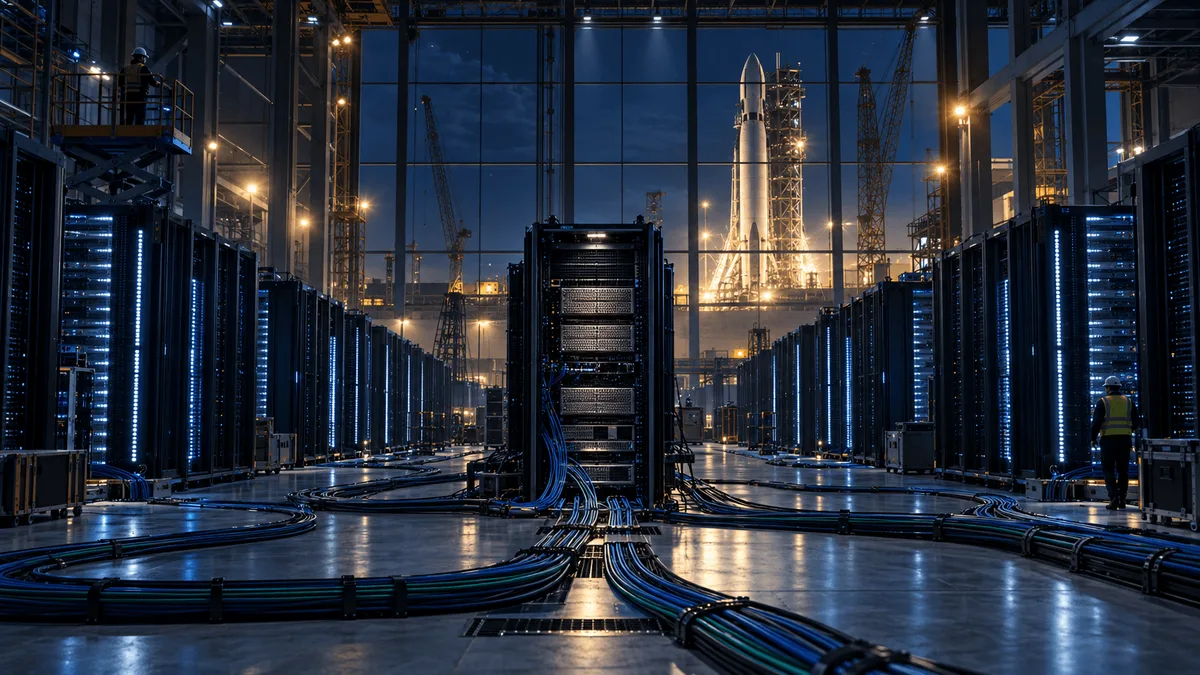
SpaceX is reportedly in talks with banks and investment firms to raise about $40 billion to pay for a large order of Nvidia artificial-intelligence chips, according to a report from the Financial Times cited by MarketWatch and other outlets. The proposed structure would split the raise into roughly $10 billion in bank loans and $30 billion in investment-grade bonds, with Apollo Global Management expected to lead the deal and help place the debt with a broad range of investors. The financing is reportedly targeted to close in 2027.
A separate report from Bloomberg, relayed by Yahoo Finance, similarly described SpaceX as looking to issue $40 billion in new debt to buy Nvidia chips for its data centers, though sourcing on the scoop varies by outlet: Reuters-linked and MarketWatch accounts credit the Financial Times, while the Yahoo Finance piece attributes the report to Bloomberg.
The reported $10 billion / $30 billion split
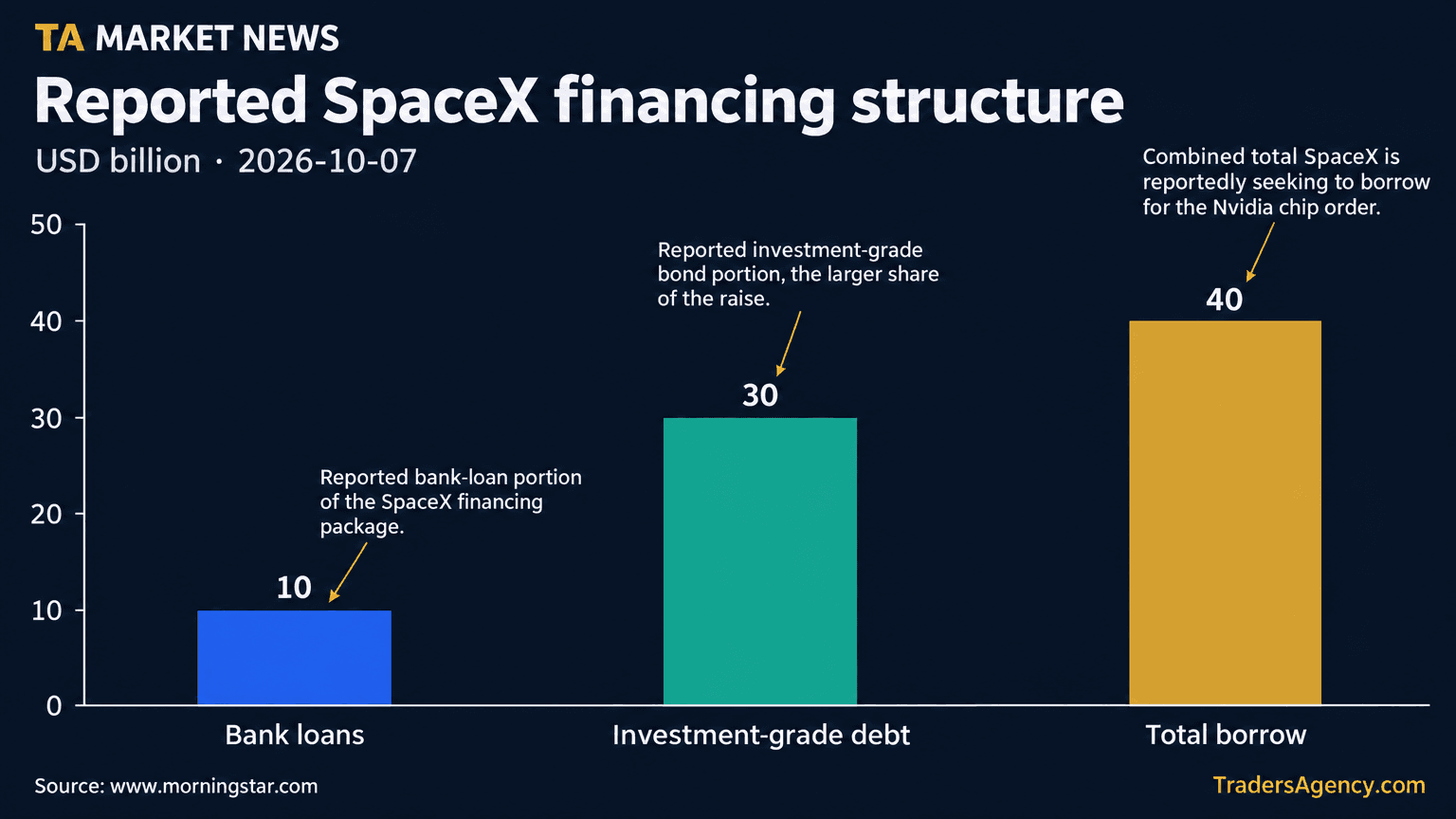
Per the Financial Times reporting cited by MarketWatch, SpaceX is aiming to raise approximately $10 billion in bank loans and an additional $30 billion in investment-grade debt specifically to pay for the Nvidia chip order. Apollo is described as the firm expected to lead the transaction, and Pimco is named as among a small group of lenders reportedly in talks to help fund it, according to Calcalist; MarketWatch likewise reported that Pimco is one of the firms in talks about funding the deal. Calcalist, relaying Reuters, said SpaceX, Apollo and Nvidia did not immediately respond to Reuters' requests for comment and that Pimco declined to comment; MarketWatch separately reported that SpaceX, Nvidia, Pimco and Apollo did not immediately respond to its own requests for comment. No chip volume or dollar commitment between SpaceX and Nvidia has been confirmed in the reporting.
The financing is described as still at the discussion stage. As 247 Wall St's reporting carried on Yahoo Finance put it, because the deal is not expected to close until 2027, the terms, the lender group and the final size could all still change before any money moves. 247 Wall St also noted that selling investment-grade bonds of this size to a wide investor base typically requires engagement with rating agencies and a marketing process that can take multiple quarters, calling it the harder half of the deal compared with the bank-loan portion; no rating agency engagement on the bond tranche has been confirmed in the available reporting.
What the chips are for, and who would own them

The reporting is not fully consistent on where the chips would end up. The Yahoo Finance account citing Bloomberg describes the purchase as destined for SpaceX's data centers, while Calcalist reported that SpaceX has said it plans to use Nvidia hardware exclusively to build those data centers. That exclusivity was underscored by Elon Musk on the company's August 4 earnings call, when, according to 247 Wall St, he said: "So we're exclusive to NVIDIA." Gurufocus separately reported that the company announced in August it would develop entirely on Nvidia hardware, citing the chipmaker's Vera Rubin architecture.
Asset ownership in the underlying buildout is less clear-cut. MarketWatch's account notes that less than two weeks before the financing report, Musk said his separate AI venture xAI would aim to more than double its Nvidia chip count at its Colossus 2 data center by year-end, a facility MarketWatch described as currently running 110,000 Nvidia GB200 chips and 440,000 GB300 chips, with Musk saying xAI expected another 220,000 GB300s operational the following week and an additional 220,000 units in November. The Yahoo Finance account, by contrast, describes Colossus 1 and 2 in Memphis as SpaceX's own data centers, generating billions per month in recurring revenue from AI compute services. The two characterizations are not necessarily reconciled in the available reporting, and it is not confirmed whether the newly sought $40 billion in debt would fund SpaceX-owned infrastructure, xAI-linked capacity, or some combination.
Scale against SpaceX's own numbers
The amount sought is large relative to SpaceX's reported financials. MarketWatch, citing FactSet, reported that the $40 billion target would represent basically all of the company's projected $44.5 billion in revenue this year. By our calculation using those two reported figures, $40 billion compares with $44.5 billion in projected revenue, a difference of $4.5 billion, or about 10.1% less than that revenue figure (40 minus 44.5, divided by 44.5). 247 Wall St separately reported that in the second quarter of 2026, SpaceX posted revenue of $7.81 billion against capital spending of $18.37 billion, of which $15.83 billion went to AI, illustrating a spending pace well ahead of quarterly revenue even before this latest financing request.
The request also follows closely on SpaceX's own balance-sheet activity this year. Gurufocus reported the company sold $25 billion of investment-grade notes shortly after its record $86 billion initial public offering in June, and that those bonds later weakened, with 2056 maturities recently quoted around 85 cents on the dollar; SpaceX's BBB rating, per that report, still allows it to sell to investment-grade buyers such as pension funds and insurers. Calcalist independently described the June listing as a record $86 billion IPO.
Market reaction and the leverage debate

SpaceX shares fell on the report, down almost 2% to $169.15 in premarket trading according to MarketWatch, and about 2% in early trade according to Yahoo Finance, while Nvidia's stock edged roughly 0.2% higher by MarketWatch's account. Nvidia separately touched a record market capitalization near $5.65 trillion as the report circulated, per Reuters figures relayed by Calcalist, with 247 Wall St citing a $239.24 close after a record intraday high of $243.37, valuing the chipmaker near $5.78 trillion.
Yahoo Finance quoted Yorkville analyst Dan Ives, described as a notable SpaceX bull, saying the deal would provide "firepower for [SpaceX's] AI buildout," even as he framed the core question as whether a company this early in its public life should carry that much leverage. The same Yahoo Finance report quoted SpaceX Chief Financial Officer Bret Johnsen saying last month that the company believes it is "on track to hit $100 billion ARR," pointing to a newly closed hosting deal translating into about $1.11 billion a month starting December 1, or roughly $13 billion of additional annual recurring revenue.
247 Wall St noted that borrowing rather than issuing equity avoids near-term shareholder dilution, but flagged approaching lockup expirations: 328.4 million shares were set to become marketable on October 9, another 328.4 million on October 24, and up to 1.3 billion more after third-quarter earnings. The stock priced at $135 in its June 11, 2026 IPO, peaked at $225.64, and closed at $171.92 on October 6, per that report.
The broader financing backdrop
The reported SpaceX raise would sit inside a much larger wave of AI infrastructure financing. Calcalist cited Morgan Stanley estimates that AI infrastructure will require $1.5 trillion in external financing by 2028, even as lenders and investors grow more cautious about funding the industry's expansion. MarketWatch also noted that in August, Nvidia said it was partnering with Apollo, BlackRock, Blackstone, Brookfield, Goldman Sachs and KKR to create a platform intended to mobilize more than $500 billion in third-party capital for AI buildouts, the same roster from which Apollo, the reported lead on SpaceX's financing, is drawn.
Bottom Line
As of this reporting, no party involved has confirmed the $40 billion financing on the record: SpaceX, Apollo and Nvidia did not immediately respond to requests for comment from Reuters or MarketWatch, and Pimco declined to comment to Reuters. The structure, size and even the identity of the end user for the Nvidia chips remain subject to change and, in parts of the reporting, to inconsistent characterization. Readers should treat the figures as reported deal terms still at the discussion stage rather than a finalized transaction.
DISCLAIMER: Traders Agency does not offer financial advice. The information provided is for educational purposes only and should not be considered financial advice. Traders Agency is not responsible for any financial losses or consequences resulting from the use of the information provided. Trading carries inherent risks and may not be suitable for all individuals. You are advised to conduct your own research and seek personalized advice before making any investment decisions, recognizing the potential risks and rewards involved.
- Seeking Alpha Market News: AM Markets Need to Know: SpaceX seeks $40B for Nvidia chips, Skydance leans on technology, and more · accessed Oct 7, 2026
- finance.yahoo.com: SpaceX stock slips on report of its $40 billion in new debt for Nvidia chips · accessed Oct 7, 2026
- 247wallst.com: SpaceX Wants to Borrow $40 Billion to Buy Nvidia Chips · accessed Oct 7, 2026
- finance.yahoo.com: SpaceX Wants to Borrow $40 Billion to Buy Nvidia Chips · accessed Oct 7, 2026
- www.morningstar.com: SpaceX reportedly is looking to borrow as much money as the company generates in revenue to buy Nvidia chips · accessed Oct 7, 2026
- www.gurufocus.com: SpaceX Wants $40 Billion More to Fund Its Nvidia AI Bet · accessed Oct 7, 2026
- www.calcalistech.com: Nvidia hits record $5.65 trillion as SpaceX seeks $40 billion to buy its AI chips · accessed Oct 7, 2026
See more from Traders Agency on Google
Make us a preferred source and our market analysis will appear more prominently in your Google Search, Top Stories, and AI results.
Add to Preferred Sources