Levi Strauss reported third-quarter adjusted earnings of 48 cents per share, above the 36 cents analysts had expected, helped by tariff refunds — even as the company acknowledged that its direct-to-consumer business underperformed expectations during the quarter. The two per-share figures are not a clean comparison: CNBC, which reported the results, noted it was unclear how the adjusted figure compared with the Wall Street estimate.
Tariff Refunds Lift Margins and EPS
Levi said tariff refunds contributed a 16-cent benefit to third-quarter earnings per share, of which 5 cents were "redeployed to support the business," per CNBC's reporting. On the earnings call, CEO Michelle Gass told analysts that the redeployed funds are being directed toward marketing and promotions during the holiday season.
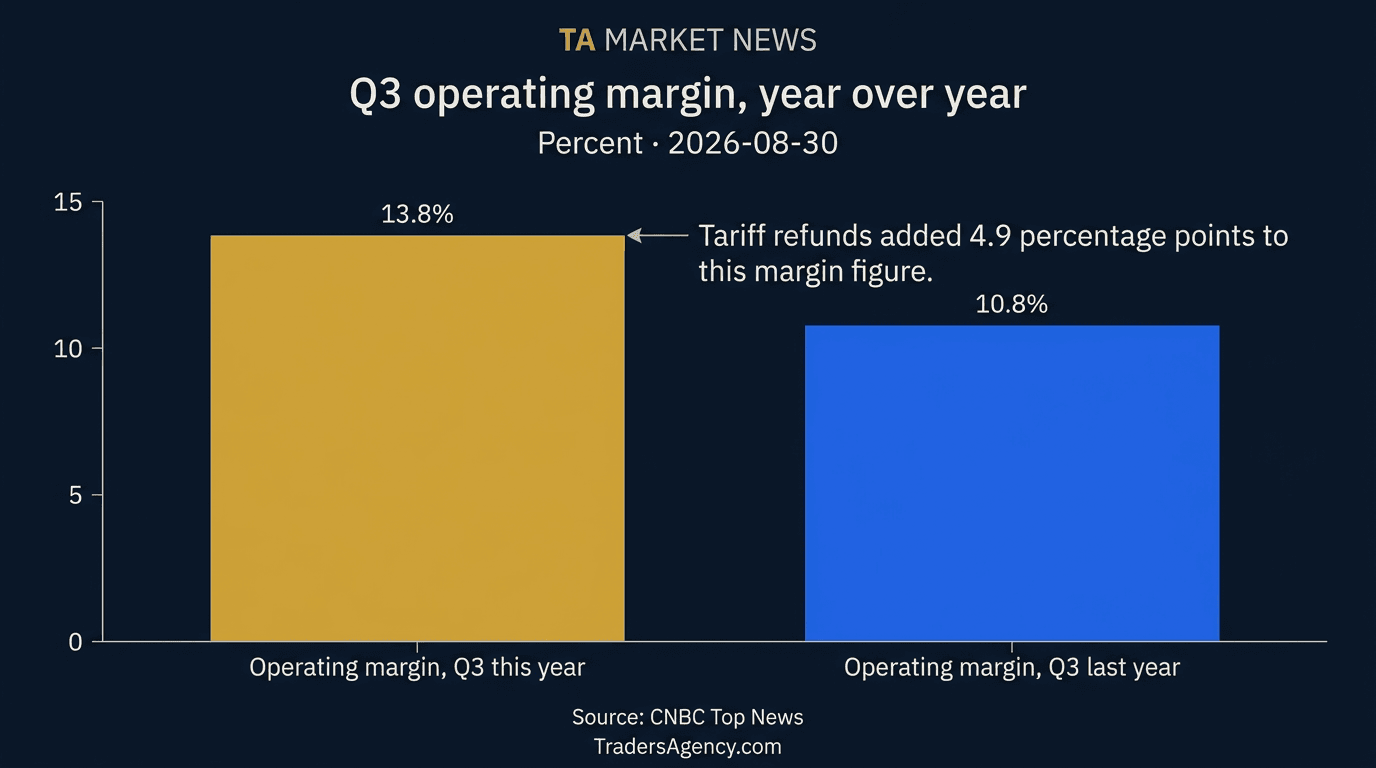
The refunds also flowed through to profitability. Levi reported an operating margin of 13.8% for the quarter, up from 10.8% in the same quarter a year earlier, with tariff refunds contributing 4.9 percentage points to both operating margin and gross margin, CNBC reported. By our calculation, based on the two reported margin figures (13.8% versus 10.8%), that represents a 3.0 percentage-point increase, or a 27.8% relative improvement year over year (13.8 minus 10.8, divided by 10.8, multiplied by 100).
Despite the margin expansion, net income fell. Levi reported net income of $168.6 million, or 43 cents per share, for the three months ended Aug. 30, down from $218.1 million, or 55 cents per share, a year earlier, according to CNBC. In our reading of these figures, the gap between the adjusted per-share result and the decline in reported net income suggests much of the quarter's reported profitability improvement traced to the tariff refund benefit CNBC said Levi quantified at 16 cents per share, rather than to underlying operating gains.
Seeking Alpha reported separately that Levi raised its full-year profit guidance while trimming its sales growth outlook, a characterization that aligns with the tariff-driven margin boost on one side and the direct-to-consumer softness on the other. Seeking Alpha cited soft direct-to-consumer sales but pointed to strong international and wholesale growth as offsetting factors.
DTC Shortfall Weighs on Results
The direct-to-consumer channel was the clear soft spot in the quarter. Levi said DTC net revenues increased 2%, but comparable sales were roughly flat, and the channel comprised 45% of total net revenue in the third quarter, according to CNBC. Wholesale revenues, by contrast, increased 6% for the quarter.
Gass addressed the shortfall directly on the call with analysts. "While we delivered strong results across much of the business, our DTC performance fell short of our expectations during the quarter," she said, according to CNBC. "We have a clear understanding of what worked and what did not, and we have already taken targeted actions to improve performance."
That statement follows prior commentary from the company describing broad-based growth across its business segments, including its core Levi's brand and its premium Blue Tab line, CNBC reported, suggesting the DTC weakness represents a channel-specific issue rather than a broader brand slowdown.
Regional Trends Mixed
Geographic performance was uneven. Levi said net revenues in the Americas rose 4% in the quarter, even as U.S. revenue alone decreased 1%, according to CNBC. The divergence between regional Americas growth and a U.S. revenue decline points to international markets within the Americas region carrying more of the growth than the domestic business.
Leadership Transition
Separately, CNBC reported that Levi announced last month that John Vandemore will take over as chief financial officer effective Nov. 1, succeeding Harmit Singh, who announced his retirement in April.
Market Reaction
Shares of Levi were roughly flat in extended trading after initially rising, according to CNBC, suggesting investors weighed the tariff-driven earnings beat against the acknowledged DTC shortfall rather than reacting decisively in either direction.
Bottom Line
Levi's third quarter presents a split picture: tariff refunds added 16 cents to per-share earnings and 4.9 percentage points to operating and gross margin, according to CNBC, while CEO Michelle Gass conceded that direct-to-consumer performance fell short of the company's expectations. Wholesale revenue rose 6%, and Seeking Alpha pointed to strong international and wholesale growth as offsets to the DTC softness, while Gass said Levi has already taken targeted actions to improve performance. In our reading, the size of the refund-related benefit is the central variable in judging how much of this quarter's margin improvement reflects ongoing operations.
DISCLAIMER: Traders Agency does not offer financial advice. The information provided is for educational purposes only and should not be considered financial advice. Traders Agency is not responsible for any financial losses or consequences resulting from the use of the information provided. Trading carries inherent risks and may not be suitable for all individuals. You are advised to conduct your own research and seek personalized advice before making any investment decisions, recognizing the potential risks and rewards involved.
- CNBC Top News: Levi Strauss (LEVI) Q3 2026 earnings · accessed Oct 7, 2026
- Seeking Alpha Market News: Levi Strauss raises FY26 profit guidance but trims sales growth outlook · accessed Oct 7, 2026
See more from Traders Agency on Google
Make us a preferred source and our market analysis will appear more prominently in your Google Search, Top Stories, and AI results.
Add to Preferred Sources