
Oracle shares jumped 11% on Wednesday after the company told investors it expects $225 billion in revenue for fiscal 2030, implying average annual growth of 35%, and that it will limit additional fundraising over that stretch to $20 billion, according to CNBC. The announcement came at Oracle's 2026 investor day, where the company also laid out margin targets and reaffirmed near-term guidance even as it continues a capital-intensive buildout tied to artificial intelligence infrastructure.
A $20 Billion Ceiling Layered Atop an Earlier Raise
Oracle said the new $20 billion financing cap is in addition to a separate $20 billion at-the-market equity raise the company already completed in the first quarter of fiscal 2027, according to Oracle's investor day materials distributed via PR Newswire. That framing suggests the company is trying to draw a line under how much new capital it plans to raise externally as it funds continued growth, even as its overall debt position remains sizable.
Oracle also said vendor financing, customer-provided hardware and customer prepayments are expected to reduce upfront cash requirements during the company's transition to positive free cash flow, a point the company made in its own investor day materials and that was also cited in a company filing with the Securities and Exchange Commission, as reported by CNBC.
Margin and Revenue Targets for Fiscal 2030

Alongside the $225 billion fiscal 2030 revenue forecast, Oracle said its operating margin that year will top 40%, according to CNBC. The company separately reaffirmed its existing fiscal 2027 outlook, which calls for total revenue of at least $90 billion and non-GAAP earnings per share of $8.10, per the PR Newswire investor day release. Oracle described its capital allocation priorities as maintaining investment-grade credit ratings, paying a dividend and funding growth opportunities, according to the same release.
Capital Spending Surge and the Road to Free Cash Flow
The growth targets arrive against a backdrop of sharply rising capital expenditures. Oracle's capex more than doubled to $55.7 billion in fiscal 2026 and is expected to jump another 65% this fiscal year to $91.9 billion, according to FactSet data cited by CNBC. Against that spending, analysts expect negative free cash flow of $35 billion this fiscal year and a similar figure next year, also per FactSet, as reported by CNBC.
The FactSet projections cited by CNBC help explain why Oracle's commentary on vendor financing, customer-provided hardware and customer prepayments matters. Oracle framed those items as expected to reduce upfront cash requirements through the transition to positive free cash flow; our reading of that framing is that the company is pointing to arrangements that shift or defer cash outlays while capital spending remains elevated and free cash flow stays negative in the near term.
Debt Load and Credit Market Reaction
Oracle enters this spending cycle already carrying a heavy debt load. The company has issued $117 billion in long-term debt and holds an investment-grade credit rating of BBB-, the lowest tier of investment grade, according to S&P data cited by CNBC. Prior to Wednesday's announcement, Oracle had lost about one-third of its value this year on investor concern that rising interest rates and the company's debt load would make its AI buildout too costly, per CNBC.
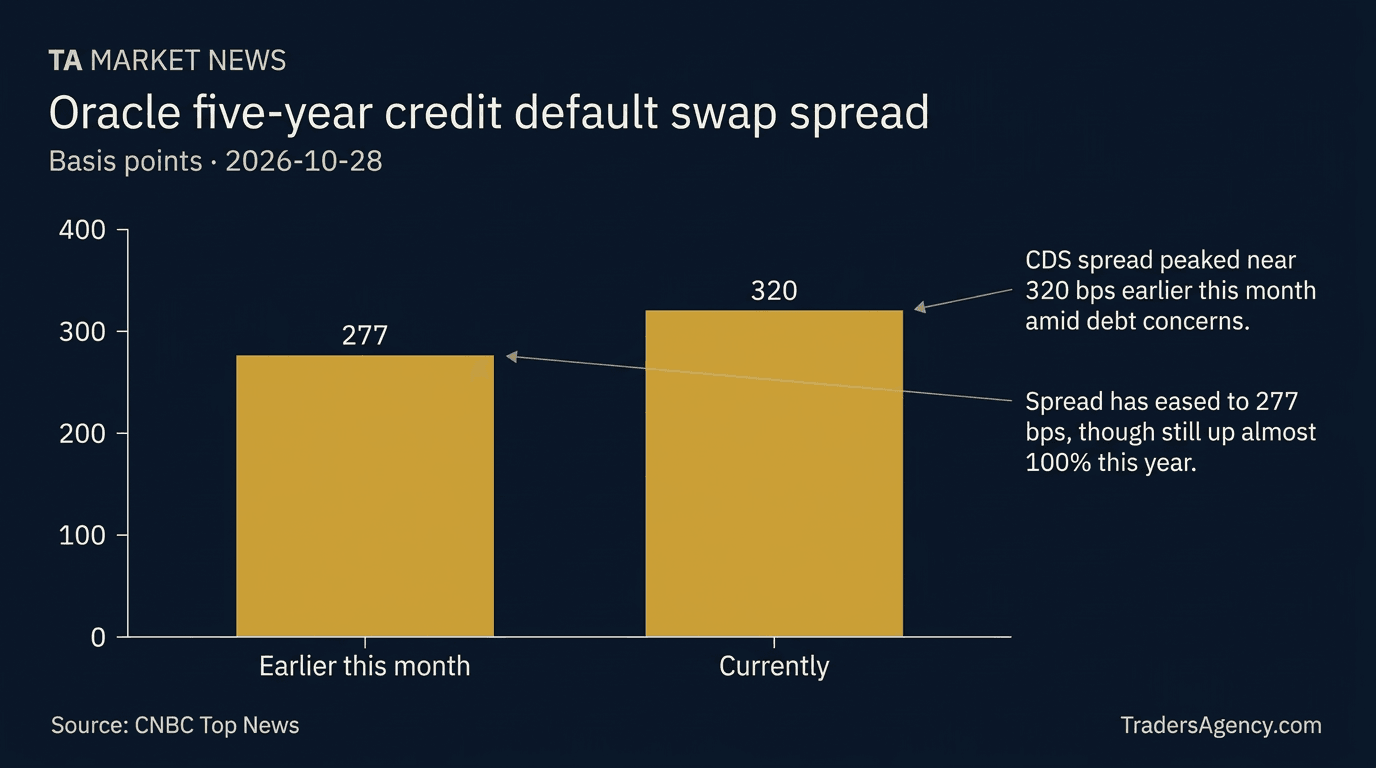
Credit markets have been pricing in some of that concern. The spread on Oracle's five-year credit default swaps, a gauge of the market's perceived default risk, currently sits at 277 basis points, down from about 320 basis points earlier this month, according to CNBC. Based on those two CNBC-reported figures, that is a decline of 43 basis points, or roughly 13.4% (277 − 320 = −43; −43 ÷ 320 × 100 ≈ −13.4%). Even with that recent pullback, CNBC reported that the spread is up almost 100% this year — an indication, in our reading, that credit investors remain considerably more cautious on Oracle than they were at the start of the year.
Bottom Line
Oracle used its investor day to pair an ambitious fiscal 2030 revenue and margin target with an explicit ceiling on new external financing — a combination that appears aimed at investors who have grown wary of the company's debt load amid an aggressive AI infrastructure buildout. Shares jumped 11% on Wednesday, according to CNBC, suggesting at least a partial easing of those concerns. Oracle's five-year credit default swap spread has also eased, to 277 basis points from about 320 earlier this month, though CNBC did not tie that move to the investor day announcement. The pressures have not disappeared: capital expenditures are still set to approach $92 billion this fiscal year, analysts expect negative free cash flow of $35 billion this fiscal year and a similar figure next year, and the credit default swap spread remains up almost 100% so far this year, all per CNBC, citing FactSet and S&P data where applicable. Whether Oracle's growth and margin targets materialize as described, and whether the new financing cap holds, will likely remain a focal point for investors and credit analysts tracking the company's balance sheet through this buildout.
DISCLAIMER: Traders Agency does not offer financial advice. The information provided is for educational purposes only and should not be considered financial advice. Traders Agency is not responsible for any financial losses or consequences resulting from the use of the information provided. Trading carries inherent risks and may not be suitable for all individuals. You are advised to conduct your own research and seek personalized advice before making any investment decisions, recognizing the potential risks and rewards involved.
- CNBC Top News: Oracle stock pops on forecast for 35% average growth through 2030 · accessed Oct 28, 2026
- Oracle via PR Newswire: Oracle Investor Day 2026: Accelerating Value Creation · accessed Oct 28, 2026
See more from Traders Agency on Google
Make us a preferred source and our market analysis will appear more prominently in your Google Search, Top Stories, and AI results.
Add to Preferred Sources