
Theta decay is the rate at which an option's value erodes as it approaches expiration, assuming the underlying stock price and volatility stay flat. It's the clock ticking against every option buyer and the clock working in favor of every option seller. By the end of this guide, you'll know how to read a decay curve, identify when theta decay is highest, and build a trading approach around it instead of getting blindsided by it.
We see this scenario constantly in our trading community: someone buys a call option, the stock moves in their favor, and they're still losing money. The culprit is almost always theta decay eating away at the contract faster than the stock price gain can offset it.
This is one of the concepts that separates traders who consistently lose premium from traders who consistently collect it. We're going to walk through the mechanics, show you real numbers, and give you a practical framework for using time decay to your advantage.
What Is Theta Decay?
Bottom Line: Theta decay accelerates as expiration nears, which is why option buyers need the stock to move far enough, fast enough, to outpace time erosion, and why sellers who manage DTE and use defined-risk spreads can consistently collect that eroding value. Understanding the decay curve, not just the Greek itself, is what lets a trader choose entries, exits, and strategies that work with time rather than against it.
Theta is one of the "Greeks" we teach every options trader to track. It represents how much an option's price is expected to drop each day purely from the passage of time, with everything else held constant.
If a call option has a theta of -0.05, that contract loses about $5 in value per day (since each contract controls 100 shares), assuming the stock price and implied volatility don't change. This is why we often call an option a "wasting asset." Every single day that passes, some of its value evaporates, whether the trade is working or not.
Theta decay exists because options have an expiration date attached to them. The closer that date gets, the less time remains for the stock to make a move that justifies the option's price, so the market prices in less and less of that "possibility premium" every day.
Key Concept: Theta measures the daily cost of holding an option. It's the price you pay (as a buyer) or collect (as a seller) just for the passage of time.
How Does Time Decay (Theta) Work?
Time decay works by stripping away an option's extrinsic value a little each day, with the rate of loss increasing sharply in the final weeks before expiration. This is not a straight-line process. It behaves more like a curve that flattens early and then drops off a cliff.
Here's a concrete theta decay options trading example we use when teaching this concept. Say a stock is trading at $100, and you buy a 30-day call option at the $100 strike for a premium of $3.00 ($300 total).
| Days to Expiration | Approximate Theta (Daily Cost) |
|---|---|
| 30 DTE | $0.04 per day |
| 10 DTE | $0.12 per day |
| 3 DTE | $0.25+ per day |
That's the core lesson we want every new trader to internalize: the pain isn't evenly distributed. It's backloaded.
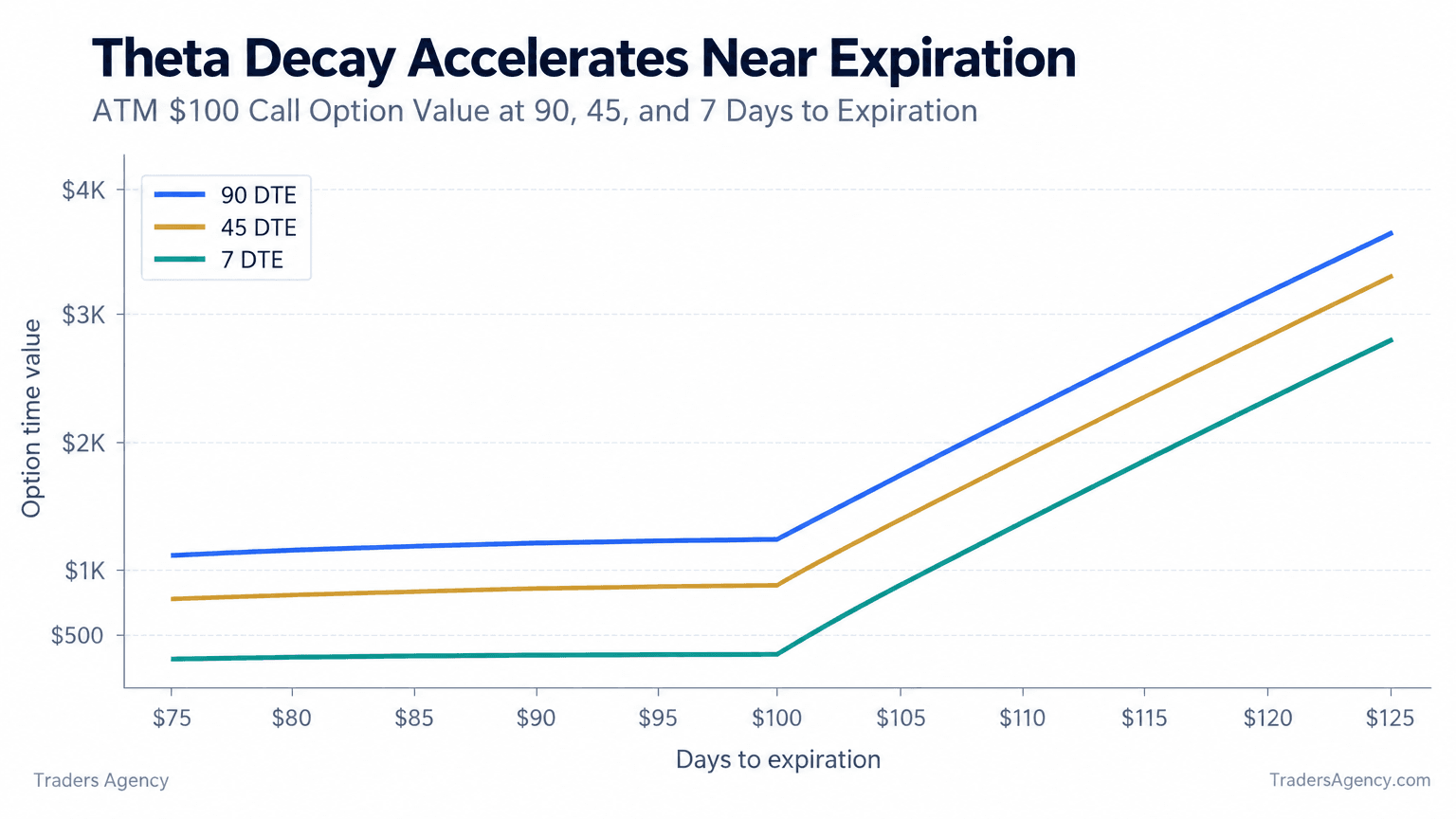
Picture that curve: a gentle slope for the first several weeks, then a steep drop in the final stretch. If you're holding a long option through that final stretch without a strong directional move, you're fighting a losing battle against the clock.
How Theta Decay Works: Quick Reference
- Daily erosion: Options lose extrinsic value every day, even if the stock doesn't move.
- Acceleration window: Decay speeds up as expiration approaches, especially inside the final 30 days.
- Fastest in dollar terms: At-the-money options experience the fastest decay in dollar terms.
- Out-of-the-money decay: These options decay toward zero since they have no intrinsic value to fall back on.
- In-the-money decay: These options retain intrinsic value, so percentage decay is slower even though theta is still deducting dollars.
When Is Theta Decay Highest?
Theta decay is highest for at-the-money options in the final 7 to 21 days before expiration. This is the window where extrinsic value is largest relative to time remaining, so each passing day removes a bigger chunk of the option's price.
Here's how we think about when theta decay is highest: it's a combination of two factors, how much extrinsic value is sitting in the option, and how little time is left to use it. At-the-money options carry the most extrinsic value of any strike because they have the highest uncertainty about finishing in or out of the money. Combine that with a short runway to expiration, and you get the steepest dollar-for-dollar decay of any option on the chain.
Which option has the highest theta decay? In almost every case, it's the at-the-money contract with the least time remaining, typically inside that final week before expiration.
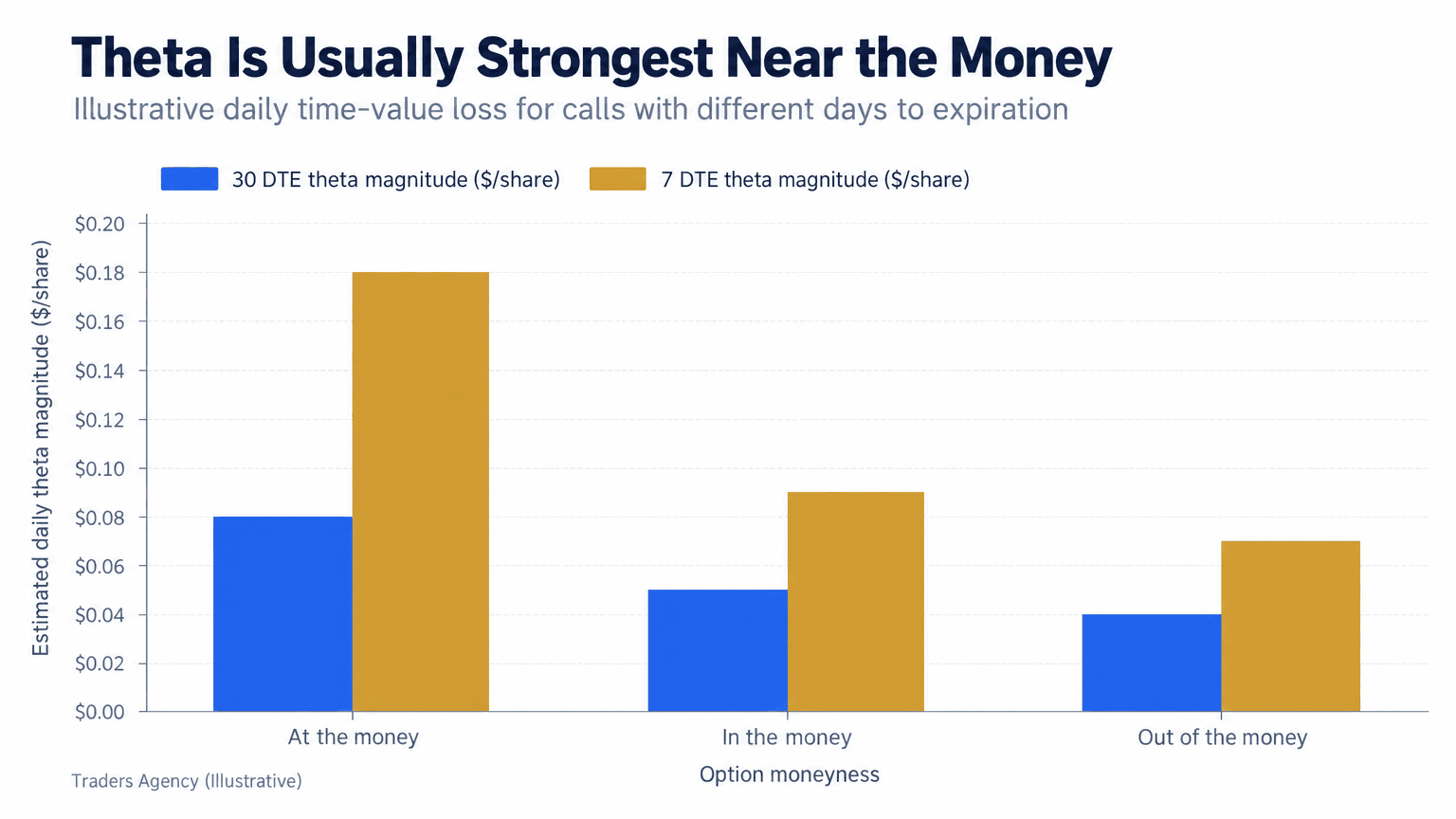
This is exactly why option sellers favor short-dated at-the-money (or slightly out-of-the-money) contracts, and why option buyers generally want to avoid holding them into that final stretch unless they're expecting a fast, strong move.
Want expert trading insights delivered daily?
Join thousands of traders who rely on Traders Agency for market analysis and trade ideas.
Join Traders AgencyWhat Are Intrinsic and Extrinsic Value in Options Theta?
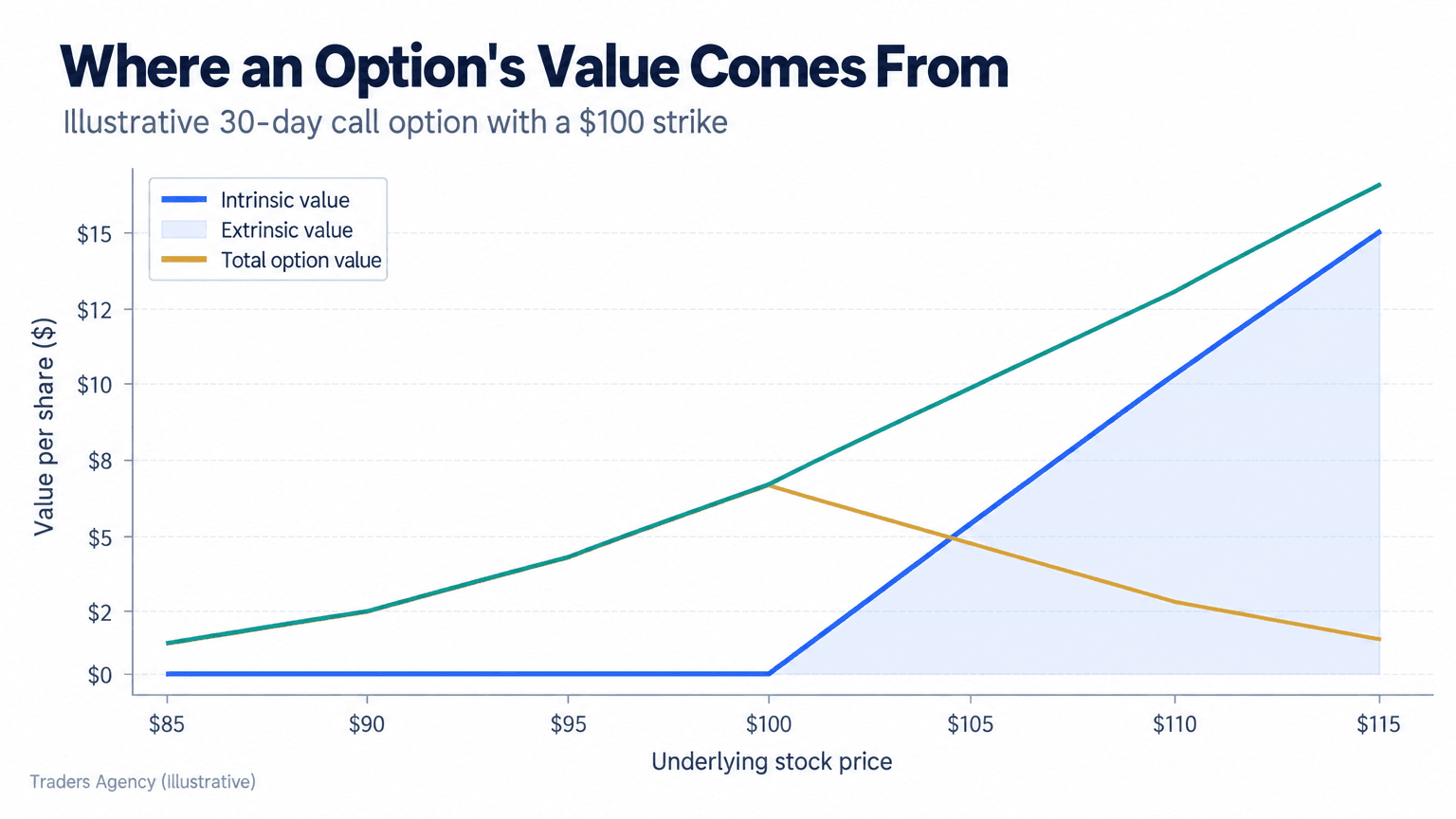
Every option's price is made up of two components: intrinsic value and extrinsic value. Intrinsic value is the amount the option is in the money by, while extrinsic value is everything else, including time value and implied volatility premium.
Theta only eats extrinsic value. It can never touch intrinsic value directly. That's why a deep in-the-money call behaves more like the stock itself as expiration nears: most of its price is intrinsic, so there's less extrinsic value left for theta to erode.
The basic theta decay formula used by pricing models (built on the Black-Scholes framework) calculates the option's expected price change per day holding the stock price and volatility constant. You don't need to compute this by hand. Most brokerage platforms display theta directly on the option chain, and a theta decay calculator can help you model different expiration dates and strikes before you place a trade. If you want to go deeper on how these Greek values are derived, the Cboe publishes educational material on options pricing mechanics that's worth reviewing.
What Are the Greeks: Delta, Theta, and Vega?
Theta doesn't operate alone. It interacts constantly with delta (sensitivity to stock price movement) and vega (sensitivity to implied volatility changes).
- Delta: tells you how much the option price moves per $1 move in the stock.
- Theta: tells you how much the option price drops per day, all else equal.
- Vega: tells you how much the option price moves per 1% change in implied volatility.
A trade can have positive delta working in your favor while theta and a volatility drop work against you at the same time. We see this trap constantly: a stock inches higher, but implied volatility collapses after an earnings report, and theta keeps grinding, so the option loses value despite the "correct" directional call.
Why Do 90% of Options Traders Lose Money?
A large share of options traders lose money because they consistently buy options without accounting for theta decay, often purchasing short-dated, out-of-the-money contracts that need a fast, large move just to break even. The odds are structurally stacked against that approach.
When you buy an option, you need the stock to move far enough, fast enough, to outpace both theta decay and any volatility contraction. Many traders buy cheap, far out-of-the-money weekly options hoping for a lottery-ticket payoff. Those contracts have the highest theta decay relative to their price, and most expire worthless. Selling premium, by contrast, puts time on your side rather than against you, which is one reason we see experienced traders shift toward strategies like credit spreads or covered calls as they mature.
Watch Out: Buying cheap, far out-of-the-money weekly options for a quick payoff is one of the fastest ways to hand your account to theta decay. These contracts carry the highest decay relative to their price and expire worthless far more often than not.
What Is the Ideal DTE Window for Theta-Based Strategies?
Your ideal days to expiration (DTE) depends entirely on which side of the theta decay trade you're on.
For Option Sellers (Harvesting Decay)
- 30 to 45 DTE is the sweet spot we recommend for selling credit spreads or covered calls, balancing meaningful premium with manageable gamma risk.
- Closing or rolling positions around 21 DTE is a guideline we teach often, since decay acceleration starts to compete with rising gamma risk near the money.
- Weekly options (under 7 DTE) offer the fastest theta decay in dollar terms but come with sharp price swings near the strike.
For Option Buyers (Fighting Decay)
- Favor 45+ DTE or longer-dated contracts when buying calls or puts, since theta decay is much gentler early in an option's life.
- Avoid buying options inside the final 2 weeks before expiration unless you expect an immediate, significant move.
- Consider in-the-money strikes over far out-of-the-money ones, since more of the premium is intrinsic value rather than decaying extrinsic value.
When Should You Use a Theta Decay Strategy?
A theta decay options trading strategy makes the most sense in range-bound or moderately directional markets where you expect the stock to stay within a defined zone through expiration. Selling premium (credit spreads, iron condors, covered calls) tends to perform best here, since you're collecting the decay rather than fighting it.
We recommend avoiding theta-selling strategies heading into known binary events like earnings or FDA announcements, where a big implied volatility crush or expansion can swamp the benefit of time decay. If you're a buyer, favor longer-dated contracts and treat theta decay as a cost of doing business, not an afterthought.
Risk Management Basics
- Size positions responsibly: A single losing trade, whether from decay or an adverse move, shouldn't exceed a small percentage of your account. We teach traders to cap this around 1-3%.
- Use defined-risk structures: Favor spreads rather than naked options when selling premium, so your max loss is known upfront.
- Monitor the decay curve: Watch the theta decay options trading chart on your platform regularly. Tracking how theta changes as DTE shrinks helps you decide when to close or roll a position rather than holding until expiration out of habit.
Risk Warning: Selling premium into earnings or other binary events exposes you to implied volatility swings that can overwhelm theta's benefit. Confirm there's no major scheduled event before entering a theta-based trade.
Want expert trading insights delivered daily?
Join thousands of traders who rely on Traders Agency for market analysis and trade ideas.
Join Traders AgencyDISCLAIMER: Traders Agency does not offer financial advice. The information provided is for educational purposes only and should not be considered financial advice. Traders Agency is not responsible for any financial losses or consequences resulting from the use of the information provided. Trading carries inherent risks and may not be suitable for all individuals. You are advised to conduct your own research and seek personalized advice before making any investment decisions, recognizing the potential risks and rewards involved.
See more from Traders Agency on Google
Make us a preferred source and our market analysis will appear more prominently in your Google Search, Top Stories, and AI results.
Add to Preferred Sources