
The U.S. labor market delivered a sharp upside surprise in October. Nonfarm payrolls rose by a seasonally adjusted 165,000, far outpacing the Dow Jones estimate of 59,000, while the unemployment rate unexpectedly fell to 4.1%, according to data reported by CNBC citing the Bureau of Labor Statistics. The report also included substantial upward revisions to prior months, suggesting the labor market has been stronger in recent months than earlier estimates indicated.
Headline Numbers Beat Estimates by a Wide Margin
Economists had expected payroll growth closer to 59,000 to 65,000, per estimates cited by CNBC and Trading Economics, so the 165,000 print represented a sizable beat. The unemployment rate's drop to 4.1%, from a forecast of 4.2%, added to the upside surprise, CNBC reported.
The picture was more complicated beneath the surface, however. A broader measure of labor underutilization that includes discouraged workers and those holding part-time jobs for economic reasons rose to 7.9%, up 0.3 percentage point, as the civilian labor force expanded by 421,000, according to CNBC's report. The participation rate also ticked up to 61.9% from 61.8%, Trading Economics data show, consistent with more people entering or returning to the labor force.
Revisions Erase Months of Soft Data
Perhaps the most striking element of the report was the scale of the revisions. August payrolls were revised up to 186,000, an increase of 53,000 from the initial estimate, while September was revised up to 60,000, a 31,000 upward adjustment, CNBC reported, citing BLS data. Combined, the two months were revised higher by 84,000, according to Trading Economics.
Those revisions stand in contrast to the much weaker preliminary readings reported earlier in the autumn. A Frontline Source Group chart of monthly payroll changes, reflecting BLS estimates as of October 2 with September listed as preliminary, had shown monthly payroll gains bouncing between a loss of 10,000 in July and a gain of 214,000 in March, with August initially pegged at 133,000 and September at just 29,000. The subsequent upward revisions to both of those months underscore how volatile and provisional early monthly jobs estimates have been this year.
Broad-Based Hiring Breaks From a Health-Care-Led Pattern
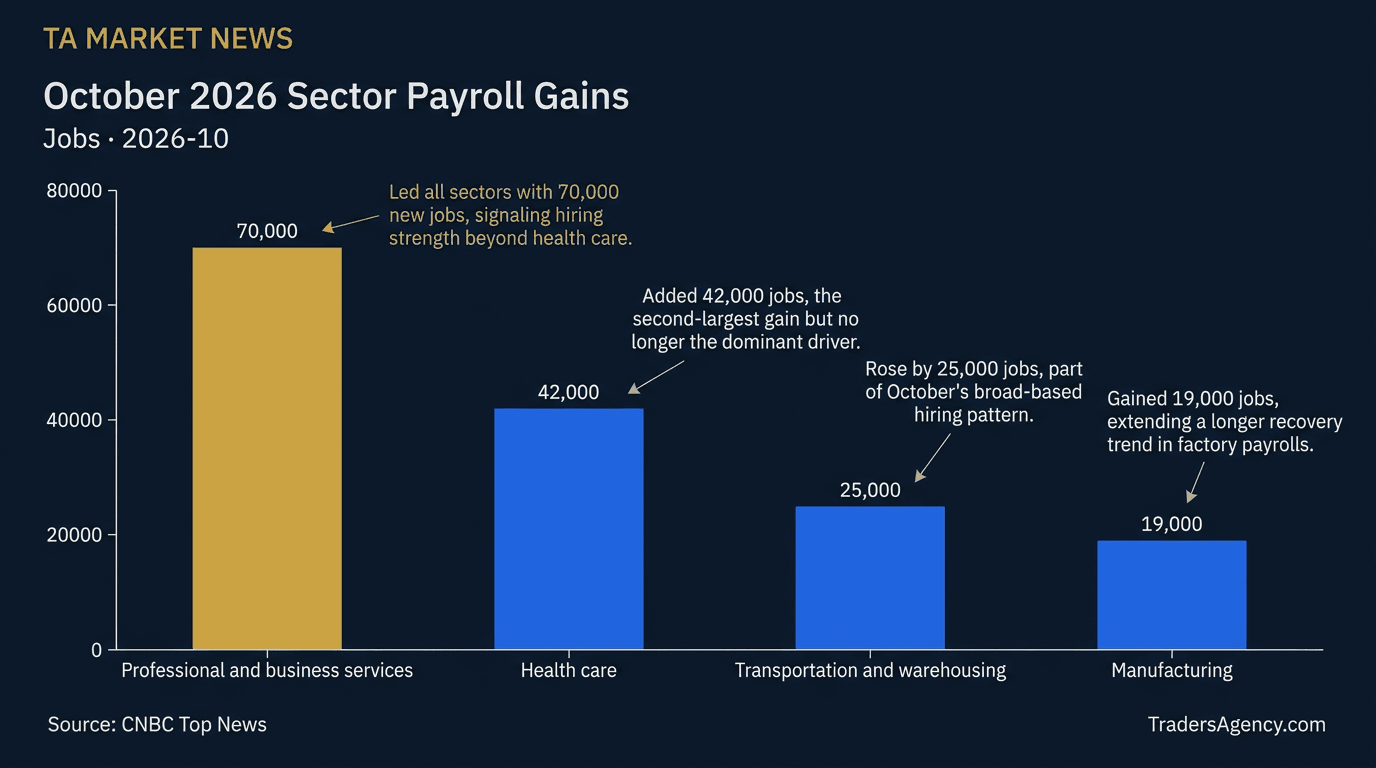
October's gains were also notable for their breadth. CNBC reported that the strength cut across sectors, a departure from a recent trend in which health care had accounted for the bulk of job growth. Professional and business services led all sectors with an increase of 70,000 jobs, followed by health care at 42,000, transportation and warehousing at 25,000, and manufacturing at 19,000, according to CNBC and confirmed by Trading Economics data.
Trading Economics' underlying dataset shows private-sector payrolls rose 159,000 in October. Subtracting that figure from the 165,000 total nonfarm gain implies government payrolls added roughly 6,000 jobs, a calculation consistent with the dataset's own reported government payroll figure of 6,000 for the month.
Most other major industries were little changed in October, including mining, construction, wholesale trade, retail trade, information, financial activities, social assistance, leisure and hospitality, other services, and government, according to Trading Economics data drawn from the BLS report. Manufacturing's 19,000 gain extended a longer run of growth; Trading Economics noted that factory payrolls have increased by 101,000 since a recent low in December 2025.
Separately, outplacement firm Challenger, Gray & Christmas reported announced job cuts of roughly 43,994 in October, little changed from September's 43,281, based on figures compiled by Trading Economics. That suggests layoffs persisted at a steady pace even as net hiring accelerated, a dynamic consistent with a labor market that is adding jobs in some areas while shedding them in others.
Wages Accelerate Alongside Hiring
Pay growth also surprised to the upside. Average hourly earnings rose 0.4% on the month and 3.1% from a year earlier, both above the 0.3% and 2.9% estimates, CNBC reported. A separate measure from payroll processor ADP showed private employment rising 86,000 in October, according to data compiled by Trading Economics, offering a corroborating, if less dramatic, signal of hiring momentum.
What It Could Mean for the Fed
In our interpretation, the combination of a payroll beat, a falling headline unemployment rate, and firmer wage growth is the type of data that would typically reduce pressure on the Federal Reserve to continue cutting interest rates in the near term. None of the sources in this report included specific commentary from Fed officials or updated rate-odds pricing tied to the October release, so any conclusion about the December policy decision should be treated as inference from the underlying data rather than a confirmed market or official reaction.
That said, the report is not uniformly strong. The rise in the broader U-6 underemployment measure to 7.9% indicates that some workers remain under-employed even as headline hiring improves, a nuance that could temper how policymakers weigh the data.
Bottom Line
October's jobs report showed payrolls rising 165,000, nearly three times the 59,000 Dow Jones estimate cited by CNBC, alongside a drop in the unemployment rate to 4.1%, stronger wage growth, and substantial upward revisions to August and September. Hiring was broad-based across professional and business services, health care, transportation and warehousing, and manufacturing, even as a wider measure of underemployment edged higher. In our interpretation, the data points to a labor market that was more resilient in recent months than earlier, weaker preliminary readings had suggested.
DISCLAIMER: Traders Agency does not offer financial advice. The information provided is for educational purposes only and should not be considered financial advice. Traders Agency is not responsible for any financial losses or consequences resulting from the use of the information provided. Trading carries inherent risks and may not be suitable for all individuals. You are advised to conduct your own research and seek personalized advice before making any investment decisions, recognizing the potential risks and rewards involved.
- CNBC Top News: Jobs report October 2026: · accessed Nov 6, 2026
- tradingeconomics.com: United States Non Farm Payrolls · accessed Nov 6, 2026
- www.frontlinesourcegroup.com: The Surge, the Revisions, and Hiring · accessed Nov 6, 2026
- www.mufgresearch.com: US Labor Update - MUFG Research · accessed Nov 6, 2026
- wmbdradio.com: US job growth undershoots expectations in September, but labor market remains stable · accessed Nov 6, 2026
- finance.yahoo.com: U.S. September 2026 jobs report: payrolls miss forecasts badly · accessed Nov 6, 2026
- www.staffingindustry.com: October 2026 US Jobs Report · accessed Nov 6, 2026
- www.youtube.com: - YouTube · accessed Nov 6, 2026
- nam.org: Payrolls Beat Expectations, with Manufacturing Adding 16,000 Jobs · accessed Nov 6, 2026
See more from Traders Agency on Google
Make us a preferred source and our market analysis will appear more prominently in your Google Search, Top Stories, and AI results.
Add to Preferred Sources