A string of technology failures hit major institutions within days of each other in mid-November, from Microsoft's email service to the Federal Aviation Administration, Chase, United Airlines, the National Security Agency and Apple. Each organization offered its own operational explanation, yet the clustering has fueled a broader debate about whether artificial intelligence is now accelerating the pace at which vulnerabilities are found and exploited across aging technology systems. The honest answer sits between two extremes: the incidents are real and worth watching, but the available evidence does not establish a coordinated attack behind all of them.
A Six-Day Stretch of Disruptions
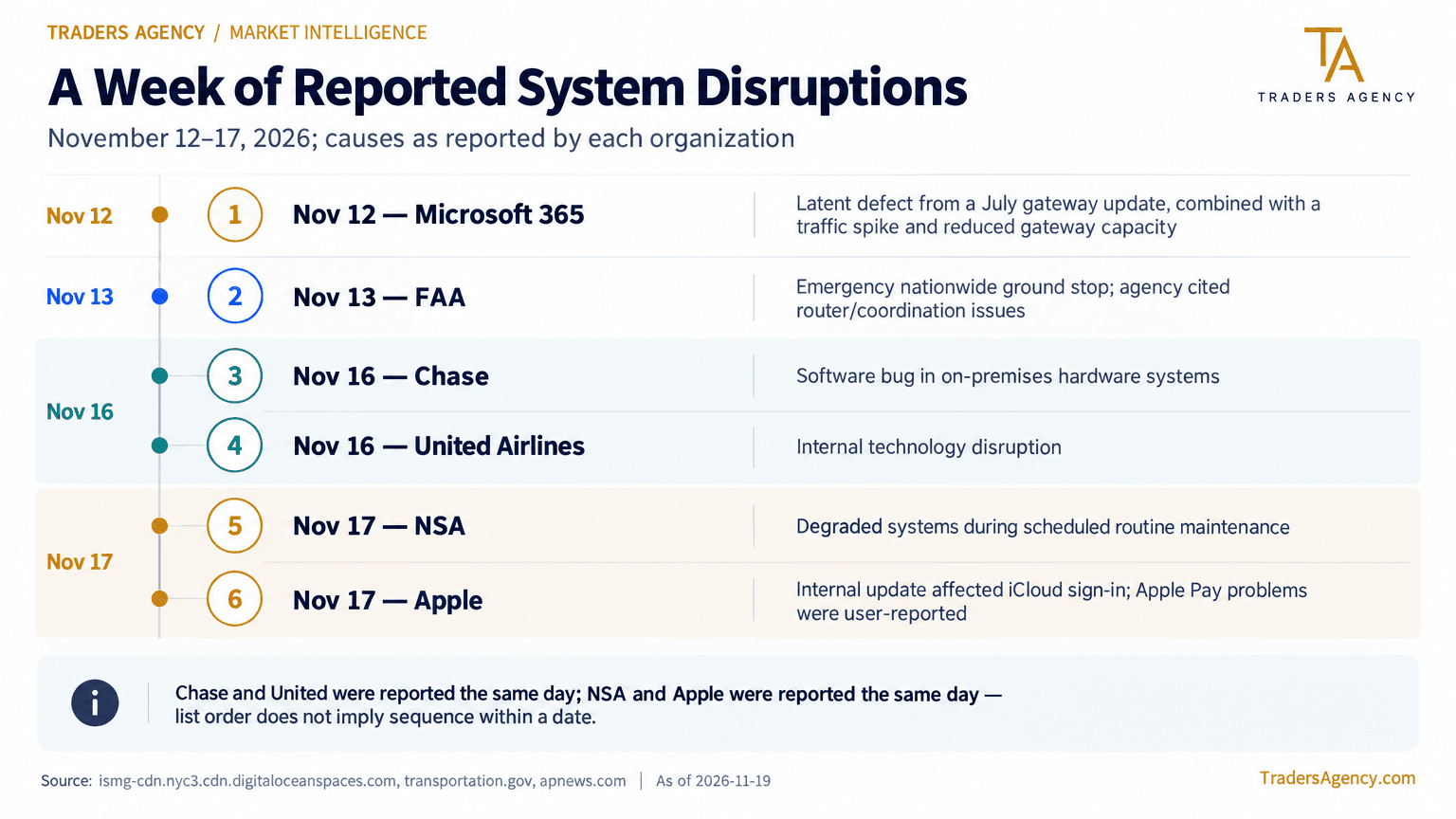
Between November 12 and November 17, six organizations reported significant technology problems. Microsoft 365 went down on November 12. The FAA ordered an emergency nationwide ground stop the next day, an action so unusual that the agency's own comparisons reach back roughly three years and ten months to the last nationwide stop, with the only earlier precedent cited being September 11, 2001. On November 16, Chase reported a software bug in its on-premises hardware systems while United Airlines disclosed an internal technology disruption. The following day, the NSA said it experienced degraded systems during what it described as scheduled routine maintenance, and Apple reported an internal update that affected services including iCloud sign-in, with separate, user-reported complaints about Apple Pay.
Microsoft's preliminary incident report, issued November 15, offers the most detailed technical picture of any single event. It attributes the outage to a latent defect introduced in a July update to its gateway servers, combined with a spike in traffic during a Teams failover and reduced available gateway capacity. Together, those three factors produced a cascading failure in which, according to the report, more than 80% of gateway servers stopped responding. That is a materially different story from a single overloaded server; it points to a fix that quietly carried its own flaw for months before conditions exposed it.
Separate Problems, One Uncomfortable Week
It's tempting to connect every one of these events into a single narrative, and officials have pushed back directly on that instinct. The Director of National Intelligence's office and other administration voices have said there is no evidence of coordinated or state-sponsored activity behind the outages, characterizing them instead as the byproduct of companies racing to patch and upgrade legacy systems. A separate government watchdog report had actually warned the FAA, roughly 60 days before its ground stop, that rushed system overhauls without adequate coordination could themselves cause outages.
That counterargument deserves real weight. A sequence of failures across unrelated industries, each with its own disclosed technical cause, is not the same as proof of a single adversary or a synchronized campaign. Software bugs, maintenance windows and defective patches happen routinely at large technology-dependent institutions; what changed this month is that several of them happened to land in the same week, making an ordinary pattern feel unusual.
Separately, Visa confirmed an apparent cybersecurity incident it said originated at an Asia-Pacific service provider, stating that Visa's own systems were unaffected and that there was no indication payment data such as card numbers had been compromised. Chase, in a distinct disclosure, reported that a cyberattack had leaked some customer emails and phone numbers. The two events are related to the same broader news cycle but are not interchangeable, and the exact scope of exposed nonpayment data has not been fully established in either company's statement.
Want expert trading insights delivered daily?
Join thousands of traders who rely on Traders Agency for market analysis and trade ideas.
Join Traders AgencyThe AI Patching Cycle: A Plausible Mechanism, Not Proof
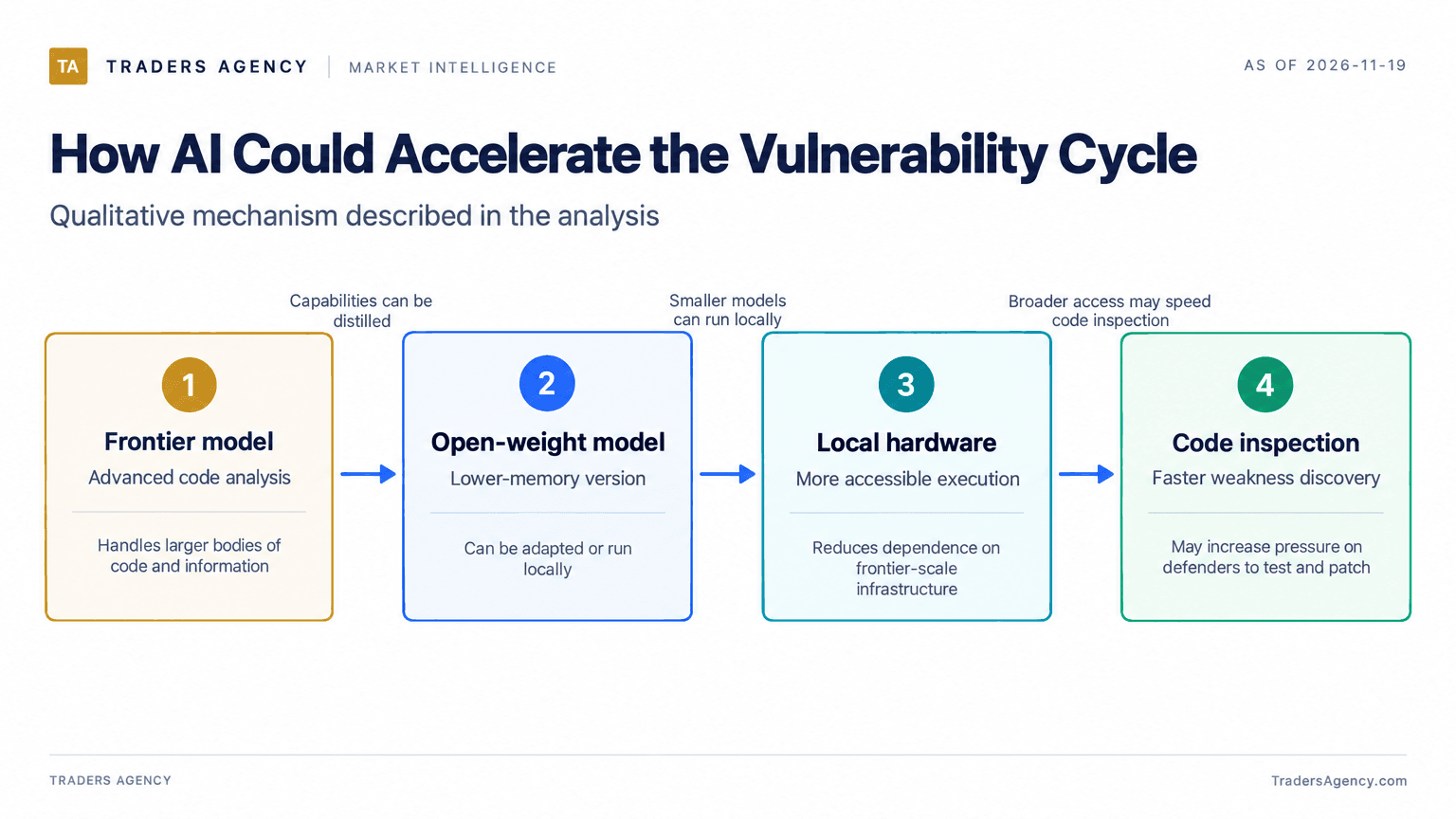
The more interesting argument concerns how artificial intelligence may be changing the economics of finding software vulnerabilities. Long-context AI tools, illustrated by Anthropic's Claude Cowork and Claude Code, substantially improved their ability to process large bodies of code without losing track of earlier information, something earlier AI models struggled with. The capability gains achieved by frontier labs can, in theory, be distilled into smaller, open-weight models that require far less computing memory and can run on consumer-grade or locally controlled hardware.
If that mechanism plays out at scale, it would lower the technical and financial barrier for a wider range of actors to inspect large codebases, legacy databases and website infrastructure for weaknesses, potentially faster than defenders can patch them. That dynamic, sometimes informally called a "patch-apocalypse," would put sustained pressure on security teams tasked with testing and updating older systems. Microsoft's own disclosed vulnerability counts give some sense of scale: contemporaneous reporting put the November 2025 Patch Tuesday total at 63 fixes, compared with roughly 1,094 in November 2026 and 1,474 in October 2026, a roughly 17-fold increase using the comparable months, though vulnerability counts depend heavily on counting methodology and should not be read as a precise measure of risk.
What the evidence does not show is that AI caused any specific outage covered above, or how much of the increased vulnerability discovery traces to AI tools versus more thorough human review, growing codebases or changed disclosure practices. The mechanism is worth monitoring, but it remains a thesis rather than a demonstrated cause.
Food, Water and Infrastructure: Where Cyber Risk Gets Physical
Several incidents this year have pushed the conversation about cyber risk beyond stolen data and into physical infrastructure. In Spartanburg, South Carolina, a power disturbance was followed by a water surge that damaged infrastructure and triggered a boil-water advisory. California separately reported E. coli detected in a local water supply. At least six U.S. military bases or commissary stores publicly reported refrigeration outages in late August 2026, though the Pentagon had not confirmed a cyberattack or an exact total as of the most recent reporting. Minnesota officials confirmed that more than 30 community water systems were targeted in a coordinated cyberattack on July 26 and 27, and later reporting attributed a broader nationwide total exceeding 100 targeted water systems that month to the Cybersecurity and Infrastructure Security Agency.
On the state-actor side, a February 2024 joint advisory from U.S. agencies found that a group tracked as Volt Typhoon had compromised critical infrastructure across energy, transportation and water networks, maintaining access in some victim environments for at least five years as assessed at that time. Separately, the FBI has linked a different group, Salt Typhoon, to intrusions into telecommunications networks involving call records and limited private communications obtained through what the bureau describes as copied information tied to court-ordered law-enforcement requests, distinct from Volt Typhoon's infrastructure access. The U.S. Treasury sanctioned a Russia-linked payment network called A7 on October 1, saying it had been used by Iran's Revolutionary Guard, while also linking North Korean cyber proceeds to the same network.
It's worth being direct about the limits of this picture. Many of the specific allegations tying individual outages to Iran, North Korea, Russia or China remain unconfirmed, and formal attribution in cybersecurity cases can take years to establish, if it happens at all. Treating every disruption as proof of a single enemy campaign outruns what public evidence currently supports.
Scenario Planning for Everyday Investors
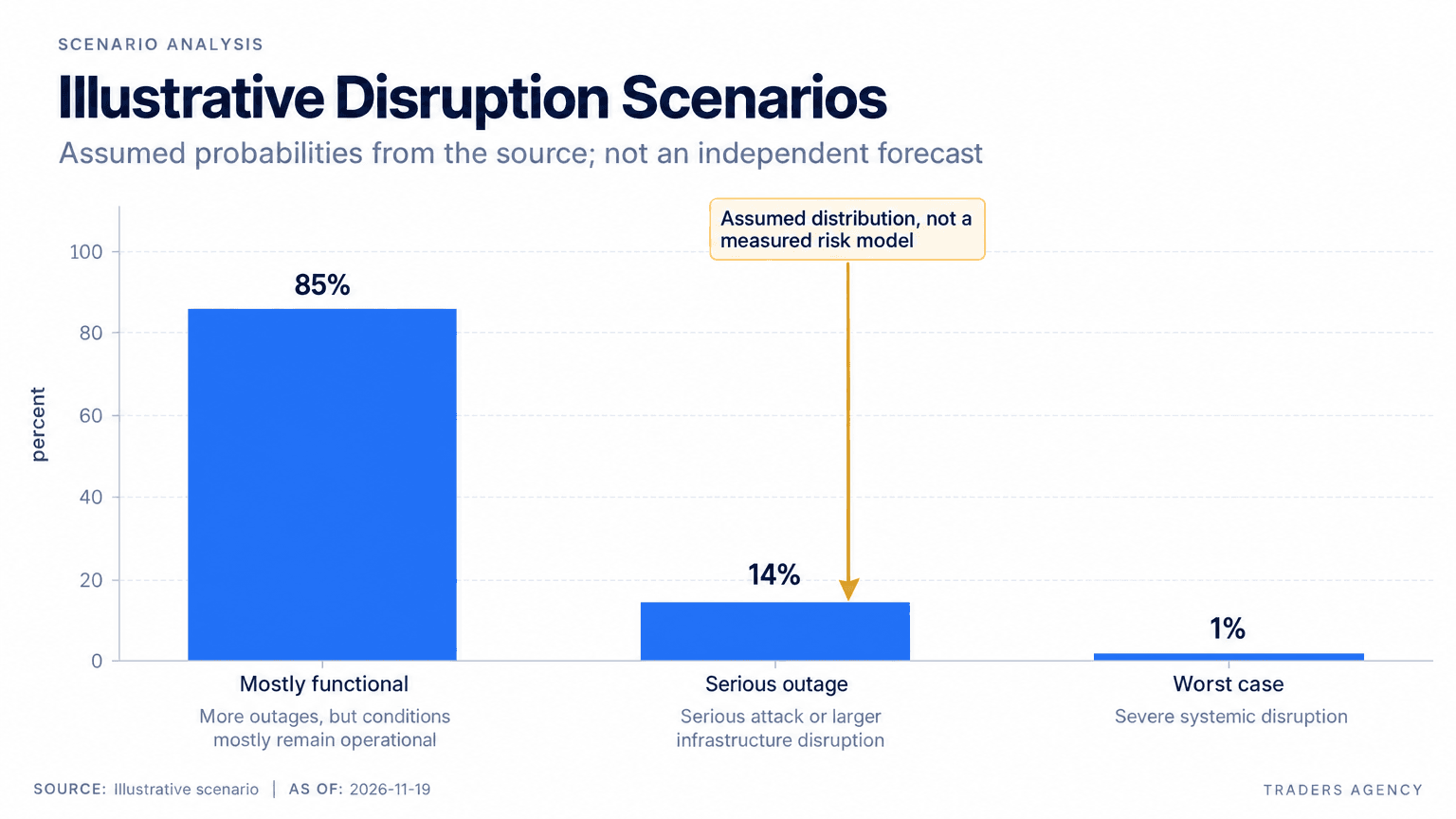
Rather than predicting a specific outcome, it may be more useful to think in terms of a range of scenarios. One illustrative framing circulating in commentary assigns roughly an 85% chance that outages continue intermittently while most systems stay broadly functional, a 14% chance of a more serious attack or larger-scale outage, and a 1% chance of a severe, systemic disruption. These are subjective estimates rather than a statistical forecast, and Traders Agency analysts are watching official incident reports and patch-cycle data for firmer signals rather than treating any single number as predictive.
For the base case, ordinary digital hygiene remains the most actionable step: strong, unique passwords, passkeys where available, multifactor authentication that avoids relying solely on phone numbers, a hardware security key for the most sensitive accounts, and careful protection of whatever secures a password manager. For a more disruptive scenario, basic preparedness such as stored water, nonperishable food and some cash on hand is a reasonable precaution rather than an alarmist one. Gold has been floated in some commentary purely as a potential emergency currency in a severe outage scenario, a framing distinct from any investment case for the metal.
The Bottom Line
The honest takeaway is that the technology environment is genuinely under strain, with AI plausibly accelerating how quickly vulnerabilities in old systems get discovered even as companies race to patch them. But the week's outages had separate, disclosed causes, officials have explicitly denied coordination, and several of the more dramatic infrastructure allegations remain unresolved or years from formal attribution. Investors and everyday users are best served by distinguishing between a real, ongoing patching challenge and a dramatic coordinated-attack narrative that the current evidence does not support.
Want expert trading insights delivered daily?
Join thousands of traders who rely on Traders Agency for market analysis and trade ideas.
Join Traders AgencyDISCLAIMER: Traders Agency does not offer financial advice. The information provided is for educational purposes only and should not be considered financial advice. Traders Agency is not responsible for any financial losses or consequences resulting from the use of the information provided. Trading carries inherent risks and may not be suitable for all individuals. You are advised to conduct your own research and seek personalized advice before making any investment decisions, recognizing the potential risks and rewards involved.
- Microsoft 365 Preliminary Post Incident Report, November 15, 2026
- DOT announces lifting of nationwide ground stop
- Trump administration blames overloaded systems for ground stop
- Visa confirms apparent cyberattack, hackers also claim hit on JPMorgan
- A cyberattack leaks thousands of Chase customer emails and some phone numbers
- Apocalypse fears may be boosting Costco's biz
- Mizuho raises Costco price target but removes stock from Top Picks list
- Cyber Alert: Critical Vulnerabilities Associated with Commonly Used Programming Language: PHP
- Microsoft Releases November 2025 Security Updates
- Microsoft Security Update Guide: November 2025
- TIGR Threat Bulletin: November 2026 Microsoft Patch Tuesday
- November Patch Tuesday boasts over 1,000 bugs, one already under attack
- Spartanburg Water Customers Can Expect Widespread Water Service Interruptions
- Spartanburg Water: System Wide Water Outage
- California American Water: West San Martin Zone 1 boil-water notice
- Two months after commissary freezer outages, Pentagon still investigating
- State partners coordinate response to cyberattack affecting Minnesota water systems
- Attackers Targeted Over 100 US Water Systems in July Hacks
- PRC State-Sponsored Actors Compromise and Maintain Persistent Access to U.S. Critical Infrastructure
- FBI Seeking Tips about PRC Targeting of U.S. Telecommunications
- Operation Economic Outcast Takes Unprecedented Action Against Sanctions Evasion Network Used by Iran
See more from Traders Agency on Google
Make us a preferred source and our market analysis will appear more prominently in your Google Search, Top Stories, and AI results.
Add to Preferred Sources