
Netflix shares recently touched an entry level that one investor had quietly set two months earlier, a small moment that doubles as a case study in how violently stock prices can move even when a company's underlying business changes far more slowly. The episode behind this analysis uses that Netflix trigger as a jumping-off point for a broader portfolio review, weighing competitive and AI-related risks across more than a dozen holdings while acknowledging that some of those theses could still fail.
Netflix Hits Its Preset Entry Level, But Durability Remains the Real Test
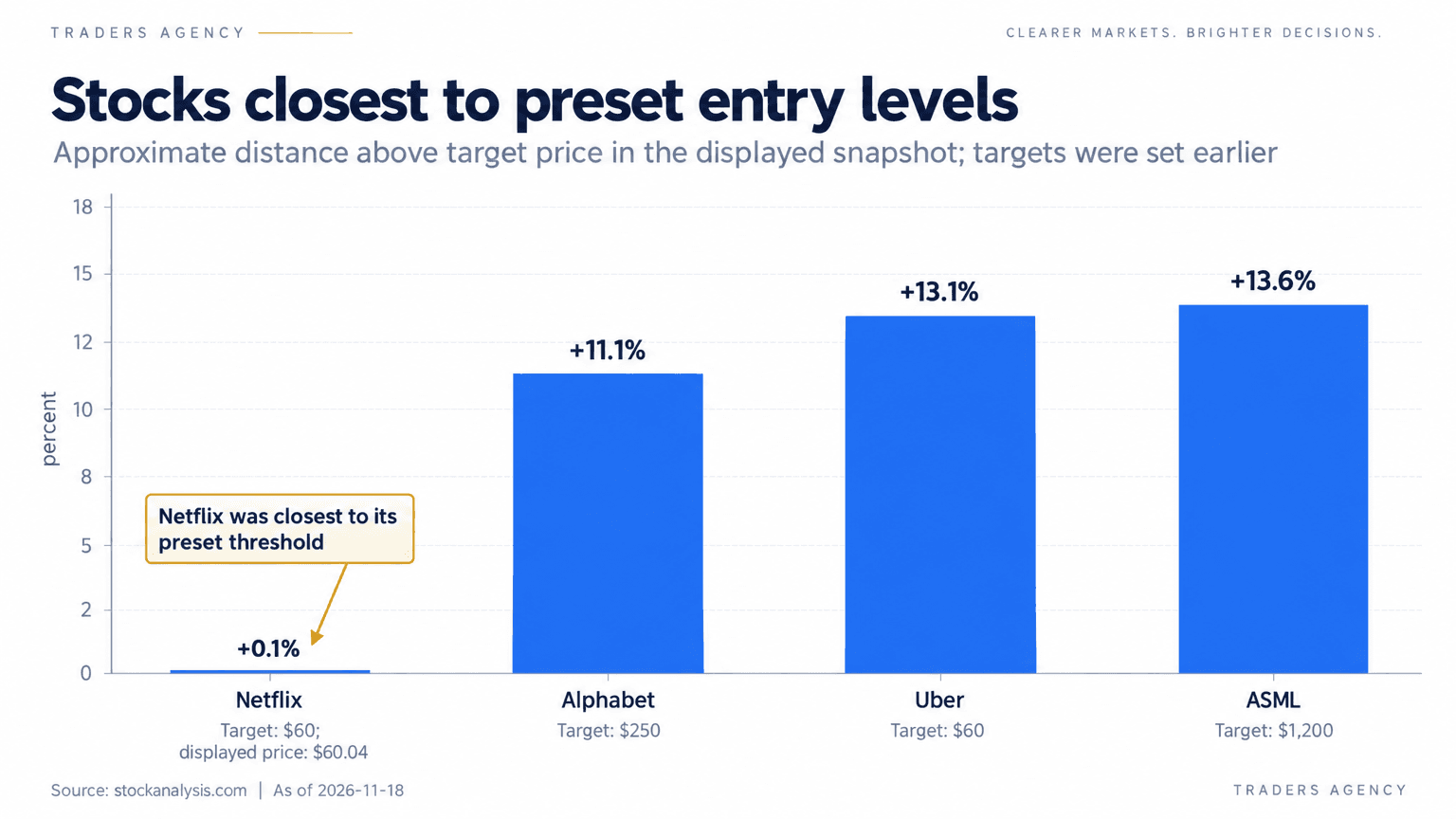
A roughly $60 per-share entry threshold was set for Netflix about two months before this review, when the stock traded closer to $80. A later snapshot showed Netflix at $60.04, just 0.1% above that target — the first of several tracked companies to reach its designated entry point. Alphabet and Uber were the next closest, sitting roughly 11% and 13% above their respective thresholds, with ASML similarly distant.
Netflix's valuation is pegged at roughly 16 times next-twelve-month earnings — a level the episode considers reasonable only if the company retains subscribers, improves margins and eventually returns to producing major cultural hits. That is an important conditional: the multiple only matters if Netflix stays relevant. If short-form video, YouTube or AI-generated content continue eroding viewing time, a low earnings multiple offers no real protection.
One recurring pushback concerns how Netflix's engagement is measured against YouTube. The counterargument is that the comparison may be imperfect, since YouTube's watch-time figures include music playlists, ambient viewing and podcasts, while Netflix is positioned as more event-driven, appointment-style television. Netflix told investors on its most recent earnings call that churn declined year over year — cited here as evidence against the strongest version of the claim that viewers are abandoning the service broadly. The discussion also references comments attributed to Netflix co-CEO Ted Sarandos, who framed recent leadership and content changes as an effort to protect the company's hit rate as it matures, rather than a simple cost-cutting exercise.
Why Stock Prices Swing Far More Than the Businesses Behind Them
Underlying the Netflix discussion is a broader framework: share prices can move dramatically over short periods even when a company's intrinsic value changes far more gradually. Amazon is offered as the clearest illustration, with the analysis noting that the business's underlying value didn't swing anywhere near as much as its stock price did across a multi-year stretch marked by a sharp decline and an eventual recovery. The takeaway is that patience and attention to fundamentals, rather than reflexive reactions to falling prices, are the more useful tools for managing volatility. That framework comes with an important caveat: a falling share price can sometimes reflect real deterioration, and holding through a decline is only sensible if the original investment thesis is still intact.
Mastercard, Amazon, Meta, Alphabet, S&P Global and Microsoft: Quality at a Discount
Several long-held positions are used to illustrate variations on the same idea: buying quality businesses during periods of depressed valuation and accepting stretches of underperformance along the way. Mastercard is described as having been purchased below its historical average valuation, with the position holding up despite periodic concerns about stablecoins and alternative payment rails.
Amazon's heavy investment in warehouses and logistics infrastructure temporarily pushed free cash flow negative in 2022 and 2023; that period is treated here as an opportunity to accumulate shares rather than a warning sign, given the stability of the underlying business. Meta continues to grow advertising revenue and daily active user counts even as its stock has swung sharply — a pattern tied to heavy capital spending on infrastructure and future products such as AI-driven wearables; the risk is that the scale of that spending, combined with ongoing share-price volatility, could still weigh on returns. Alphabet is described as benefiting from continued cloud growth, with its core search business facing a real, if so far manageable, threat from AI chat tools. S&P Global's financial footing is not in question, but its growth rate trails faster-growing holdings like Meta, making it more of an opportunity-cost consideration than an outright business-quality concern. Microsoft, meanwhile, is used to show how a long holding period, including purchases made during a broad market selloff, can make eventual gains look outsized, even though the stock itself went through significant volatility along the way.
Want expert trading insights delivered daily?
Join thousands of traders who rely on Traders Agency for market analysis and trade ideas.
Join Traders AgencyASML, Costco and Texas Roadhouse: Moats, Memberships and Input Costs
ASML occupies an unusual position in the semiconductor supply chain as the only commercial manufacturer of extreme ultraviolet lithography systems, the machines required to produce the most advanced chips. That status supports a genuine competitive moat, though it describes dominance in a specific, leading-edge manufacturing technology rather than every possible route to building an advanced chip; other equipment makers and processes still play a role elsewhere in the industry. Part of the ASML position was trimmed after a sharp run-up in the stock reduced its margin of safety.
Costco is framed less as a traditional retailer and more as a distribution platform, where membership dues and customer loyalty support a broad merchandise business that other companies rely on to reach shoppers. Costco's fiscal 2026 renewal rates came in at 92.3% in the United States and Canada and 89.8% worldwide, implying non-renewal in the high single digits to low double digits rather than the lower figure sometimes cited in casual discussion. The company added 25 net new warehouses in fiscal 2026, a slower pace than the 30-to-40 figure referenced in the broader conversation, though that alone doesn't rule out faster expansion in future years. Specific claims about customer traffic per location are best treated as rough approximations rather than confirmed company metrics.
Texas Roadhouse is presented as one of the strongest-performing positions in the portfolio. The chain is described as having used the pandemic's toll on independent restaurants to gain market share, leaning on a stronger balance sheet to keep expanding while smaller competitors closed. Future profitability remains closely tied to cattle prices, since beef represents the company's largest single input cost.
Moody's, Duolingo, Uber and DoorDash: Growth Stories Facing AI Questions
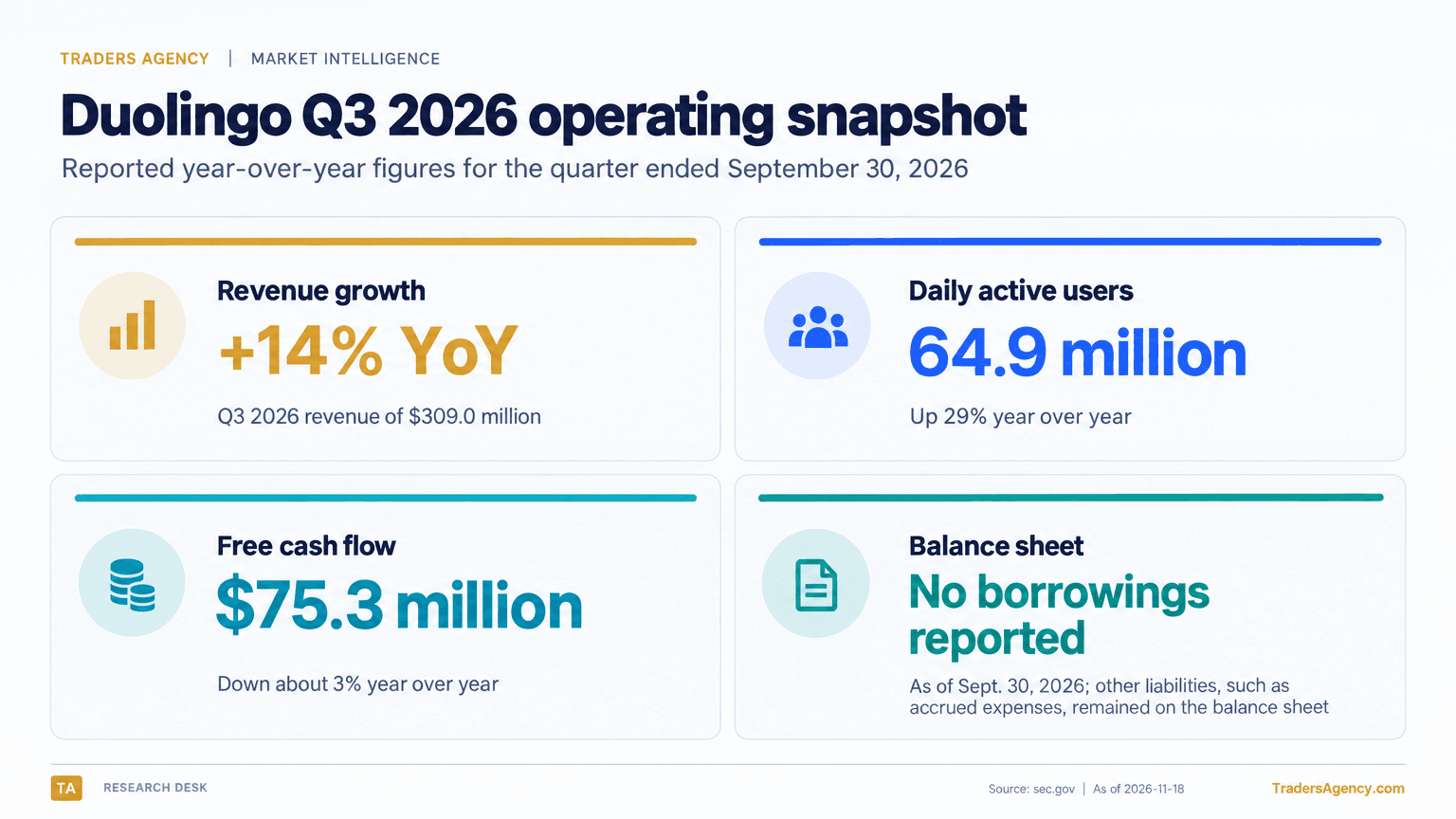
Moody's is described as a steady, financially secure holding whose growth has been comparatively flat in recent years, prompting new investment dollars to flow toward faster-growing positions instead. Duolingo draws more scrutiny. Its Q3 2026 results showed revenue rising 14% year over year to $309.0 million and daily active users climbing 29% to 64.9 million, with free cash flow remaining positive at $75.3 million, though down modestly, about 3%, from the prior year. Its September 30 balance sheet carried no borrowings, though it still held other liabilities such as accrued expenses. Monthly active user growth for the quarter was not independently confirmed in available disclosures. The broader argument, that steady revenue and daily-user growth undercuts the idea that generative AI tools are simply replacing the app, remains a reasoned judgment rather than a settled conclusion.
Uber's biggest overhang is the possibility that autonomous ride-hailing could eventually erode its driver network. The counterargument offered is that Uber could integrate robo-taxis into its existing platform rather than lose the market outright, with delivery expansion cited as a second avenue for growth. DoorDash's position was tested when Uber Eats struck a delivery partnership with Amazon that includes a zero-dollar delivery fee for Prime members — a development framed here as a real challenge to DoorDash's long-established footing in the delivery market, though not necessarily a fatal one.
What Past Sales of Apple, Salesforce and Intuit Reveal
Not every decision in the portfolio's history looks good in hindsight. One of the largest positions ever closed was Apple, sold years earlier on the stated view that its valuation already exceeded 30 times earnings while growth had slowed to roughly the mid-single digits. Looking back, that sale is characterized here as a mistake, since Apple's growth and valuation both continued climbing afterward — a reminder that a reasonable-sounding thesis doesn't guarantee a good outcome.
Salesforce and Intuit were both exited at a loss over AI-related concerns. Salesforce's sale reflected worry that AI tools such as Anthropic's Claude could increasingly sit between Salesforce and its own customers, weakening the platform's central role. Intuit's exit stemmed from similar unease: as AI makes tax preparation easier for people to navigate on their own, doubts emerged about whether Intuit could sustain its pricing power, a concern compounded by a business model that offers investors only infrequent feedback given tax season's once-a-year cadence.
A Cautionary Note on Leveraged AI Bets
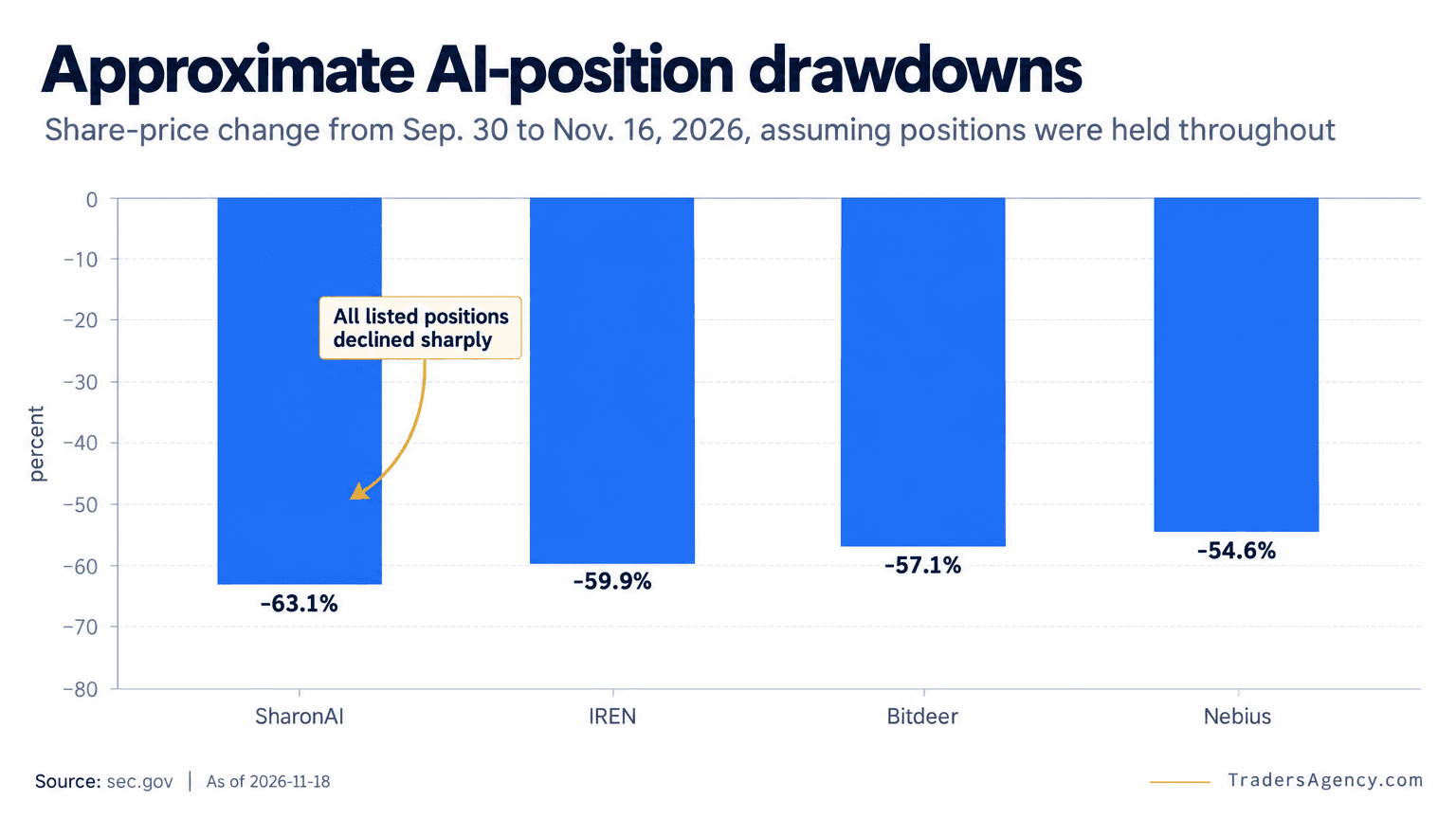
The episode closes with a cautionary example involving Leopold Aschenbrenner's Situational Awareness fund, which previously drew attention for a leveraged bet on AI stocks. A regulatory filing tied to the fund showed a renewed set of AI and data-center-related positions as of September 30, 2026. Comparing those holdings' share prices to levels on November 16, 2026, and assuming the positions were held throughout that stretch, points to declines of roughly 36% to 63% across names including SharonAI, IREN, Bitdeer and Nebius. Because the available snapshot doesn't show whether any positions were later trimmed, hedged or moved to cash, these figures describe share-price moves in specific securities rather than a confirmed total return for the fund.
The broader point drawn from this example is that layering leverage onto a concentrated, volatile basket of stocks amplifies both gains and losses without, by itself, demonstrating investment skill. It mostly increases beta and volatility relative to the market, rather than producing durable outperformance.
The Bottom Line
Traders Agency analysts are watching how Netflix's engagement trends and content slate evolve from here, since that trajectory, not the stock's current multiple, will ultimately determine whether this entry level looks prescient or premature. The wider lesson from this portfolio review is less about any single ticker and more about discipline: valuations, moats and growth rates matter, but they only hold up if the underlying business keeps performing the way an investor expects. Price swings are frequent and often loud; the businesses behind them tend to change more slowly, and separating the two remains the harder, more valuable skill.
Want expert trading insights delivered daily?
Join thousands of traders who rely on Traders Agency for market analysis and trade ideas.
Join Traders AgencyDISCLAIMER: Traders Agency does not offer financial advice. The information provided is for educational purposes only and should not be considered financial advice. Traders Agency is not responsible for any financial losses or consequences resulting from the use of the information provided. Trading carries inherent risks and may not be suitable for all individuals. You are advised to conduct your own research and seek personalized advice before making any investment decisions, recognizing the potential risks and rewards involved.
- Netflix Statistics & Valuation
- Netflix Q3 2026 Shareholder Letter
- Netflix Q3 2026 Earnings Call Transcript
- Meta Q3 2026 Form 10-Q
- Meta Reports Third Quarter 2026 Results
- ASML 2025 Annual Report — Strategic Report
- Costco Fiscal 2026 Form 10-K — Reproduced Filing
- Costco Fiscal 2026 Form 10-K — SEC Filing
- Texas Roadhouse Announces Third Quarter 2026 Results
- Texas Roadhouse Fiscal 2025 Form 10-K
- Duolingo Q3 2026 Shareholder Letter
- Duolingo Q3 2026 Form 10-Q
- Amazon Launches Partnership with Uber Eats Featuring $0 Delivery Fee for Prime Members
- Apple Reports Fourth Quarter Results — Fiscal 2024
- Situational Awareness LP Form 13F-HR — Filed November 16, 2026
- Situational Awareness LP — September 30, 2026 Information Table
See more from Traders Agency on Google
Make us a preferred source and our market analysis will appear more prominently in your Google Search, Top Stories, and AI results.
Add to Preferred Sources