A rough few weeks for technology stocks have investors asking an uncomfortable question: is this the start of something worse, or just a painful repricing of expectations? The evidence pointing toward an outright recession remains thin. What looks far more likely is a combination of fear, aggressive institutional positioning and renewed worry about higher interest rates colliding with still-growing earnings. Underneath that volatility, demand for AI computing power appears to be holding up, even as a leadership controversy at Nvidia and an insider stock sale at Anthropic add extra noise to an already jittery market.
Nvidia's Leadership Turmoil Meets Firm GPU Rental Demand
Nvidia's reinstated chief executive Jensen Huang used his first all-hands meeting since returning to the role to address his personal conduct directly. According to reporting corroborated by the New York Times, Wall Street Journal, Bloomberg, CNBC and Wired, Huang told employees he had been attending therapy nearly every day for about an hour and a half, said he had made serious mistakes, and acknowledged being unfaithful to his wife and hurting his family and colleagues. He also pushed back on suggestions that his return was driven by special treatment or pressure from Donald Trump, saying Nvidia's board reviewed the full situation and made its own determination before reinstating him.
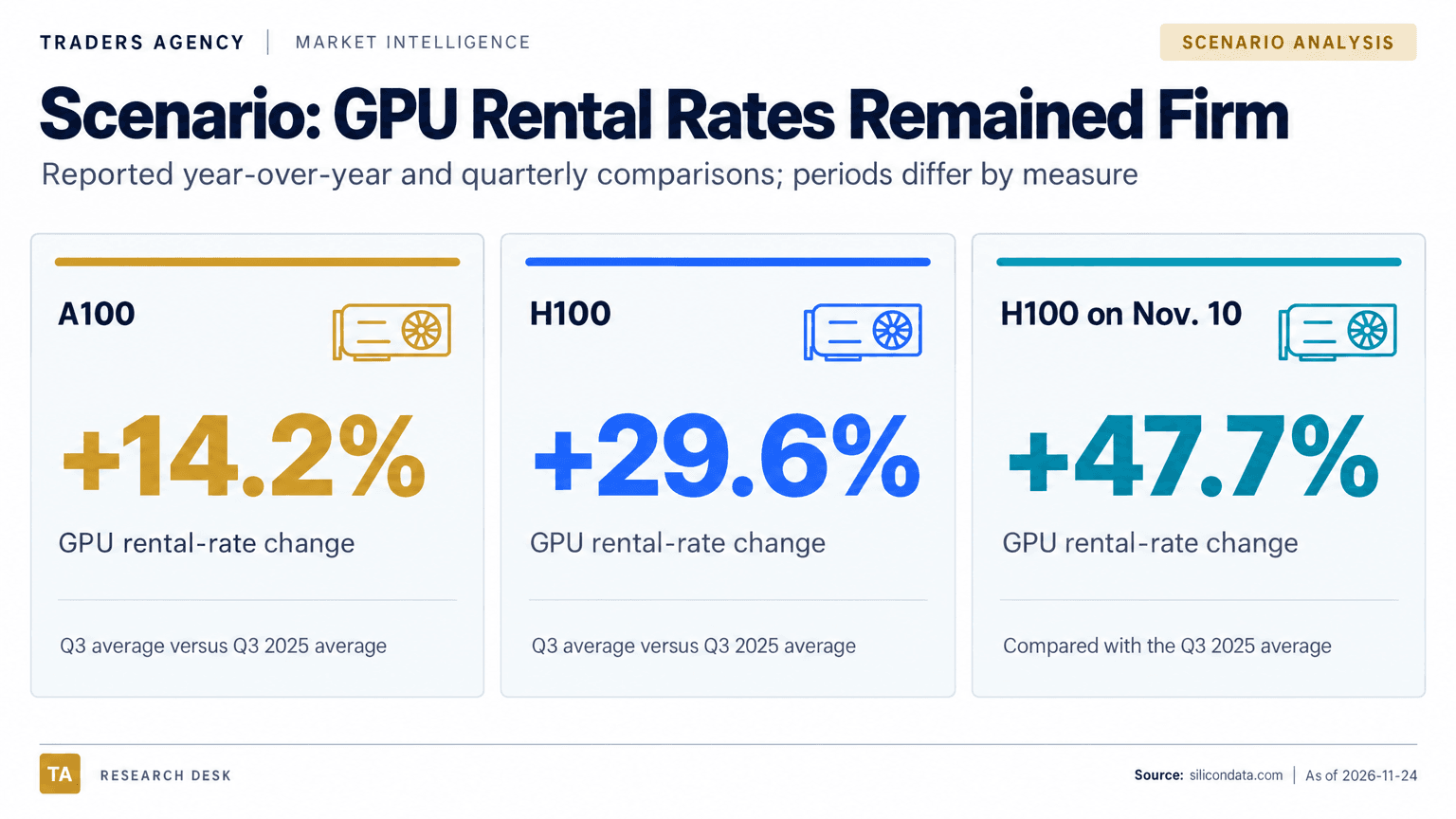
Whatever one makes of the leadership drama, it has not shown up in the GPU rental market. Data from Silicon Data's rental-price indices show the H100, a chip now roughly four and a half years old, commanded a third-quarter average rental price about 29.6% higher than a year earlier, while the older A100 rose 14.2% over the same comparison. By November 10, H100 rental rates were running about 47.7% above the third-quarter 2025 average, based on a single-date snapshot rather than a full quarterly comparison. These figures do not prove demand is accelerating in real time, since the measurement periods differ, but they are consistent with continued, firm pricing for AI infrastructure even as equity markets wobble.
There is a plausible explanation for why older chips keep commanding a premium: as open-weight AI models proliferate, companies increasingly favor hardware that is already installed, readily available and cheaper than the newest generation. Some compressed open-weight models can run on consumer gaming cards such as the RTX 5090 or even older RTX 3090 units. If enterprise adoption of AI continues to broaden, that dynamic could keep demand for both new and legacy accelerators elevated, though this remains a reasonable scenario rather than a guaranteed outcome, since it depends on how capable and memory-efficient future open-weight models turn out to be.
Enterprise Spending and the Anthropic Opportunity
A separate storyline centers on Anthropic, the AI company behind the Claude model family. On November 24, 2026, Canaccord Genuity initiated coverage of Anthropic with a Buy rating and a $135 price target, arguing that enterprise AI spending could expand well beyond current investor expectations. The firm's thesis envisions Claude Code-style tools spreading across a wide range of white-collar work, from legal and accounting tasks to healthcare and other professional services, while cautioning that investors should not assume rapid margin expansion until the company demonstrates it can sustain profitability at scale.
That bullish framing arrived alongside a notable insider transaction. A Form 4 filed with the SEC shows Anthropic co-founder Dario Amodei sold 3,378,378 shares at $83 each on November 20, 2026, as part of the IPO process, generating roughly $280.4 million in gross proceeds before taxes, or about 1.4% of his pre-IPO holdings. Reporting indicates his sister and fellow co-founder, Daniela Amodei, completed a comparable sale. Insider sales during an IPO lockup window can reflect personal liquidity needs rather than a signal about a company's valuation, so the transaction should be read in that context rather than as a verdict on Anthropic's prospects.
A separate Goldman Sachs analysis drew a distinction between usage and spending in the broader AI market, estimating that a majority of raw token usage runs on open-weight models while the larger share of actual spending still flows to closed-weight providers such as Anthropic. Because these two measures capture different things, usage volume versus dollars spent, they should not be read as directly comparable market-share figures, but the contrast helps explain why bulls argue open-weight competition has not yet undercut premium AI providers' revenue.
The concentration risk embedded in enterprise AI spending is not unique to Anthropic. Snowflake's fiscal 2026 annual report shows that customers generating more than $1 million each in trailing 12-month product revenue accounted for about 68% of its product revenue in the year ended January 31, 2026, up from 66% a year earlier. That kind of concentration can work in a company's favor when big customers keep expanding usage, but it becomes a vulnerability quickly if even a handful of major accounts pull back spending, a dynamic worth watching as AI budgets face greater scrutiny.
Want expert trading insights delivered daily?
Join thousands of traders who rely on Traders Agency for market analysis and trade ideas.
Join Traders AgencyValuations Under Pressure, Earnings Still Growing
Bernstein's research argues that several technology, storage, semiconductor and energy names have been punished more severely than their underlying fundamentals justify, maintaining favorable ratings and high price targets across names including Apple, Western Digital, Seagate, Dell and SanDisk. These targets represent one firm's forecasts rather than guaranteed outcomes, and they can shift quickly as a sell-off evolves, but the broader point is worth considering: many companies in this group continue to post earnings growth even as their valuation multiples compress.
That distinction matters. A falling stock price driven by shrinking profits is a very different situation from one driven by fear and crowded positioning squeezing multiples lower while earnings keep climbing. Traders Agency analysts are watching whether upcoming earnings reports from large technology and AI-infrastructure companies continue to show revenue and profit growth, which would support the argument that this is a valuation reset rather than the early stage of a broader downturn.
Pullback, Growth Scare or Something Worse?
One widely referenced framework divides S&P 500 drawdowns into four rough tiers: a 5% to 10% garden-variety pullback, a 14% to 20% growth scare, a 27% to 32% median decline tied to a recession or major shock, and roughly 50% or more for a full-blown crisis. The current decline has been described as sitting near the boundary between an ordinary pullback and a growth scare, with the exact percentage depending on the reference high point and date used.
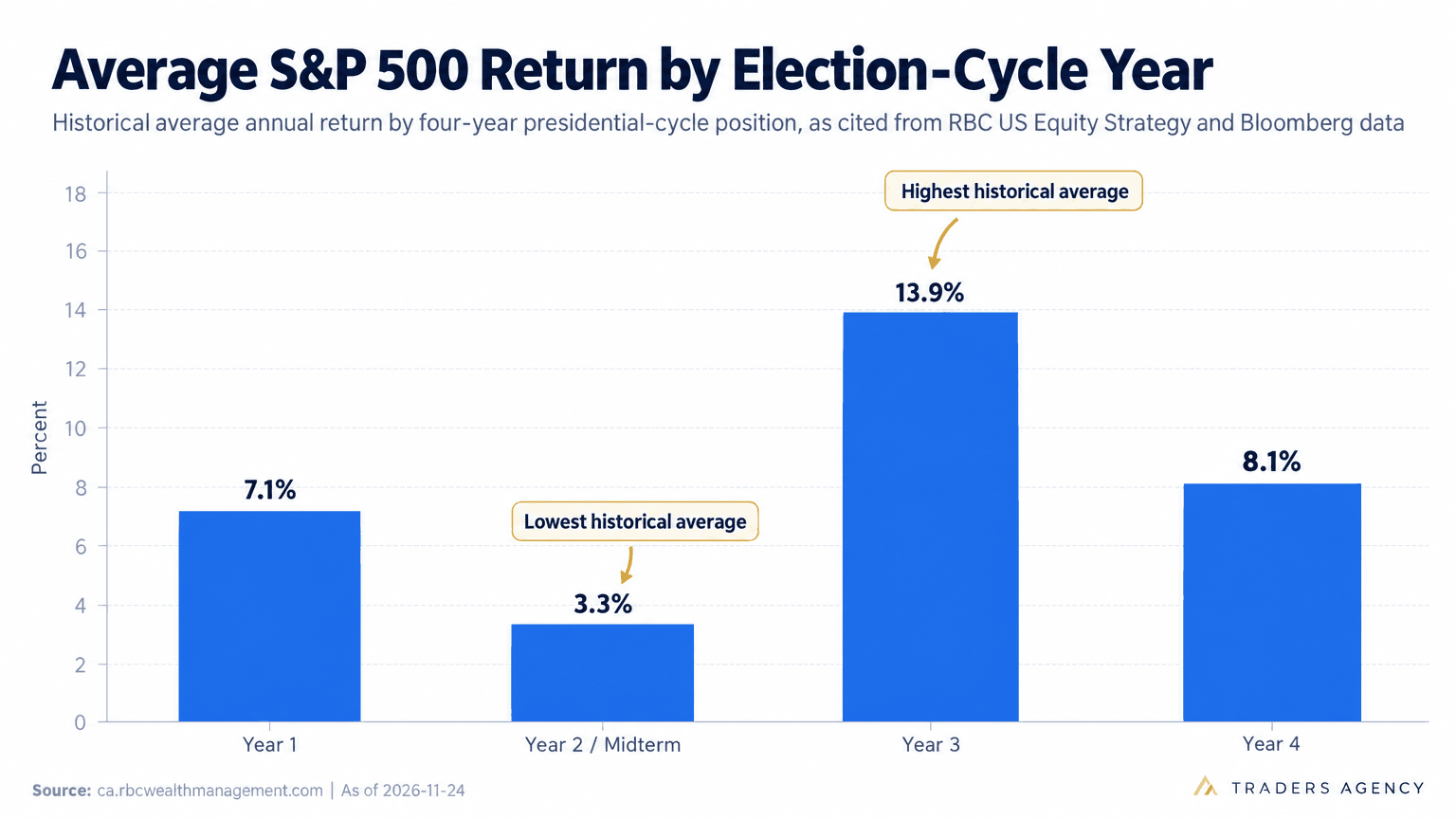
Historical patterns tied to the four-year presidential election cycle have also been cited to add context, with past data showing weaker average S&P 500 returns in midterm years compared with stronger average performance in the year that follows. These are backward-looking averages across a limited sample of election cycles, not predictions for the current environment, and they should be treated as useful context rather than a timing signal.
Commentary attributed to Deutsche Bank suggests volatility shocks like this one typically take six to eight weeks to bottom, while RBC has said it remains unclear whether a bottom is actually in and that additional record highs this year look unlikely. Separately, a Nasdaq valuation multiple has been described as running modestly below its longer-term historical average, above levels seen during the 2022 rate-hiking cycle low but below some other recent stress periods. These are attributed market views rather than guarantees, and they underscore that no one, including the analysts making these calls, can say with certainty where the market goes from here.
Rates, Rotation and Where Investors Are Positioning
Renewed expectations for Federal Reserve rate hikes have been linked to pressure on equities broadly, a relationship that reflects how markets tend to behave when borrowing costs are expected to rise, rather than proof of where rates or stocks will actually land. Elevated put buying and defensive positioning suggest many investors remain cautious even after sharp moves lower, which can itself amplify volatility in either direction.
Amid that uncertainty, some analysts have pointed to large-cap technology names, healthcare and financials as areas offering relatively more stability, while flagging consumer-discretionary valuations as comparatively stretched. These are analyst opinions about relative positioning, not guarantees against further declines in any sector. On a more personal note, paying down debt during periods of market stress is widely viewed as a straightforward way to build financial flexibility, reducing the pressure to sell investments at an inopportune time.
The Bottom Line
None of this adds up to a confirmed recession, and the data on GPU rental pricing, enterprise AI spending intentions and continued earnings growth across several major technology names argue against the most pessimistic interpretations of the current sell-off. At the same time, elevated fear, aggressive institutional hedging and the possibility of further Fed rate hikes mean that calling an exact bottom remains speculative. Investors weighing AI-exposed positions may be better served focusing on company-specific fundamentals, customer concentration risk and margin trends than on trying to time a market low that even seasoned analysts say they cannot yet confirm.
Want expert trading insights delivered daily?
Join thousands of traders who rely on Traders Agency for market analysis and trade ideas.
Join Traders AgencyDISCLAIMER: Traders Agency does not offer financial advice. The information provided is for educational purposes only and should not be considered financial advice. Traders Agency is not responsible for any financial losses or consequences resulting from the use of the information provided. Trading carries inherent risks and may not be suitable for all individuals. You are advised to conduct your own research and seek personalized advice before making any investment decisions, recognizing the potential risks and rewards involved.
- Jensen Huang Apologizes to Nvidia Employees in First All-Hands Since His Return
- Hopper and Ampere rents are rising, but the 30–50% is a reset, not a quarter
- Canaccord Starts Anthropic at Buy, $135 Price Target
- Anthropic, PBC Analyst Ratings
- Dario Amodei — SEC Form 4
- Anthropic stock below $83 IPO price: founders sold in the IPO
- Snowflake Fiscal 2026 Annual Report
- It's Politics, Stupid — Transcript
- RBC Strategy Spotlight — US Elections, October 2024
- Bloomberg Surveillance TV: November 23rd, 2026 — Chorus
See more from Traders Agency on Google
Make us a preferred source and our market analysis will appear more prominently in your Google Search, Top Stories, and AI results.
Add to Preferred Sources