A chaotic week for Nvidia ended with Jensen Huang back in the chief executive's chair, President Trump taking credit for the reversal, and markets rallying on the news. Behind the drama sits a bigger question for investors: does the economy underneath this volatility actually look recessionary? Based on labor-market data and business surveys referenced this week, the near-term case for a broad downturn is thin, though several qualifications are worth weighing before drawing conclusions.
A President's Call to Nvidia's Board
In a CNBC interview, Donald Trump said he began paying closer attention to Nvidia's leadership turmoil as the stock fell, by his own rough estimate, by roughly half from its highs. Once the decline reached that point, Trump said he decided to get involved directly, speaking with Nvidia's board the day before it agreed to reinstate Huang.
Trump described giving the board assurances related to Huang's standing, though when pressed on what specific intelligence informed that view, he declined to go into detail, saying only that he had the clearance needed to proceed. That stops well short of establishing any formal finding clearing Huang, and the exact nature of the assurances Trump offered remains unconfirmed.
Trump also told CNBC that Huang had been forced out by Nvidia's board rather than resigning voluntarily, a characterization that differs from the company's earlier public description of the departure as a resignation. That discrepancy has not been resolved and is worth watching for further clarification from Nvidia itself.
Separately, Semafor reported that Trump joined the Nvidia board's deliberations on bringing Huang back, an unusual degree of direct presidential involvement in a public company's leadership decision. Commentator George Gammon, who has generally taken a more cautious view of the economy, argued that it is highly unusual for a sitting president to weigh in on a corporate CEO selection, and suggested the episode raises questions about whether Nvidia had effectively become too significant to the U.S. economy to be allowed to falter.
Shares in Nvidia and broader U.S. indexes rallied sharply once the reinstatement became public, according to reports from the day. Trump separately said he is inclined to strike Iran directly after the new year absent a deal, a statement that landed close in time to the Nvidia announcement. Some observers have speculated, without evidence, that the timing was designed to support markets alongside the Nvidia news. That suggestion remains unproven and should be treated as speculation rather than an established fact.
Is the Labor Market Signaling Recession?
Much of the recession worry circulating in markets this week centers on whether layoffs are about to accelerate. On that question, the broad labor-market data referenced by analysts this week showed the civilian labor force holding up and recently recovering, even as a rising share of people looking for work can, in isolation, push the unemployment rate higher before it improves. The reasoning behind that caveat is straightforward: a bigger pool of job seekers initially adds to the unemployment count until those workers are absorbed.
Beyond that general picture, the available commentary did not point to a sustained deterioration in long-term unemployment or participation trends severe enough to support an imminent downturn narrative. Bloomberg reportedly noted that the kind of evidence typically associated with recession fears, specifically deteriorating earnings expectations and weakening real domestic-demand forecasts, has so far been largely absent from the current data.
Business Surveys Point to Continued Expansion
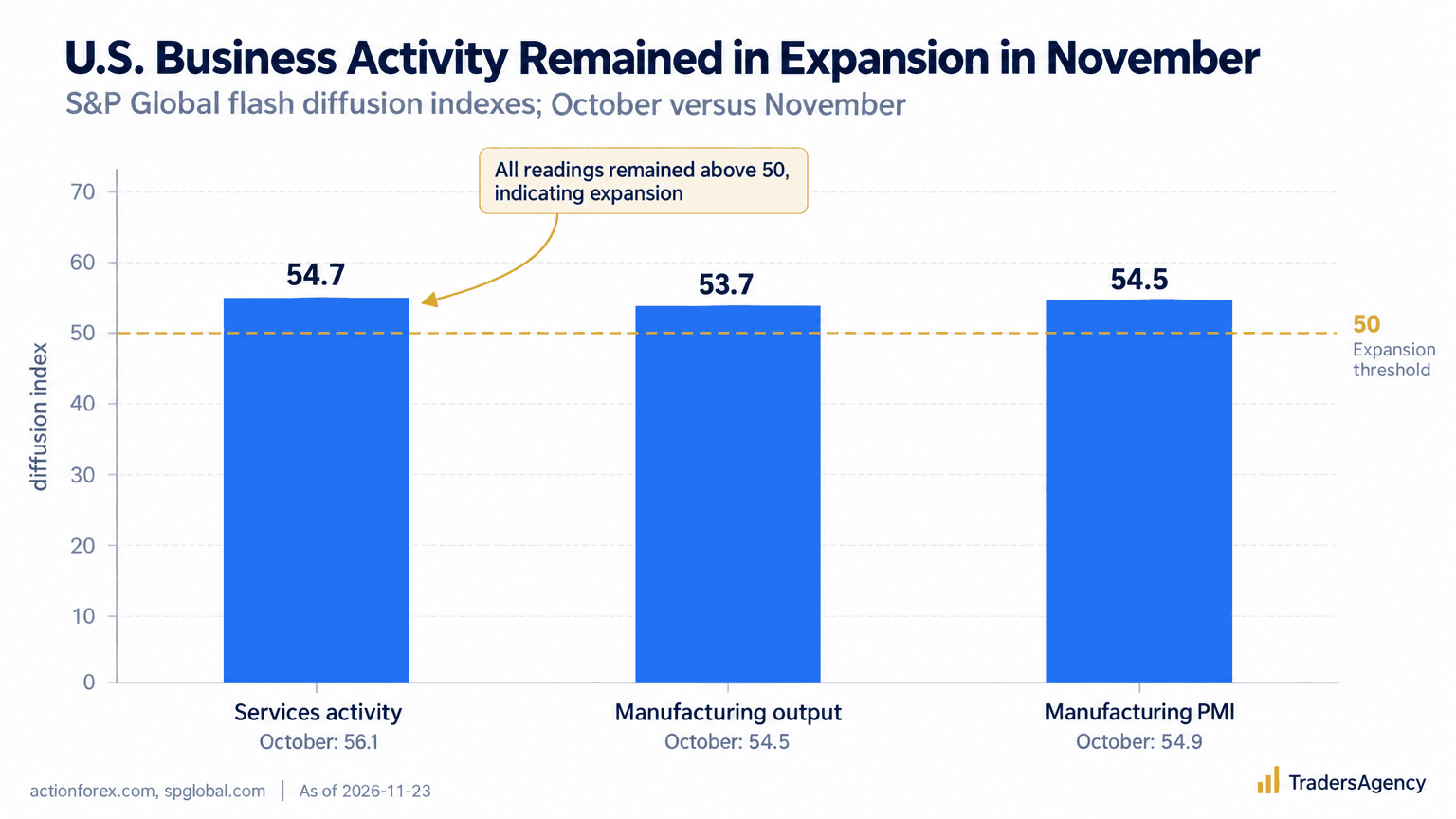
S&P Global's flash survey data for November, covering the period referenced this week, showed activity cooling from October but still comfortably above the threshold that separates expansion from contraction. The services business activity index slipped to 54.7 from 56.1, manufacturing output eased to 53.7 from 54.5, and the broader manufacturing PMI dipped to 54.5 from 54.9. All three readings remained above 50.
S&P Global's survey commentary attributed part of that moderation to constrained capacity and a buildup of backlogged work, a dynamic that reflects businesses struggling to keep up with demand rather than demand disappearing. The surveys also pointed to lingering political uncertainty and customer caution as separate factors weighing on new orders. Chris Williamson, S&P Global Market Intelligence's chief business economist, was cited as saying the survey data pointed to annualized fourth-quarter GDP growth of roughly 3%, alongside continued hiring gains across both manufacturing and services. That figure is a survey-based estimate rather than a reported GDP print, and it should be read as a signal of underlying momentum rather than a confirmed outcome.
Corporate Dealmaking as a Sign of Demand
Alongside the survey data, a string of recent corporate transactions has been cited as evidence that appetite for AI infrastructure and software has not cooled. Amazon announced an agreement to acquire Decart's AI optimization technology and bring on its founding team, with Bloomberg reporting an unconfirmed price near $7.5 billion based on an unnamed source rather than a figure Amazon itself has disclosed. Palo Alto Networks separately announced an agreement to acquire Applied Compute to bolster its enterprise AI security offerings, and Marvell completed its acquisition of Celestial AI. Nvidia was reported to be in advanced talks to acquire Inception, a small startup building diffusion-based language models, in a deal valued at more than $500 million, with discussions reportedly beginning before Huang's departure.
None of these transactions alone proves the broader economy is healthy, and the dollar figures attached to unannounced or in-progress deals should be treated as reported estimates rather than confirmed terms. Taken together, though, continued dealmaking by large, well-capitalized companies is a data point worth weighing against the louder recession narrative.
Want expert trading insights delivered daily?
Join thousands of traders who rely on Traders Agency for market analysis and trade ideas.
Join Traders AgencyAI's Resource Competition With Housing
One argument gaining attention is that the AI buildout is absorbing resources, chips, electricity, labor and capital, that other parts of the economy also need. Applied to housing, the reasoning goes that data-center construction competes with homebuilding for the same workers, materials and equipment, at a time when the U.S. already faces a well-documented housing shortage.
If that competition persists, it could theoretically tighten housing supply further and support home values, even as it adds friction elsewhere in the economy. That outcome depends on several conditions holding: sustained AI-related construction demand, limited ability for workers and materials to shift between sectors, and housing demand and financing conditions remaining strong enough for constrained supply to translate into higher prices rather than simply weaker construction activity. It is a plausible scenario rather than a settled outcome, and Traders Agency analysts will be watching housing starts and construction-employment data for signs of whether this dynamic is actually showing up in the numbers.
Fed Policy and the Road to 2027
Investor Bill Ackman argued this week that financial conditions have tightened materially and that the Federal Reserve's longstanding 2% inflation target may no longer fit an economy shaped by tariffs, deglobalization, elevated military spending and heavy AI infrastructure investment. He suggested a target closer to 3% would better reflect those structural pressures, a view echoed by other commentators including former Fed governor candidate Kevin Warsh.
One scenario floated this week envisions a cleaner setup for 2027 if several sources of uncertainty fade together: a delay in any Iran escalation, resolution of the Nvidia leadership question, midterm-related political noise settling down, and a final Fed rate increase followed by a pause rather than continued tightening. That is a constructive scenario built on several assumptions holding simultaneously, including that economic growth and corporate earnings remain resilient through the transition. It is not a forecast of what will happen, and any of those assumptions could fail to materialize.
A Quiet Risk in Corporate Earnings
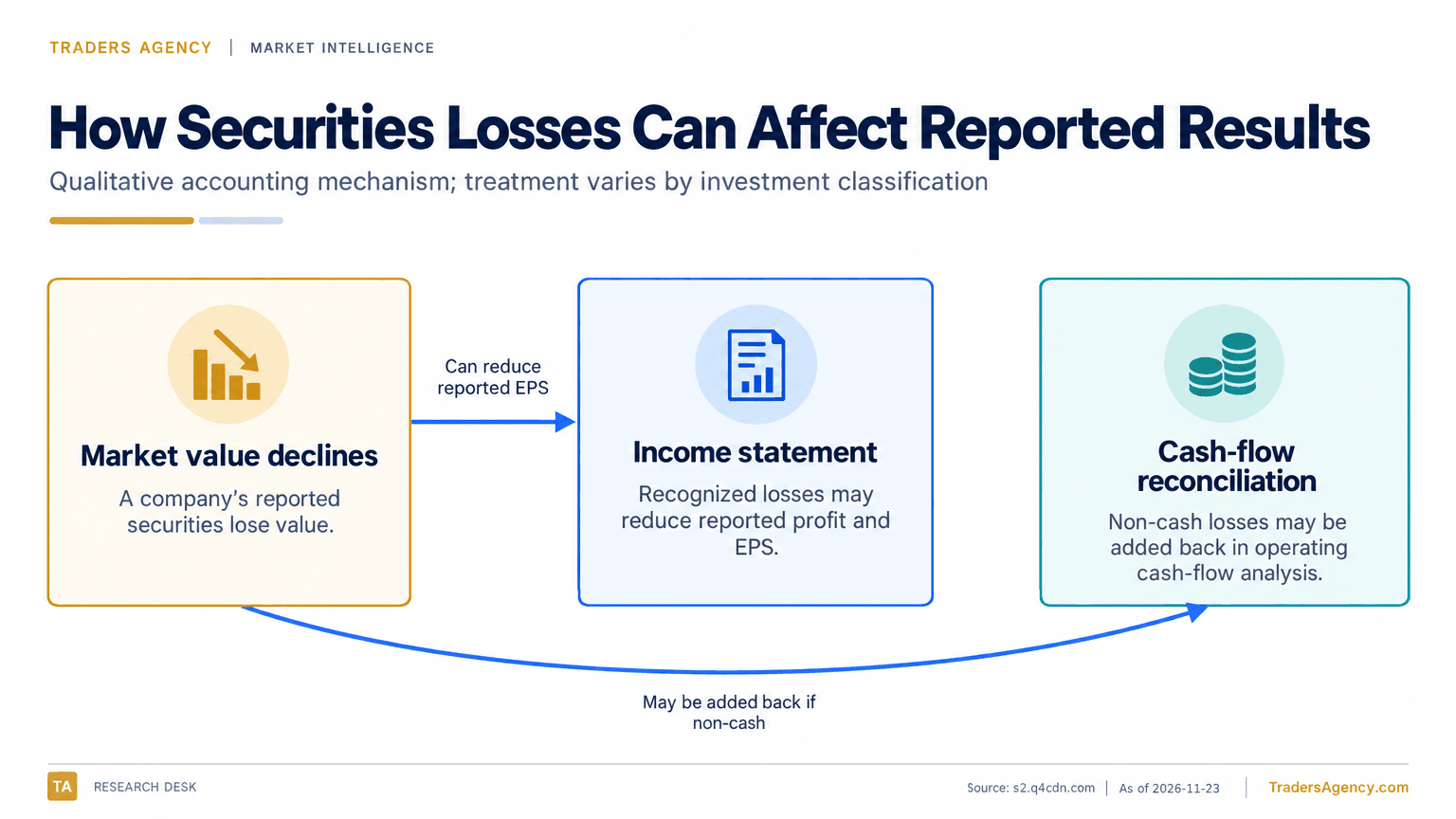
One less-discussed risk sits in corporate accounting rather than the broader economy. When companies hold equity stakes in other businesses and those investments lose value, the decline can show up as a loss on the income statement, reducing reported profit and earnings per share, even though the same loss is typically added back as a non-cash item in cash-flow analysis. The exact treatment depends on how the investment is classified and which accounting rules apply, so this is not a uniform rule across every holding. Companies with meaningful equity stakes in other AI-related businesses could see reported earnings pressured by this mechanic in coming quarters, even if their underlying operating performance remains solid.
Where This Leaves Investors
The data referenced this week does not support an imminent, broad-based recession, and continued corporate dealmaking and business-survey readings above the expansion threshold argue for some resilience. At the same time, the unresolved questions around Nvidia's leadership episode, tightening financial conditions, accounting-driven earnings noise and the uncertain path of AI's competition for construction resources all argue for a measured rather than a complacent stance. Investors watching this space should separate confirmed data, like the November PMI readings, from attributed claims and open scenarios that still need to play out.
Want expert trading insights delivered daily?
Join thousands of traders who rely on Traders Agency for market analysis and trade ideas.
Join Traders AgencyDISCLAIMER: Traders Agency does not offer financial advice. The information provided is for educational purposes only and should not be considered financial advice. Traders Agency is not responsible for any financial losses or consequences resulting from the use of the information provided. Trading carries inherent risks and may not be suitable for all individuals. You are advised to conduct your own research and seek personalized advice before making any investment decisions, recognizing the potential risks and rewards involved.
- CNBC transcript: President Donald Trump interview, November 23, 2026
- NVIDIA Form 8-K: Huang resignation and interim CEO appointment
- Trump Reportedly Joined Nvidia Board Meeting to Push for Jensen Huang’s Return
- Kalshi Research: AI and Data Centers
- BLS: The Employment Situation—October 2024
- Strong Earnings Prove No Match for the Crumbling AI Trade
- US PMI Growth Cools to Four-Month Low, but Strong Hiring and Inflation Persist
- S&P Global: US flash PMI analysis, November 23, 2026
- US flash PMI indicates still elevated, but cooling, business activity growth and price pressures
- Amazon to purchase Decart’s AI optimization technology
- Amazon Is Said to Pay $7.5 Billion for AI Startup Decart’s Tech
- Palo Alto Networks to Acquire Applied Compute
- Marvell Completes Acquisition of Celestial AI
- Nvidia Nears Acquisition of Diffusion AI Developer for More Than $500 Million
- The AI Build-Out Is Sucking Up Resources and Crowding Out the Rest of the Economy
- Billionaire Bill Ackman sounds the alarm on Wall Street’s next big risk
- Bill Ackman Urges Federal Reserve to Drop 2% Target, Adopt 3% Inflation Goal
- Amazon 2025 Annual Report
See more from Traders Agency on Google
Make us a preferred source and our market analysis will appear more prominently in your Google Search, Top Stories, and AI results.
Add to Preferred Sources