
We've all seen it happen: a trader builds a strategy, runs it against a few months of price history, watches the equity curve climb in a straight line, and gets excited enough to go live with real money. Three weeks later, the account is bleeding and nobody can explain why. In this guide, we'll show you what backtesting actually is, which tools we recommend for different skill levels, and the specific mistakes that quietly wreck otherwise promising strategies, so you can build a backtest you can actually trust.
What Is Backtesting a Trading Strategy?
Bottom Line: A backtest is only as trustworthy as the honesty behind it: the real payoff is the discipline of writing precise rules, testing them without bias, and discarding strategies that don't hold up, not the equity curve itself. Treat it as one input alongside forward paper-trading, position sizing, and risk management, never as a green light to skip stops or oversize a trade.
Backtesting a trading strategy means applying a defined set of entry and exit rules to historical price data to see how that strategy would have performed in the past. It's a simulation, not a guarantee, but it's the closest thing we have to a dress rehearsal before risking real capital.
The logic behind it is simple: markets repeat behavior patterns often enough that a rules-based system with a genuine statistical edge tends to show that edge across different historical periods. If a strategy loses money consistently across years of varied market conditions, it's unlikely to suddenly start working going forward.
We like to compare it to a pilot running flight simulations before ever touching a real cockpit. The simulator doesn't guarantee a smooth flight, but it catches obvious design flaws before they become expensive in the real world.
Key Concept: A backtest tells you how a strategy would have performed historically. It never tells you how it will perform tomorrow. Treat it as a filter for bad ideas, not a crystal ball.
Which Tool Should You Use to Backtest a Trading Strategy: TradingView, Thinkorswim, or QuantConnect?
The right backtesting trading software depends on your coding comfort level and how complex your strategy is. Here's how we break down the three platforms we see our members use most:
- TradingView: Best for traders who want a visual, chart-based approach. Its Strategy Tester and Pine Script editor make it one of the most approachable backtesting options available, and it offers a usable free tier if you're looking for backtesting strategy free options before committing to a paid plan.
- Thinkorswim's thinkOnDemand: Strong for options and futures traders who want to replay historical sessions tick by tick, almost like rewinding a DVR of the market.
- QuantConnect: Built for traders comfortable with Python or C#, offering institutional-grade data and the ability to test across stocks, options, futures, and crypto in one environment.
If you're just starting out and want a backtest trading app that doesn't require programming knowledge, TradingView is usually our first recommendation. Traders who outgrow its limitations (longer historical windows, multi-asset portfolios, custom slippage models) tend to migrate toward QuantConnect.
How Do You Backtest a Trading Strategy in TradingView?
Here's how we walk our members through how to backtest a trading strategy in TradingView for the first time:
- Open a chart for the asset you want to test and select your timeframe. Daily charts are a reasonable starting point for swing strategies.
- Write or import your strategy using Pine Script's
strategy()function instead ofindicator(), since only strategy scripts generate backtest performance reports. - Define entry and exit conditions explicitly in code. For example, entering long when a 20-period moving average crosses above a 50-period moving average.
- Open the Strategy Tester panel at the bottom of your screen and review the "Overview," "Performance Summary," and "List of Trades" tabs.
- Adjust your initial capital and position sizing under the Properties tab to reflect what you'd actually trade, not an arbitrary default.
- Export the trade list so you can cross-check results manually rather than trusting the summary numbers alone.
Watch Out: A common early mistake is leaving the commission and slippage fields at zero. We'll explain why that matters in just a bit.
Common Pitfalls: Look-Ahead Bias, Survivorship Bias, and Overfitting
Three problems quietly inflate backtest results more than any other, and all three can make a losing strategy look like a winner on paper.
Look-ahead bias happens when your backtest accidentally uses information that wouldn't have been available at the time of the trade. A classic example: testing a strategy that enters based on the day's closing price, but the code executes the trade at that same candle's open, effectively "knowing" the close before it happened.
Survivorship bias creeps in when your historical dataset only includes companies or assets that still exist today. If you backtest a stock-picking strategy using only the current S&P 500 constituents, you've silently excluded every company that went bankrupt or was delisted, which flatters your results.
Overfitting is the most dangerous of the three because it feels like success. This happens when you tweak parameters (moving average lengths, RSI thresholds, stop-loss percentages) over and over until the backtest looks perfect on one specific chunk of historical data.
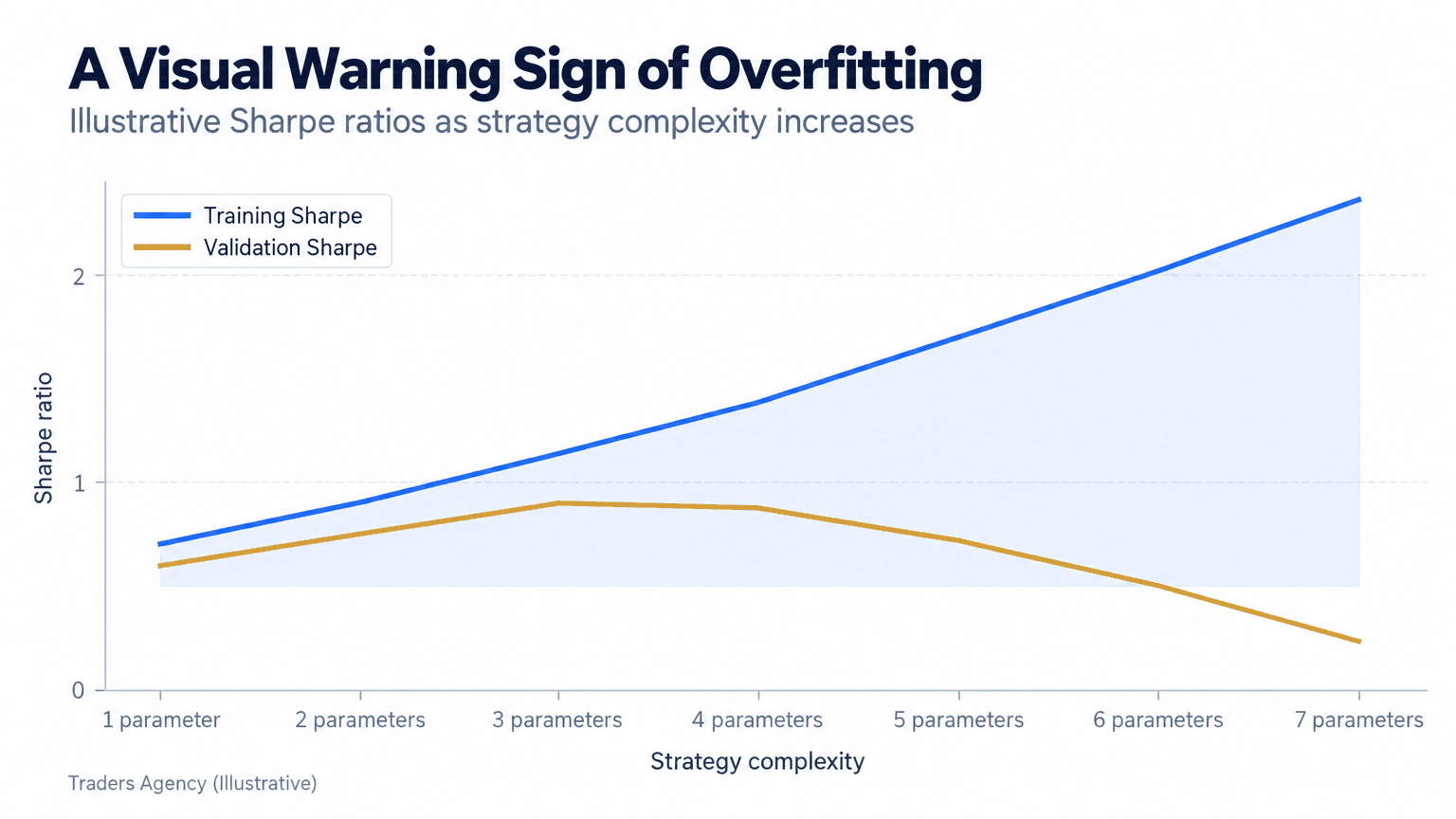
Notice how the training performance keeps climbing as you add complexity, while the out-of-sample validation performance peaks and then falls off. That gap is overfitting made visible.
Want expert trading insights delivered daily?
Join thousands of traders who rely on Traders Agency for market analysis and trade ideas.
Join Traders AgencyHow Do You Account for Slippage and Commissions?
You account for slippage and commissions by building realistic cost assumptions directly into your backtest, typically a small per-share or percentage fee plus an estimated price slip on entry and exit, rather than assuming trades fill at the exact displayed price for free.
Most free backtesting platforms default to zero trading costs unless you change the settings. That single oversight can turn a mediocre strategy into a false winner.
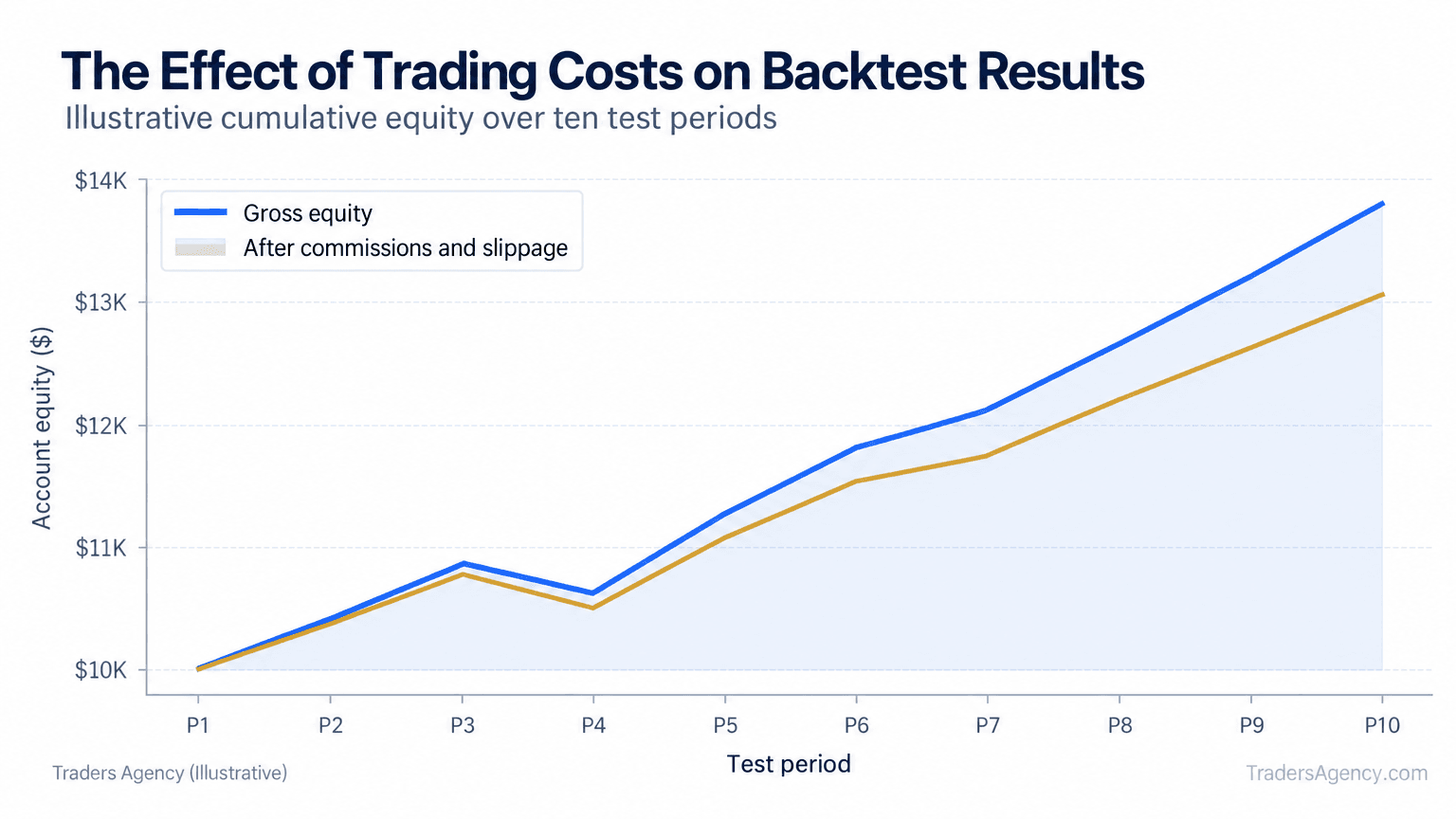
Both the gross and cost-adjusted equity curves above start at the same $10,000 base, but the gap between them widens every time a trade fires. A strategy that trades frequently, say 200 round trips per year, can see its edge disappear entirely once realistic costs are applied.
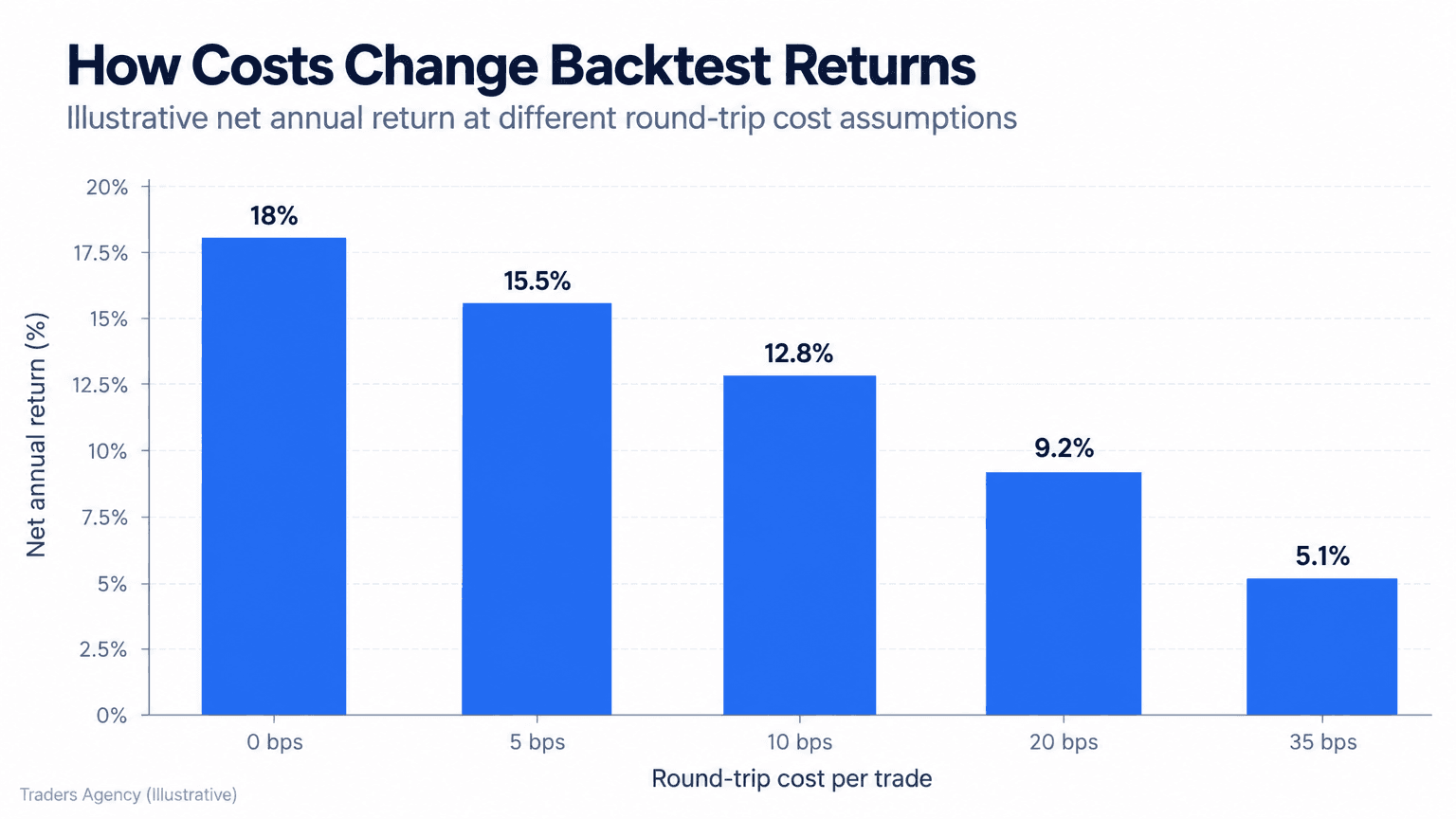
In TradingView's Strategy Tester, you'll find commission and slippage fields under the Properties tab. We generally recommend testing at least three cost scenarios (zero, moderate, and aggressive) to see how sensitive your strategy is to real-world friction before trusting it with live capital.
What Is Walk-Forward Analysis and How Does It Validate Your Results?
Walk-forward analysis is a validation method where you optimize a strategy's parameters on one chunk of historical data (in-sample) and then test those same fixed parameters on a separate, later chunk the strategy has never seen (out-of-sample).
This matters because a strategy can look flawless on the data it was built from and still fall apart the moment it faces new conditions.
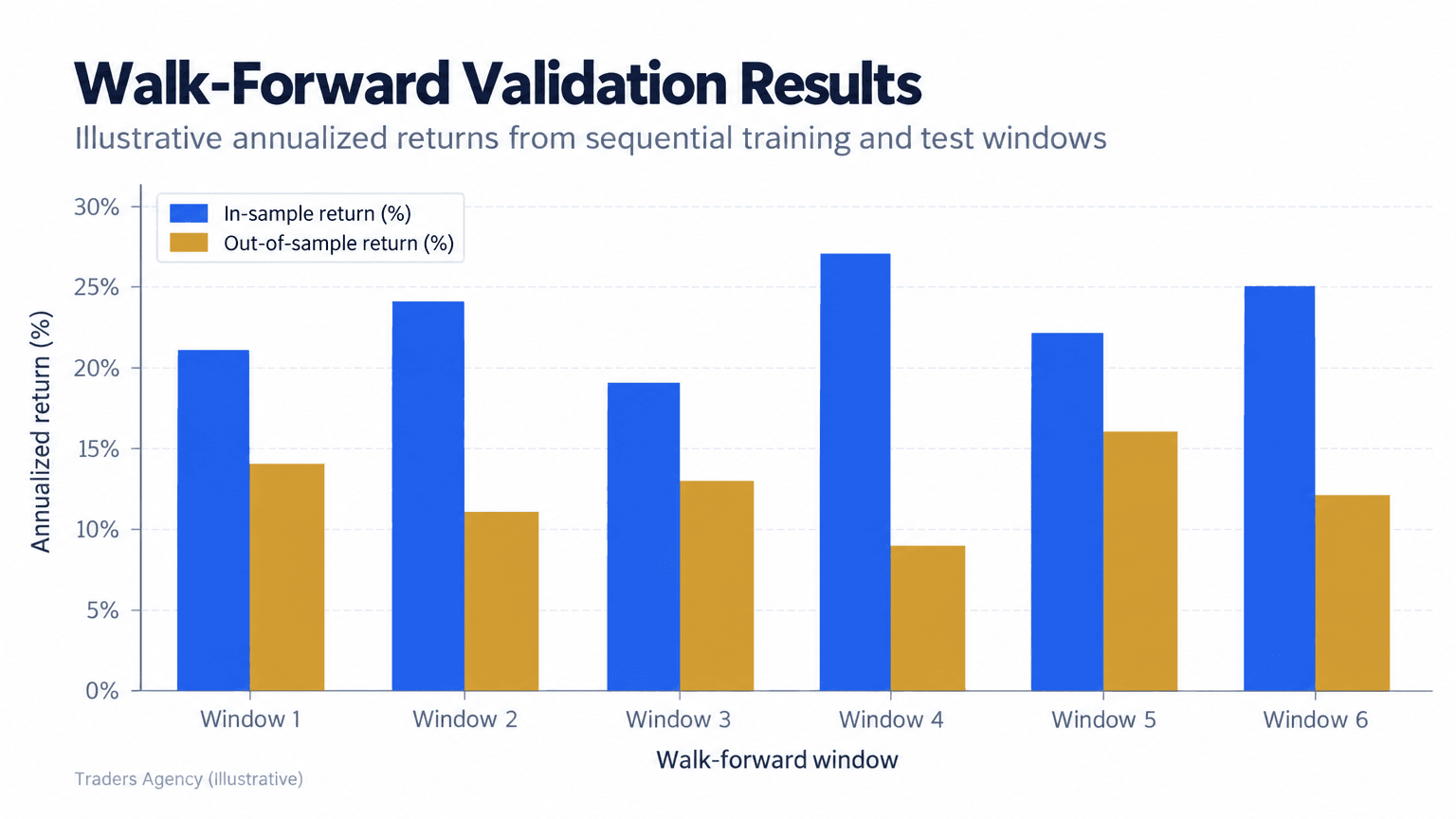
Here's a practical approach we teach: split five years of data into six rolling windows, optimize on the first 70% of each window, then test on the remaining 30%. If out-of-sample returns consistently trail in-sample returns by a wide margin across most windows, that's a strong signal the strategy is overfit rather than genuinely edge-driven.
Key Concept: If a strategy only wins on the data it was built from and loses on data it hasn't seen, it isn't a strategy. It's a curve-fit coincidence.
What Is the Best Way to Backtest a Trading Strategy?
The best way to backtest a trading strategy combines a realistic cost model, a long enough data history to cover multiple market regimes, and out-of-sample validation through walk-forward testing, rather than relying on a single clean backtest run.
We'd also add: test across more than one asset or time period if your strategy logic is meant to generalize. A strategy that only works on one ticker during one specific bull run isn't a strategy, it's a coincidence dressed up as a backtest.
Here's when backtesting earns its keep:
- You have a rules-based strategy with clear, mechanical entry and exit logic
- You're comparing two or more strategy variants before committing capital
- You want to stress-test a strategy across different volatility regimes
And here's when it isn't enough on its own:
- The strategy relies on discretionary judgment that can't be coded into rules
- You're testing on illiquid assets where historical fills wouldn't reflect real execution
- You haven't paper-traded the strategy forward in real time to confirm the backtest holds up
We always remind our members that regulators like the SEC and FINRA caution investors that past performance, simulated or otherwise, never guarantees future results. That applies directly to backtests, which are historical simulations built on data that has already happened.
Does Backtesting Make You a Better Trader?
Does backtesting make you a better trader? Yes, but indirectly. It doesn't hand you a winning strategy. It trains you to think in probabilities, question your assumptions, and separate a genuine edge from random noise in the data.
The real value isn't the final performance number. It's the discipline of writing down exact rules, testing them honestly, and being willing to throw out a strategy that doesn't hold up under scrutiny.
We treat backtesting as one input among several, alongside forward paper-trading, position sizing discipline, and ongoing risk management. No backtest, however clean, should ever be the only reason you size a trade heavily or skip a stop-loss.
Want expert trading insights delivered daily?
Join thousands of traders who rely on Traders Agency for market analysis and trade ideas.
Join Traders AgencyDISCLAIMER: Traders Agency does not offer financial advice. The information provided is for educational purposes only and should not be considered financial advice. Traders Agency is not responsible for any financial losses or consequences resulting from the use of the information provided. Trading carries inherent risks and may not be suitable for all individuals. You are advised to conduct your own research and seek personalized advice before making any investment decisions, recognizing the potential risks and rewards involved.
See more from Traders Agency on Google
Make us a preferred source and our market analysis will appear more prominently in your Google Search, Top Stories, and AI results.
Add to Preferred Sources