
A trailing stop order automatically adjusts your stop price as a stock moves in your favor, locking in gains without forcing you to babysit the screen all day. In this guide, we'll show you how to set one up, how to pair it with a bracket order for full automation, and which mistakes trip up most beginners.
You've probably had this happen: a stock you bought runs up nicely, you get busy, and by the time you check again it's given back every dollar of profit. A trailing stop order is built to prevent exactly that scenario. Instead of sitting at one fixed price like a regular stop loss, it "trails" the stock by a set dollar amount or percentage, and once the stock reverses by that amount, the order triggers and exits your position.
We'll also cover how trailing stops compare to standard stop orders, how trailing stop limit orders differ from trailing stop market orders, and how to choose a trailing percentage that fits your trading style.
What Is a Trailing Stop Order?
Bottom Line: A trailing stop order lets a trader lock in gains automatically as a stock rises, without needing to watch the screen or guess the right exit point. It still carries limits worth remembering: execution price isn't guaranteed in fast markets, and gaps from news events can blow through the trail distance entirely, so position sizing matters as much as the order type itself.
A trailing stop order is a protective exit order that moves with a stock's price in your favor but stays fixed if the price moves against you. It's designed to let winners run while still capping your downside.
Here's the mechanic in plain terms. Say you buy a stock at $100 and set a trailing stop at 5%. Your initial stop sits at $95. If the stock climbs to $110, the stop trails up to $104.50 (5% below the new high). If the stock then drops to $104.50, the order triggers and you're out with profit locked in. But if the stock never climbs and instead falls straight to $95, you're stopped out there, same as a normal stop loss.
This isn't a separate product from a regular stop loss. It's simply a stop loss with a moving trigger point instead of a static one, which is where a lot of the confusion around the term comes from.
Key Concept: A trailing stop follows a stock's best price in your favor and holds its ground if price pulls back, giving you a moving safety net instead of a fixed one.
How Does a Trailing Stop Order Work?
A trailing stop order works by tracking the highest price reached since you placed it (for a sell order) and maintaining a set distance below that high. When the stock price falls to meet that trailing distance, the order converts into a market or limit order and executes.
The detail beginners miss most often: the stop price only moves in one direction. For a trailing stop sell order protecting a long position, the stop can only rise or stay flat, never fall. For a trailing stop buy order used to cover a short position, the stop can only fall or stay flat, never rise. This one-way ratchet is exactly what makes trailing stops useful for locking in gains automatically.
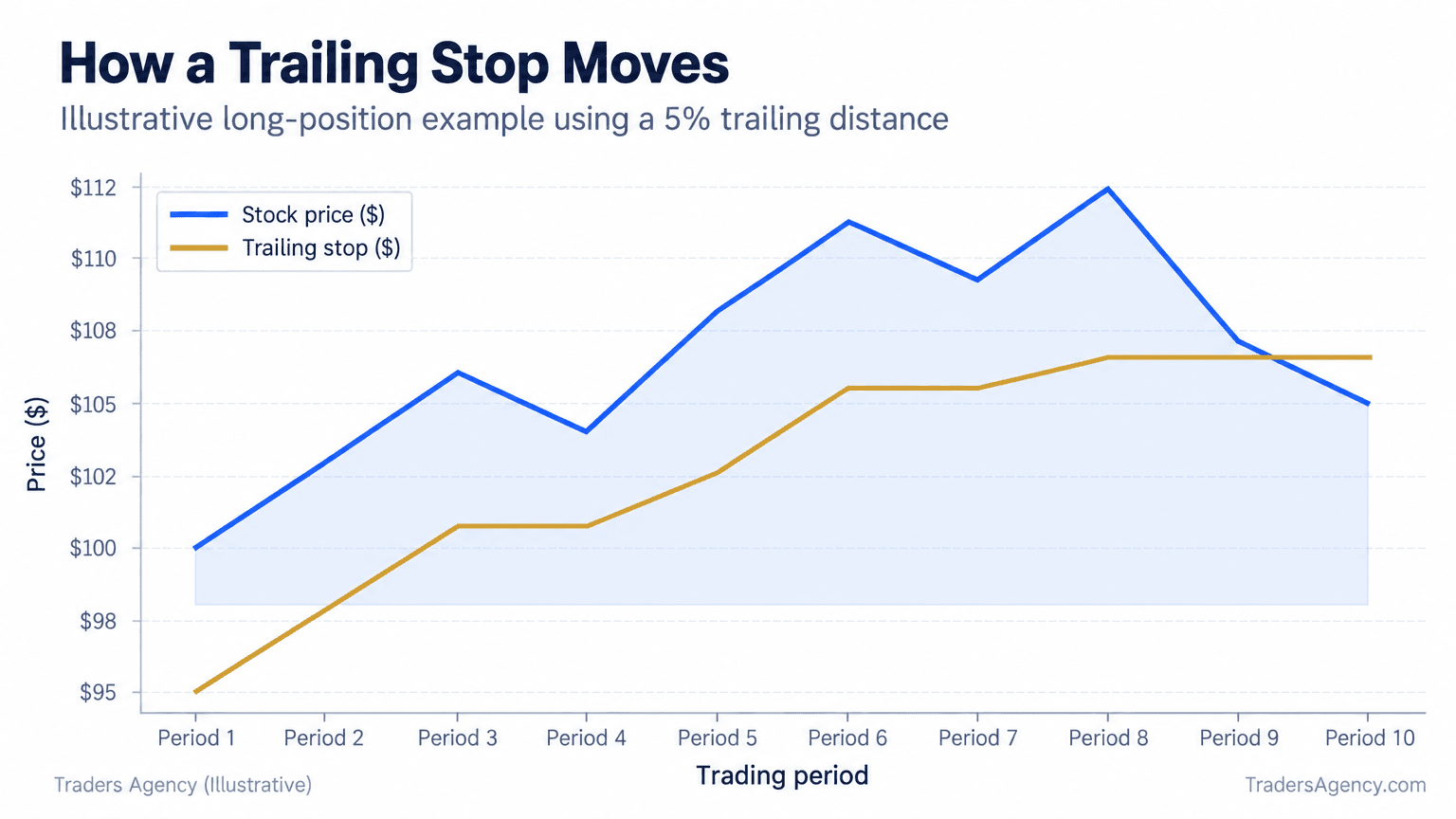
In the chart above, the stop climbs from $95 to $106.40 as the stock rises toward $112, then triggers as price pulls back through $106.40 on its way down to $105. That gap between the peak and the trigger point is the cost of giving the trade room to breathe. Set it too tight and normal price noise stops you out early. Set it too wide and you give back too much profit.
Key Concept: A trailing stop's protection only ratchets in one direction. It never loosens if a stock pulls back. The stop holds at its current level until price makes a new high, which lifts the trail again.
Trailing Stop vs Stop Order: What's the Difference?
A regular stop order sits at one fixed price you choose, and it never moves. A trailing stop order adjusts automatically as the price moves favorably, which means less manual adjustment but also less predictability about your exact exit price.
Setting a Trailing Stop Order Step by Step
Most major platforms, including Fidelity, Schwab, and Robinhood, follow a similar order ticket layout. Here's how we walk our members through it.
- Step 1: Open the order ticket – Pull up the stock you're holding or planning to buy, and select the order type menu. Look for "Trailing Stop" as an option alongside market, limit, and stop orders.
- Step 2: Choose your trail type – You'll typically see two choices: trail by dollar amount (a fixed amount, like $5.00 below the highest price reached) or trail by percentage (like 5% below the highest price reached).
- Step 3: Set your trail value – Enter the dollar amount or percentage. This is where ATR-based sizing (more on that below) can improve on a flat guess.
- Step 4: Choose market or limit execution – A standard trailing stop becomes a market order once triggered, meaning it fills at the next available price. A trailing stop limit order instead becomes a limit order at a price you specify, which protects against slippage but risks not filling at all in a fast-moving market.
- Step 5: Review and submit – Confirm the order details on screen before submitting. This is your last chance to catch a typo in the trail percentage or dollar figure.
Want expert trading insights delivered daily?
Join thousands of traders who rely on Traders Agency for market analysis and trade ideas.
Join Traders AgencyHow Do You Choose the Right Trailing Stop Percentage?
A good trailing stop percentage typically falls between 5% and 10% for most individual stocks, though it depends heavily on the stock's normal volatility. Tighter percentages suit stable, low-volatility names, while wider percentages fit volatile growth stocks that swing more on ordinary news days.
What Is the 7% Rule for Stop Loss?
The 7% rule is a guideline suggesting traders cut losses once a stock falls 7% to 8% below their purchase price, limiting damage before it compounds. We treat it as a simple, widely used starting point rather than a strict law, and we encourage our members to adjust it based on the stock's typical daily movement.
Fixed-Dollar, Percentage, and ATR-Based Trailing Stops
Here's where configuration gets more precise. ATR (Average True Range) measures a stock's typical daily price swing over a set period, usually 14 days, and some platforms let you set trailing stops as a multiple of ATR instead of a flat percentage.
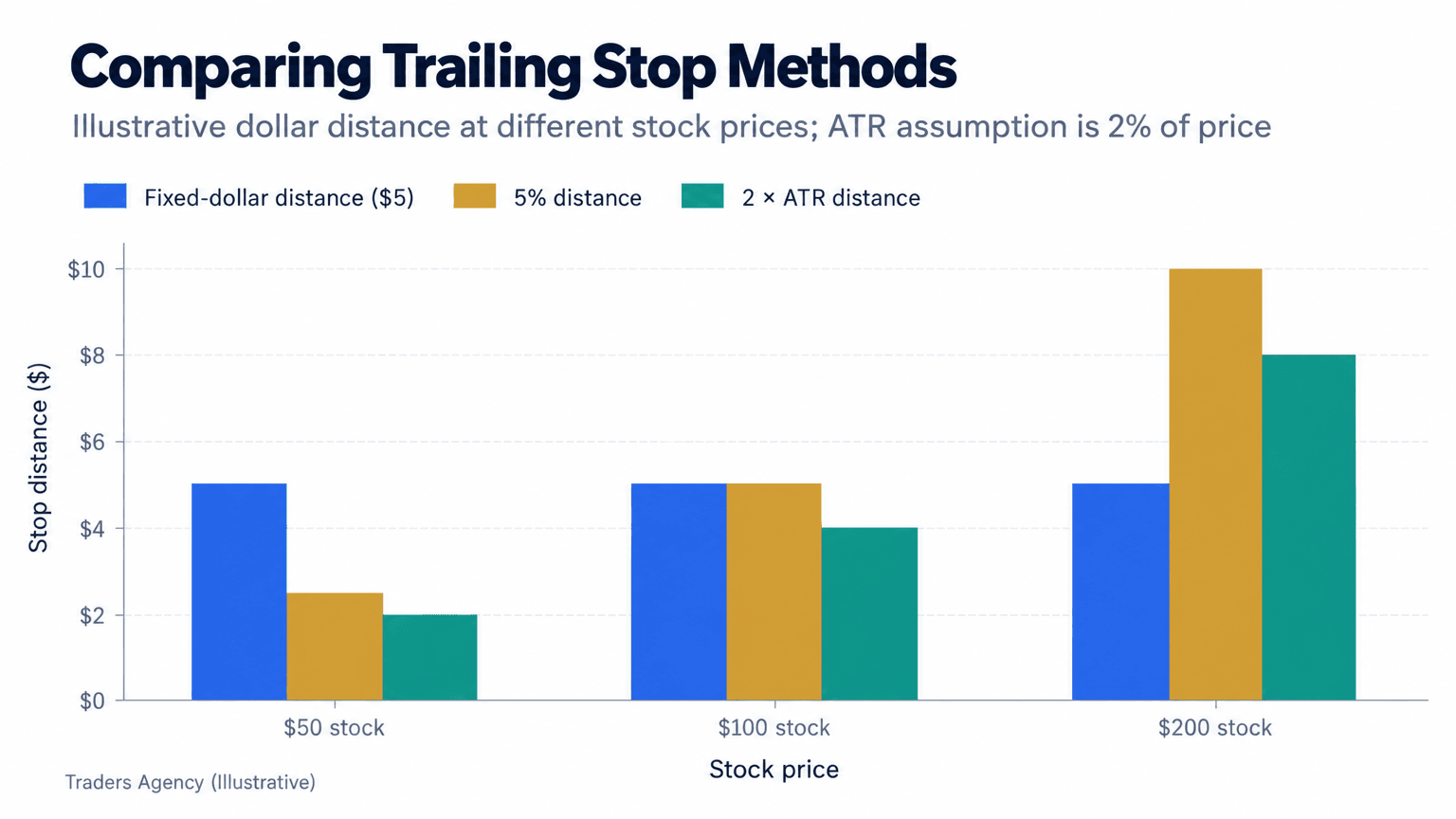
Notice how a fixed-dollar trail stays flat regardless of price, while percentage and ATR-based trails scale with the stock. For a trailing stop strategy that adapts to actual volatility rather than an arbitrary number, we generally favor ATR-based sizing because it scales the trail to each stock's own typical daily range.
Trailing Stop vs Bracket Order: What's the Difference?
A bracket order combines three orders into one ticket: an entry order, a profit target, and a protective stop. A trailing stop, by contrast, is just the exit leg and doesn't include an entry or target on its own.
Think of a bracket order as the full round trip planned in advance, and a trailing stop as just the seatbelt for the ride home.
Using Bracket Orders to Automate Entry, Target, and Stop
To set a bracket order, enter your buy price, then add a profit target (a limit sell order above your entry) and a stop loss (below your entry) in the same order ticket. Many platforms also let you substitute a trailing stop for the fixed stop leg, giving you a profit target plus a moving stop in one package.
These two exit legs work together through OCO (one-cancels-other) logic: if the stock hits your profit target, the stop order cancels automatically, and vice versa.
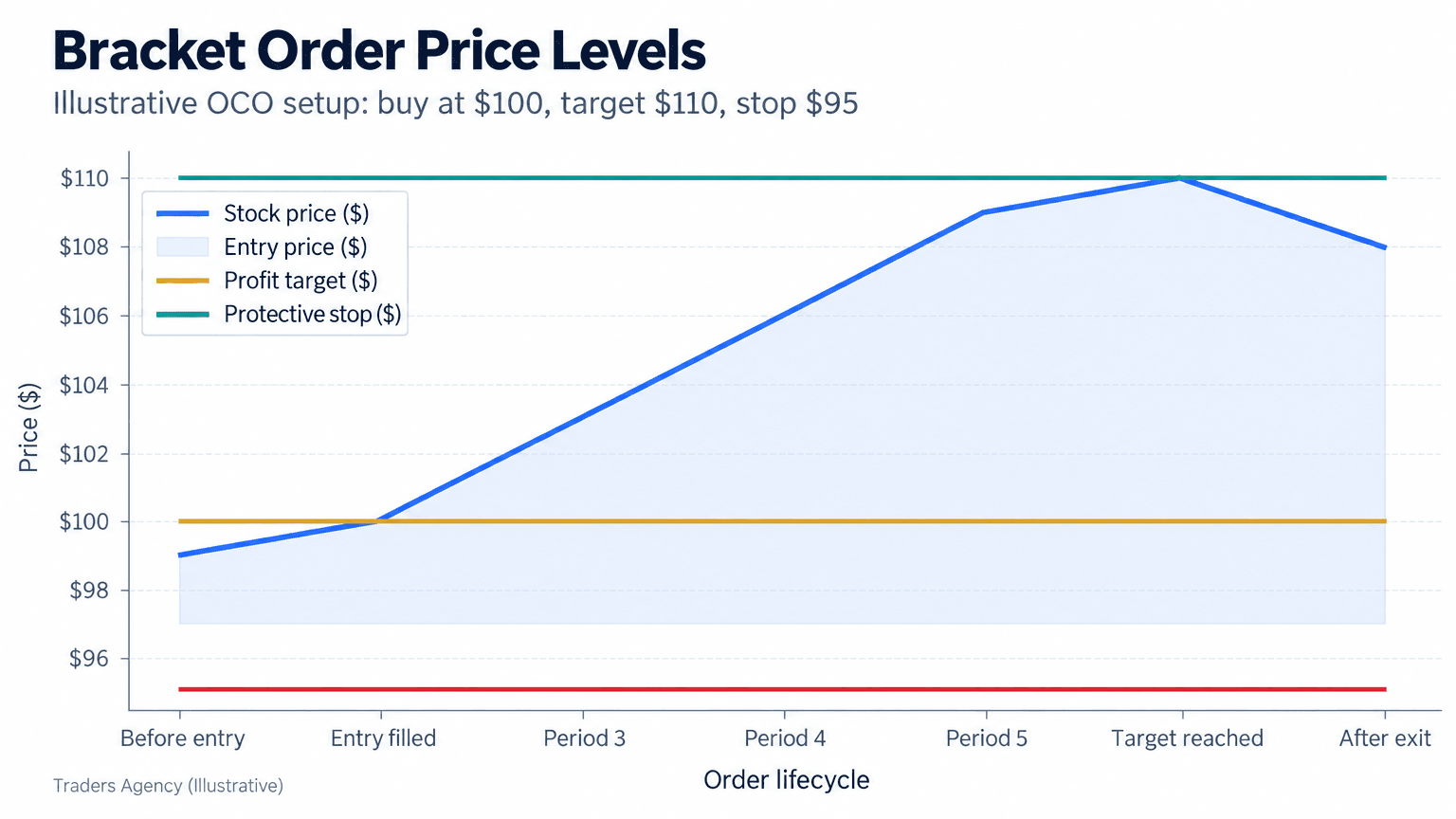
In this example, the entry fills at $100, the target sits at $110, and the stop sits at $95. Once price touches $110, the $95 stop cancels instantly, so you never end up with two open exit orders fighting each other.
| Order Leg | Price | Status After Target Hit |
|---|---|---|
| Entry | $100 | Filled |
| Profit Target | $110 | Filled, triggers OCO |
| Protective Stop | $95 | Canceled automatically |
What Are the Most Common Trailing Stop Order Mistakes?
We see the same handful of errors repeated by newer traders. Keep these in mind:
- Setting the trail too tight on a volatile stock, getting stopped out on normal noise before any real move happens.
- Confusing a trailing stop with a trailing stop limit, then being surprised when a gap-down causes no fill at all because the limit price was skipped over.
- Forgetting the stop only moves one way, then expecting it to reset lower if the stock pulls back and later recovers.
- Ignoring ATR or typical daily range, using the same flat percentage on a steady utility stock and a swinging small-cap.
- Not checking day vs. good-til-canceled settings, which can cause an order to vanish overnight when you expected it to stay active.
When Should You Use a Trailing Stop Order?
Trailing stops work best in trending markets where a stock is moving steadily in one direction and you want to protect profit without exiting too early. They're less useful in choppy, sideways markets, where normal price swings can trigger an exit before any real trend develops.
We generally avoid trailing stops around earnings announcements or other scheduled news events, since a gap can blow straight through your trail distance with no chance to adjust. For risk management, we suggest limiting any single position to a size where even a full stop-out represents a small, planned percentage of your overall account, not a number that keeps you up at night.
Watch Out: Stop and trailing stop orders, as noted in the SEC's investor education resources, do not guarantee an exact execution price, particularly during fast market conditions. Treat that as a hard limitation, not a maybe, before you lean on any stop order as a guarantee.
Want expert trading insights delivered daily?
Join thousands of traders who rely on Traders Agency for market analysis and trade ideas.
Join Traders AgencyDISCLAIMER: Traders Agency does not offer financial advice. The information provided is for educational purposes only and should not be considered financial advice. Traders Agency is not responsible for any financial losses or consequences resulting from the use of the information provided. Trading carries inherent risks and may not be suitable for all individuals. You are advised to conduct your own research and seek personalized advice before making any investment decisions, recognizing the potential risks and rewards involved.
See more from Traders Agency on Google
Make us a preferred source and our market analysis will appear more prominently in your Google Search, Top Stories, and AI results.
Add to Preferred Sources