
You've probably seen the headlines: EV sales projected to triple, a "white gold" rush, then six months later a different headline about lithium prices crashing 80% from their peak. If you bought in during the hype and watched your position get cut in half, you're not alone. We've seen plenty of traders learn the hard way that lithium stocks don't move like typical growth stocks. In this guide, we'll walk you through how the lithium market actually works, how to compare different ways of getting exposure, and how to size a position so a single bad cycle doesn't wreck your portfolio.
What Is the Best Lithium Stock to Buy?
Bottom Line: Lithium stocks swing hard with lithium prices, so treat them as a satellite position sized to survive a full boom-bust cycle rather than a core holding expected to compound steadily. Matching your risk tier (producer, developer, or explorer) to your own risk tolerance matters more than chasing a single "best" ticker.
There is no single "best" lithium stock because the right pick depends on your risk tolerance, time horizon, and whether you want direct mining exposure or diversified exposure. Albemarle (ALB) and SQM are the two names we hear most often, thanks to their scale and production history, but both carry significant price swings tied to lithium spot prices.
Rather than chasing a single ticker, we teach our members to think in tiers. Tier one is established producers with existing revenue and multiple mines in production. Tier two is mid-stage developers with permitted projects but limited current output. Tier three is early-stage explorers with no revenue at all, essentially a bet on a future discovery turning into a mine.
When people search for lithium stocks to buy, they're often looking for a shortcut. The more useful question is which tier matches your risk budget. A tier-one producer might fall 30% in a bad quarter. A tier-three explorer can fall 70% and never recover if the deposit doesn't pan out.
Building Your Own Lithium Stocks List
Here's the screening process we use when evaluating candidates for a lithium stocks list:
- Production status: Is the company actually shipping lithium, or still developing a project?
- Balance sheet strength: Can it survive 18-24 months of depressed prices without diluting shareholders heavily? You can review this directly in a company's SEC filings.
- Cost position: Is it a low-cost producer, or does it need high prices just to break even?
- Customer contracts: Does it have offtake agreements with battery makers or automakers, or is it selling entirely on the spot market?
- Jurisdiction: Is the mine in a politically stable region with clear permitting?
Run every candidate through that checklist before you commit capital. Skipping step two is the single most common mistake we see, especially with the smaller names that get hyped on forums.
Key Concept: Think of lithium stocks in tiers, not individual picks. Producers, developers, and explorers carry very different risk profiles, and matching the tier to your risk budget matters more than finding a single "best" ticker.
Is It Worth Investing in Lithium Stocks?
Lithium stocks can be worth investing in for traders comfortable with high volatility and willing to hold through multi-year price cycles, but they are not a reliable short-term bet. The sector rewards patience and position discipline far more than it rewards timing a single headline.
The long-term demand case is straightforward: electric vehicle adoption requires lithium-ion batteries, and battery demand has grown substantially over the past decade. That's the bullish argument you'll see repeated everywhere.
The part that gets left out is the supply side. Lithium supply responds to price with a long lag, and when prices spike, capital floods in to fund new mines and processing capacity. That new supply eventually overshoots demand, prices crash, and the stocks that rallied hardest on the way up fall hardest on the way down.
Why Lithium Has a Boom-Bust Cycle
Lithium pricing follows a pattern we see across many commodities, but it's particularly pronounced in this sector.
- Demand surges (new EV sales targets, government subsidies) push prices sharply higher.
- High prices attract new mining projects and processing capacity.
- New supply typically takes several years to reach the market, but when it arrives all at once, it overwhelms demand growth.
- Prices fall, sometimes dramatically, until the weakest producers cut output and the cycle resets.
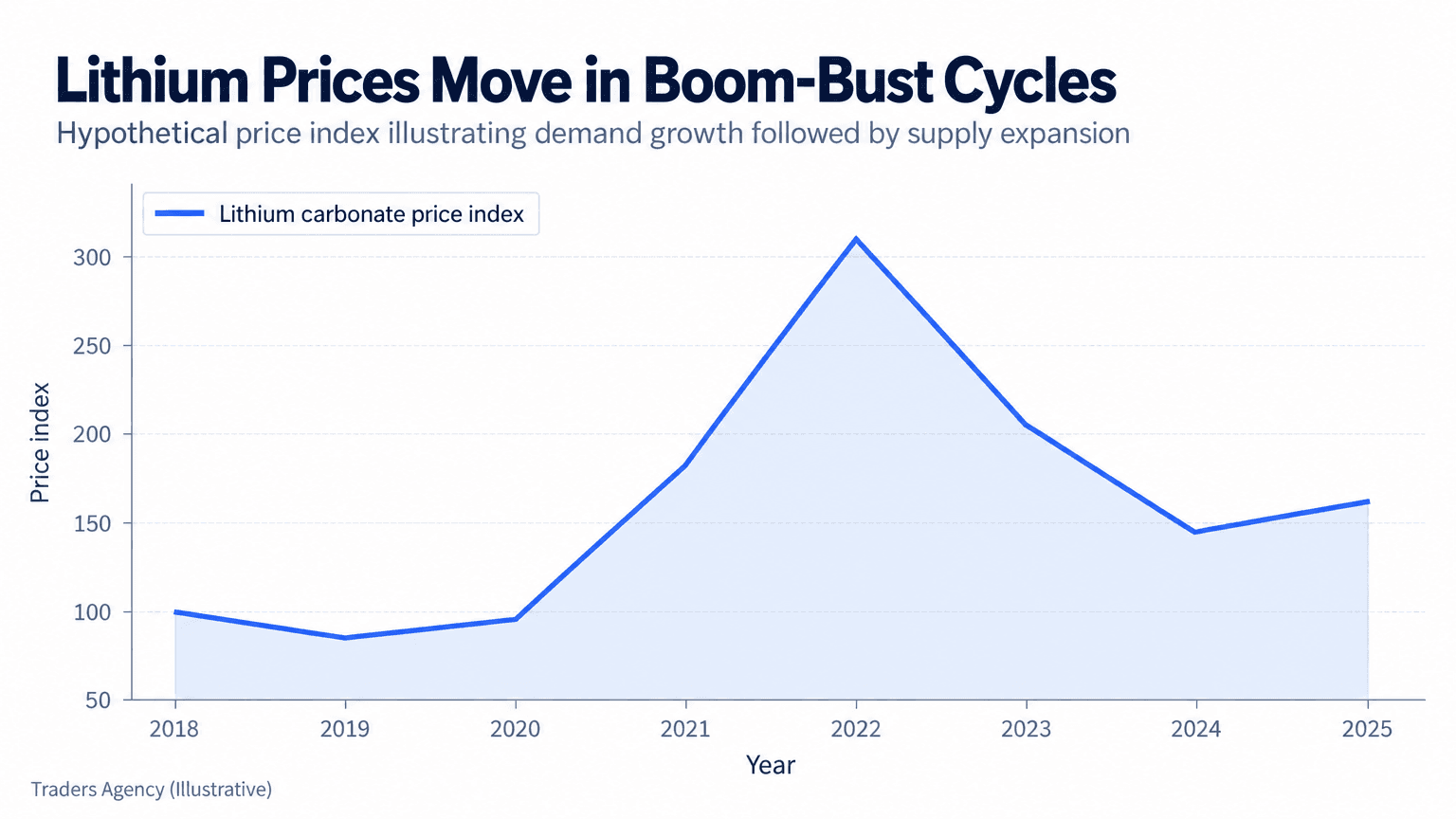
Understanding this cycle is what separates a trader who buys undervalued lithium stocks near a cycle bottom from one who buys a hyped name at the top and holds through a 70% drawdown.
Want expert trading insights delivered daily?
Join thousands of traders who rely on Traders Agency for market analysis and trade ideas.
Join Traders AgencyHow Can We Stay Informed About Lithium Market Trends?
Staying informed means tracking a few specific data points rather than reacting to every news headline. Lithium carbonate and lithium hydroxide spot prices, quarterly production reports from major producers, and EV sales data by region are the core inputs we watch.
We don't recommend trading lithium stocks based on headlines alone. A single article about a "new battery breakthrough" or a mine disruption can move prices for a day, but the trend that actually matters plays out over quarters, not days.
Key Data Points for Lithium Stocks
When we evaluate the sector, we check these inputs regularly:
- Spot lithium prices (carbonate and hydroxide), often tracked through commodity data providers
- Quarterly production volumes reported directly in company earnings
- Inventory levels at battery manufacturers, which signal near-term demand strength
- New mine permitting and construction timelines, which forecast future supply
- EV sales growth by region, since China, the US, and Europe drive different parts of demand
A lot of traders also check lithium stocks reddit communities for sentiment and early news flow. That can be useful for spotting emerging narratives, but we treat it as a sentiment gauge, not a research source. Forum enthusiasm tends to peak right before a correction, not before a sustainable rally.
Can Lithium Stocks Pay Dividends?
Yes, some lithium stocks with dividends exist, but they're typically the larger, established producers rather than growth-stage explorers. Albemarle has historically paid a dividend, though the yield is modest and the payout can be pressured during periods of low lithium prices.
Dividend payers in this sector behave differently than dividend stocks in defensive sectors like utilities. The dividend is a signal of financial stability, not a reason by itself to buy. If lithium prices crash hard enough, even a historically reliable payer can cut its dividend to preserve cash for operations.
If dividend income is your primary goal, we'd treat lithium stocks as a small satellite position, not a core holding. Dividend stability depends entirely on the commodity cycle, which is the opposite of what most income investors want.
Is There an ETF for Lithium?
Yes, there are ETFs built specifically for lithium and battery metal exposure, with the Global X Lithium & Battery Tech ETF (LIT) being the most widely known. A LIT ETF holds a basket of miners, refiners, and battery producers rather than betting on a single company.
This matters because single-stock lithium exposure carries company-specific risk on top of commodity risk. A mine can flood, a permit can get delayed, a CEO can make a bad acquisition. An ETF spreads that risk across many companies while still giving you commodity-cycle exposure.
Comparing Your Exposure Options
| Vehicle | Pros | Cons |
|---|---|---|
| Direct stock (ALB, SQM) | Higher upside if you pick well | Company-specific risk, higher volatility |
| Lithium ETF (LIT) | Diversified, less single-stock risk | Dilutes upside, still tracks the commodity cycle |
| Broad equity index | Lowest volatility | Minimal direct lithium exposure |
| Futures | Pure commodity exposure, no equity risk | Requires a futures account, leverage risk, thin liquidity, not for beginners |
Traders considering futures exposure can review contract specifications directly through CME Group, though we generally reserve this route for experienced traders comfortable with leverage.
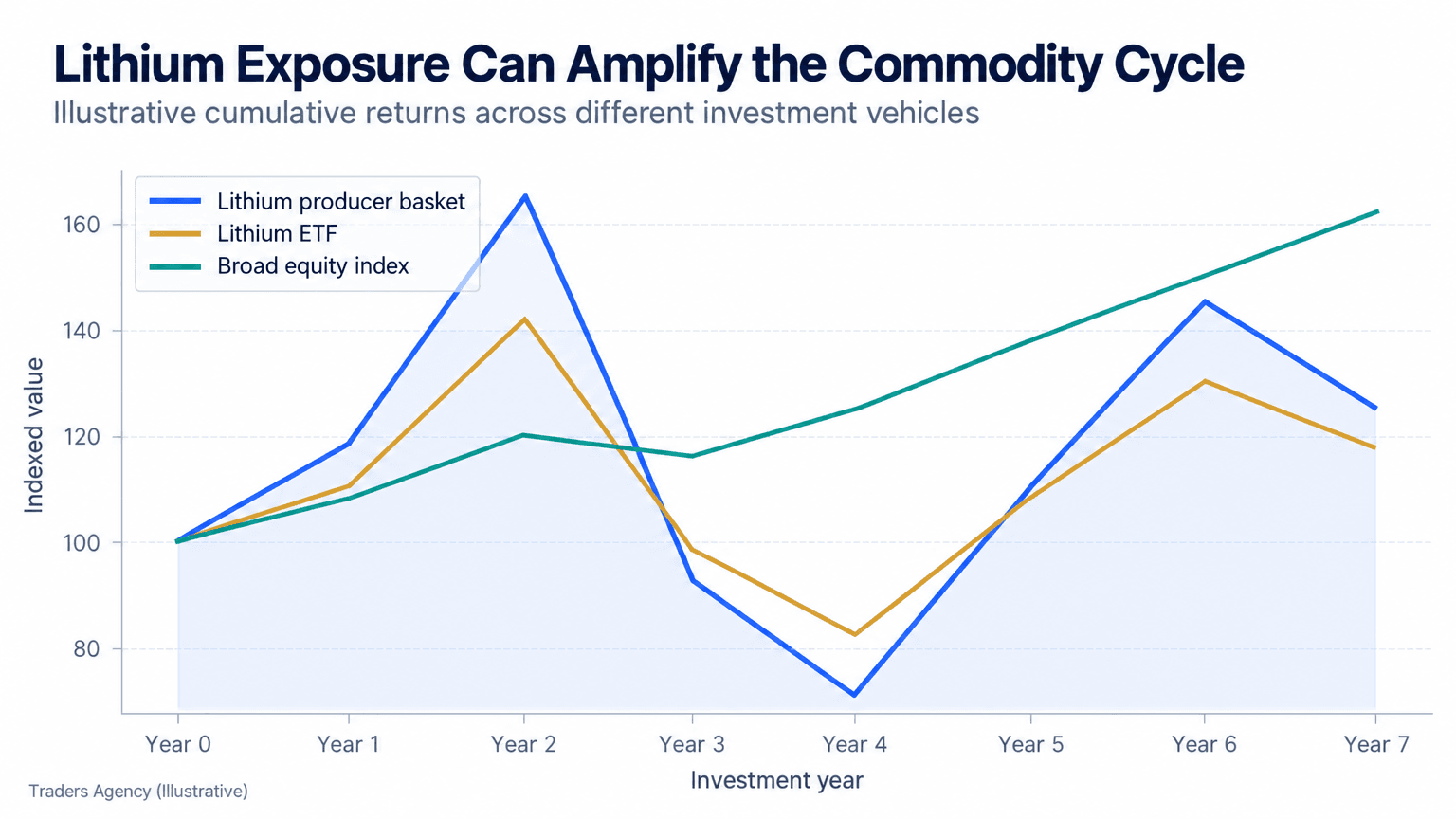
We generally suggest intermediate traders start with an ETF before moving into individual names. It gives you cycle exposure while you build a feel for how the sector actually trades through earnings seasons and price swings.
What Lithium Company Does Tesla Use?
Tesla has sourced lithium from multiple suppliers over the years, including agreements tied to producers operating in Australia and other major mining regions, rather than relying on a single exclusive supplier. Automakers generally diversify their lithium supply chains to avoid being dependent on one producer or one country.
This diversification approach from automakers is actually a useful lesson for traders. If Tesla and other major EV makers hedge their supply risk across multiple producers and regions, we'd encourage you to apply the same logic to your portfolio instead of concentrating in one lithium stock.
Who Are the Top Producers of Lithium?
The largest lithium-producing regions are Australia, Chile, and China, though the roles differ: Australia and Chile dominate raw mining output, while China holds an outsized role in processing and refining lithium into battery-grade chemicals.
That processing concentration is a risk factor many traders overlook. Even if a mine is located in a stable jurisdiction, the raw material often still needs to pass through Chinese refining capacity before it becomes usable battery material.
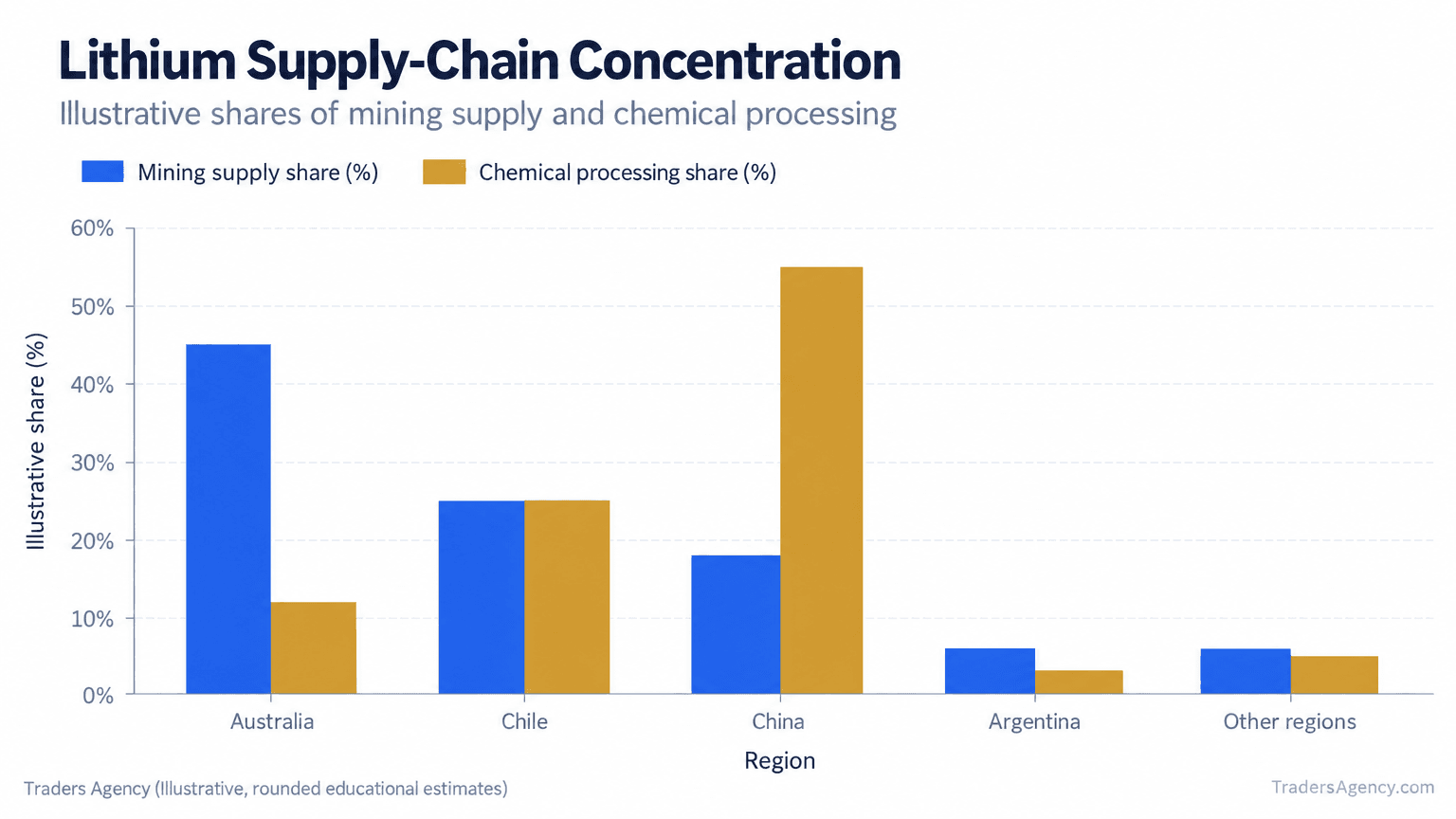
When we screen a company for a portfolio, we check where both its mining operations and its processing partnerships are located. A stock with mines in Chile but processing dependent on a single Chinese refiner carries geopolitical risk that a pure production number won't show you.
Watch Out: A mine in a stable country doesn't guarantee a stable supply chain. Check where the raw lithium actually gets refined into battery-grade material before assuming a stock is low-risk.
How Should You Size and Manage Risk in Battery Metal Stocks?
Given the volatility we've covered, how you size a lithium position matters more than which specific stock you pick. We teach members to treat this entire sector as a satellite allocation, not a core holding.
A Sample Allocation Framework
Here's a structure we often walk through with members building exposure to this sector within a diversified portfolio:
- 70-80% in diversified core holdings (broad index funds, established large caps)
- 10-15% in a lithium or battery metals ETF like LIT for diversified commodity exposure
- 5-8% in established producers such as ALB or SQM for higher-conviction direct exposure
- 2-5% in speculative explorers, sized small enough that a total loss doesn't meaningfully hurt the portfolio
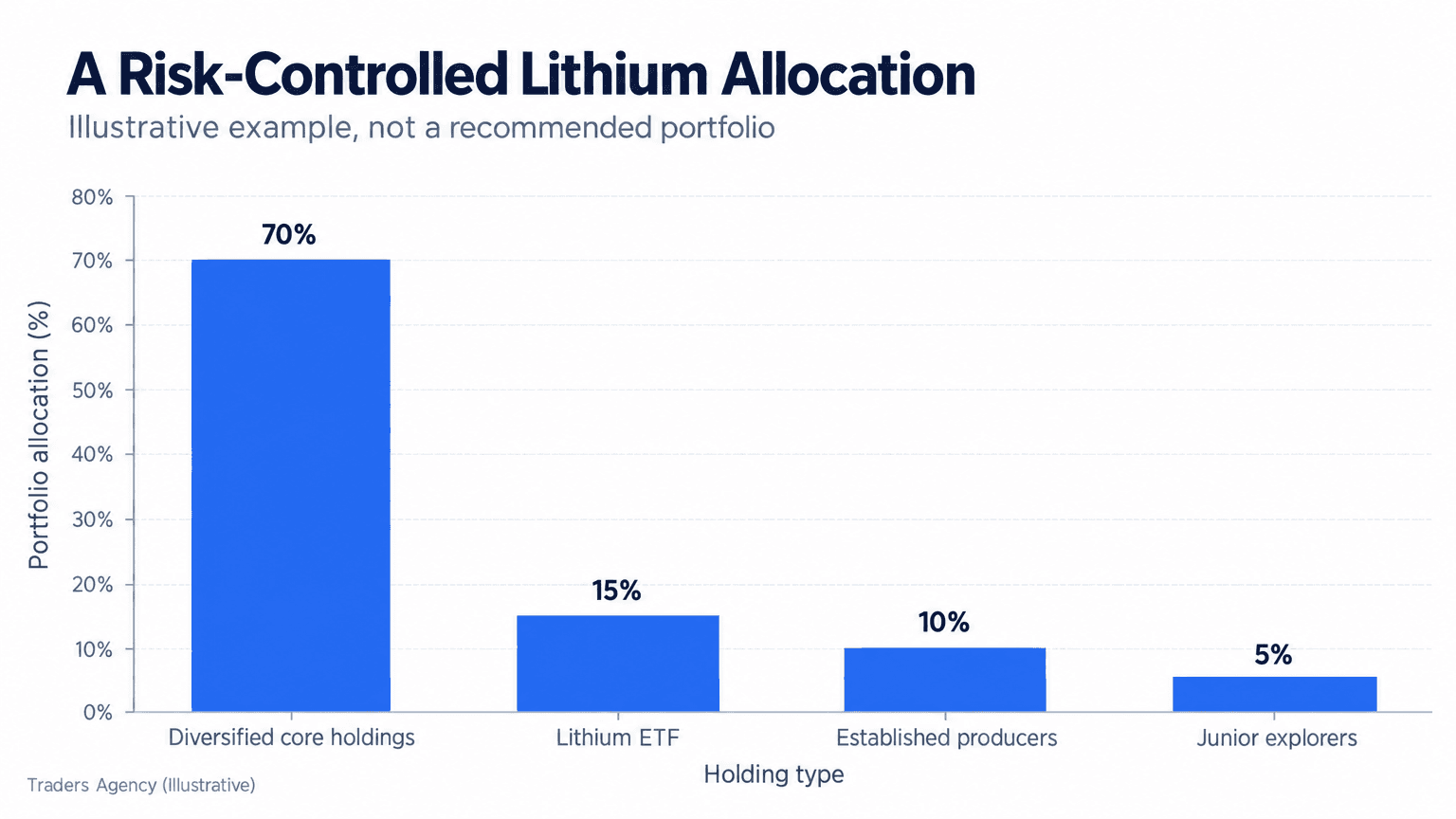
These percentages are illustrative, not prescriptive, and the ranges are meant to total 100% at their midpoints. Your actual allocation should reflect your own risk tolerance, time horizon, and existing portfolio concentration, not a fixed rule copied from an article.
When This Approach Works, and When It Doesn't
Lithium stocks tend to perform best for traders who:
- Can hold through multi-year cycles without needing the capital
- Track production and pricing data rather than relying on headlines alone
- Size speculative explorer positions small enough to absorb a full loss
This approach tends to fail for traders who:
- Chase a stock after it's already up sharply on hype
- Concentrate a large percentage of their portfolio in a single junior miner
- Ignore the correlation between lithium stocks and the broader EV sentiment cycle, which can amplify losses when both turn negative at once
Battery technology evolution is another risk worth flagging. Sodium-ion and other alternative chemistries are in development, and while lithium-ion remains dominant today, a shift in battery technology over the coming decade could change long-term demand assumptions. That's a reason to diversify across the sector rather than betting the farm on lithium specifically.
Key Concept: Treat lithium exposure as a satellite allocation sized to survive a full cycle, not a core holding you expect to compound smoothly every year.
Want expert trading insights delivered daily?
Join thousands of traders who rely on Traders Agency for market analysis and trade ideas.
Join Traders AgencyDISCLAIMER: Traders Agency does not offer financial advice. The information provided is for educational purposes only and should not be considered financial advice. Traders Agency is not responsible for any financial losses or consequences resulting from the use of the information provided. Trading carries inherent risks and may not be suitable for all individuals. You are advised to conduct your own research and seek personalized advice before making any investment decisions, recognizing the potential risks and rewards involved.
See more from Traders Agency on Google
Make us a preferred source and our market analysis will appear more prominently in your Google Search, Top Stories, and AI results.
Add to Preferred Sources