

Hey, Ross here:
The China AI chip ban making headlines this week isn't China blocking Nvidia. It's the opposite. The FCC is preparing to restrict Chinese-made optical transceivers, the components that let AI chips talk to each other inside data centers, and China currently makes most of that market.
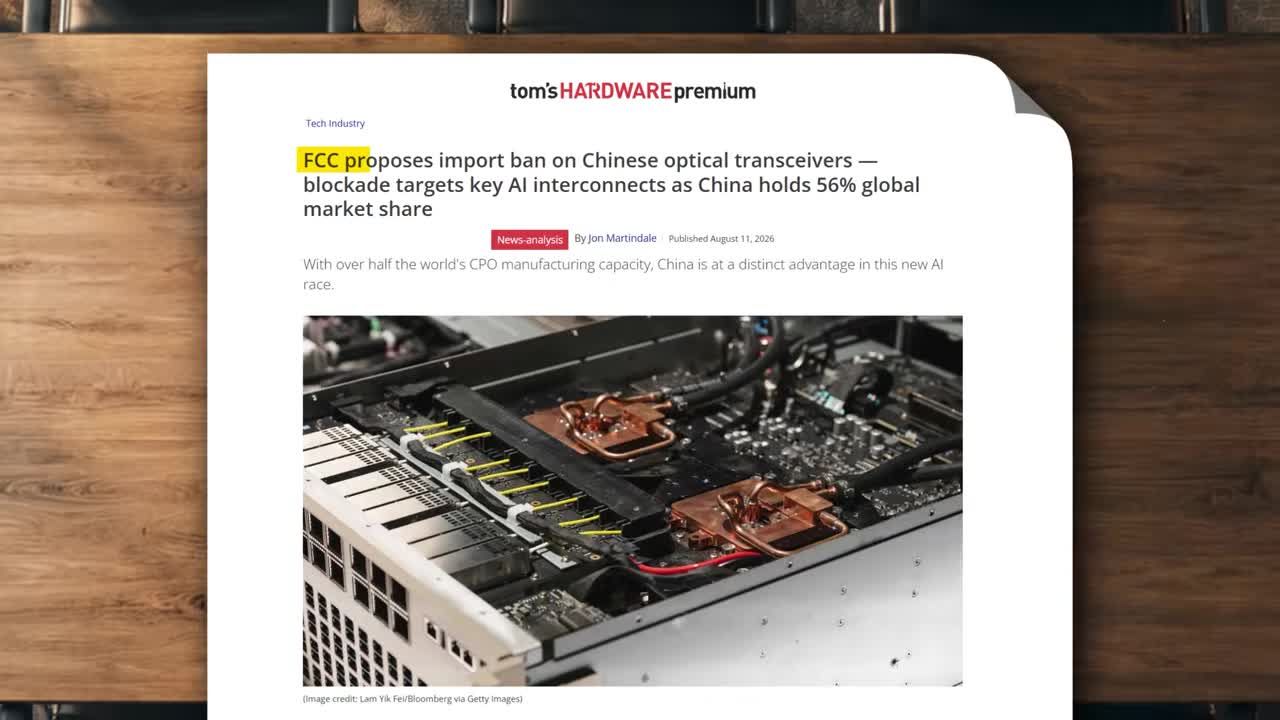
On Monday, October 5th, analysts told Wall Street's biggest clients that the FCC is likely to restrict these Chinese-made parts, possibly before this month is even over. You'd think that spells disaster for the AI build-out. It doesn't. Buried inside the proposal is an exception clause big enough to turn China's biggest factories into paying customers of American suppliers instead of competitors to them.
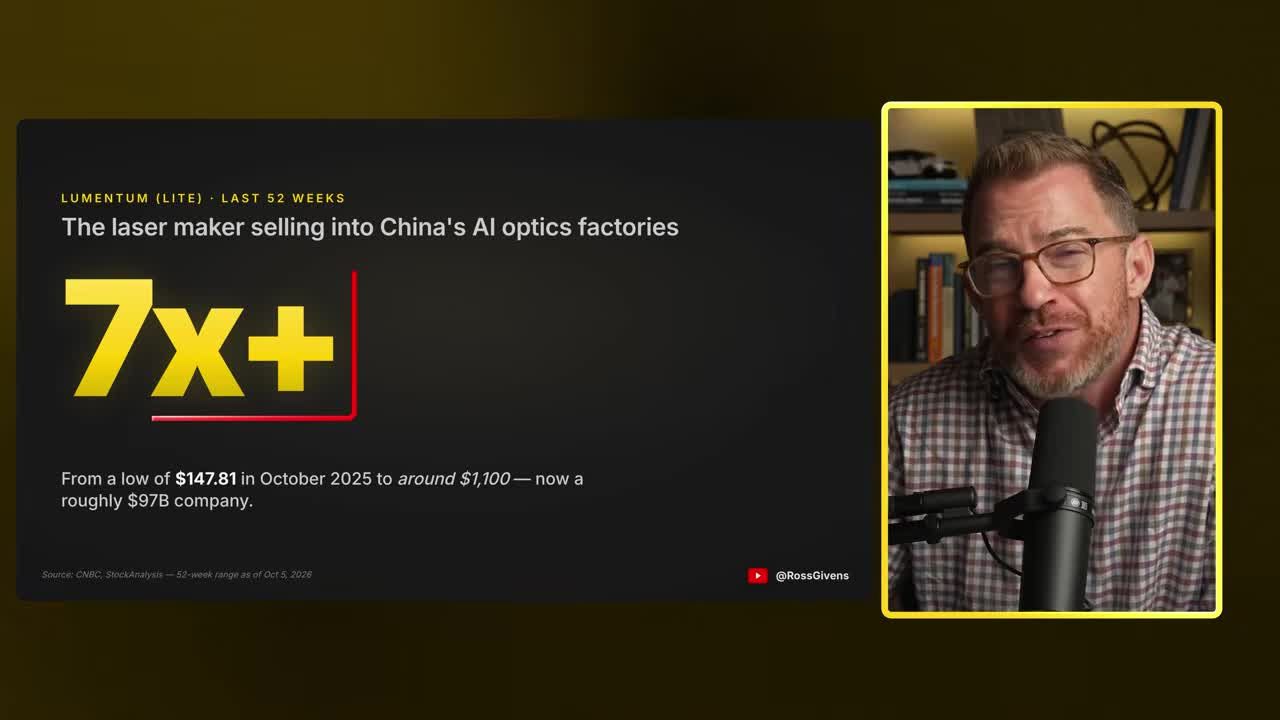
One of the companies sitting at the center of this, Lumentum, has already climbed more than seven-fold since last October and just broke out to fresh highs after a five-month pause. Three stocks are positioned to benefit from how this rule is actually written, and one of them is still trading 50% below its peak from earlier this year.
What Does the China AI Chip Ban Actually Restrict?
Bottom Line: The FCC's proposed limit on Chinese-made optical transceivers includes an exception that could turn Chinese factories into buyers of American components instead of rivals. That shift could favor a few US suppliers, including one still trading well below its earlier peak.
The light-based plugs nobody talks about
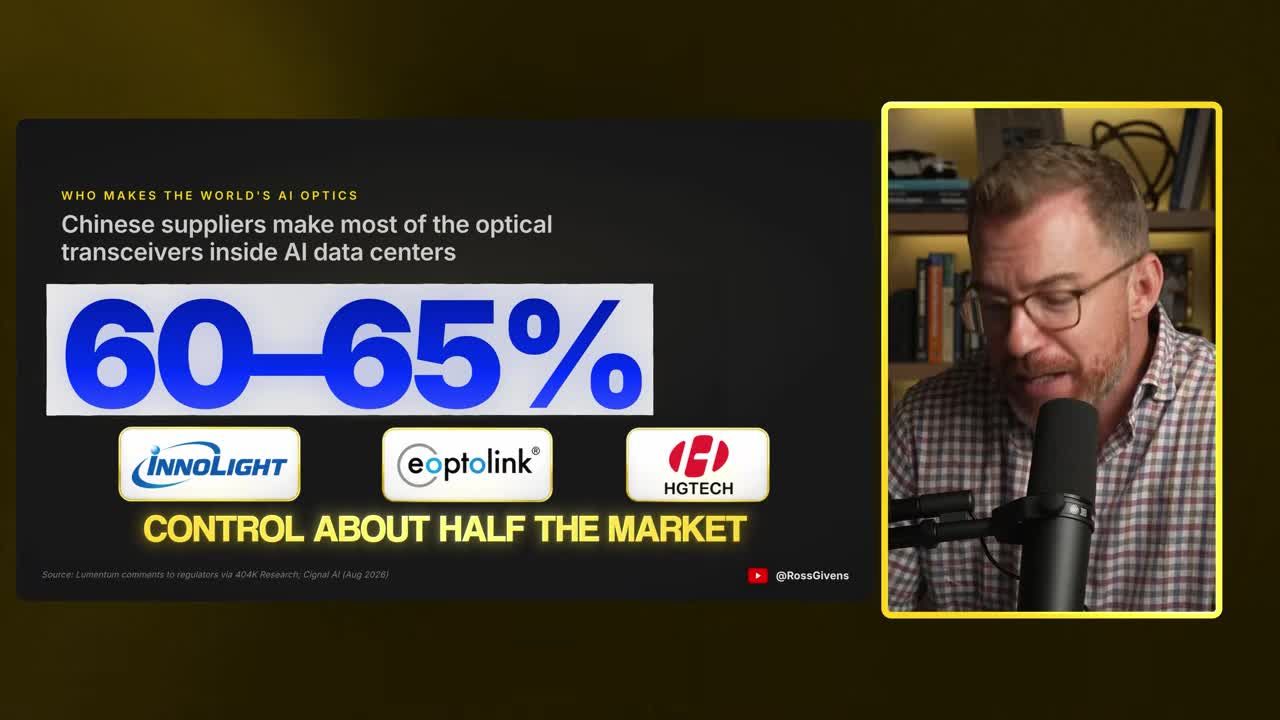
The China AI chip ban refers to a new FCC proposal that would restrict imports of Chinese-made optical transceivers, the light-based plugs that let AI chips communicate with each other. Chinese suppliers currently make roughly 60 to 65% of the world's optical transceivers, and Washington wants American companies controlling the most valuable parts instead.
To understand why this is such a big deal, you have to understand what's actually happening inside an AI data center. Everybody talks about Nvidia's GPUs, and yes, they matter. But a GPU by itself is just a very expensive space heater.
To train a large AI model, you need thousands of these chips working together like one giant computer, constantly passing data back and forth. If the data can't move fast enough, the chips just sit there burning electricity and doing nothing.
That's why the network connecting all those chips isn't an accessory. It is the computer. And the bigger these systems get, the more money flows into the network rather than the chip itself.
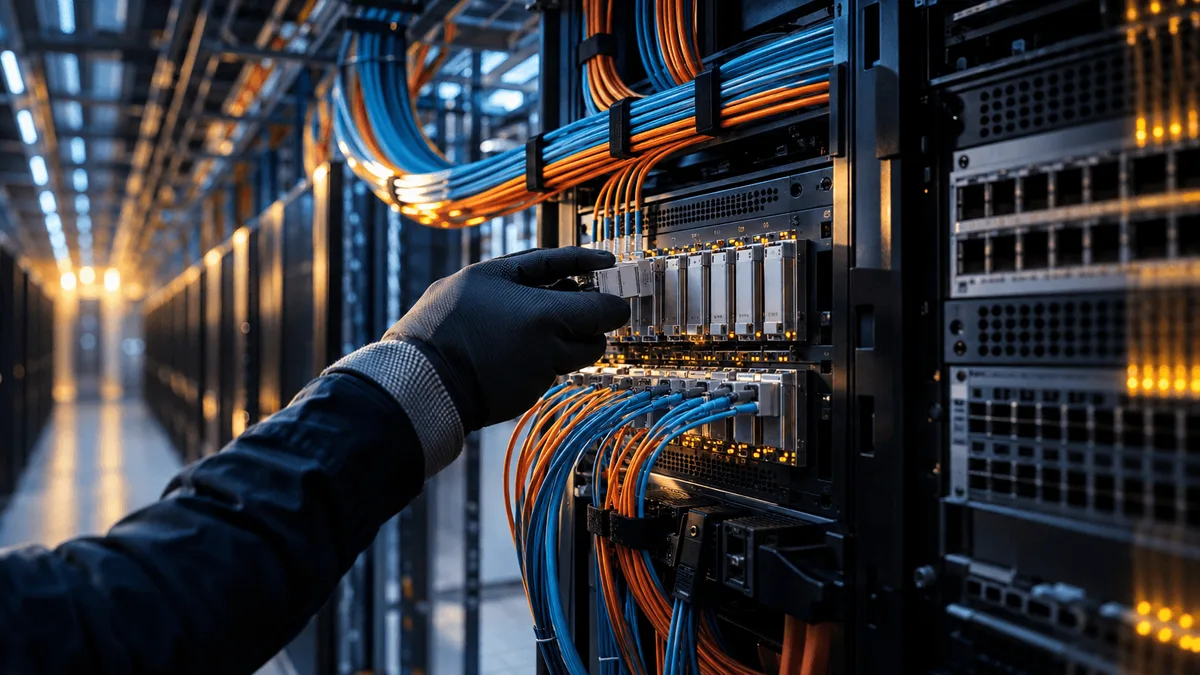
The way that data moves is light. Data gets turned into pulses of light, sent down a fiber, and converted back into data on the other end. The device that does that conversion is the optical transceiver, and a single large AI cluster can use tens of thousands of them.
Three Chinese companies alone, InnoLight, Eoptolink, and HG Genuine, control about half of that global market. The United States has been building the most important technology of the century on parts made by its biggest competitor. That's the problem the FCC is trying to fix.
Why Isn't This the Nvidia Story?
If you've been searching for news about Nvidia being banned from selling to China, this is a completely different story. The China AI chip ban being discussed here is an FCC proposal aimed at optical transceivers, not at GPUs.
The action is in the network layer, not the chip itself. This rule is about the plumbing that connects chips.
And here's what makes it smart rather than destructive: if Washington just slammed the door shut on Chinese transceivers tomorrow, the entire AI build-out would grind to a halt. Even Lumentum warned regulators directly that an abrupt cutoff would cause a severe supply shock.
So according to analysts who've been meeting with policy people in Washington, the restriction is being staged. It starts with the next generation of devices, the 3.2 terabit units, not the 800 gig and 1.6 terabit transceivers already running in today's data centers.
China doesn't get kicked out of the market. China gets turned into a customer.

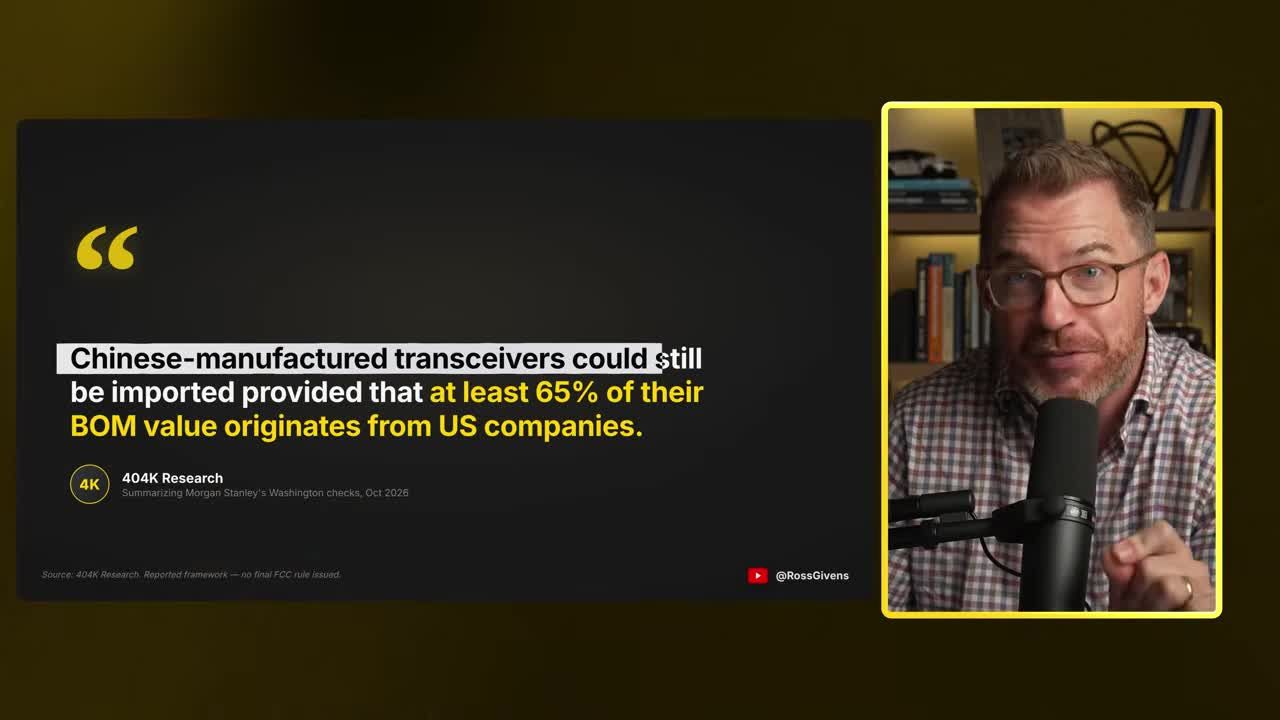
A Toll Booth, Not a Wall
The brain and the flashlight inside every transceiver
Three American companies sit at the center of this story: Marvell Technology, which makes the chip that cleans up the data signal, Lumentum, which makes the laser, and Applied Optoelectronics, which according to one research firm is the only American company building complete transceivers at scale.
Every optical transceiver has two expensive pieces inside. Think of it as a brain and a flashlight. The brain is a chip called a DSP, and it cleans up the signal so the data arrives in one piece. It's the single biggest cost in the module, somewhere between a quarter and 40% of the total. The flashlight is the laser, the next biggest cost.
Pair an American brain with an American laser, and a Chinese-made transceiver lands right up near that 65% American-content line.
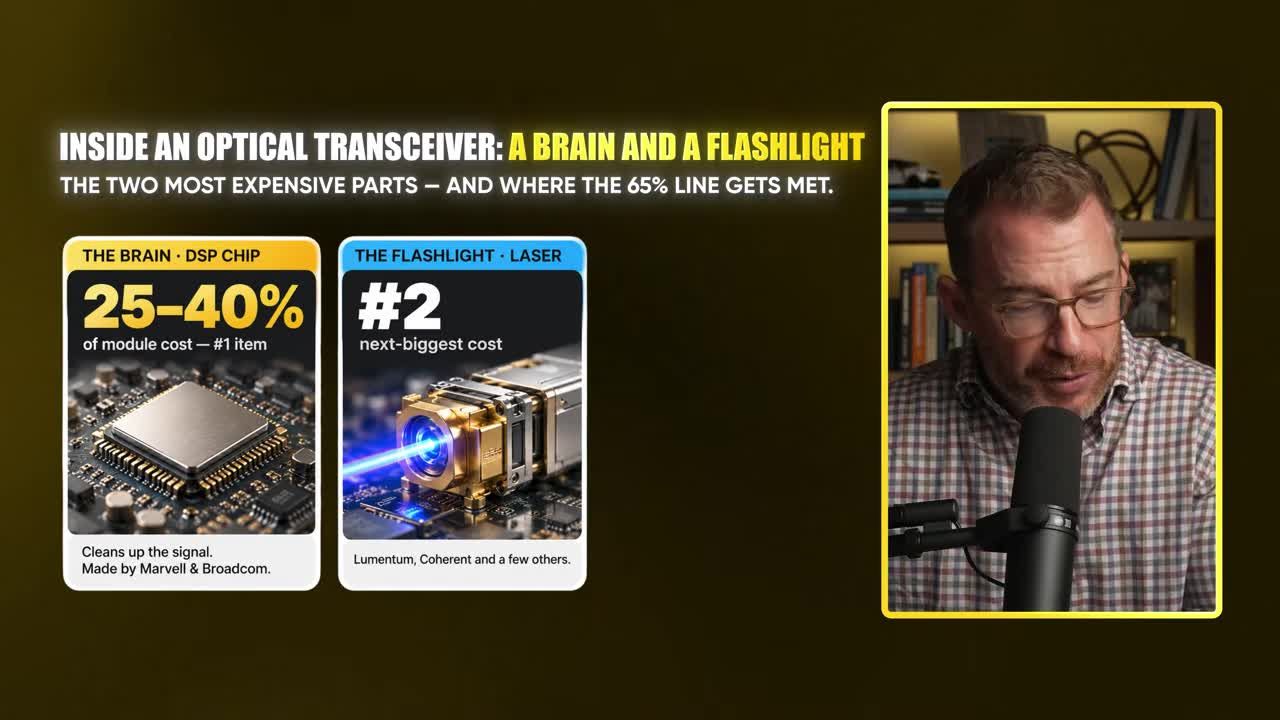
On the brain, China has no good substitute. One industry analysis this spring put it bluntly: there is currently no mature Chinese alternative for these DSP chips. So if China's biggest factories want to keep selling into America's AI data centers, the easiest path over that 65% line is to buy the brain and the flashlight from American companies.
Washington thinks it's building a wall. It's really building a toll booth.
The market for optical DSP chips is dominated by just two American companies, Marvell and Broadcom, and those chips are already sitting inside transceivers coming out of Chinese factories today. Marvell bought a company called Polaritan back in April specifically to push its optical technology toward that 3.2 terabit generation and beyond, the exact segment this rule targets.
On the laser side, Lumentum builds its lasers using a material called indium phosphide and already sells into the same Chinese transceiver makers this rule is aimed at. Demand for these lasers is running more than 30% above what the industry can produce, and Lumentum's order book stretches all the way through 2028.
Get an entire year of live weekly mentoring sessions, my newsletter, indicators, bonus reports, tons more. Click the link and I'll see you in the next live session.
Join my Black Ops Trading ClubWhich Three Stocks Could Benefit From the China AI Chip Ban?
Three names make up the full picture of this toll booth. Each plays a different role, and each one is sitting in a very different spot on its chart right now.
1. Marvell Technology (MRVL)
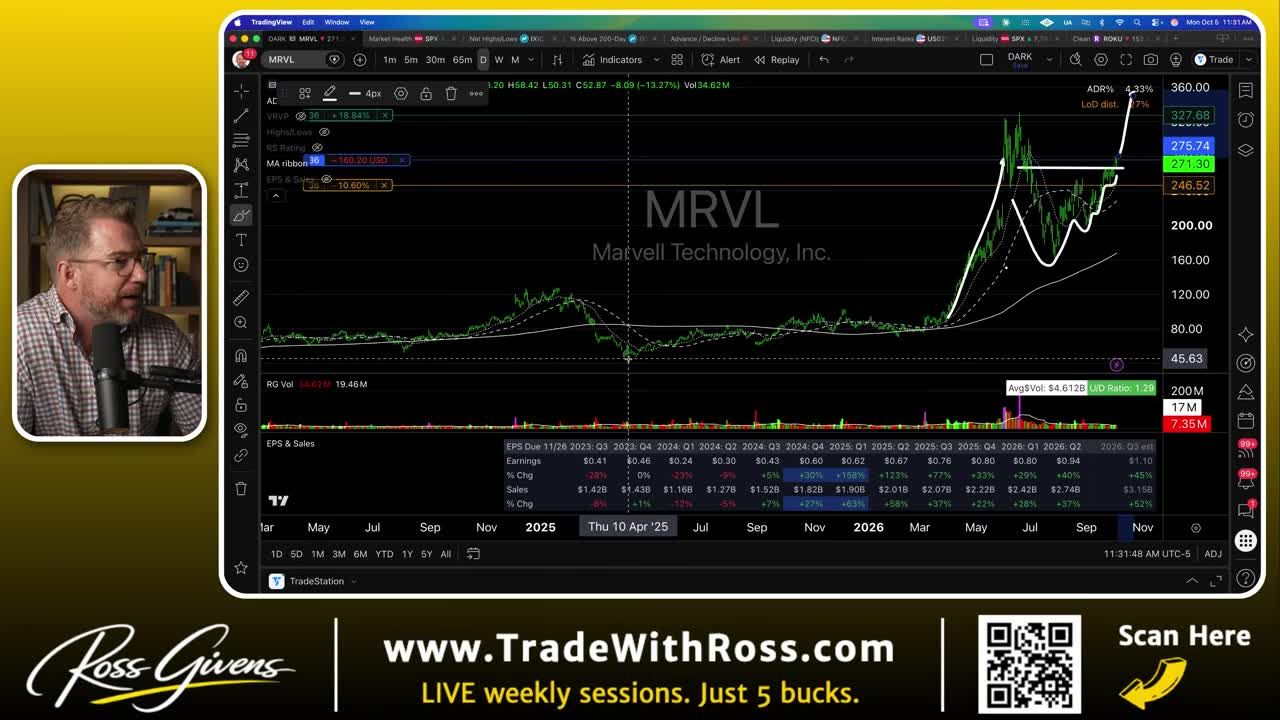
Marvell, headquartered in Santa Clara, California, makes the DSP chip, the brain that cleans up the data signal inside these transceivers. It's worth well over $200 billion and does a lot more than optics, so this rule alone isn't going to double the stock. But if the rule lands the way it's been described, Chinese factories have even more reason to make sure that brain is American.
The chart shows a big run higher in April and May, followed by a clean, shallowing consolidation where supply got pulled out of the stock. I recently initiated a position and I'm currently down about $100 on it.
Marvell was a $50 stock a year and a half ago. Now it trades around $270. That doesn't mean it can't keep climbing.
2. Lumentum (LITE)
Lumentum, based in San Jose, makes the laser. Rosenblatt named it one of the biggest potential winners from this rule and set a $1,300 price target on it. The stock currently trades around $1,000.
It's up more than seven-fold since last October, and over the last twelve months alone it's gone from roughly $150 to $1,100.
The chart shows a five-month base, a big run-up in February and March, and a consolidation that absorbed the move before breaking out again to new highs. The problem with Lumentum now is simple: everybody knows about it.
3. Applied Optoelectronics (AAOI)
AAOI builds the whole transceiver, not just a piece of it. According to one research firm, it's the only American company building these devices at scale, with laser and transceiver capacity in Texas and Taiwan for the current 800 gig and 1.6 terabit generations. When the first reports of a possible Chinese ban hit on August 4th, AAOI jumped 19% in a day.
Then it fell apart. From a high above $230, the stock has been cut roughly in half. It's currently trading around $115, and I took a small position in it last week. The average analyst target sits up in the 160s.
Mania vs. Fundamentals
Two are near highs. One is cut in half.
Some of these names are expensive. Others are cheap for a reason that has nothing to do with the story falling apart. The two toll collectors, Marvell and Lumentum, are both trading near the tops of their ranges. Lumentum climbing from $150 to $1,100 in twelve months is not a typo, and no, Marvell at $270 a share isn't cheap either.
AAOI fell for two reasons, and neither one is demand drying up.
First, the company has been selling a lot of new stock to pay for its new factories, roughly a billion dollars worth this year alone, including a $600 million stock sale announced in August. The next trading day, the stock fell 14%. When a company prints new shares, every existing share owns a smaller slice, and investors don't love that.
Second, it's just volatile. The stock moves almost four times as much as the market every day, swinging from under $20 to over $230 inside a single year.
Stocks that make 10x moves in a year don't go straight up. They overshoot, then correct, then overshoot again. What matters is what the money is actually buying: factories in Texas making the exact product Washington is trying to stop buying from China, with management saying demand will outrun production capacity through the middle of next year.
Does the China AI Chip Ban Actually Ban AI Chips?
No. This proposal doesn't ban artificial intelligence chips at all, and it doesn't ban China from the optics market either. It targets a specific future generation of optical transceivers, the 3.2 terabit units, while leaving today's 800 gig and 1.6 terabit devices flowing exactly as they are now.
Those 3.2 terabit transceivers barely exist yet. Practically none will ship before 2028. This isn't something that shows up in next quarter's earnings. The current generation keeps flowing from China like nothing happened.
So why does any of this matter right now?
Because the market doesn't wait for revenue to show up before it prices a story in. Lumentum didn't climb seven times on last year's sales. It climbed on the assumptions of 2026, 2027, and 2028 sales. The market prices the future the minute it can see it, and right now, it's starting to see this one.
What to Watch Next
- The FCC. Action could come as soon as this month. If it lands and that 65% exception survives, the toll booth becomes very real.
- Congress. A separate bipartisan bill in the Senate would ban Chinese transceivers from the government's most sensitive networks, naming InnoLight and Eoptolink directly. Two different paths, pointing the same direction.
- China. If Beijing tightens its grip on indium, the lasers get even scarcer. A headache for everybody, but it makes every American laser that does get made worth even more money.
The Network Is the Real Story
AI runs on GPUs. The GPUs run on the network. And that network runs on light.
For years, China built most of that light. Washington is now signaling that China can keep building it, as long as the most valuable parts come from American companies. That's the part of the China AI chip ban story most people are missing.
This isn't about cutting China out. It's about forcing China to pay American companies first.
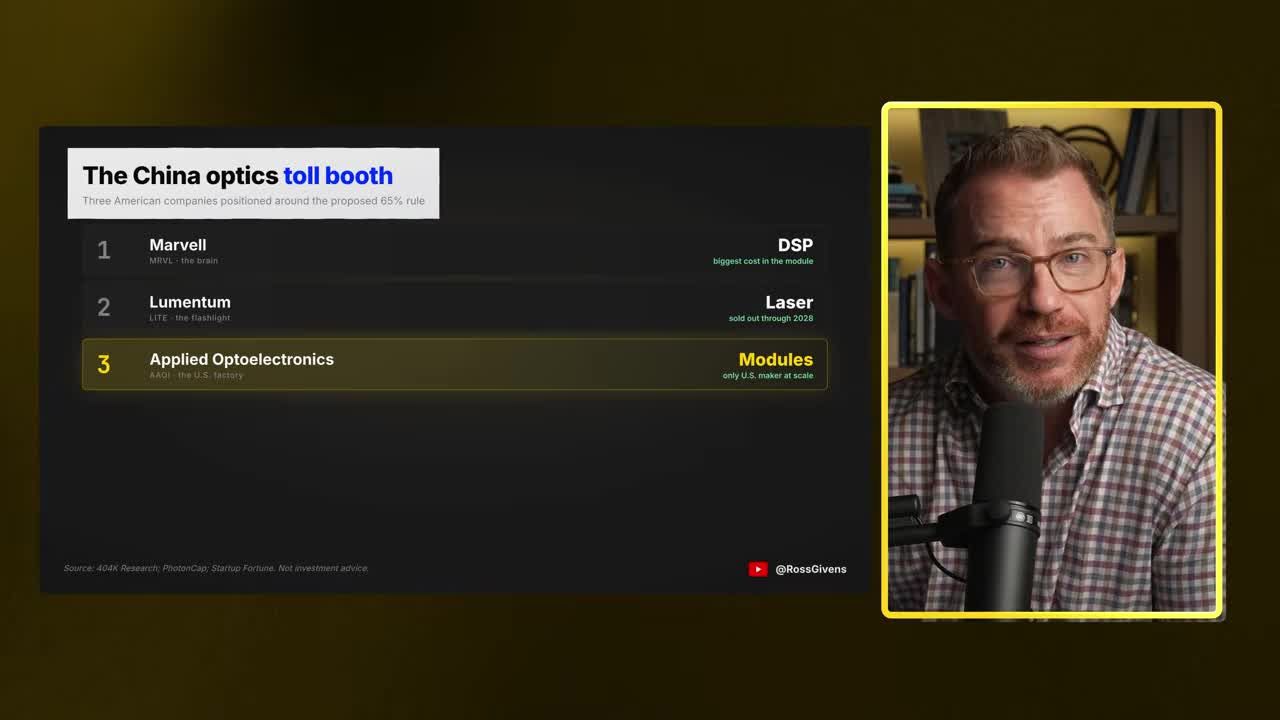
Marvell makes the brain. Lumentum makes the flashlight. Applied Optoelectronics is the one American factory big enough to build the whole device. Two of those three are trading near their highs. The third is sitting 50% off its peak, building exactly what Washington wants built on American soil.
That gap won't stay open forever.
Get an entire year of live weekly mentoring sessions, my newsletter, indicators, bonus reports, tons more. Click the link and I'll see you in the next live session.
DISCLAIMER: Traders Agency does not offer financial advice. The information provided is for educational purposes only and should not be considered financial advice. Traders Agency is not responsible for any financial losses or consequences resulting from the use of the information provided. Trading carries inherent risks and may not be suitable for all individuals. You are advised to conduct your own research and seek personalized advice before making any investment decisions, recognizing the potential risks and rewards involved.
See more from Traders Agency on Google
Make us a preferred source and our market analysis will appear more prominently in your Google Search, Top Stories, and AI results.
Add to Preferred Sources