
Dividend investing for beginners starts with one simple idea: you buy shares of a company, and that company pays you a portion of its profits just for holding the stock. It's one of the oldest and most straightforward ways to build income from the stock market. By the end of this guide, you'll know how dividends work, how to calculate the numbers that matter, and how to sidestep the traps that catch new investors.
We built this guide because so many of our members ask the same question when they're starting out: "Can I actually live off dividends someday, or is this just a nice bonus on top of growth investing?" The honest answer is both, depending on how much you invest and how you structure your portfolio.
Our team will walk you through dividend yield, payout ratios, reinvestment plans, and the tax rules that trip people up every April. We'll also show you the math behind generating real monthly income, not just vague promises.
What Is Dividend Investing?
Bottom Line: Dividend investing for beginners works best as a long-term approach built on sustainable yields, typically in the 2% to 5% range, rather than chasing double-digit payouts that often signal a yield trap. Real income takes meaningful capital and careful attention to payout ratios and tax rules, so new investors should focus on steady reinvestment and risk awareness rather than quick payoff promises.
Dividend investing is a strategy where you buy stocks specifically for the cash payments companies distribute to shareholders, rather than (or in addition to) hoping the share price rises. Those payments typically come from company profits and are usually distributed quarterly.
Dividend investing works best when you treat it as a two-part return: the dividend check plus whatever the stock price does over time. Some investors focus purely on income and barely think about price movement. Others blend dividend stocks with growth stocks to balance both goals.
This differs from pure growth investing, where a company reinvests all its profits into expansion and pays shareholders nothing directly. Both approaches can build wealth. Dividend investing just gives you cash along the way.
Key Concept: A dividend is a cash payment made from company profits to shareholders, usually quarterly. Your total return equals the dividends collected plus (or minus) any change in the share price.
Why Do Companies Pay Dividends?
Companies pay dividends when they generate more cash than they need for operations, debt, and growth projects. Rather than sit on that cash, management returns a slice to shareholders as a reward for ownership.
Mature companies in stable industries (think utilities, consumer staples, and established banks) tend to pay dividends because they don't need every dollar to fund rapid expansion. Younger, fast-growing companies often skip dividends entirely because they'd rather reinvest in new products or markets.
Paying a dividend is also a signal. A company that commits to a steady or rising dividend is telling the market it's confident in its future cash flow.
How Does a Dividend Payment Actually Work?
A dividend payment runs through four key dates: the declaration date, the ex-dividend date, the record date, and the payment date. You must own the stock before the ex-dividend date to receive the upcoming payment.
Here's a concrete walkthrough. Say a company declares a $0.50 per share quarterly dividend on March 1st.
| Date | What It Means | Example |
|---|---|---|
| Declaration Date | Company announces the dividend amount | March 1 |
| Ex-Dividend Date | Buy on or after this date and you miss the payment | March 15 |
| Record Date | Company checks its books for shareholders of record | March 16 |
| Payment Date | Cash hits your brokerage account | April 1 |
If you buy the stock on March 14th, you get the dividend. If you buy on March 15th or later, you don't, even though you now own the shares. The stock price typically drops by roughly the dividend amount on the ex-dividend date, since that cash is leaving the company.
If you own 100 shares, that $0.50 per share dividend puts $50 in your account on April 1st. Multiply that across a diversified portfolio and four payments a year, and you start to see how a dividend portfolio built for monthly income can take shape, especially if you stagger companies with different payment schedules.
How Do You Calculate Dividend Yield and Payout Ratio?
Dividend yield is the annual dividend per share divided by the current stock price, expressed as a percentage. Payout ratio is the percentage of net income a company pays out as dividends. Together, these two numbers tell you how much income you're getting and how sustainable it is.
The yield formula is simple:
Dividend Yield = (Annual Dividend Per Share ÷ Stock Price) × 100
If a stock pays $2.00 per share annually and trades at $50, the yield is 4%. Buy that stock, and roughly 4% of your investment comes back as cash each year (before tax and price changes).
The payout ratio formula:
Payout Ratio = (Total Dividends Paid ÷ Net Income) × 100
A company earning $5 per share that pays $2 per share in dividends has a 40% payout ratio. That leaves 60% of profit to reinvest in the business, pay down debt, or build a cash cushion.
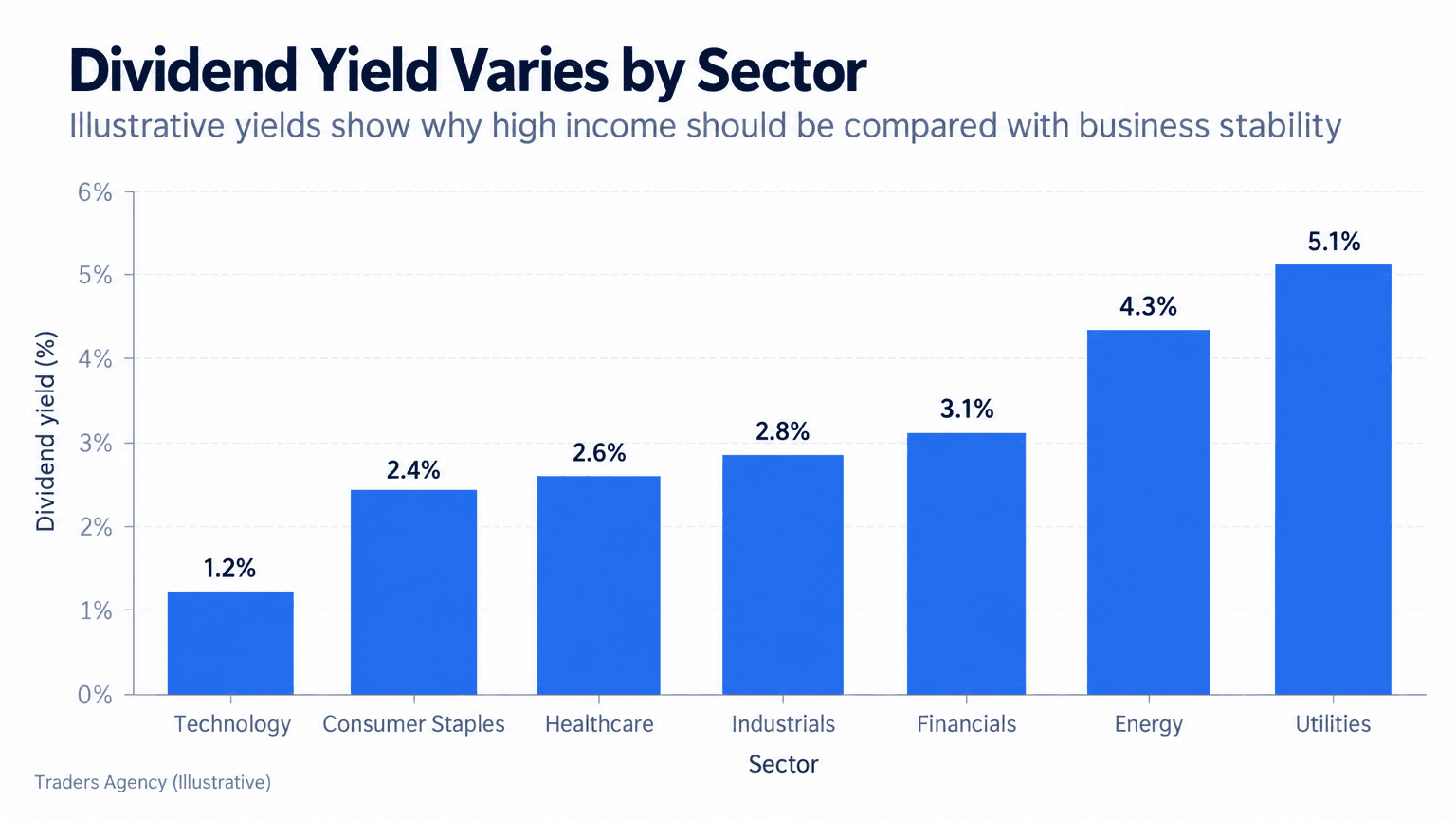
Notice how yield varies by sector. Technology companies often yield below 2% because they reinvest heavily, while utilities frequently sit above 4% because their revenue is stable and often rate-regulated. Neither number is automatically "good" or "bad," it depends on the industry you're comparing against.
What Are Dividend Aristocrats and Dividend Kings?
Dividend Aristocrats are S&P 500 companies that have raised their dividend every year for at least 25 consecutive years. Dividend Kings have done it for 50 years or more. The Aristocrats list is maintained as a formal index by S&P Dow Jones Indices, while the Kings list is an informal screen tracked across financial research sites rather than an official index.
For a beginner building a dividend portfolio for monthly income, these lists are a reasonable starting screen. A 25-year or 50-year streak of raises survives multiple recessions, which tells you something real about the durability of the business model.
That said, past consistency doesn't guarantee future payments. We've seen long-standing streaks broken when an industry faces a structural shift. Use these lists as a starting point for research, not a substitute for checking current financials.
Want expert trading insights delivered daily?
Join thousands of traders who rely on Traders Agency for market analysis and trade ideas.
Join Traders AgencyHow Does DRIP (Dividend Reinvestment) Work?
A DRIP, or dividend reinvestment plan, automatically uses your cash dividend to buy more shares (or fractional shares) of the same stock instead of paying it out to you in cash. Most brokerages offer this as a free, automatic setting on individual positions.
Here's why it matters for compounding. Say you own shares worth $10,000 yielding 4% annually. In year one, that's $400 in dividends. With a DRIP turned on, that $400 buys more shares automatically, which then generate their own dividends the following year.
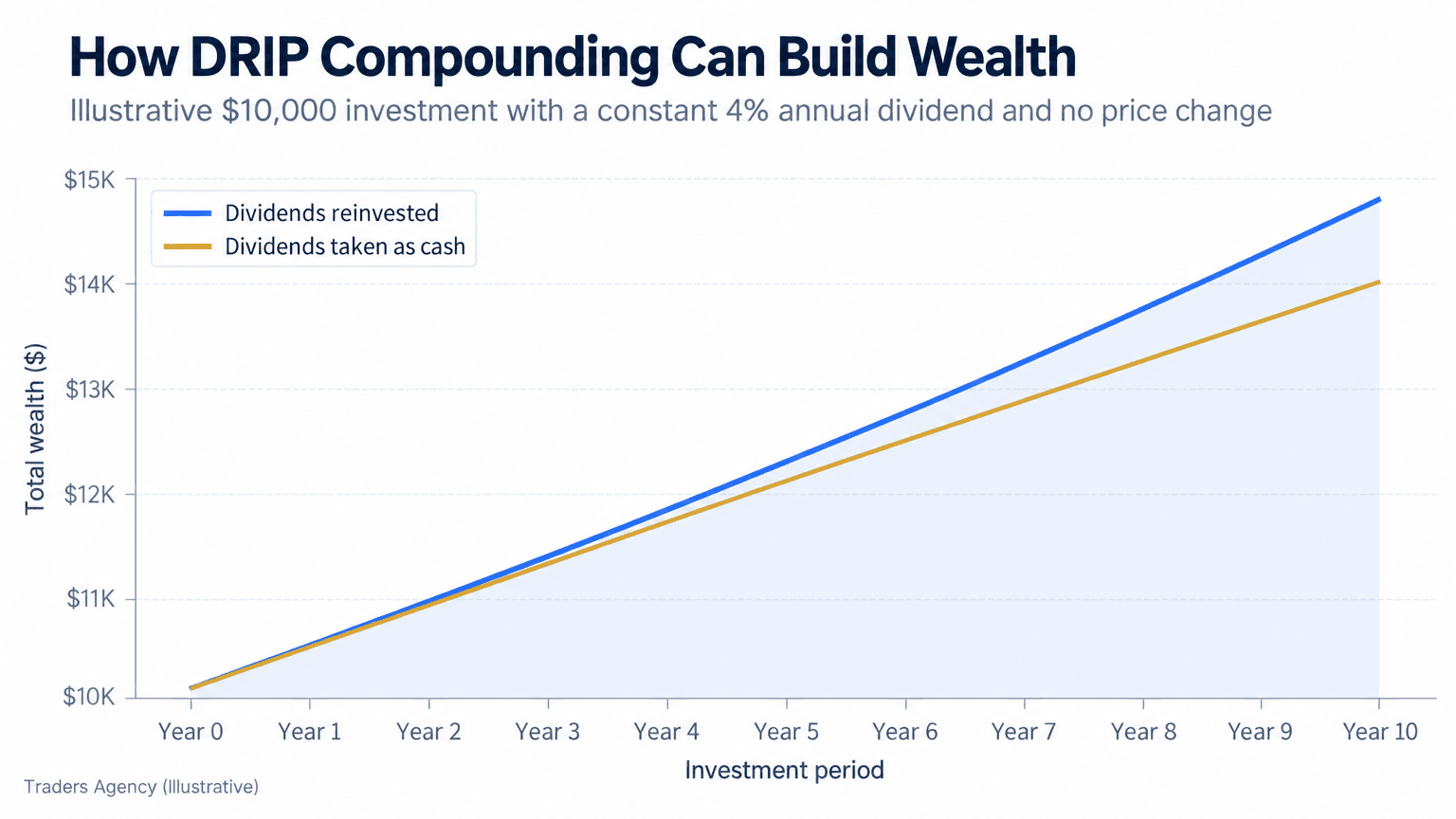
Over a decade, reinvested dividends snowball into meaningfully more total wealth than taking the same dividends as cash, assuming the stock price holds up. This is the core reason dividend investing pairs so naturally with long-term accounts like IRAs, where reinvestment can happen without triggering a taxable event each time.
What Are the Tax Rules on Dividends?
Qualified dividends are taxed at the lower long-term capital gains rates (0%, 15%, or 20% depending on income), while ordinary (non-qualified) dividends are taxed at your regular income tax rate. To qualify, you generally must hold the stock for more than 60 days around the ex-dividend date.
This distinction matters more than most beginners realize:
| Dividend Type | Tax Rate Applied | After-Tax Value of $1,000 |
|---|---|---|
| Ordinary dividend | 24% income bracket | $760 |
| Qualified dividend | 15% capital gains rate | $850 |
That's a $90 difference on a single $1,000 payment, and it compounds across every position you hold. Holding periods and account type (taxable versus retirement) both affect what you owe, so confirm the current rules before you file.
How Do You Avoid Dividend Yield Traps?
A dividend yield trap happens when a stock's yield looks unusually high, not because the dividend is generous, but because the stock price has crashed, often signaling the company can't sustain the payment. Spotting these before you buy is one of the most valuable skills a new dividend investor can build.
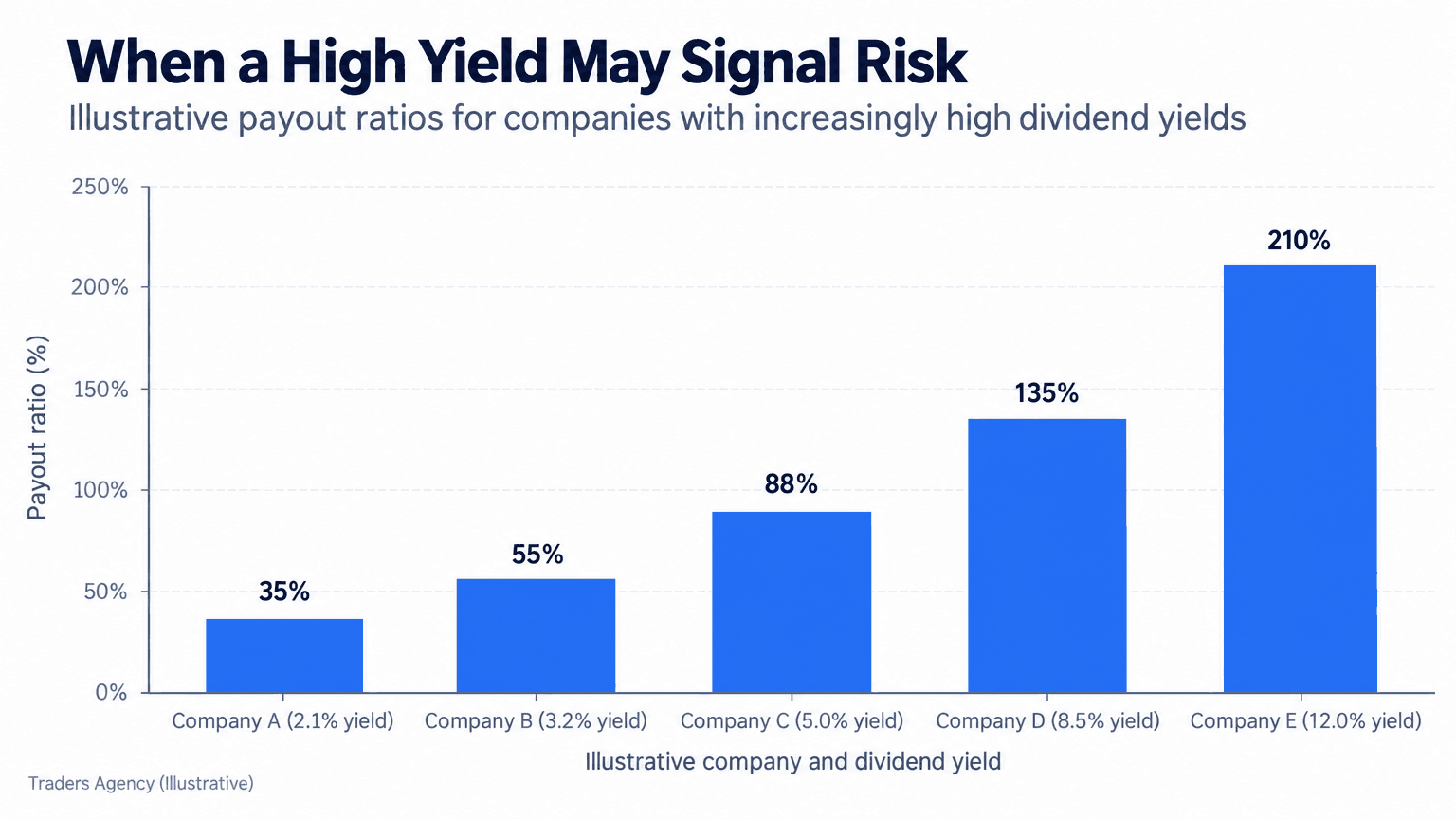
Notice the pattern: as yield climbs toward double digits, payout ratio often climbs well past 100%, meaning the company is paying out more than it earns. That's unsustainable, and it usually ends in a cut.
Watch Out: A double-digit yield is rarely a gift. When the payout ratio exceeds 100%, the company is funding dividends from debt or cash reserves, and the payment is living on borrowed time.
Our Screening Checklist
We run every dividend candidate through these checks before considering it for an income portfolio:
- Check the payout ratio and look for under 75% in most sectors (utilities and REITs can run higher because of different accounting rules).
- Review the earnings trend over the last 3 to 5 years. Flat or growing is acceptable. Declining is a red flag.
- Measure debt levels against the industry average, not against the broad market.
- Trace the dividend growth history. Even small annual raises beat a flat payment, and a past cut deserves a hard look.
- Compare the yield to sector peers. A yield wildly above the group average needs an explanation before you buy.
You can pull every one of these data points from a company's 10-K and 10-Q filings on the SEC's EDGAR database, or through most major broker stock screeners.
How Do I Make $1,000 a Month in Dividends?
To make $1,000 a month ($12,000 a year) in dividends, you need roughly $600,000 invested at a 2% yield, or about $200,000 invested at a 6% yield. The required capital shrinks as yield rises, but higher yields usually carry higher risk.
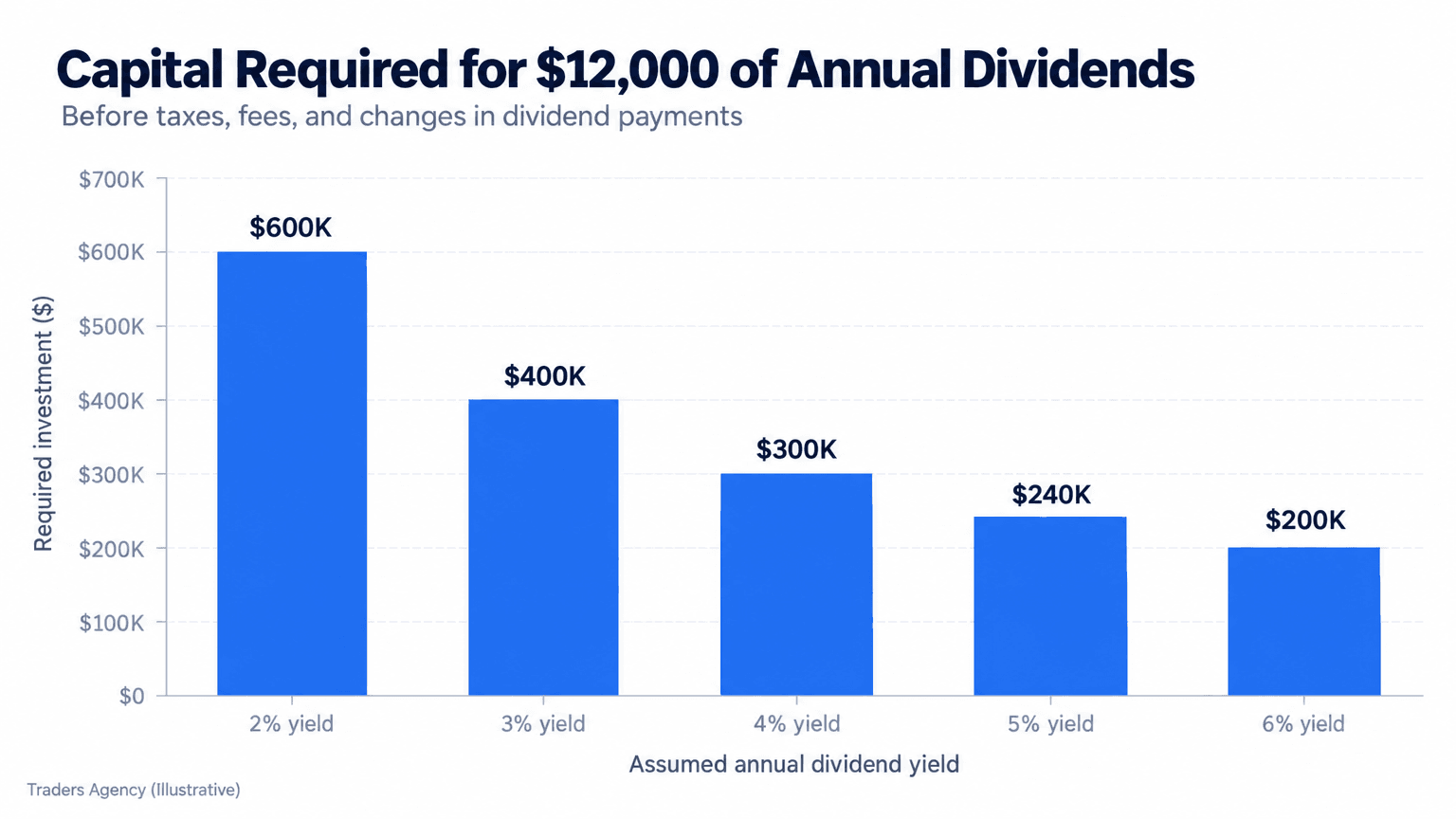
This math scales directly, which makes it easy to set a realistic target:
| Income Goal | Assumed Yield | Capital Required |
|---|---|---|
| $1,000 per year | 4% | ~$25,000 |
| $1,000 per month | 2% | ~$600,000 |
| $1,000 per month | 6% | ~$200,000 |
| $2,000 per month | 4% | ~$600,000 |
| $5,000 per month | 4% | ~$1.5 million |
For investors who want monthly cash flow rather than quarterly, some REITs and business development companies pay on a monthly schedule. Holding a few of those can smooth out your income without changing the underlying math on capital required.
When Should You Use a Dividend Investing Strategy?
Dividend investing fits investors with a long time horizon, a preference for steady cash flow, and the patience to let reinvestment compound over years. It works less well for traders seeking fast capital appreciation or anyone who may need to access their full principal on short notice.
Disadvantages of Dividend Stocks to Keep in Mind
- Slower growth potential: Companies paying large dividends often reinvest less in expansion.
- Dividend cuts happen: A payment can be reduced or eliminated during a downturn, hurting both income and share price at once.
- Tax drag in taxable accounts: Dividends are taxed in the year received, even if you reinvest every dollar.
- Interest rate sensitivity: High-yield sectors like utilities and REITs often fall when rates rise, since bonds become more competitive.
- Concentration risk: Chasing only the highest-yielding names without diversification exposes you to sector-specific shocks.
Building Your Starting Portfolio
We suggest beginners spread capital across 15 to 25 positions from different sectors rather than concentrating in a handful of high-yield names. Start with a broad universe of established payers, then apply the screening checklist above before buying anything.
Keep any single position to a reasonable percentage of your total portfolio, and revisit payout ratios every quarter when companies report earnings. Monitoring the Federal Reserve's rate policy also helps, since rate moves tend to hit yield-sensitive sectors hardest.
Remember This: Sustainability beats size. A 3% yield backed by growing earnings and a 45% payout ratio is worth far more over ten years than a 10% yield that gets cut in half next quarter.
What Questions Do Beginners Ask About Dividend Investing?
Is dividend investing good for beginners?
Yes. Dividend investing is approachable because it teaches fundamental analysis skills, like reading financial statements and assessing payment sustainability, while generating cash flow along the way.
How much do I need to make $2,000 a month in dividends?
At a 4% average yield, you'd need roughly $600,000 invested. At a 6% yield, that drops to around $400,000, though higher yields typically carry more risk.
How much do I need to make $5,000 a month in dividends?
At a 4% yield, you'd need approximately $1.5 million invested. The exact figure shifts with the blended yield of your portfolio.
What's the difference between qualified and ordinary dividends?
Qualified dividends are taxed at lower capital gains rates if you meet the holding period requirement, while ordinary dividends are taxed at your regular income tax rate.
Can I lose money with dividend stocks?
Yes. The share price can fall, and the dividend itself can be cut or eliminated. Dividend investing carries real market risk like any equity strategy.
What is a reasonable dividend yield to target?
Most sustainable dividend stocks yield between 2% and 5%. Yields far above that, especially in double digits, often signal a yield trap rather than genuine opportunity.
Want expert trading insights delivered daily?
Join thousands of traders who rely on Traders Agency for market analysis and trade ideas.
Join Traders AgencyDISCLAIMER: Traders Agency does not offer financial advice. The information provided is for educational purposes only and should not be considered financial advice. Traders Agency is not responsible for any financial losses or consequences resulting from the use of the information provided. Trading carries inherent risks and may not be suitable for all individuals. You are advised to conduct your own research and seek personalized advice before making any investment decisions, recognizing the potential risks and rewards involved.
See more from Traders Agency on Google
Make us a preferred source and our market analysis will appear more prominently in your Google Search, Top Stories, and AI results.
Add to Preferred Sources