
Robinhood options trading lets you buy and sell options contracts directly from the same app you already use for stocks, with no separate platform or account required. Options give you the right (but not the obligation) to buy or sell a stock at a set price before a certain date. Robinhood built its options tools around simplicity, which makes the app a reasonable starting point for beginners, even though it lacks some of the deeper analytics you'd find on professional trading platforms.
You've probably opened the app, tapped on a stock you already own, and noticed a small "Trade Options" button you've never touched. Maybe you've heard friends talk about "selling calls" or "buying puts" and wondered how to actually do that yourself without making an expensive mistake. That's exactly what we're covering here.
By the time you finish this guide, you'll understand Robinhood's options approval levels, how to read an options chain inside the app, when to use a limit order instead of a market order, and the specific pitfalls that trip up new options traders. We'll walk through real numbers so you can see exactly how a trade comes together from start to finish.
What Are Robinhood Options Approval Levels?
Bottom Line: Robinhood options trading works fine for beginners because it folds options into the same app and interface used for stocks, but the app's simplicity means traders still need to bring their own risk rules, since Robinhood won't enforce position sizing or exit planning for you. Getting approved for a trading level is just the first step; reading the options chain correctly and choosing limit orders over market orders are what actually protect you from costly mistakes.
Before you can place a single options trade, Robinhood has to approve your account for options. That approval isn't automatic. It's part of the Robinhood options trading requirements every new user has to clear first.
The app asks a series of questions about your trading experience, income, net worth, and investment goals. Based on your answers, it assigns you to one of several approval tiers, and each tier unlocks a different set of option strategies.
1. How the Tiers Work
Robinhood generally breaks approval into levels that control which strategies you're allowed to place:
- Level 1: Covered calls and cash-secured puts (strategies backed by stock or cash you already hold)
- Level 2: Long calls and long puts (buying options outright)
- Level 3: Spreads and more advanced multi-leg strategies
Higher levels require more demonstrated experience and often a larger account balance. If you're brand new, don't be surprised when Robinhood starts you at a lower tier and asks you to build a track record first.
2. How Much Money You Actually Need
One of the most common questions we hear is how much money do you need to trade options on Robinhood. The honest answer: it depends entirely on the strategy, not on a fixed account minimum.
Buying a single call option might cost you $150 to $300 total, depending on the stock and strike price. Selling a cash-secured put is a different story. That requires you to set aside enough cash to buy 100 shares at the strike price if the option gets exercised, which could mean committing $5,000 or more for a single trade on a $50 stock.
Key Concept: Options contracts control 100 shares of the underlying stock. A premium quoted at $2.50 means the contract costs $250, and a $100 strike put you sell obligates you to buy $10,000 worth of stock if assigned.
How Do I Trade Options on Robinhood?
To trade options on Robinhood, you search for a stock, tap "Trade," select "Trade Options," choose an expiration date and strike price, then pick either "Buy" or "Sell" before confirming your order with a swipe.
Here's the step-by-step sequence we walk members through the first time they ask how do I trade options in Robinhood:
- Step 1: Search and Select Your Stock. Open the app, search the ticker symbol, and tap the stock's page. Scroll down to where you'd normally see the "Trade" button and look for the options tab instead.
- Step 2: Choose Your Expiration Date. Robinhood shows a horizontal list of expiration dates, usually weekly and monthly contracts going out several months. Shorter expirations cost less but give the trade less time to work in your favor.
- Step 3: Pick a Strike Price. The strike price is the price at which you have the right to buy (call) or sell (put) the stock. Robinhood lists strikes in a scrollable column with the current stock price highlighted, so you can see which strikes sit above and below it.
- Step 4: Review and Confirm. Before you submit, the app displays the estimated cost per contract, the breakeven price, and your maximum risk on that specific order. Read all three before you swipe.
How Do You Read an Options Chain in the Robinhood App?
The options chain is the list of every available strike price and expiration date for a given stock, along with the current bid, ask, and trading volume for each contract. Learning to read it correctly is what separates a confident trader from one guessing in the dark.
Each row in the chain represents one specific contract. As you move to higher strike prices on a call option, the price of the contract typically drops, because the right to buy at a higher price is worth less than the right to buy at a lower one.
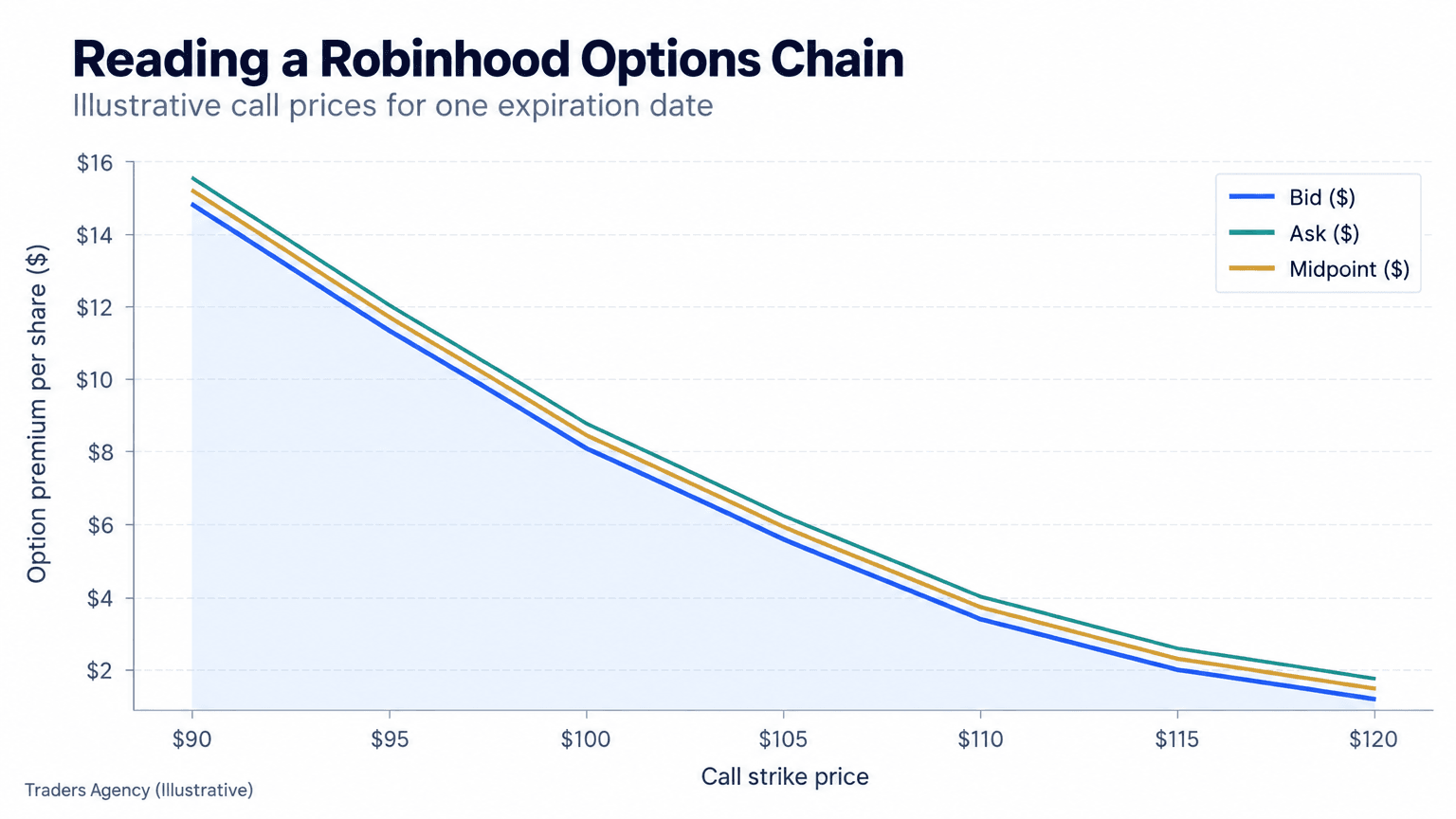
Here's what each column actually tells you:
- Bid: the highest price buyers are currently willing to pay
- Ask: the lowest price sellers are currently willing to accept
- Volume: how many contracts have traded that day (higher volume usually means easier entry and exit)
- Open Interest: how many contracts are currently open across all traders
A wide gap between the bid and the ask, known as the spread, is a warning sign. It usually means the contract is thinly traded, which makes it harder to get a fair price when you buy or sell. For a deeper reference on contract specifications and how listed options are standardized, the Cboe Options Exchange publishes the product details behind nearly every contract you'll see in the chain.
Want expert trading insights delivered daily?
Join thousands of traders who rely on Traders Agency for market analysis and trade ideas.
Join Traders AgencyShould You Use Limit Orders or Market Orders for Options Trades?
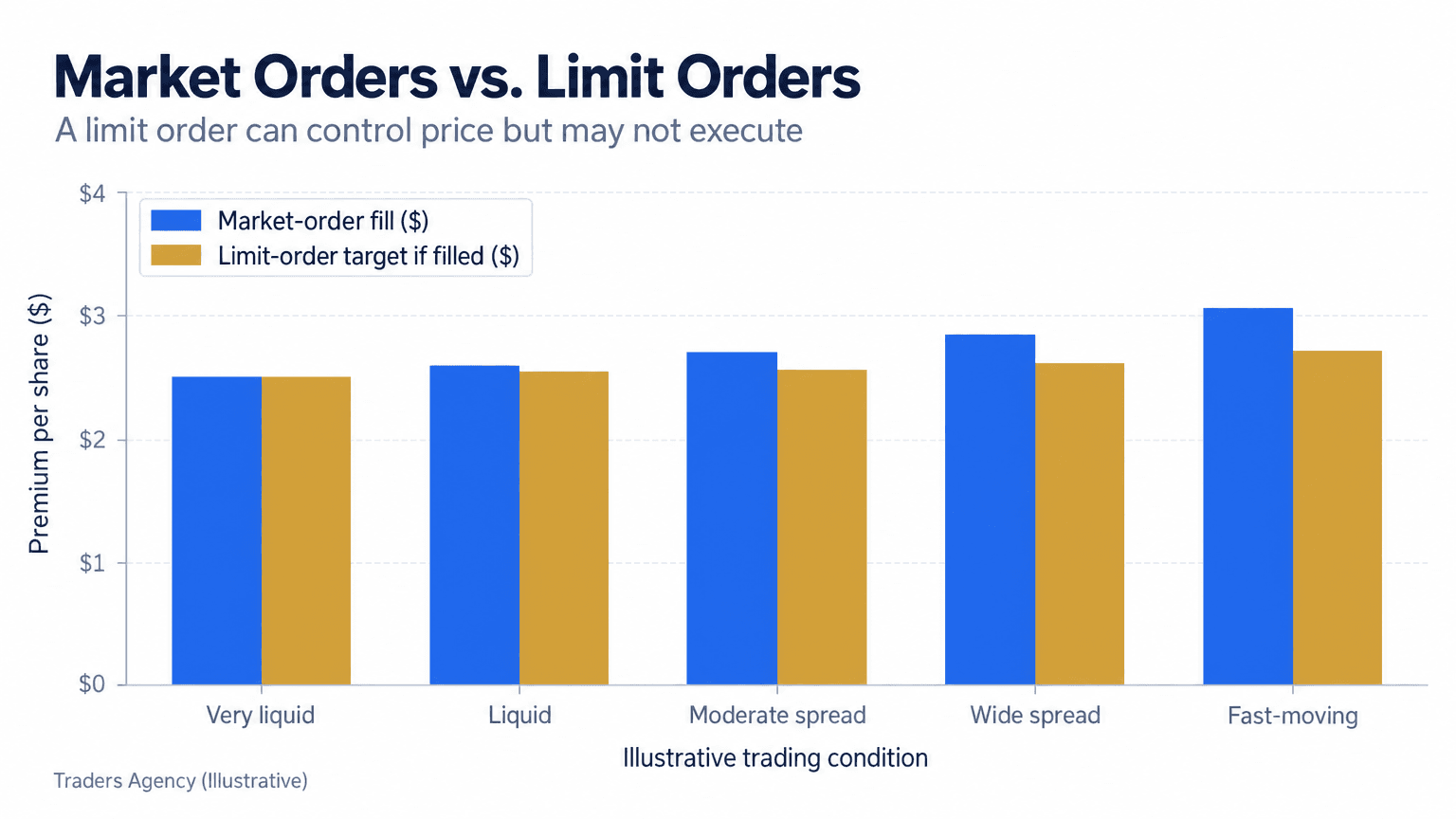
A market order fills immediately at whatever price is currently available. A limit order only fills at the price you specify or better. For options, we almost always recommend limit orders, because option prices can swing sharply even when the underlying stock barely moves.
Say a call option is quoted with a bid of $2.40 and an ask of $2.60. A market order might fill you at $2.60, or slightly worse if the market is moving fast. A limit order set at $2.50 forces the trade to wait until someone meets your price, and on contracts with wider spreads that discipline saves real money.
A Cash-Secured Put Walkthrough
Let's put this into a full example using a cash-secured put, a Level 1 strategy where you sell a put option and set aside enough cash to buy the stock if it gets assigned to you.
Imagine a stock trading at $102. You sell one put contract with a $100 strike price expiring in 30 days, and you collect a premium of $2.50 per share, or $250 total for the contract.
| Parameter | Value |
|---|---|
| Stock Price | $102 |
| Put Sold | $100 strike, 30 days to expiration |
| Premium Collected | $250 ($2.50 x 100 shares) |
| Cash Required | $10,000 (to buy 100 shares at $100 if assigned) |
| Max Gain | $250 (if the stock stays above $100 through expiration) |
| Breakeven | $97.50 ($100 strike minus $2.50 premium) |
| Max Loss | Substantial if the stock falls well below $97.50 |
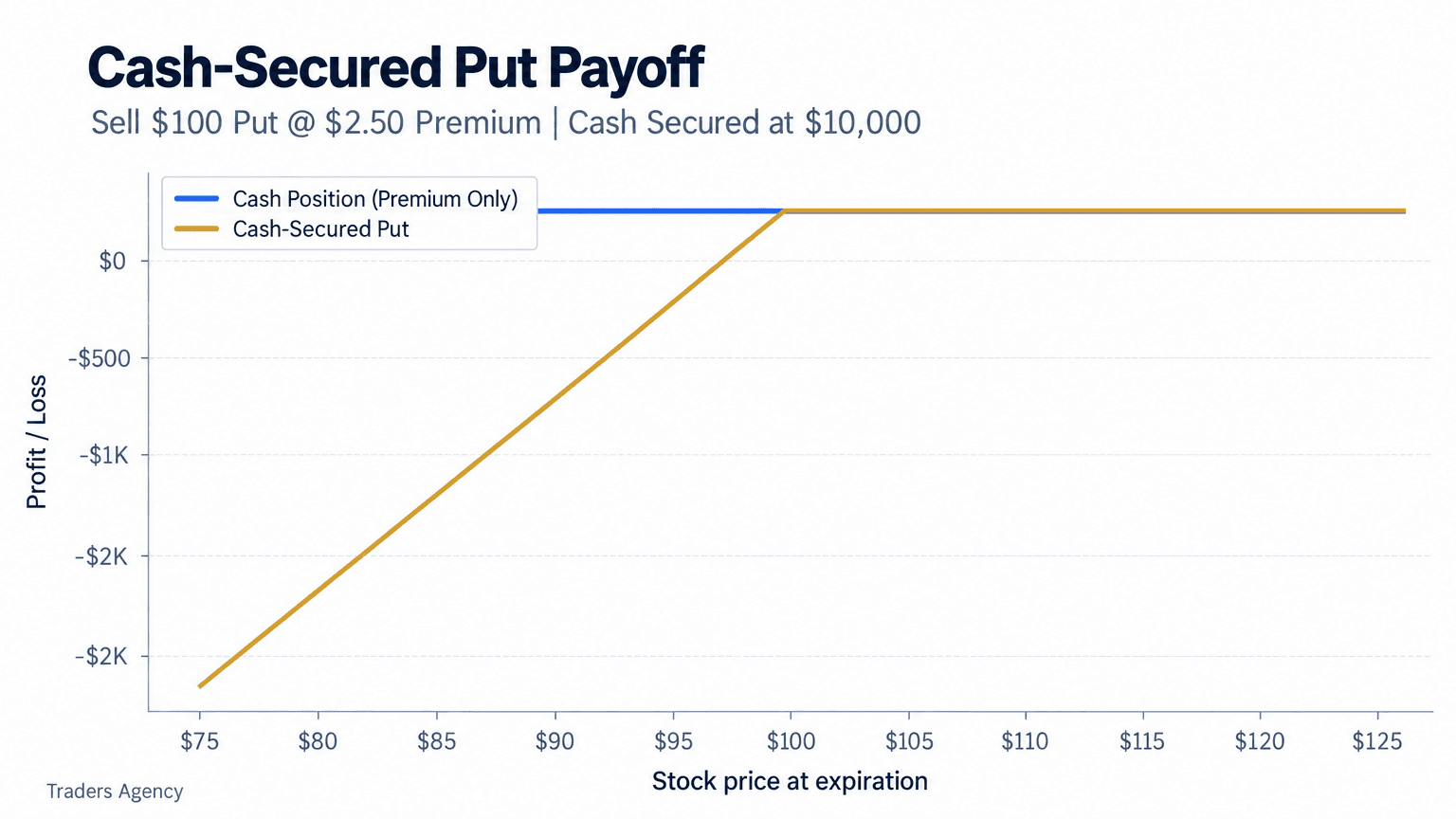
Here's how the three outcomes play out:
| Scenario | Stock at Expiration | Result |
|---|---|---|
| Best Case | $110 | Put expires worthless, you keep +$250 |
| Most Likely Case | $102 (flat) | Put expires worthless, you keep +$250 |
| Breakeven | $97.50 | $0 net, assigned at an effective cost basis of $97.50 |
| Worst Case | $90 | Assigned 100 shares at $100, roughly -$750 after premium |
Watch Out: A cash-secured put caps your gain at the premium collected but leaves your downside open all the way to zero. Never sell a put on a stock you wouldn't be comfortable owning 100 shares of at the strike price.
What Are the Common Pitfalls When Trading Options on Robinhood?
Even with a clean interface, new traders run into the same handful of mistakes over and over. These are the ones we see most often among members just getting started with Robinhood options trading:
- Using market orders on illiquid contracts: this can cost you a noticeably worse fill price than the quote you were looking at
- Ignoring Robinhood options trading hours: options generally trade during standard market hours, roughly 9:30 AM to 4:00 PM Eastern, so orders placed outside that window simply queue up for the next session
- Letting options expire without a plan: unlike stocks, options can expire worthless or trigger assignment, so you need to know your exit before you enter
- Overcommitting cash to cash-secured puts: tying up $10,000 on a single position leaves little room for other opportunities or emergencies
- Not checking Robinhood options trading fees before placing multi-leg trades: there are no per-contract commissions, but regulatory fees still apply and add up with frequent trading
Is Robinhood Good Enough for Serious Options Traders?
Robinhood works well for beginners and casual traders running simple, single-leg strategies. What it lacks is the advanced charting, probability analysis, and multi-leg order flexibility found on platforms like thinkorswim or tastytrade. Active, high-frequency options traders tend to outgrow it.
In an honest Robinhood options trading review, the app wins on simplicity and cost. There are no per-contract commissions, and the interface is far less intimidating than a professional terminal. On the other side, you won't find built-in options probability calculators, customizable risk graphs, or the depth of order types active traders rely on to adjust positions mid-trade.
If your Robinhood options trading strategy involves straightforward calls, puts, covered calls, or cash-secured puts, the platform covers those basics well. If you're building complex spreads or need real-time Greeks (delta, theta, gamma) displayed right on the trade ticket, you'll likely graduate to a more specialized platform eventually.
Why Won't Robinhood Let Me Do Options Trading?
Robinhood may deny or limit your options approval if you report little to no trading experience, low income or net worth, or if your account has recent issues such as a pattern day trading flag or an unresolved margin call.
If you've been denied, don't treat it as permanent. You can often reapply after gaining more experience with stocks first, or after updating your financial information if it has changed. These applications also get reviewed periodically, so a denial today isn't a denial forever. If you want the plain-English background on how options work and what brokers are required to disclose, the SEC's investor education materials are a solid place to start.
Tips for Getting the Most Out of Robinhood Options Trading
- Start with Level 1 strategies like covered calls before requesting access to more advanced tiers
- Always use limit orders on anything with a wide bid-ask spread
- Check volume and open interest in the options chain before entering any position
- Track your fees on trade confirmations, even though per-contract commissions are free
- Set a personal position-size rule, such as never risking more than a small percentage of your account on a single options trade
- Know your exit before you enter, including both a profit target and the point where you'll cut losses
Risk Warning: Options carry real risk, including losing your entire premium on a single trade or, with cash-secured puts, being assigned shares at a loss. Treat every trade as a decision you fully understand before you swipe to confirm, not just a button to tap.
Want expert trading insights delivered daily?
Join thousands of traders who rely on Traders Agency for market analysis and trade ideas.
Join Traders AgencyDISCLAIMER: Traders Agency does not offer financial advice. The information provided is for educational purposes only and should not be considered financial advice. Traders Agency is not responsible for any financial losses or consequences resulting from the use of the information provided. Trading carries inherent risks and may not be suitable for all individuals. You are advised to conduct your own research and seek personalized advice before making any investment decisions, recognizing the potential risks and rewards involved.
See more from Traders Agency on Google
Make us a preferred source and our market analysis will appear more prominently in your Google Search, Top Stories, and AI results.
Add to Preferred Sources