
You've probably watched a stock creep higher and thought, "I want in on this, but buying 100 shares feels expensive and buying a call option alone feels too risky." That gap is exactly what a bull call spread was built to fill.
A bull call spread is a defined-risk options strategy that lets you position for a stock's upward move while capping both your cost and your maximum loss from the moment you enter. By the end of this guide, you'll know how the trade is built, how to calculate your breakeven price by hand, and when this strategy earns a place in your portfolio.
We'll walk through a complete example with real strike prices and premiums, show you the math behind max gain and max loss, and compare this setup to its close cousin, the bull put spread.
What Is a Bull Call Spread?
Bottom Line: A bull call spread caps both your cost and your maximum loss while still letting you profit from a stock's rise, making it a defined-risk way to trade moderate bullishness. Knowing the three key numbers, max loss, max gain, and breakeven, before entering the trade is what makes this strategy manageable, and closing at 50% to 70% of max profit often beats waiting for expiration.
A bull call spread is an options strategy where you buy a call option at a lower strike price and simultaneously sell a call option at a higher strike price, both with the same expiration date. It's a moderately bullish position that limits your risk to the net amount you pay to open the trade.
Think of it as buying a discounted bet on a stock's rise. You're still betting the stock goes up, but you've sold off some of your unlimited upside in exchange for a lower entry cost and a fixed maximum loss.
This structure is often called a vertical spread, because both options share the same expiration but sit at different strike prices. We see it as one of the best entry points for traders stepping beyond plain stock ownership and into options.
Key Concept: A bull call spread means buying a lower-strike call and selling a higher-strike call with the same expiration. Your maximum loss is the net debit you pay, and your maximum gain is the strike width minus that debit.
Why Traders Use This Strategy
- It caps your maximum loss at the net debit you pay to open the trade.
- It reduces upfront cost compared to buying a single call outright.
- It performs well in moderately bullish conditions where you expect a steady climb, not a moonshot.
How Does a Bull Call Spread Work?
A bull call spread combines two call options into one position: a long call that gives you the right to buy shares, and a short call that obligates you to sell shares if you're assigned. The premium you collect from the short call partially offsets the cost of the long call.
Here's the mechanical breakdown we teach our members:
- Step 1: Buy the Long Leg – Purchase a call option at the lower strike price. This is the leg that generates your profit as the stock rises.
- Step 2: Sell the Short Leg – Sell a call option at a higher strike price with the same expiration. This premium reduces your cost but caps your upside.
- Step 3: Pay the Net Debit – Your cost is the difference between what you paid for the long call and what you collected on the short call.
- Step 4: Manage or Hold – Hold until expiration or close the spread early to lock in profit or cut the loss.
Because you're buying and selling options at the same time, the position carries less sensitivity to time decay than a single long call. The short call's theta works in your favor, partially offsetting the theta working against your long call.
Bull Call Spread Example With Real Numbers
Say a stock is trading at $100 per share and you believe it will climb modestly over the next 30 days. Here's how we'd structure the trade.
Setting Up the Trade
| Parameter | Value |
|---|---|
| Stock Price | $100 |
| Call Bought (Long Leg) | $100 strike, $5.00 premium ($500 per contract) |
| Call Sold (Short Leg) | $110 strike, $2.00 premium ($200 per contract) |
| Expiration | 30 days |
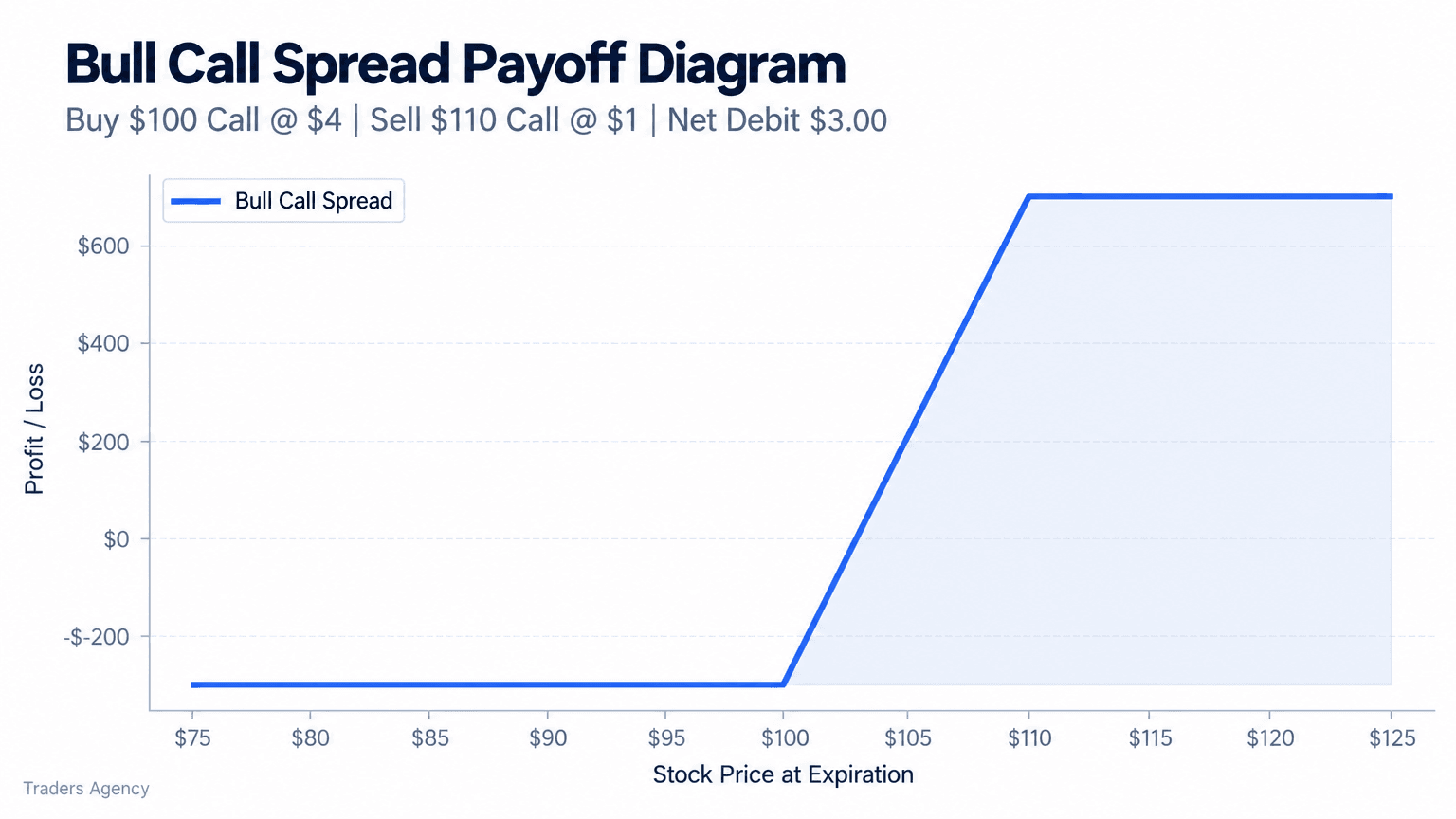
| Net Debit | $3.00 per share, or $300 per contract |
Your net debit is $5.00 minus $2.00, which equals $3.00 per share, or $300 per contract, since each contract controls 100 shares.
Walking Through the Outcomes
That $300 net debit is also your maximum possible loss. If the stock finishes at or below $100 at expiration, both options expire worthless and you give up the full $300. Once the stock climbs past your breakeven point, the position starts producing profit.
| Scenario | Stock Price at Expiration | Profit / Loss |
|---|---|---|
| Worst Case | $100 or below | -$300 |
| Partial Loss | $101 | -$200 |
| Breakeven | $103 | $0 |
| Partial Profit | $105 | +$200 |
| Best Case | $110 or above | +$700 |
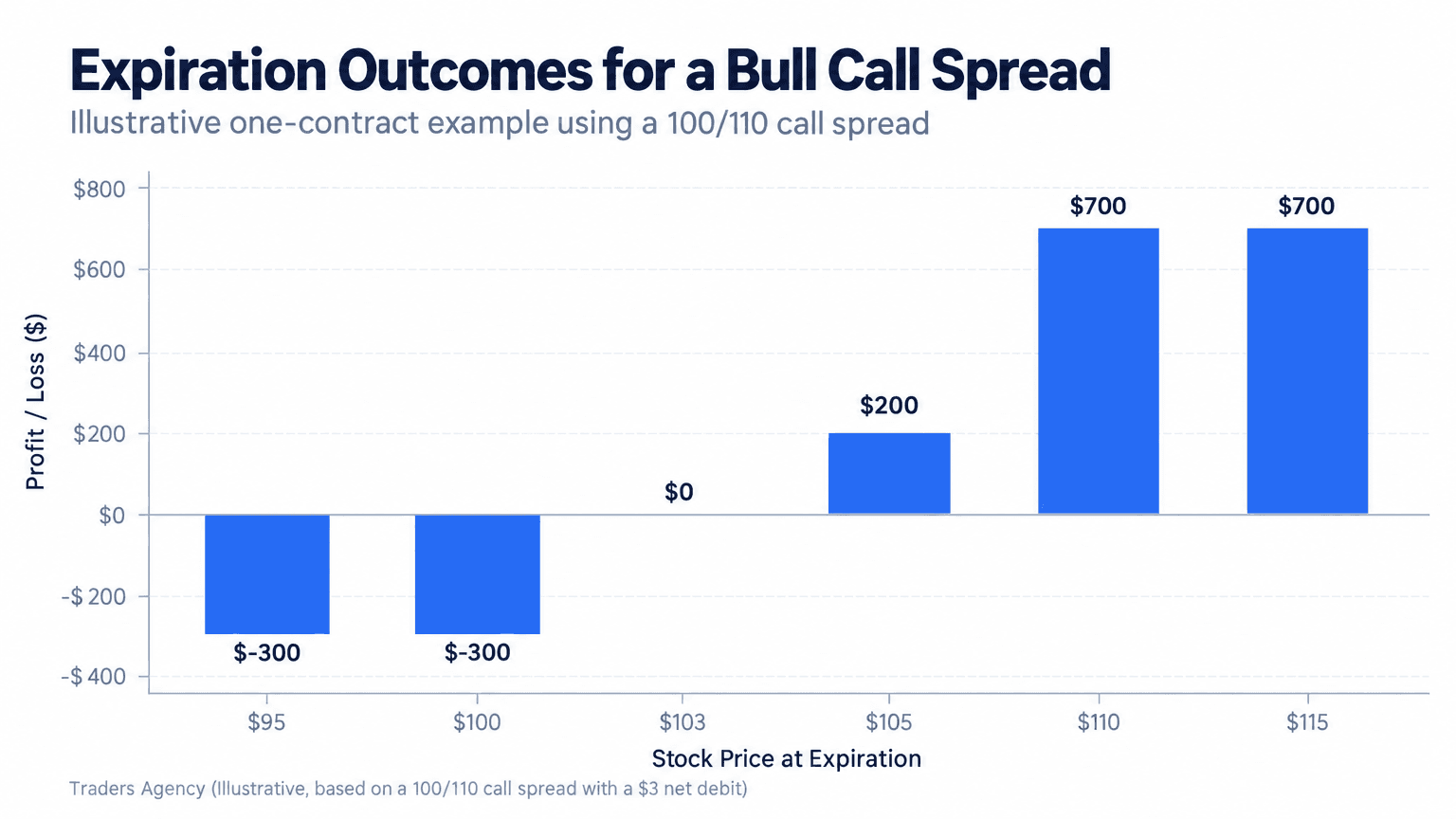
As the chart shows, losses stay capped below the breakeven price, profit grows steadily between breakeven and the short strike, and gains flatten out completely once the stock reaches $110 or higher. That flattening is the tradeoff you accept in exchange for a lower entry cost.
Want expert trading insights delivered daily?
Join thousands of traders who rely on Traders Agency for market analysis and trade ideas.
Join Traders AgencyHow Do You Calculate Max Gain, Max Loss, and Breakeven?
Every bull call spread follows the same three-part math, and you don't need a fancy calculator to work it out. Run these three lines before you place any spread:
- Max Loss – Equal to the net debit paid: $300 in our example.
- Max Gain – (Strike width × 100) minus net debit: (($110 - $100) × 100) - $300 = $700.
- Breakeven – Lower strike plus net debit per share: $100 + $3.00 = $103.
If the stock closes at exactly $103 at expiration, you break even. Above $103, every dollar of upward movement adds $100 of profit per contract, right up to $110. Above $110, gains stop at $700 because the short call caps your upside.
That's the full bull call spread payoff structure: limited loss on the downside, capped but attractive gains on the upside, and a clearly defined breakeven in between. If you want to study contract specifications and exercise mechanics in more detail, the Cboe publishes free reference material on listed options.
How the Greeks Affect the Position
- Delta: The spread opens with positive delta, meaning it gains value as the stock rises, but that net delta shrinks as price rises toward and beyond your short strike.
- Theta: Time decay is far more forgiving here than with a single long call, since your short call also loses value and partially cancels the decay on your long call.
- Vega: Rising implied volatility helps your long call more than it hurts your short call early on, though that effect fades as expiration approaches.
Are Bull Call Spreads Risky?
Yes, bull call spreads carry risk, but it's defined and limited to the net debit paid at entry. Unlike selling naked options, your maximum loss is known before you ever click the order button, which makes position sizing straightforward.
That said, "limited risk" does not mean "low risk." If the stock drops or simply goes nowhere, you can lose 100% of the $300 you committed. The real trap for beginners is oversizing, treating the defined-risk structure as permission to pile on contracts the account can't absorb.
Watch Out: A defined-risk trade can still wipe out a meaningful chunk of your account if you trade too many contracts. Size the position so a total loss of the net debit is an outcome you can shrug off.
So when traders ask us whether bull call spreads are risky, our honest answer is this: they're risky like any directional bet, just with a hard ceiling on how much you can lose. That ceiling is the main reason we favor this bull call spread strategy over buying calls outright.
When Should You Use a Bull Call Spread?
This strategy performs best when you expect a moderate, steady rise in the underlying stock rather than an explosive rally. Because your upside stops at the short strike, you forfeit extra profit if the stock rockets well past that level.
We also like this setup when implied volatility is elevated, because high premiums make a single long call expensive, and selling the higher strike recovers part of that inflated cost. Here's the checklist we run with our members before entering:
- Step 1: Confirm the Outlook – You're moderately bullish, not expecting a parabolic move.
- Step 2: Find the Ceiling – The stock shows a clear resistance level near or just above your intended short strike.
- Step 3: Check Volatility – Implied volatility is high enough that the short call premium takes a real bite out of your cost.
- Step 4: Plan the Exit – You're comfortable either holding through expiration or managing the trade actively.
Bull Call Spread or Bull Put Spread: Which Should You Choose?
A bull call spread uses two calls and requires paying a net debit upfront. A bull put spread uses two puts and generates a net credit upfront. Both profit from a rising stock price, but they differ in how you collect your gains and how margin is treated.
With a bull put spread, you sell a higher-strike put and buy a lower-strike put, collecting premium immediately. Your max profit is that credit, and your max loss is the strike width minus the credit received, the mirror image of the bull call spread formula.
| Feature | Bull Call Spread | Bull Put Spread |
|---|---|---|
| Options Used | Two calls | Two puts |
| Cash Flow at Entry | Net debit (you pay) | Net credit (you collect) |
| Max Profit | Strike width minus debit | Credit received |
| Max Loss | Net debit paid | Strike width minus credit |
| Time Decay | Mildly negative early on | Works in your favor from day one |
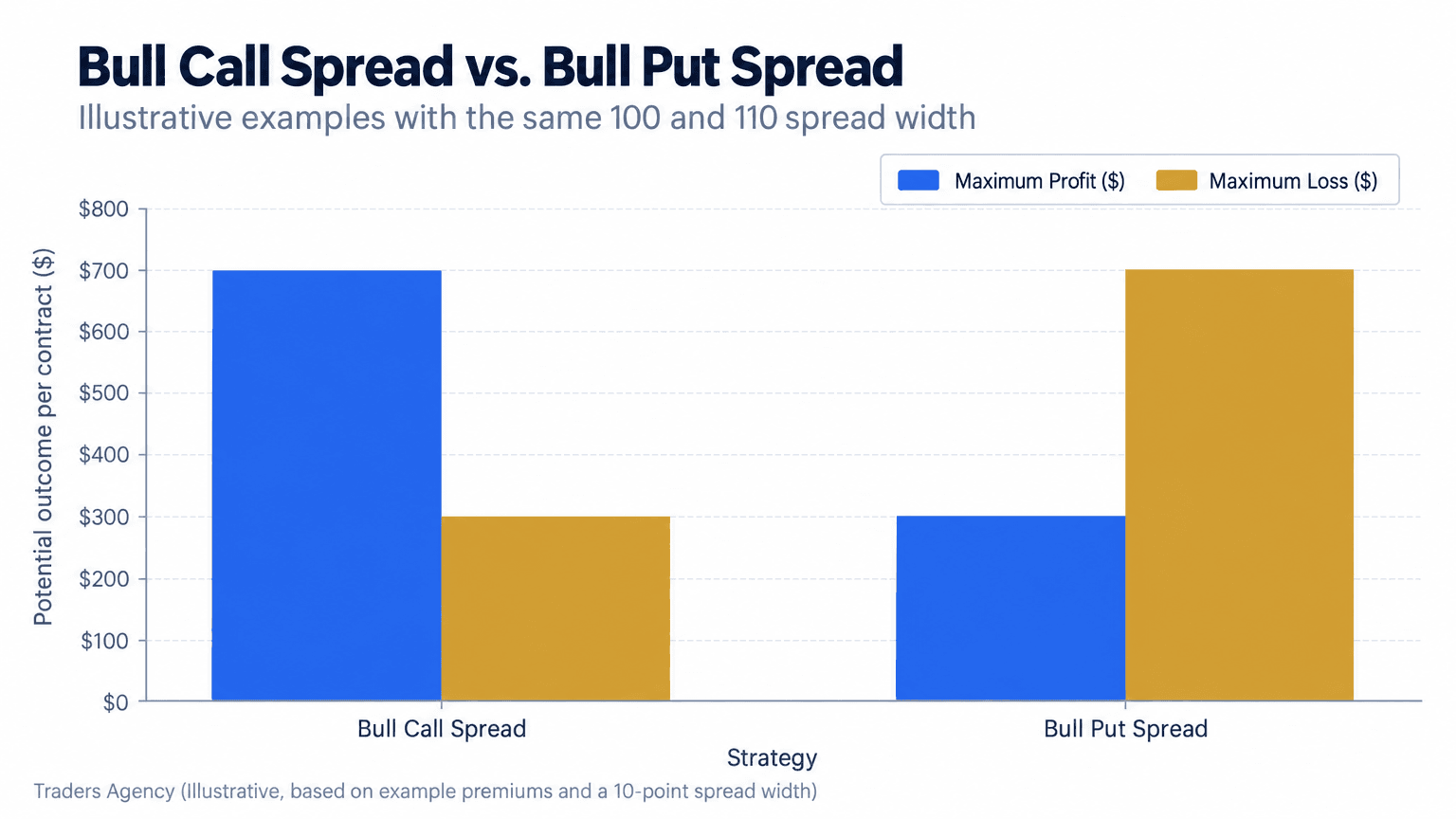
Neither version is universally better. We lean toward the bull call spread when we want to pay upfront and know our exact cost basis, and toward the bull put spread when we'd rather collect a credit and let time decay work for us from the first day.
Risk Management and Practical Application
We recommend treating the net debit of a bull call spread as your true dollar risk, the same way you'd size a stop loss on a stock trade. If $300 represents more than roughly 1% to 2% of your trading account, trade fewer contracts or tighten the spread width.
Common Mistakes to Avoid
- Choosing strikes too far apart, which raises your cost without a proportional increase in your probability of profit.
- Holding through expiration while the stock sits right at your short strike, which invites unexpected assignment.
- Ignoring liquidity, since wide bid-ask spreads on either leg quietly erode your edge on both entry and exit.
When to Close Early
Many of our members close a bull call spread once it has captured 50% to 70% of max profit instead of waiting for expiration. That locks in gains, frees up capital, and skips the last slice of profit that rarely justifies the added time risk.
Remember This: The three numbers that define every bull call spread are max loss (your net debit), max gain (strike width minus debit), and breakeven (lower strike plus debit per share). Calculate all three before you enter, every single time.
Want expert trading insights delivered daily?
Join thousands of traders who rely on Traders Agency for market analysis and trade ideas.
Join Traders AgencyDISCLAIMER: Traders Agency does not offer financial advice. The information provided is for educational purposes only and should not be considered financial advice. Traders Agency is not responsible for any financial losses or consequences resulting from the use of the information provided. Trading carries inherent risks and may not be suitable for all individuals. You are advised to conduct your own research and seek personalized advice before making any investment decisions, recognizing the potential risks and rewards involved.
See more from Traders Agency on Google
Make us a preferred source and our market analysis will appear more prominently in your Google Search, Top Stories, and AI results.
Add to Preferred Sources