
Staking ETH has become one of the most common ways crypto holders put idle tokens to work instead of watching a wallet balance sit flat. If you've ever looked at your Ethereum position and wondered whether there's a way to earn something on top of price appreciation, staking is usually the first answer you run into. In this guide, we'll show you how staking rewards actually work, what you can realistically expect to earn, and where staking fits (or doesn't fit) inside a broader portfolio.
Ethereum staking rewards are the payments, denominated in ETH, that validators and stakers receive for helping secure the Ethereum network under its Proof of Stake system. In plain terms: you lock up ETH, the network uses it to validate transactions, and you get paid a percentage return for your participation.
By the end of this article, you'll understand the four main ways to stake ETH, how to estimate your expected yield using a basic Ethereum staking rewards calculator approach, the real risks involved, and how staking income gets taxed.
What Are Ethereum Staking Rewards?
Bottom Line: Ethereum staking rewards can produce a steady ETH-denominated yield, but the method you choose (solo, delegated, pooled, or exchange) changes your risk, minimum deposit, and control over your keys. Staking income doesn't erase market risk: slashing, lock-ups, and ETH price moves can still leave your overall position down even while rewards accrue, so staking should be sized as one piece of a portfolio rather than treated as guaranteed income.
Ethereum staking rewards are the ETH-denominated payouts validators earn for proposing and attesting blocks on the Ethereum blockchain. Rewards come from newly issued ETH plus a share of transaction priority fees, and they scale based on how much ETH is staked network-wide and how reliably a validator performs.
Here's the mechanic behind it. Ethereum moved from Proof of Work to Proof of Stake in September 2022, which means the network no longer relies on miners solving computational puzzles. Instead, validators put up 32 ETH as collateral and get randomly selected to propose or confirm blocks. Do the job correctly and you earn a reward. Act maliciously, such as signing two conflicting blocks, and you lose a portion of your stake through a penalty known as slashing. Simply going offline costs you smaller inactivity penalties instead.
The yield itself isn't fixed. It moves with two main variables: the total amount of ETH staked across the network (more total stake generally means a lower reward rate per validator) and the volume of transaction fees being generated. That's why you'll see slightly different numbers depending on when you check an Ethereum staking rewards chart, but the range most stakers see today sits roughly between 3% and 5% annually.
Key Concept: Staking rewards are paid in ETH, not dollars. Your yield can be positive while your dollar-denominated position still loses value if ETH's price falls.
What's the difference between home staking and delegated staking?
Not everyone wants to run their own validator hardware, and that's where the split between home staking and delegated staking comes in. Each path trades off control, cost, and convenience differently.
1. Home (Solo) Staking
This is the purest form of participation. You run your own validator node, stake the full 32 ETH requirement, and keep 100% of the rewards you earn minus whatever it costs you to run the hardware and stay online.
Ethereum solo staking rewards tend to sit at the higher end of the yield spectrum, often cited around 4.2% annually, because there's no intermediary taking a cut. The tradeoff is that you need technical comfort, reliable uptime, and the full 32 ETH minimum, which at most price levels represents a substantial capital commitment.
2. Delegated Staking
If you don't have 32 ETH or don't want to manage a node, you can delegate your ETH to a staking provider or pool. The provider runs the validator infrastructure, and you receive a proportional share of the rewards after their fee.
This is where most retail participants end up, simply because the entry barrier drops from 32 ETH to whatever minimum the pool or platform requires, sometimes as little as 0.01 ETH.
Liquid and Pooled Staking Explained
Pooled staking lets multiple users combine smaller ETH amounts to collectively meet the 32 ETH validator threshold, splitting the rewards based on contribution size. Liquid staking goes a step further by issuing a tradable token, like stETH, that represents your staked position so you're not locked out of using that capital elsewhere.
Pooled staking services aggregate deposits from many users and run validators on their behalf, typically charging a fee somewhere around 10% to 15% of rewards earned. The appeal is obvious: you get staking exposure without needing the full 32 ETH or any technical setup.
Liquid staking tokens solve a different problem. Historically, staked ETH was locked up with no way to access liquidity until withdrawals were enabled. Liquid staking protocols issue a receipt token you can hold, trade, or even use as collateral in other DeFi applications while your underlying ETH keeps earning. The tradeoff is an added layer of smart contract exposure, since you're now trusting both the validator operator and the token's underlying protocol.
Exchange staking, offered through platforms like Coinbase or Kraken, is the most hands-off option. The Ethereum staking rewards Coinbase users see are generally the lowest in this comparison, often closer to 3%, because the exchange takes a sizable commission in exchange for near-zero effort on your part.
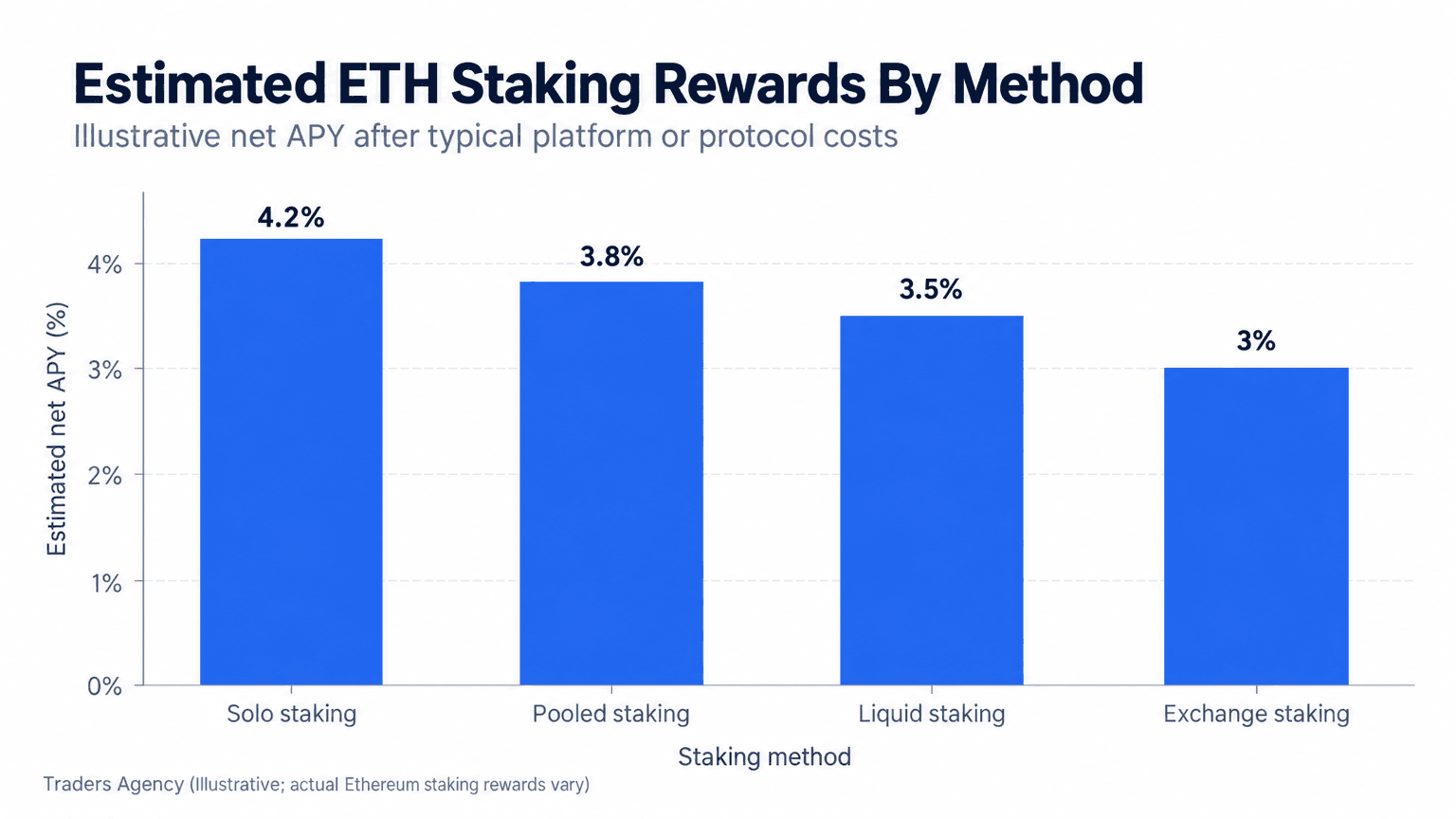
Here's how the four methods stack up side by side:
| Method | Minimum ETH | Illustrative Net Yield | Main Tradeoff |
|---|---|---|---|
| Solo (Home) Staking | 32 ETH | ~4.2% | Technical setup and uptime responsibility |
| Pooled Staking | Fractional | ~3.8% | Operator fees of roughly 10% to 15% |
| Liquid Staking | Fractional | ~3.5% | Smart contract and token price risk |
| Exchange Staking | Fractional | ~3.0% | Custodial risk and highest commissions |
Each method lands on a different point along the risk-to-convenience spectrum, and the highest ETH staking rewards generally go to whoever takes on the most responsibility.
Want expert trading insights delivered daily?
Join thousands of traders who rely on Traders Agency for market analysis and trade ideas.
Join Traders AgencyHow Much Do You Earn Staking Ethereum?
How much you earn staking Ethereum depends on your staking method, the network-wide total staked, and how long you stay active. At current rates, a 32 ETH solo validator earning around 4% annually would generate roughly 1.28 ETH in rewards over a full year, before accounting for any downtime penalties.
Let's walk through a concrete example. Say you're running a solo validator with the full 32 ETH staked, and the network pays an average annual yield of 4%. Over five years, assuming you reinvest nothing extra and the yield stays flat, your rewards compound to roughly 6.9 ETH, bringing your balance from 32 ETH to about 38.9 ETH.
| Parameter | Value |
|---|---|
| Starting Stake | 32 ETH |
| Assumed Annual Yield | 4% |
| Year 1 Rewards | 1.28 ETH |
| Cumulative Rewards (5 Years) | ~6.9 ETH |
| Ending Balance (5 Years) | ~38.9 ETH |
| Not Included | Hardware costs, downtime penalties, ETH price change |
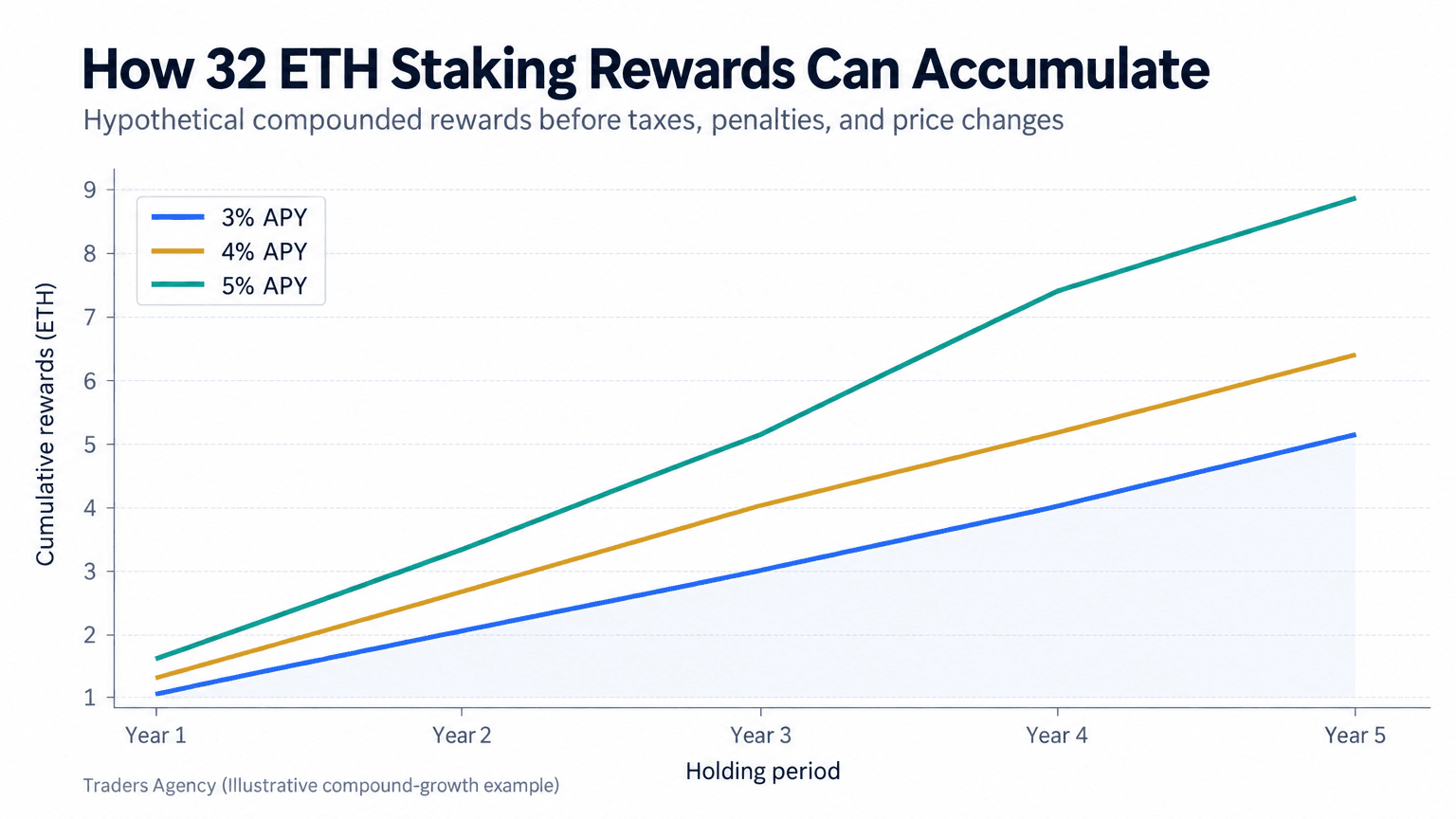
These numbers are illustrative, not a promise of future performance. Real rewards fluctuate with network participation, and running your own validator carries uptime and hardware costs that eat into net returns. If you're staking through a pool or exchange instead, run the same math using the platform's advertised net yield (after fees) rather than the gross protocol rate. That gap is usually wider than people expect.
Is Ethereum Staking Worth It?
Whether Ethereum staking is worth it depends on your time horizon, your risk tolerance, and whether you're comfortable holding ETH through price volatility while collecting a modest yield. For long-term holders who already planned to keep ETH untouched, staking adds a return stream that simple holding does not.
The honest answer: it depends on what you're comparing it to. A 3% to 5% yield sounds appealing next to a savings account, but it's small compared to the price swings ETH can produce in a single month. Staking doesn't protect you from a price decline. It just adds a bit of extra ETH on top of whatever your position is worth.
Where staking tends to make the most sense:
- You already hold ETH as a long-term position and don't plan to trade it actively
- You can tolerate lock-up periods or liquid staking token premium/discount risk
- You're comfortable with the operational or smart contract risk of your chosen method
Where it tends to make less sense:
- You need the capital liquid for short-term trading opportunities
- You're treating staking as a substitute for actual price research or diversification
- You're chasing the highest ETH staking rewards advertised without checking the underlying risk profile
What are the key risks of staking Ethereum?
Ethereum staking carries three primary risk categories: slashing penalties for provable validator misbehavior, lock-up periods that limit access to your capital, and smart contract risk from the protocols or platforms managing your stake. Each one varies significantly by method.
Slashing is the harshest penalty, applied when a validator commits a provable offense such as double-signing, and it can cost you a portion of your staked ETH along with forced removal from the validator set. Extended downtime is handled separately through smaller inactivity penalties. Solo stakers bear this risk directly. Pooled and exchange stakers are exposed indirectly, since losses are frequently passed through to participants on a proportional basis unless the provider explicitly covers them, and the fine print varies.
Lock-up risk has eased since Ethereum enabled staking withdrawals, but queue times during heavy network activity can still delay access to your funds. Smart contract risk is unique to liquid and pooled staking, since you're trusting code (and the team behind it) to manage deposits correctly. Custodial risk shows up most with exchange staking, where you're trusting the platform's solvency and security practices entirely.
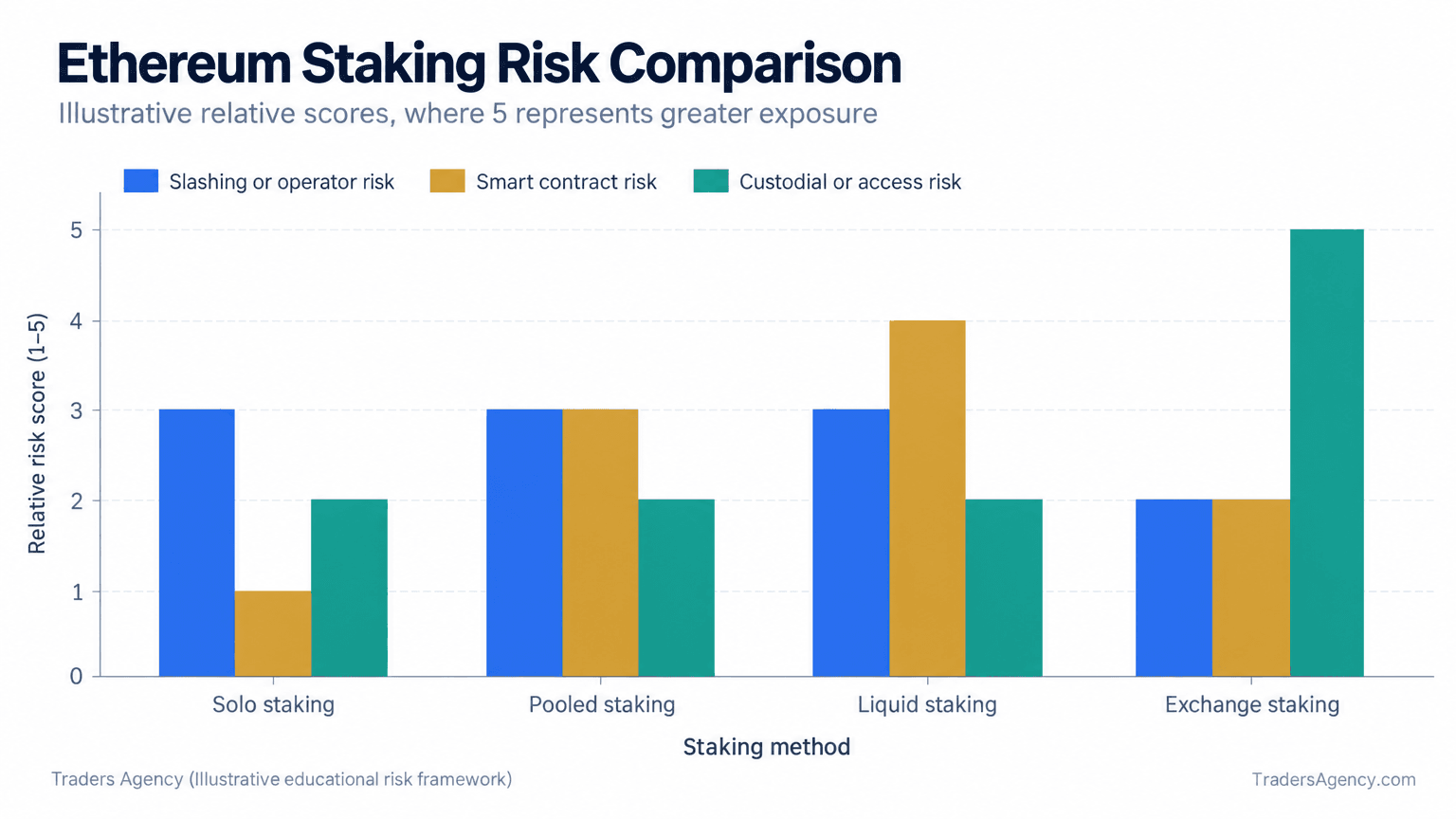
Watch Out: A high advertised yield often signals higher underlying risk, not a better deal. Before committing capital, verify the provider's slashing history, fee schedule, and smart contract audit record. We treat the Ethereum Foundation's staking documentation as the baseline reference for validator mechanics and current network-wide staking statistics.
How are Ethereum staking rewards taxed?
Staking rewards are generally treated as ordinary income at the fair market value of the ETH on the date you receive it, with a second taxable event (capital gain or loss) triggered when you later sell that ETH. This two-step treatment catches a lot of new stakers off guard.
In the United States, the Internal Revenue Service has issued guidance clarifying that staking rewards are taxable upon receipt, not just upon sale. If you earn 0.5 ETH in rewards over a year and ETH trades at $3,000 when you receive each portion, you owe income tax on that value, separate from any gain or loss realized later when you sell. Keeping a running log of reward dates and corresponding ETH prices makes filing dramatically easier, especially if you're staking through multiple methods at once. The IRS digital asset guidance page is the place to confirm current rules.
Tax treatment varies by country, so check your local guidance or work with a tax professional familiar with crypto income before assuming any single rule applies universally.
Practical Application: Where Staking Fits Your Portfolio
Staking works best as a yield layer on top of an existing long-term ETH position, not as a standalone investment thesis. If you're holding ETH the way you might hold gold or a dividend stock, for the long haul, staking is a reasonable way to add incremental return without selling anything.
When Staking Makes Sense
- Step 1: Confirm Your Time Horizon. You hold ETH you weren't planning to trade for months or years.
- Step 2: Vet the Provider. Research the specific platform or validator's track record, uptime, and fee structure.
- Step 3: Pick Your Risk. Decide which of the risk categories above you're genuinely comfortable accepting.
- Step 4: Size the Position. Treat staking yield as a bonus, not a replacement for diversification across crypto, equities, and metals.
When to Avoid It
- You need fast access to capital for active trading
- You haven't verified the staking provider's slashing history or smart contract audits
- You're staking a position size that would hurt badly if ETH's price dropped sharply
As with any yield-bearing position, position sizing matters. Our approach is to treat a staked ETH allocation the same way we'd treat any single-asset concentration: keep it proportional to overall risk tolerance, and don't let the appeal of a steady yield distract from the price risk sitting underneath it.
Remember This: Yield and price are two separate return components. A 4% staking reward does nothing for you if the underlying asset drops 30%, so size the position based on price risk first and yield second.
Frequently Asked Questions
How much do you earn staking Ethereum?
Most stakers currently earn between 3% and 5% annually in ETH-denominated rewards, with solo validators typically landing on the higher end and exchange staking on the lower end once fees are taken out.
Is Ethereum staking worth it?
It can be worth it for long-term holders comfortable with ETH's price volatility and the specific risks of their chosen method, but it shouldn't be viewed as a substitute for price appreciation or portfolio diversification.
Why are ETH staking rewards so low?
Rewards decrease as more total ETH gets staked network-wide, since total protocol issuance grows more slowly than the number of validators, so each validator's share of rewards shrinks as participation rises. As participation has grown since the 2022 Proof of Stake transition, per-validator yields have trended lower.
How much is $1,000 in Ethereum 5 years ago worth today?
That depends entirely on ETH's price movement over the period rather than staking rewards, since price appreciation and staking yield are separate return components. Check historical ETH price data directly for an accurate figure instead of relying on staking math.
What's the minimum ETH needed to stake?
Solo staking requires a full 32 ETH to run an independent validator, while pooled and exchange options often allow deposits as small as a fraction of one ETH.
Can I lose money staking Ethereum?
Yes. Through slashing penalties, platform insolvency, or simply because ETH's price drops more than your staking yield offsets, your overall position value can still decline even while you're earning rewards.
Do I need to run a computer 24/7 to stake solo?
Yes. Solo validators need consistent uptime, since extended downtime can trigger penalties and drag down your overall reward rate.
Want expert trading insights delivered daily?
Join thousands of traders who rely on Traders Agency for market analysis and trade ideas.
Join Traders AgencyDISCLAIMER: Traders Agency does not offer financial advice. The information provided is for educational purposes only and should not be considered financial advice. Traders Agency is not responsible for any financial losses or consequences resulting from the use of the information provided. Trading carries inherent risks and may not be suitable for all individuals. You are advised to conduct your own research and seek personalized advice before making any investment decisions, recognizing the potential risks and rewards involved.
See more from Traders Agency on Google
Make us a preferred source and our market analysis will appear more prominently in your Google Search, Top Stories, and AI results.
Add to Preferred Sources