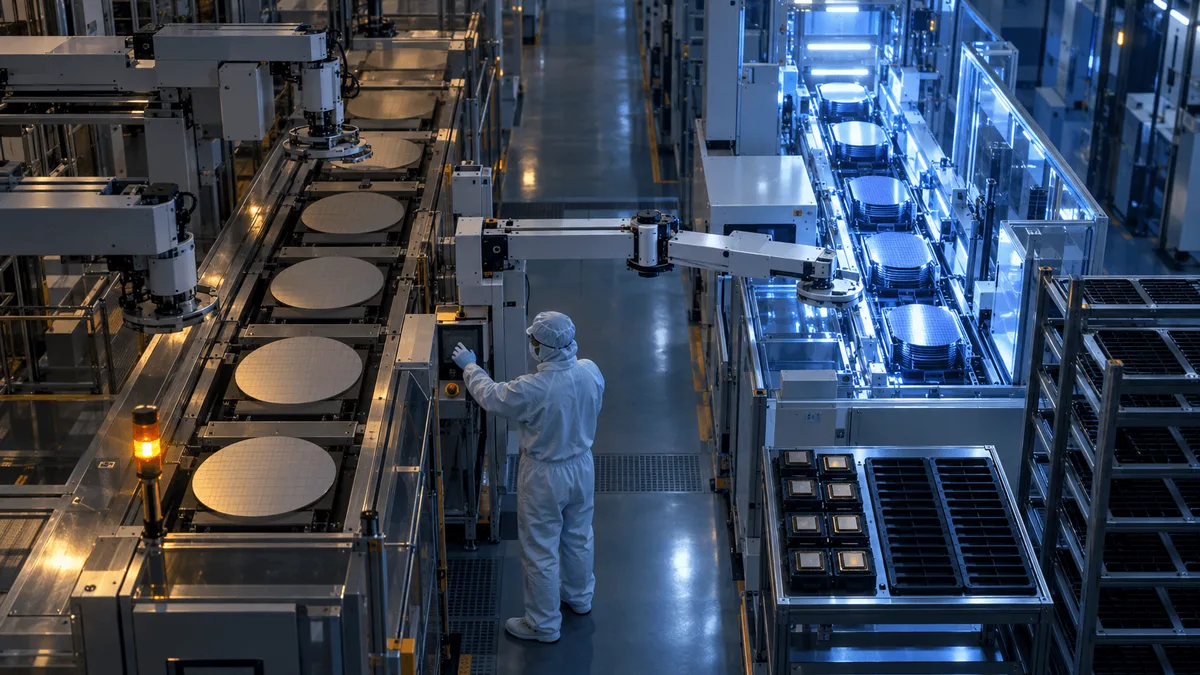
Intel forecast fourth-quarter 2026 revenue of $15.0 billion to $16.0 billion, a sequential decline from the $16.5 billion it reported for the third quarter, as executives pointed to a worsening PC market and an industry-wide memory component crunch. The guidance triggered a sharp sell-off, with The Register reporting that Intel's share price sank by almost a quarter on the day the results were disclosed.
Shares Sink After Guidance Release
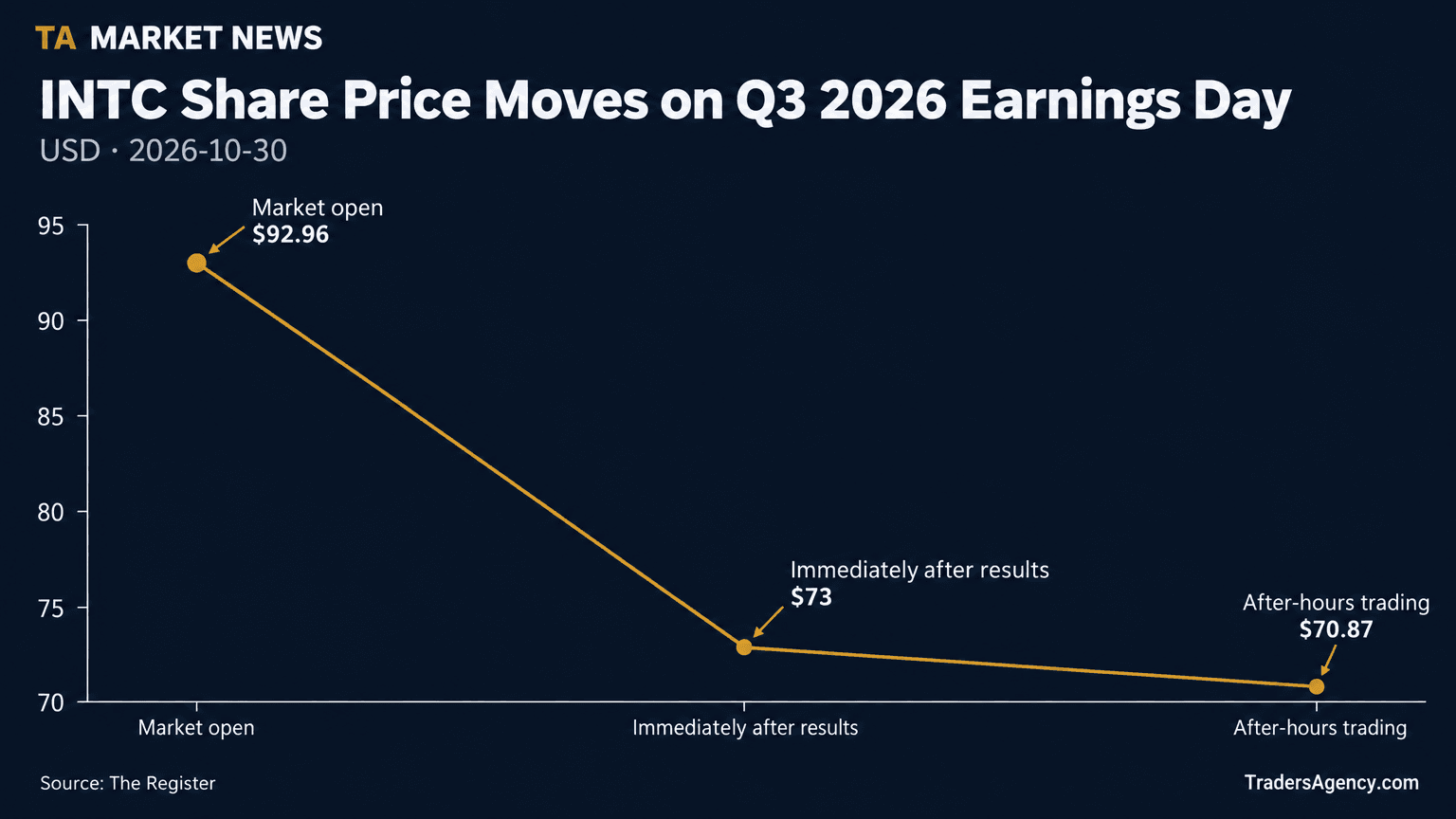
According to data cited by The Register, Intel's shares started the trading day at $92.96 apiece. Immediately after the company announced its results, shares sank to $73, and after-hours trading pushed the price further down to $70.87, a 23.7 percent slump from the opening level.
Memory Prices and PC Demand Collapse Together
Intel's own account of the quarter, detailed in its SEC filing, said client-market demand declined in the third quarter of 2026 compared with the first half of the year "due to industry-wide impacts from higher component prices, particularly memory, constrained IT budgets and tighter inventory management," and the company said it expects these trends to worsen in the fourth quarter and persist into 2027.
Speaking to the pressure, CEO Lip-Bu Tan said, as reported by The Register, that "in recent weeks, our customers began signaling a PC slowdown based on memory prices and availability," adding that "year-to-date system end-point prices have increased significantly placing additional pressure on already limited IT budgets." Tan further said the correction "accelerated over the last two months" as OEM partners aggressively managed inventory to match softer sell-through, and he predicted the PC chip market would shrink 12 percent next year, remaining difficult "until memory availability and prices begin to normalize."
Intel CFO David Zinsner, quoted in the company's earnings release, said: "Looking ahead, we see the PC slowdown continuing at least through the first half of next year, but we remain optimistic about the opportunities across our broader portfolio, and we will continue making disciplined investments in capacity and working capital to increase supply and support future growth."
Tan also acknowledged supply-side strain beyond the PC market, telling analysts, per The Register: "I am disappointed that we were not able to meet strong customer demand in this quarter. We face near term challenges, including manufacturing supply shortages, the unprecedented memory crunch, and the resulting softness in PC demand. But I remain confident in our path forward."
Server and Data Center Business Outpaces Client Segment
Despite the client-side weakness, Intel's Data Center and AI (DCAI) segment reported revenue of $7.3 billion in the third quarter, up 78% year over year, while the Client Computing and Physical AI Group (CCPG) brought in $8.1 billion, down 5%, according to the company's earnings release. On those two reported figures, CCPG revenue exceeded DCAI revenue by $0.8 billion in the quarter (8.1 - 7.3), a gap equal to roughly 11% of DCAI's total ((8.1 - 7.3) / 7.3 x 100). Interpretation, based on those figures and the company's own guidance commentary: the client business remains the larger of the two reported segments, so continued softness there bears directly on total revenue even while the data center segment grows — consistent with the sequential revenue decline Intel guided for the fourth quarter.
Server Chip Supply Constraints Loom Into 2027

Asked whether Intel could meet growing demand for server CPUs, Zinsner stopped short of a commitment, telling analysts, as reported by The Register: "There is going to be a strong driver of demand for CPUs. We see that continuing all through next year. We are working on the supply side of the equation to make sure that we can meet what customers need. We will likely not fully meet what they require, but I think we are going to be in a more challenging situation in the first half of the year than we are in the second half."
To address the shortfall, Intel is shifting production across its fab network and, according to The Register, will "even devote some PC chip production capacity to datacenter products" in an effort to stretch available manufacturing capacity toward higher-demand server chips.
The company's SEC filing struck a similarly cautious note on components generally, stating that Intel expects industry-wide shortages of substrates, memory and other critical parts to persist into next year, and that the company's "ability to mitigate the impact of other constraints, such as those with respect to memory, is very limited." The Register also reported that South Korean memory maker SK Hynix has predicted that memory shortages will persist until the year 2030, underscoring that the supply pressure Intel described is not isolated to its own operations.
Kiryat Gat Accident Adds to Cost Pressure
Compounding the supply challenges, Intel's filing disclosed that a mid-October 2026 accident at its manufacturing facility in Kiryat Gat, Israel, resulted in employee casualties and injuries and halted operations there. The filing said operations remained suspended for roughly two weeks and were expected to resume by the end of October 2026, but the company said it expects the reduced production volumes and operating inefficiencies during the stoppage and restoration period to adversely affect manufacturing costs, gross profit and operating results in the fourth quarter of 2026 and through the first half of 2027.
Bottom Line
Intel's guidance for a sequential revenue decline in the fourth quarter reflects two compounding pressures described by the company itself: a client PC market that executives say is weakening faster than expected because of memory component costs and tighter IT budgets, and manufacturing-side constraints, including an industry-wide memory shortage and a production outage in Israel, that limit how much supply Intel can bring to a data center business still growing briskly. Management's own commentary, as relayed by The Register and in Intel's SEC filings, suggests these pressures are expected to extend into at least the first half of 2027, with the broader memory shortage flagged by SK Hynix seen persisting well beyond that.
DISCLAIMER: Traders Agency does not offer financial advice. The information provided is for educational purposes only and should not be considered financial advice. Traders Agency is not responsible for any financial losses or consequences resulting from the use of the information provided. Trading carries inherent risks and may not be suitable for all individuals. You are advised to conduct your own research and seek personalized advice before making any investment decisions, recognizing the potential risks and rewards involved.
- Intel: Document · accessed Oct 30, 2026
- www.google.com: Intel Reports Second-Quarter 2026 Financial Results · accessed Oct 30, 2026
- www.google.com: Intel Stock Falls 8% After Q2 Beat · accessed Oct 30, 2026
- www.google.com: - YouTube · accessed Oct 30, 2026
- www.google.com: __symbol__ Stock Quote Price and Forecast | CNN · accessed Oct 30, 2026
- www.google.com: 12 reactions | Intel (INTC) heads into earnings with another sign that AI-related demand remains strong. Nicole Petallides walks through reports that Intel and AMD are signing longer-term server processor agreements with Chinese clients amid rising prices. For more market news, tune in at: SchwabNetwork.com/?CID=SM:Facebook:Organic:2026-7-23 | Schwab Network · accessed Oct 30, 2026
- Intel Corporation: intc-20260926 · accessed Oct 30, 2026
- The Register: PC chip plunge wipes out a quarter of Intel’s value · accessed Oct 30, 2026
See more from Traders Agency on Google
Make us a preferred source and our market analysis will appear more prominently in your Google Search, Top Stories, and AI results.
Add to Preferred Sources