
If you've ever opened the Robinhood app, tapped on a stock, and seen an unfamiliar "Trade Options" button, you've probably wondered what's behind it. Options can look intimidating at first: strange tickers, strike prices, expiration dates, and numbers that move faster than the stock itself. That confusion is normal, and it's exactly why we built this walkthrough. By the end of this guide, you'll know how to get approved, place your first trade, read an options chain, and avoid the mistakes that trip up most new traders.
We're going to show you, step by step, how Robinhood options trading actually works: from getting approved, to placing your first contract, to reading the options chain like someone who's done it before. We'll also be straight with you about where Robinhood falls short compared to more advanced platforms, because a good education includes knowing the limits of your tools.
What Are Robinhood Options Trading Approval Levels?
Bottom Line: Robinhood makes it easy to get approved and place basic options trades, but its simplified interface can hide the risk details that more experienced traders rely on. Treat it as a solid entry point for learning mechanics like approval levels, order types, and reading an options chain, then consider pairing it with a more advanced platform once your strategies grow beyond single calls or puts.
Robinhood options trading approval levels are tiers the platform assigns based on your trading experience, income, and risk tolerance, and they determine which strategies you're allowed to place. Before you can buy your first call or put, Robinhood requires you to fill out an application covering your investing experience and financial situation.
There are generally a few tiers of approval, and Robinhood decides where you land based on your answers:
- Level 1: Covered calls and cash-secured puts, strategies where you already own the stock or have cash set aside to cover the trade.
- Level 2: Long calls and long puts, the most common starting point for beginners, where your maximum loss is limited to the premium you pay.
- Level 3: Spreads and other multi-leg strategies, which require more margin and carry more complex risk profiles.
To apply, go to your profile icon, tap Investing, then look for the options application. Robinhood will ask about your trading history, income, and net worth. These requirements aren't about minimum dollar amounts in your account, they're about demonstrating you understand the risks involved.
A common question we hear is how much money do you need in Robinhood to trade options. There's no official minimum balance to get approved, but you do need enough cash to cover the premium (the price of the contract) plus fees. Many single contracts trade for $0.50 to $5.00 per share, multiplied by 100 shares per contract, so a real-world trade might cost $50 to $500. That means $1,000 is enough to trade options on Robinhood for most beginner strategies, though it won't leave much room for mistakes or multiple positions.
Key Concept: Your approval level isn't about how much money you have, it's about demonstrating enough understanding of risk that Robinhood will let you access more complex strategies.
How Do You Place a Single-Leg Options Trade on Robinhood?
A single-leg options trade is a trade involving just one contract, like buying one call or one put, and it's the simplest way to start Robinhood options trading. This is different from spreads, which combine multiple contracts at once.
Here's the process we walk our members through:
- Search for the Stock: Open the Robinhood app and search for the ticker symbol of the company whose options you want to trade.
- Tap "Trade" and Select "Trade Options": On the stock's detail page, tap the Trade button, then choose Trade Options instead of the regular stock buy/sell screen.
- Choose Call or Put: A call option gives you the right to buy 100 shares at a set price (the strike price) before expiration. A put option gives you the right to sell 100 shares at a set price before expiration. If you think a stock will rise, you'd look at calls. If you think it will fall, you'd look at puts.
- Pick an Expiration Date and Strike Price: Robinhood shows you a calendar of available expiration dates and a list of strike prices. We cover exactly how to read this screen in the next section.
- Review the Order and Submit: Robinhood will show you the estimated cost (premium x 100 shares x number of contracts), your breakeven price, and your maximum risk. Confirm the details before you tap Review and then Submit.
Here's how that looks with real numbers:
| Parameter | Value |
|---|---|
| Stock | XYZ trading at $100 |
| Contract | 1 call option, $105 strike, 30 days to expiration |
| Premium | $2.00 per share ($200 total) |
| Breakeven Price | $107.00 (strike plus premium) |
| Max Loss | $200 (the premium paid) |
| Max Gain | Theoretically unlimited if the stock keeps climbing |
How Do You Read the Options Chain in Robinhood?
The options chain is the table of available contracts for a stock, organized by expiration date and strike price, showing the premium (price) for each one. Learning to read it is the single most useful skill for anyone starting Robinhood options trading.
When you tap into the options chain, you'll see strike prices listed down the middle, with calls typically on one side and puts on the other (Robinhood toggles between the two with a switch at the top). Each strike shows a bid (what buyers are offering), an ask (what sellers want), and sometimes the last traded price.
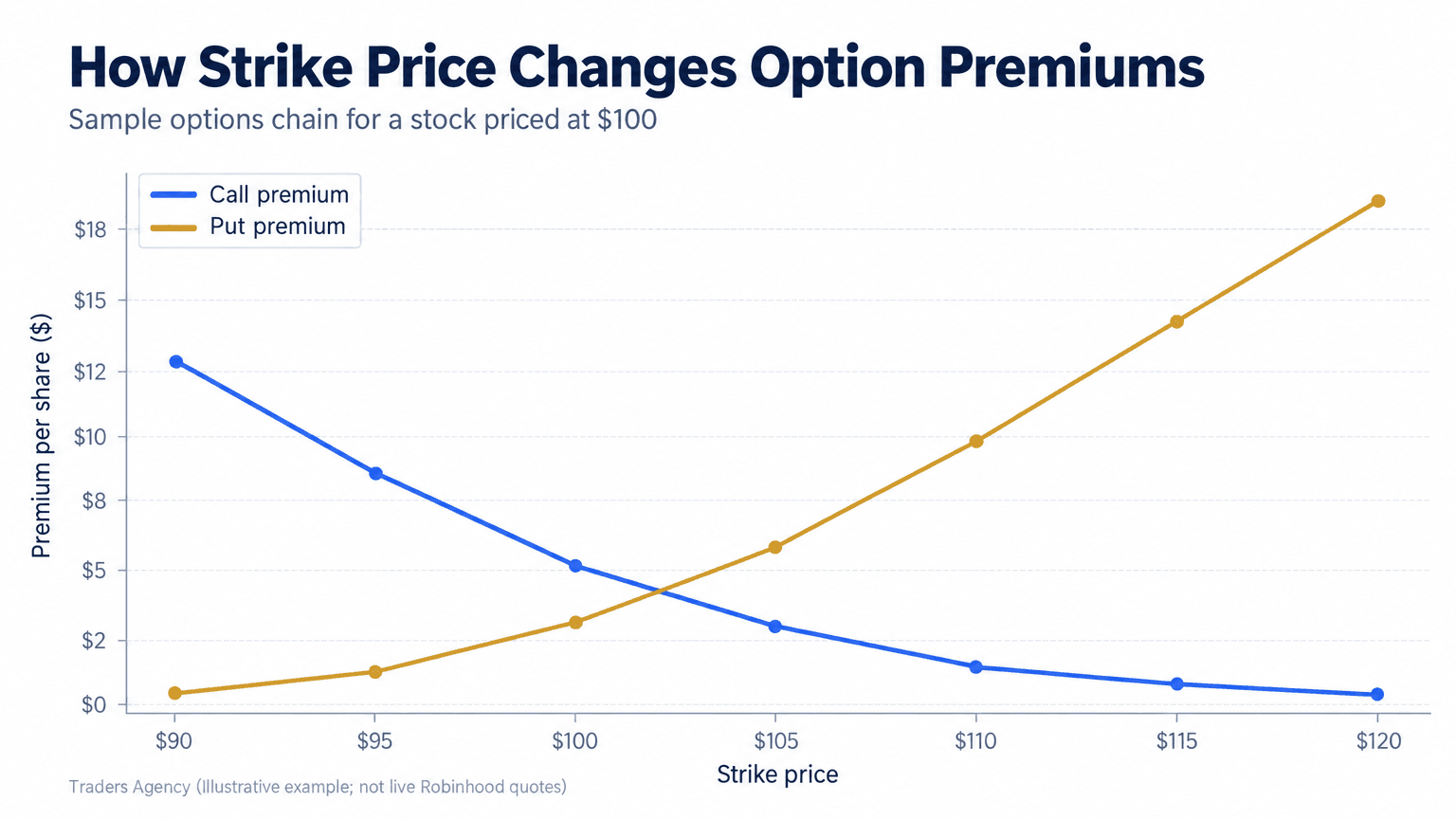
A key pattern to recognize: as strike prices move further above the current stock price, call premiums get cheaper and put premiums get more expensive. That's because a call at a higher strike is less likely to end up profitable, while a put at that same strike becomes more likely to pay off.
Robinhood also displays open interest (how many contracts are outstanding) and implied volatility (the market's expectation of future price swings) if you tap into an individual contract. Higher open interest generally means it's easier to buy or sell that contract without a big gap between bid and ask.
Want expert trading insights delivered daily?
Join thousands of traders who rely on Traders Agency for market analysis and trade ideas.
Join Traders AgencyShould You Use Limit Orders or Market Orders for Robinhood Options Trading?
A limit order sets the exact price you're willing to pay or accept, while a market order executes immediately at whatever price is currently available. For options specifically, we strongly recommend limit orders almost every time.
Here's why the distinction matters more with options than with stocks. Options can have wide gaps between the bid and ask price, especially on less popular contracts, so a market order can fill at a noticeably worse price than you expected.
Example Walkthrough
Say a contract's bid is $1.90 and the ask is $2.10, giving a midpoint price of $2.00. If you place a market order to buy, you might get filled at or near the $2.10 ask. If you place a limit order at $2.00, your order sits until a seller is willing to meet that price, or it may not fill at all if the market moves away from you.
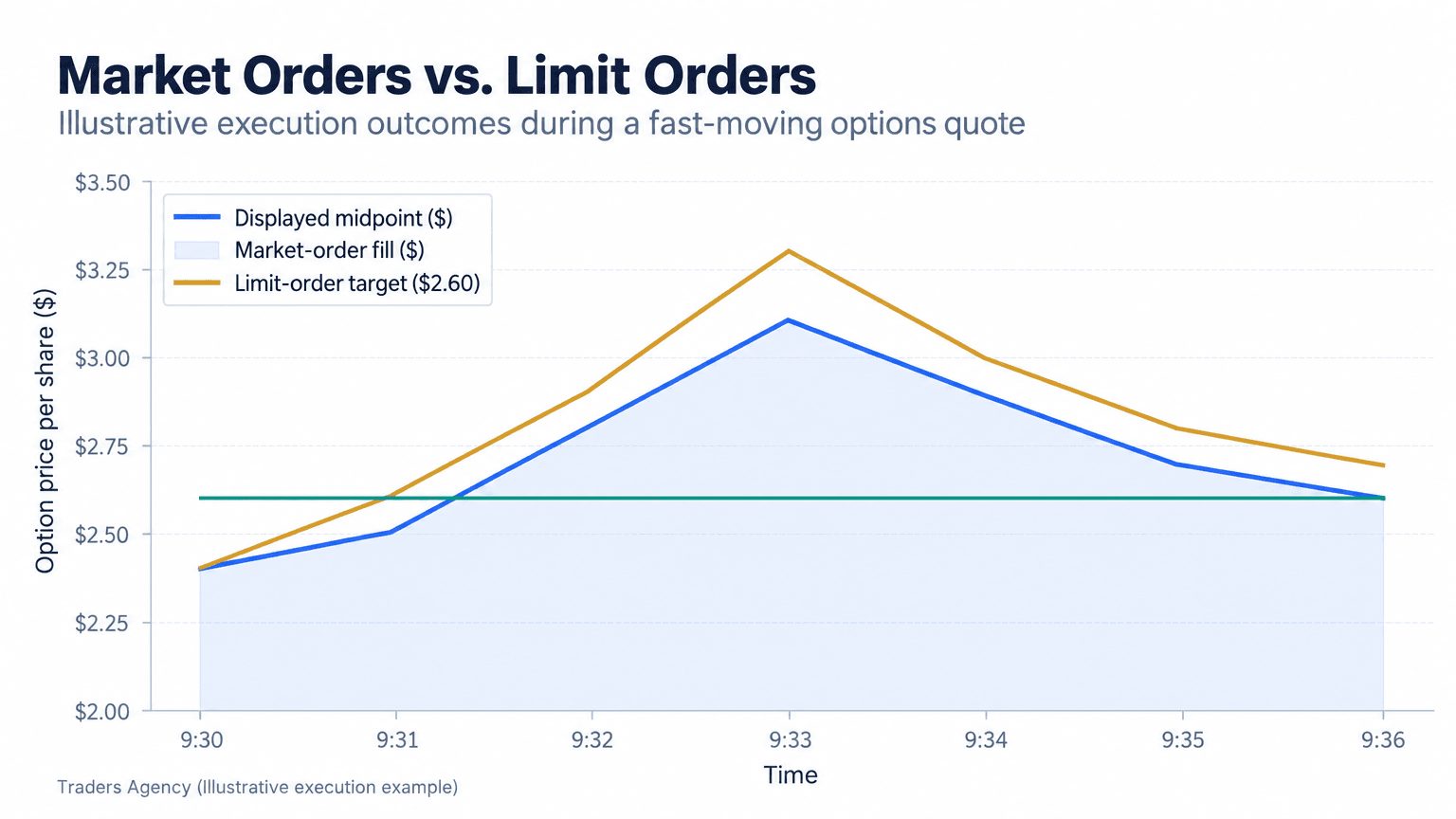
That tradeoff, a guaranteed fill versus a guaranteed price, is the core decision every options trader makes on every order. For beginners building a Robinhood options trading strategy, we think the small chance of a missed fill is worth the protection a limit order gives you.
Common Pitfalls When Starting Robinhood Options Trading
Most new options traders run into the same handful of problems. Here are the ones we see most often among members who are new to Robinhood options trading.
- Ignoring time decay: Options lose value as expiration approaches, even if the stock price doesn't move at all. This erosion, called theta decay, accelerates in the final weeks before expiration.
- Buying too far out of the money: Cheap contracts are tempting, but strikes far from the current price require a huge move to become profitable.
- Trading during low-volume hours: Robinhood options trading hours generally mirror standard market hours (9:30 a.m. to 4:00 p.m. Eastern), and bid-ask spreads are often widest in the first few minutes after the open and during the quieter midday stretch, when fewer contracts are changing hands.
- Not checking assignment risk: If you sell contracts, you can be assigned shares before expiration, which is a different risk profile than simply buying contracts.
- Overusing market orders: As we covered above, this can quietly cost you money on every single trade.
Time decay deserves special attention because it's the pitfall that surprises almost everyone the first time they experience it.
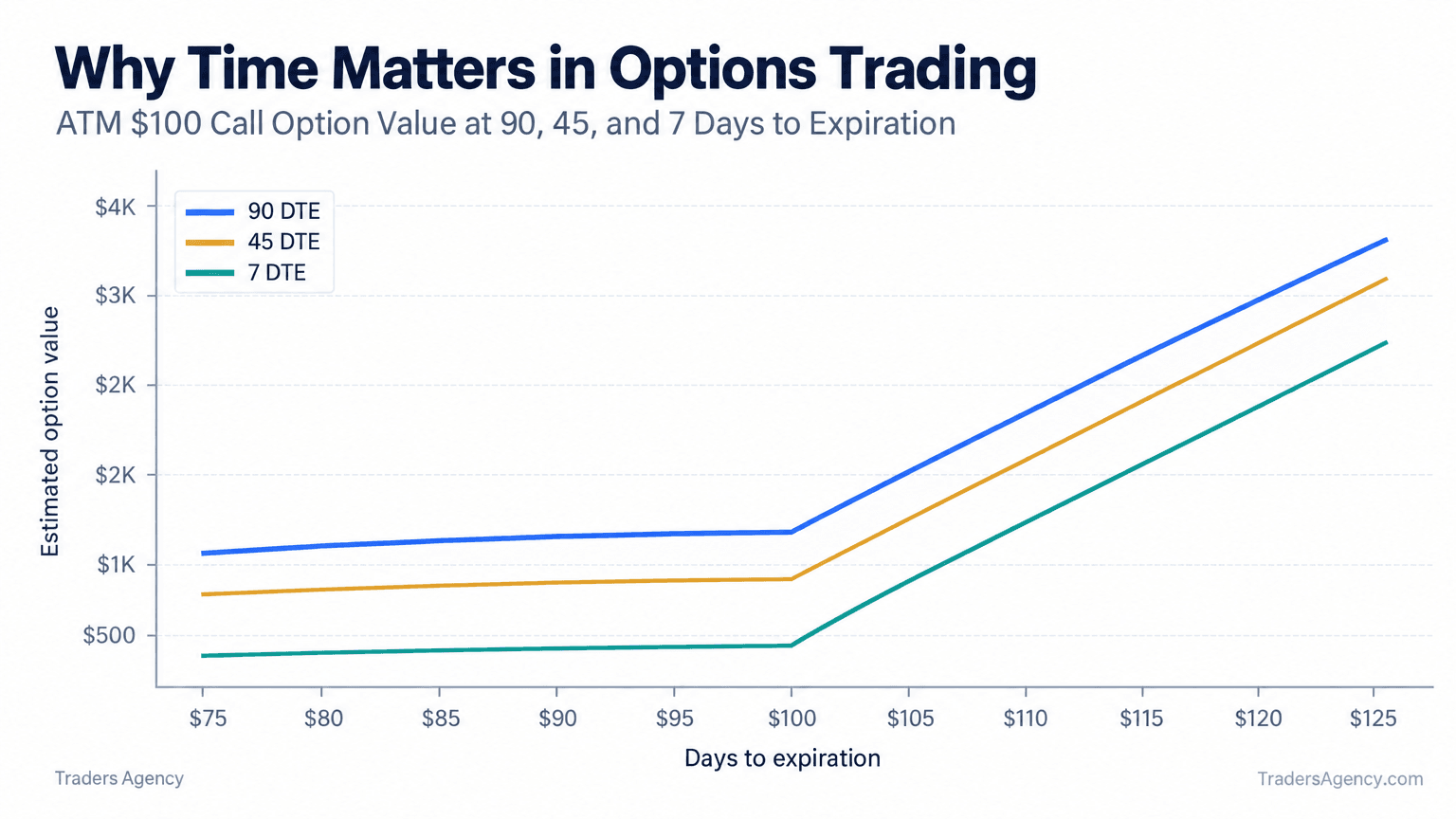
Notice how the decline speeds up in the final stretch before expiration. This is one reason many traders avoid holding long options contracts into the last week before they expire, unless they have a specific reason to.
Watch Out: Theta decay works against option buyers every single day, even when the stock doesn't move. Holding a long call or put too close to expiration without a plan is one of the fastest ways to watch a position lose value for reasons that have nothing to do with being "wrong" about direction.
Is Robinhood Options Trading Good Enough for Active Traders?
Robinhood options trading works well for beginners placing simple, single-leg trades, but active traders running frequent multi-leg strategies may find the tools limited compared to dedicated options platforms. The app is built for simplicity first, which is a strength for new traders and a constraint for experienced ones.
On the positive side, Robinhood options trading fees are a genuine advantage: Robinhood doesn't charge a per-contract commission, which is different from many legacy brokers that still charge $0.50 to $0.65 per contract. The Robinhood options trading app is also clean and easy to use, which matters when you're still learning.
Where it falls short is in analytical depth. Aside from a basic chance-of-profit readout on individual contracts, there's no deeper probability analysis, no customizable risk graphs showing how a position's profit and loss changes across price and time, and limited ability to backtest a Robinhood options trading strategy before putting real money behind it.
What Are Robinhood's Options Trading Limitations Compared to Other Platforms?
Platforms like thinkorswim (from Charles Schwab) and Tastytrade offer features Robinhood simply doesn't have yet. Here's an honest comparison based on what each platform is known for:
- Risk graphs and probability tools: thinkorswim's "Analyze" tab lets you visualize potential outcomes before you place a trade. Robinhood has no equivalent.
- Advanced order types: Platforms like Tastytrade support more complex conditional orders and automated strategy rolling. Robinhood's order types are more basic.
- Paper trading: thinkorswim offers a full paper money account to practice strategies risk-free. Robinhood does not offer a true paper trading environment.
- Depth of options chain data: Full-featured platforms often show more granular Greeks (delta, gamma, theta, vega) directly on the chain. Robinhood shows limited Greek data per contract.
None of this means Robinhood is a bad choice, especially for someone just starting out. For a deeper look at how options contracts and standardized terms work, the Options Clearing Corporation and Cboe both publish investor education material that applies across all platforms, not just Robinhood.
When Should You Use Robinhood for Options Trading?
Robinhood is a strong fit if you're a beginner placing occasional single-leg trades and want a simple, low-cost app without a steep learning curve. It's a weaker fit if you're running frequent multi-leg strategies that need deep analytical tools.
Our Risk Management Recommendations
- Position size: Many of our members starting out limit any single options trade to 1% to 3% of their total account value.
- Know your max loss before entering: For long calls and puts, your maximum loss is the premium paid, full stop.
- Avoid holding through earnings without a plan: Implied volatility often drops sharply right after earnings, which can hurt option prices even if the stock moves in your favor.
- Don't let a hunch replace a strategy: Every trade should have a defined entry reason, target, and exit plan before you place it.
Key Concept: Robinhood is a genuinely good starting point for learning the mechanics of options, but as your strategies grow more complex, you'll likely want to pair it with, or eventually move to, a platform built for deeper analysis.
Want expert trading insights delivered daily?
Join thousands of traders who rely on Traders Agency for market analysis and trade ideas.
Join Traders AgencyDISCLAIMER: Traders Agency does not offer financial advice. The information provided is for educational purposes only and should not be considered financial advice. Traders Agency is not responsible for any financial losses or consequences resulting from the use of the information provided. Trading carries inherent risks and may not be suitable for all individuals. You are advised to conduct your own research and seek personalized advice before making any investment decisions, recognizing the potential risks and rewards involved.
See more from Traders Agency on Google
Make us a preferred source and our market analysis will appear more prominently in your Google Search, Top Stories, and AI results.
Add to Preferred Sources