We just received one of the worst economic reports of all time.
While the headlines look grim, this data contains a massive hidden benefit for one very specific sector of the stock market.
The government recently revealed that the administration overstated the number of jobs created last year by 1,029,000. Over a million fewer jobs were created last year than initially reported.
You might hear that number and think the market is about to get killed. But you have to look past the headline shock. This isn’t about the report itself—it’s about what the report triggers.
That trigger is interest rate cuts.
Because the labor market is significantly weaker than believed, the Federal Reserve has no choice but to act. This creates a specific window of opportunity in the construction and housing sectors, and I have two stocks flashing clear buy signals right now.
The Reality Behind the Data
The Department of Labor releases monthly numbers on job creation and loss. The idea is to gauge the health of the overall economy.
The problem? These monthly reports are notoriously inaccurate. They’re done by the federal government—and the data comes from surveys rather than hard numbers.
Once a year, we get the actual revision. They look at real employment data and adjust the previous year’s numbers.
The market was already shocked earlier when it appeared jobs were overstated by more than 800,000. But the final reality was far starker.
Why Bad News Forces the Fed’s Hand
The Federal Reserve has a dual mandate—two specific jobs they must do:
- Tame Inflation: If prices rise too much, they raise rates to squash demand.
- Ensure a Healthy Labor Market: This is the more important job.
When job creation is lagging by over a million positions, the Fed is forced to stimulate the economy. They need to encourage companies to borrow, spend, and hire.
Their hands are tied. They’re going to have to cut interest rates in 2026—and probably in a big way.
This is where the opportunity lies.
When you cut interest rates, mortgage rates come down. When mortgage rates drop, people sitting on the sidelines of the housing market finally step in. They start buying, building, and expanding.
You’re going to build a bigger, nicer house at 4.5% rates than you are at 6.5%. Simple math.
Where the Money Is Flowing
My Industry Strength Indicator tracks which areas of the market are showing the most strength. One of the things to keep an eye on are areas rising up the ranks—new areas showing new strength because that’s where money is flowing.
For the first time in a couple of years, Building Products and Basic Materials are appearing on this list.
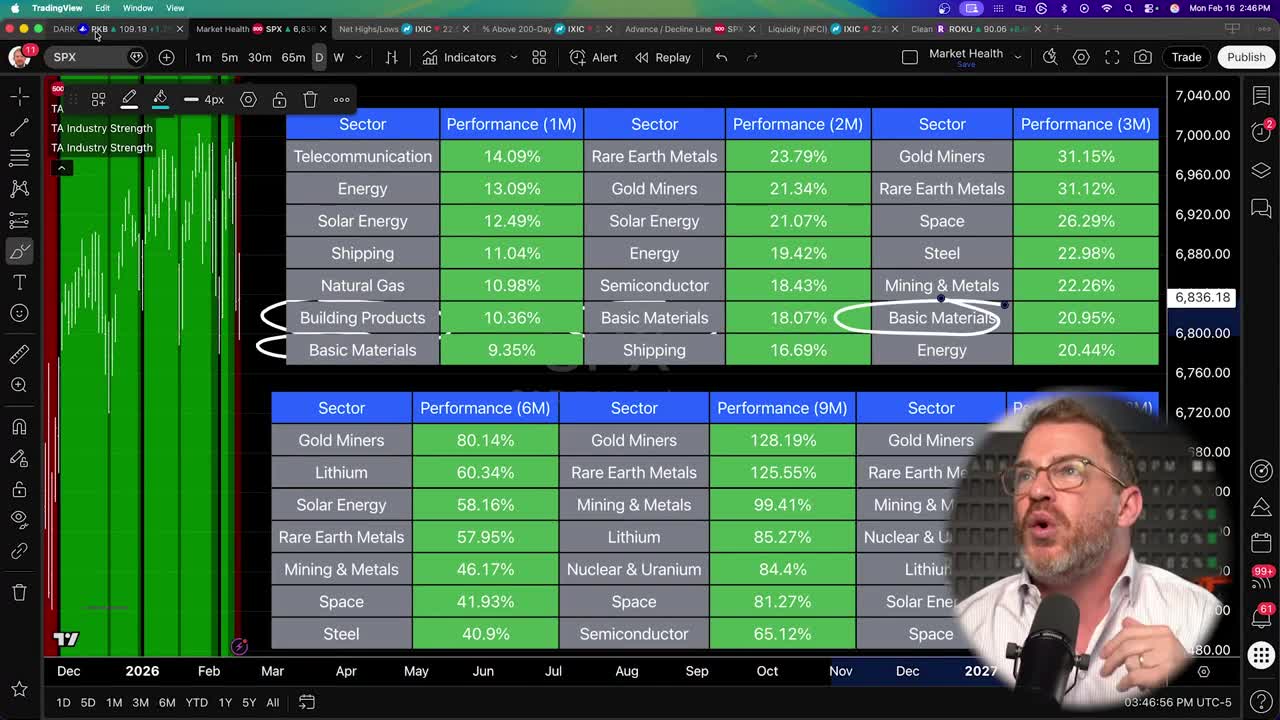
The smart money is already positioning for this shift:
- PKB (Invesco Building and Construction ETF) is ripping up the right side of the chart.
- The entire lumber sector has tacked on 10% in just the last two weeks.
- Homebuilders are beginning to shallow out and consolidate.
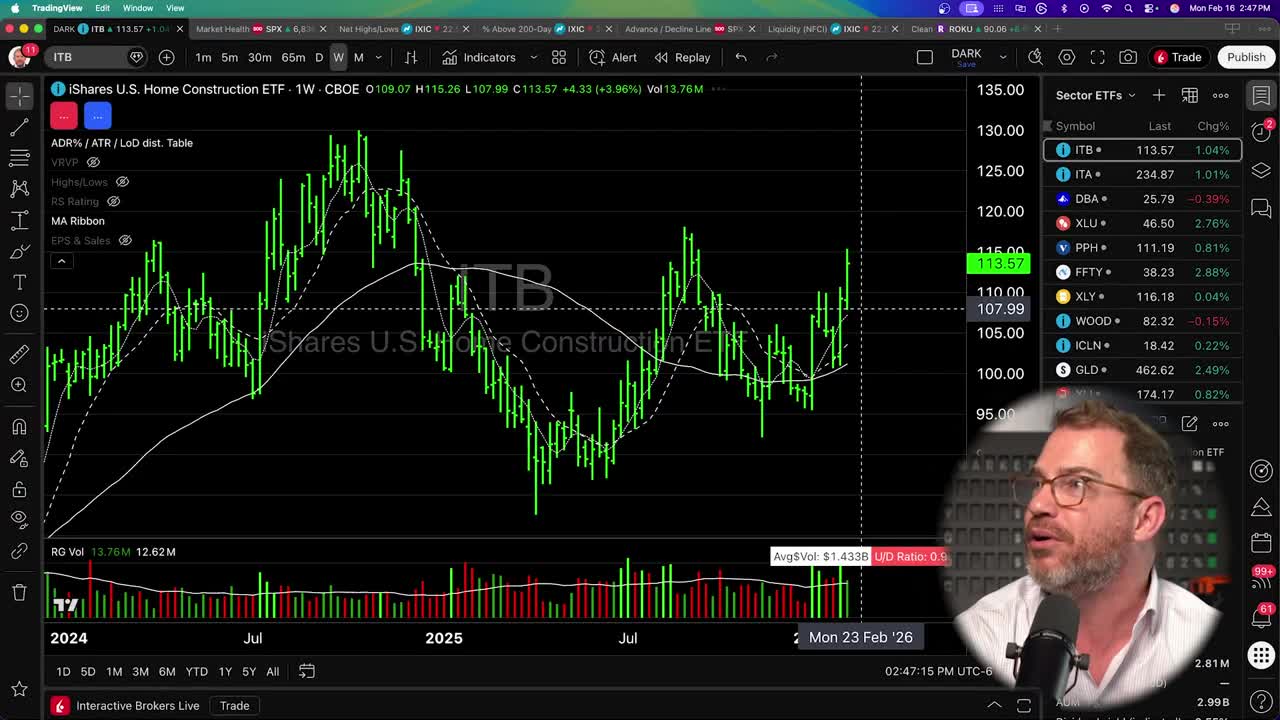
After a big rise in 2023 and 2024, the homebuilders pulled back when rate cuts didn’t materialize as expected. Now, they’ve absorbed that selling and appear ready for a run higher.
This is the absolute best-case scenario for investors: A bull market, a new group breaking out and showing strength, and then grabbing leading stocks coming out of clean patterns. It’s like A plus B equals C. That’s when the odds are best stacked in your favor.
The Turnaround Play: Leggett & Platt (LEG)
The first stock I’m targeting is Leggett & Platt (LEG).
When you look at the chart, your first reaction might be skepticism. This stock was $60 a couple of years ago and is now sitting around $11 or $12.
Why would you buy a stock that’s been beaten down this badly? Because we’re betting on a turnaround.
Understanding the Stock Cycle
Every growth stock follows a repeatable four-stage life cycle:
- Accumulation: Institutions buy heavily.
- Markup: The price runs up (Stage 2).
- Distribution: Institutions sell.
- Markdown: The price crashes.
LEG appears to be near the end of a Stage 4 decline. If it can form a base and break out, we’re looking at the start of a new Stage 2 uptrend. That’s where the big money is made.
The Technical Setup
For a stock that’s been “murdered” like LEG, you need specific signs that the selling is exhausted:
Rounded Bottom: You want to see the price compress and tighten. This indicates that everyone who wanted out is finally out.
Support & Resistance: The $10.50 level acted as support previously, then resistance. It finally broke out in December and is starting to get legs.
Stage 2 Confirmation Rules
I don’t guess with turnarounds. I look for three specific criteria to confirm a new uptrend:
1. Price Recovery: The stock needs to be at least 30% above its 52-week low. LEG is up 80%, so it definitely qualifies.
2. 200-Day Moving Average: This line needs to stop going down and start trending upward for at least two months. LEG began to turn up in December, so we’re about two and a half months into that trend.
3. The Proper Stack: The stock price must be above the 50-day moving average, which must be above the 200-day moving average. All of them need to be trending higher.
LEG checks all these boxes.
The Trade
This is a viable entry. Could easily be a double over the next couple of quarters.
The Continuation Play: Williams-Sonoma (WSM)
The second stock is a company most of us know: Williams-Sonoma (WSM).
Unlike LEG, this isn’t a beat-down turnaround. This is a breakout pattern forming off the highs.
Stocks don’t go straight up forever. WSM made a run, consolidated, and ran again. Recently, it’s undergone a 12 to 14-month consolidation.
During this time, the price has tightened and shallowed out. It’s absorbed the supply and is setting up for a new breakout higher.
The Trade
If this stock is going to run, this should be the start of it.
Don’t Fight the Cycle
The economic data is clear: the labor market is overstated, and the economy is weaker than the government initially believed.
This forces the Fed to stimulate.
When rates drop, construction and housing stocks move. We’re already seeing the early signs with the 10% move in lumber and the strength in the PKB ETF.
You have two ways to play this:
The Turnaround (LEG): High reward potential as it enters a new Stage 2 uptrend.
The Continuation (WSM): A strong stock consolidating near highs, ready for the next leg up.
You don’t need to bet the farm. Disciplined risk management—risking just 8-12%—allows you to participate in these moves without exposing your portfolio to ruin.
The setup is there. The data supports it. Now it’s just about execution.
Get an entire year of live weekly mentoring sessions, my newsletter, indicators, bonus reports, tons more. Click the link and I’ll see you in the next live session.
DISCLAIMER: Traders Agency does not offer financial advice. The information provided is for educational purposes only and should not be considered financial advice. Traders Agency is not responsible for any financial losses or consequences resulting from the use of the information provided. Trading carries inherent risks and may not be suitable for all individuals. You are advised to conduct your own research and seek personalized advice before making any investment decisions, recognizing the potential risks and rewards involved.