
The bitcoin halving cycle is a roughly four-year rhythm built around a programmed event that cuts the rate of new bitcoin creation in half. It fires automatically inside Bitcoin's code, and it has lined up with some of the most dramatic price moves in the asset's history. In this guide, we'll walk you through what causes the halving, how past cycles actually played out, and what a beginner should realistically expect heading into the next one.
By the time you finish, you'll know the key dates, the mechanics behind the supply shock thesis, why each cycle's returns have gotten smaller, and how to think about gaining exposure without betting your whole portfolio on a single pattern repeating.
What Is the Bitcoin Halving Cycle?
Bottom Line: Each bitcoin halving cycle has historically coincided with major price moves, but returns have shrunk with every cycle and only four halvings have occurred, too few to call it a reliable pattern. The key takeaway is to size any bitcoin exposure around what you could survive if the pattern breaks, not around what you'd gain if it repeats.
The bitcoin halving cycle refers to the four-year period between events where Bitcoin's mining reward is cut by 50%, slowing the rate at which new coins enter circulation.
Bitcoin runs on a network of computers called miners that verify transactions and get paid in newly created bitcoin for doing so. Roughly every 210,000 blocks, which works out to about four years, the code automatically cuts that reward in half. This isn't a decision made by a company or a government. It's written into Bitcoin's original design, and it's one of the reasons people compare bitcoin to a finite resource like gold.
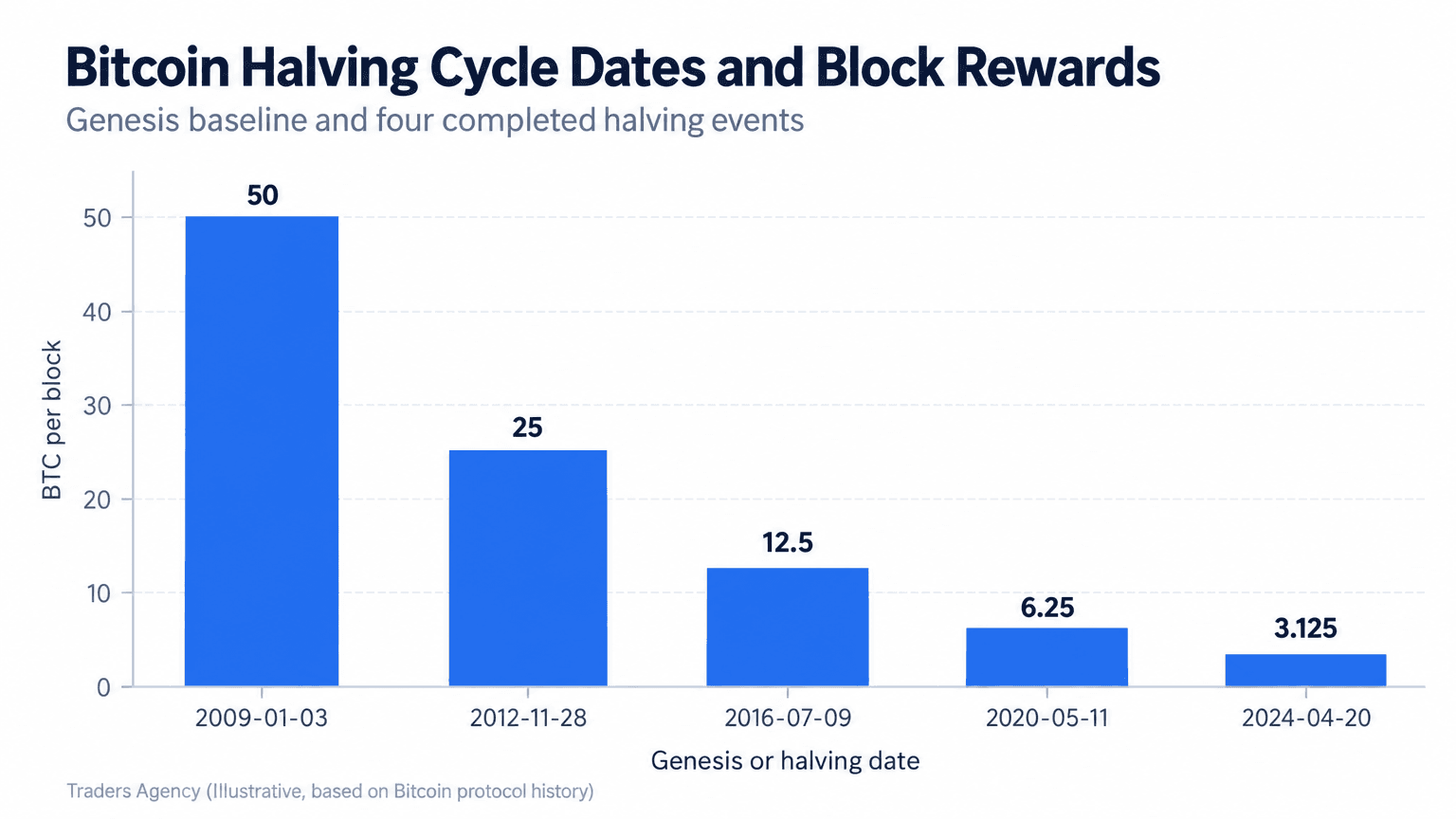
At launch in 2009, miners earned 50 BTC per block. After the first halving, that dropped to 25 BTC, then 12.5 BTC, then 6.25 BTC, and after the April 2024 halving, the reward fell to 3.125 BTC. This process continues until total supply approaches its hard cap of 21 million coins, expected around the year 2140.
Key Concept: The halving does not create demand. It simply cuts the rate of new supply in half on a fixed, predictable schedule that every market participant can see years in advance.
How Does the Bitcoin Halving Cycle Affect Price?
The halving does not move price directly. It changes the supply side of the equation, and if demand holds steady or grows while new supply shrinks, basic economics suggests prices should feel upward pressure over time.
We call this the supply shock thesis. Here's the logic: before a halving, miners typically sell a large chunk of their earned bitcoin to cover operating costs like electricity and equipment. After the halving, they're earning half as many coins, so there's simply less new bitcoin hitting the market every day. If buyers keep showing up at the same pace, that reduced flow of new supply can tighten the market.
We'd rather be honest than hype this: correlation is not proof of causation. Bitcoin's price also responds to macro conditions, interest rate policy, regulatory news, and broad investor appetite for risk assets. The halving is one input among several, not a guaranteed trigger.
When Did Bitcoin Halving Cycles Happen?
Here are the completed bitcoin halving cycle dates so far, along with the approximate price near each event:
| Halving | Date | Reward Change | Approx. BTC Price at Event |
|---|---|---|---|
| 1st | November 2012 | 50 BTC to 25 BTC | ~$12 |
| 2nd | July 2016 | 25 BTC to 12.5 BTC | ~$650 |
| 3rd | May 2020 | 12.5 BTC to 6.25 BTC | ~$8,700 |
| 4th | April 2024 | 6.25 BTC to 3.125 BTC | ~$64,000 |
Looking at bitcoin halving dates and price side by side, each of the first three halvings was followed by a significant rally within 12 to 18 months, though the size and timing varied. Bitcoin traded in the single digits to low double digits around the 2012 halving and climbed into the hundreds within about a year. Around the 2016 halving, bitcoin sat near $650 and reached roughly $2,500 to $3,000 a year later, before continuing much higher into early 2018. The 2020 halving saw bitcoin near $8,700, and about a year later it had moved into the tens of thousands.
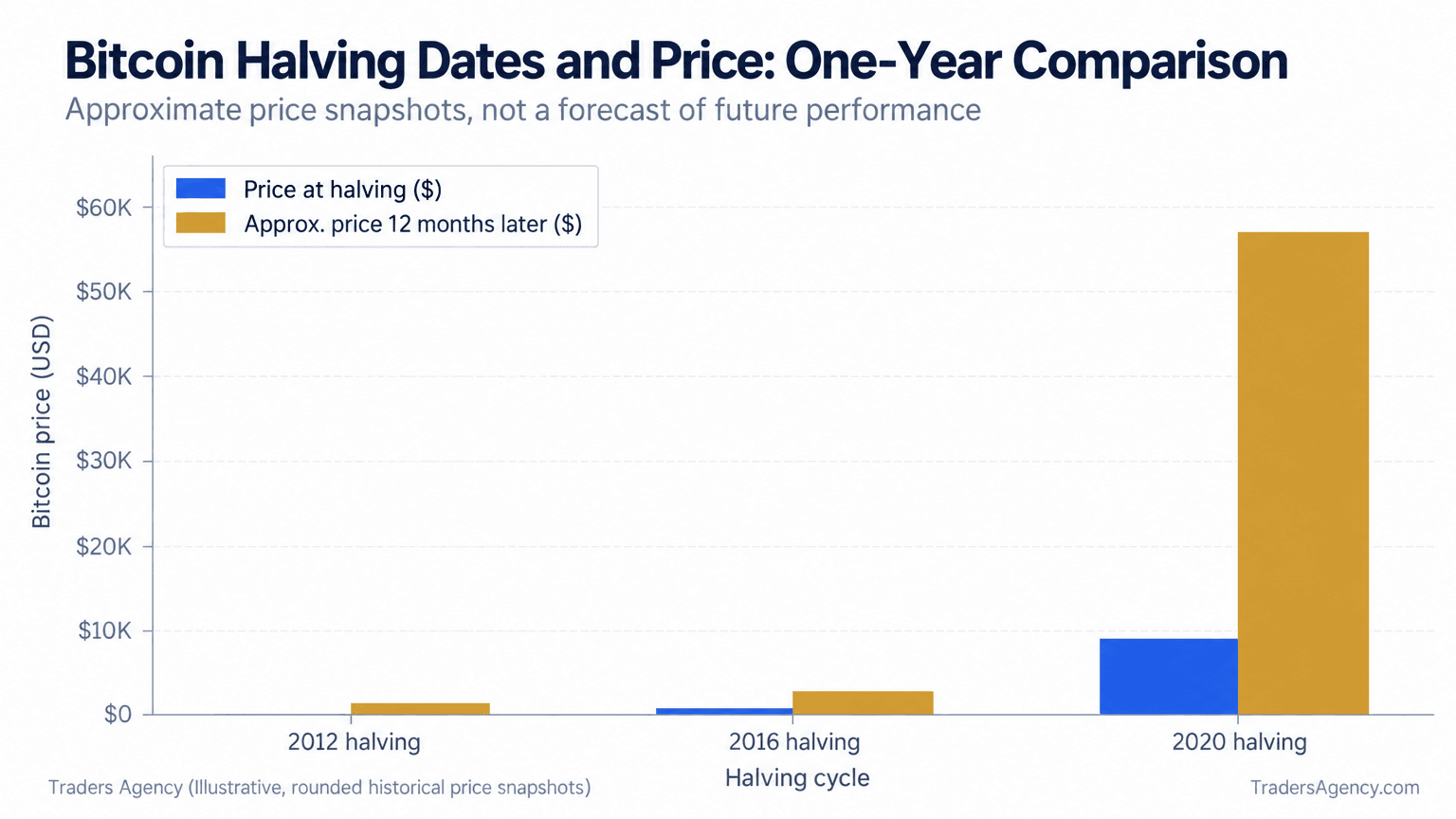
Anyone studying bitcoin halving history on a bitcoin halving chart TradingView setup will notice this pattern of delayed rallies rather than immediate price jumps on the halving date itself. The market tends to price in anticipation beforehand, then react more forcefully in the months that follow.
Want expert trading insights delivered daily?
Join thousands of traders who rely on Traders Agency for market analysis and trade ideas.
Join Traders AgencyWhat Are the Four Stages of the Bitcoin Halving Cycle?
We generally break the bitcoin halving cycle into four rough stages, though real markets rarely follow a clean script.
- Stage 1: Pre-Halving Accumulation – Price often stabilizes or grinds upward as anticipation builds in the months ahead of the event.
- Stage 2: The Halving Event – The block reward cuts in half. Price reaction on the actual day is usually muted, because the date was known years in advance.
- Stage 3: Post-Halving Expansion – Historically the 12 to 18 month window where the strongest rallies have shown up.
- Stage 4: Cycle Peak and Correction – A sharp pullback, sometimes 50% or more off the high, before the next accumulation phase begins.
How Many Halvings Are Left for Bitcoin?
There are roughly 29 halvings left before Bitcoin reaches its maximum supply of 21 million coins, with the final one expected somewhere around the year 2140.
That's a long runway. Most of those remaining halvings will cut rewards by increasingly tiny fractions of a coin, meaning their practical impact on new supply will shrink dramatically compared with the events traders focus on today.
Will the Bitcoin Halving Cycle Continue in 2026?
The next real test of the bitcoin halving cycle 2026 pattern isn't a new halving (the next one is expected around 2028), but whether the post-2024 cycle respects the historical timing of a peak roughly a year to 18 months out.
Traders running a bitcoin halving countdown toward future events are really watching one question: does the four-year rhythm of rally, correction, and accumulation hold up as the market matures and more institutional capital arrives through regulated products?
Diminishing Returns in Each Halving Cycle
Every completed halving cycle has produced a smaller percentage gain than the one before it, a pattern we call diminishing returns.
| Cycle | Halving Date | Approx. Peak Gain to Cycle Top |
|---|---|---|
| Cycle 1 | November 2012 | ~9,000%+ |
| Cycle 2 | July 2016 | Thousands of percent, clearly smaller |
| Cycle 3 | May 2020 | ~680% |
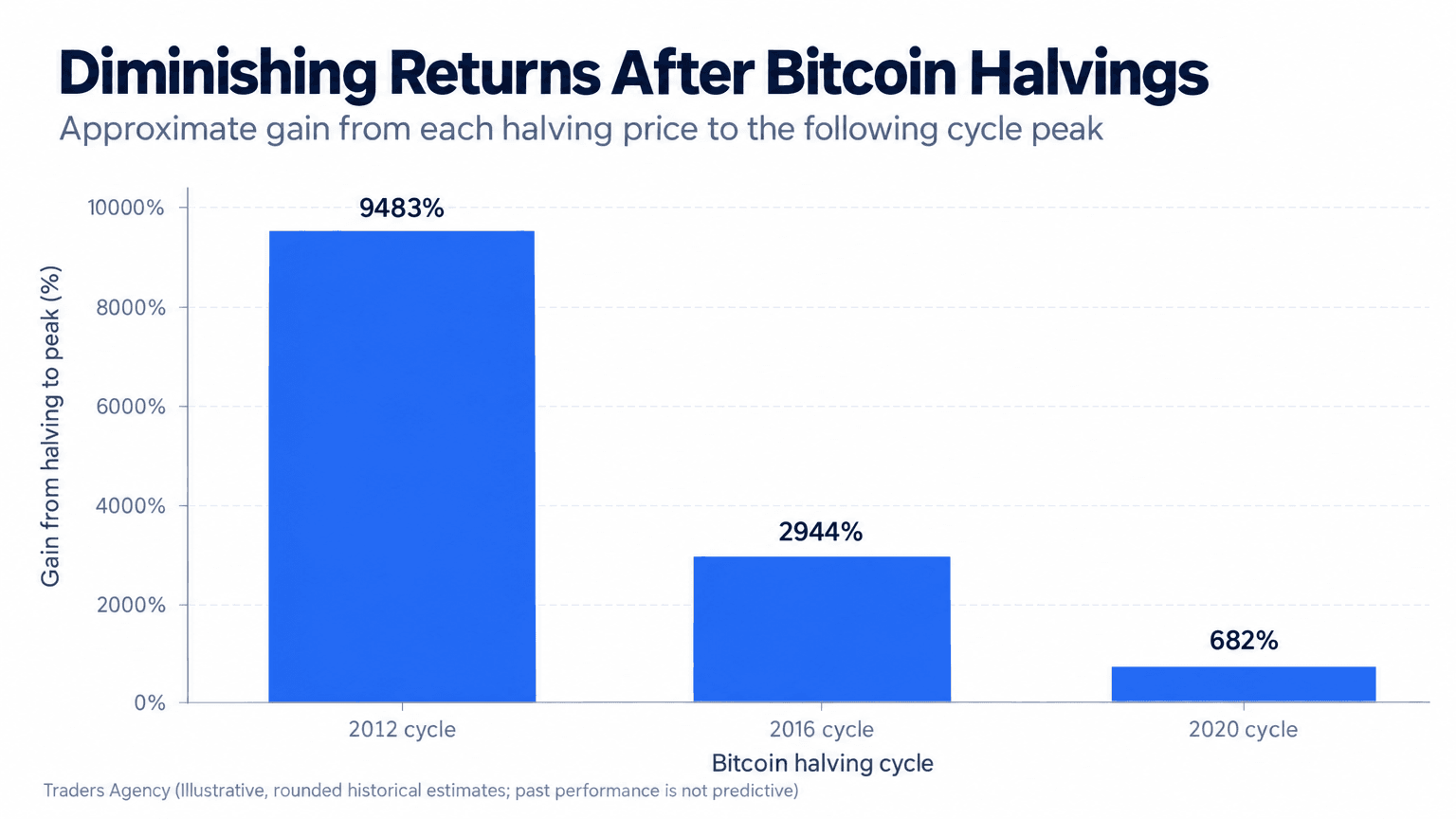
This makes sense once you think about market size. A small market with limited supply and few buyers can move dramatically on a modest shift in demand. As bitcoin's total market value has grown into the hundreds of billions and then trillions of dollars, it takes far more new capital to produce the same percentage move. Will bitcoin go up after halving again in the future? History suggests upward pressure is possible, but expecting the same magnitude as past cycles ignores how much the market has grown.
Remember This: Percentage returns and dollar returns are not the same story. A 680% move on an asset already worth hundreds of billions requires vastly more capital inflow than a 9,000% move on an asset worth roughly a hundred million.
How Can You Gain Exposure to Bitcoin During a Halving Cycle?
Beginners have several practical ways to get exposure, each with its own tradeoffs. Here's how we rank them from most direct to least:
- Direct ownership – Buying bitcoin on an exchange and holding it in a wallet. You get full control, but you also own the security burden.
- Spot bitcoin ETFs – Exchange-traded funds that track bitcoin's price and trade in a standard brokerage account, no crypto wallet required. Several major asset managers now offer these, and their filings are public through the SEC's EDGAR database.
- Futures-based products – Regulated contracts that track bitcoin's price movement, listed on venues like the CME Group, often used by traders who want exposure without holding the underlying asset.
- Mining and blockchain equities – Shares of companies involved in bitcoin mining or infrastructure, which carry business risk on top of bitcoin price risk.
Our team generally encourages treating bitcoin as a small satellite position inside a diversified portfolio rather than a core holding, given its history of sharp drawdowns. Bitcoin's correlation with equities has swung around over the years, sometimes tracking risk assets during macro stress and sometimes going its own way entirely.
Risk Management and Common Mistakes
The biggest mistake we see beginners make is treating the bitcoin halving cycle as a guaranteed trading signal instead of a historical pattern with a small sample size of just four data points.
- Don't oversize your position. Swings of 20% to 30% in a single week are not unusual for bitcoin.
- Don't chase the post-halving rally after it has already run far. Entering near a cycle peak has historically preceded steep corrections.
- Don't ignore macro conditions. Rate policy and broad risk sentiment can override the halving narrative completely.
- Do size positions you could hold through a 50% drawdown without being forced to sell at the worst possible moment.
Watch Out: Four completed halvings is not a statistically meaningful sample. Build your position sizing around what you can survive if the pattern breaks, not around what you'd earn if it repeats.
Want expert trading insights delivered daily?
Join thousands of traders who rely on Traders Agency for market analysis and trade ideas.
Join Traders AgencyDISCLAIMER: Traders Agency does not offer financial advice. The information provided is for educational purposes only and should not be considered financial advice. Traders Agency is not responsible for any financial losses or consequences resulting from the use of the information provided. Trading carries inherent risks and may not be suitable for all individuals. You are advised to conduct your own research and seek personalized advice before making any investment decisions, recognizing the potential risks and rewards involved.
See more from Traders Agency on Google
Make us a preferred source and our market analysis will appear more prominently in your Google Search, Top Stories, and AI results.
Add to Preferred Sources